What is a waterproof football bladder?How do thread bladders, rubber thread bladders, and PVC bladders work?
Simply put, the bladder of a waterproof football is the core component inside the ball responsible for "holding the air." It determines whether the ball is stable when kicked, whether it becomes heavier in rainy weather, and how long it lasts. Currently, there are three mainstream waterproof football bladders:thread bladder, rubber thread bladder, and PVC bladder。
Their working principles and performance differences directly determine which one you should choose.
Basic Structure and Working Principle of the Three Bladders
- Thread Bladder: Formed by winding multiple layers of cotton or synthetic threads around a rubber bladder.The thread layers act like a "skeleton" to provide support, and the outer layer is then covered with rubber or PU material.Working principle: The thread layer absorbs impact force and evenly distributes air pressure, making the ball rounder and the bounce more stable.Water resistance mainly depends on the outer material and stitching process; the thread bladder itself is not directly waterproof, but its tight structure reduces moisture penetration.
- Rubber Thread Bladder: A layer of thread is wound around a rubber bladder, and then the whole is vulcanized and molded.The thread layer is encased in rubber, forming a "rubber + thread" composite structure.Working principle: Rubber provides basic air tightness, and the thread layer enhances deformation resistance.Waterproofness is better than pure thread bladder because the rubber layer directly blocks moisture, and the thread layer does not directly contact water.
- PVC Bladder: A one-piece airbag made of pure PVC (polyvinyl chloride) material, without a thread layer.Working principle: Relies on the elasticity of the material itself to maintain air pressure, with a simple structure.Waterproofness completely depends on the PVC film; once damaged, it will leak air quickly.The advantage is low cost, but air tightness and impact resistance are the weakest.
How the Bladder Affects the Waterproofness and Air Tightness of a Soccer Ball
| Inner bladder type | Waterproof principle | Air tightness performance | Suitable scenarios |
|---|---|---|---|
| Thread Bladder | Relies on outer leather for waterproofing; the thread layer itself is not waterproof. | Moderate; the thread layer can buffer air pressure fluctuations, but may absorb water and swell after long-term use. | Dry field training, matches, occasional light rain. |
| Rubber Thread Bladder | Rubber layer directly blocks water; thread layer reinforces structure. | High, rubber + thread composite structure ensures stable air retention and good performance in rainy conditions. | Rainy matches, frequent outdoor use, high-intensity play. |
| PVC Bladder | Pure PVC film water resistance. | Low, material aging leads to air leakage, and low temperatures cause hardening, reducing air retention. | Indoor recreation, short-term activities, limited budget. |
Key trade-off: If you mainly play on dry fields, a thread bladder offers the best value;if you often encounter rain or need long-term stable air retention, a rubber bladder is a more reliable choice.PVC bladders are only suitable for casual play or low-intensity use by children, and are not recommended for formal training or matches.
Next Step to Confirm: Provide your main usage scenario to the Winsunsport team (e.g., how many times per week, whether in rain, field type), and they can help confirm whether the bladder configuration of the current product (such as the Adult Outdoor Waterproof Soccer Ball) matches your needs.
Which Bladder Is More Durable?In-Depth Comparison of Air Retention, Elasticity, and Wear Resistance
Choosing a soccer bladder essentially involves a trade-off between "how long before you need to pump air" and "how hard the ball feels when kicked." The three types—butyl bladder, rubber-butyl bladder, and PVC bladder—have performance differences that directly determine whether you are playing a match or constantly inflating.
Air Retention Comparison: Which Maintains Pressure Better and Reduces Inflation Frequency?
- Thread Bladder: Best air tightness. The nylon thread layer wrapped around the bladder effectively locks in air; after a full inflation, it can maintain pressure for weeks under normal use. Suitable for matches or high-intensity training, no need to reinflate between games.
- Rubber Thread Bladder: Good air tightness, but slightly inferior to pure thread bladder.The rubber layer itself has some air tightness, aided by the thread layer; for daily recreation or 2-3 uses per week, one inflation lasts about a week.
- PVC Bladder: Weakest air tightness. PVC material inherently has many micropores, allowing faster natural gas permeation. Typically, after one session (about 1-2 hours), it needs reinflation; otherwise, the ball becomes soft and affects bounce.
Decision Point: If you don't want to check air pressure before every kick, prioritize butyl bladder or rubber butyl bladder;PVC bladder is better for occasional play where you don't mind frequent inflation.
Elasticity and Feel Comparison: Which Bladder Is More Comfortable to Kick?
- Thread Bladder: Even elasticity with clear feedback.The fabric layer allows the ball to recover quickly from deformation, giving a crisp feel, suitable for players seeking precise ball control and power feedback.Feel is firmer but solid.
- Rubber Thread Bladder: Moderate elasticity with a softer feel.The rubber layer provides some cushioning, while the thread layer ensures a more reliable rebound without dragging.Suitable for daily fitness and recreational games, with less impact on ankles and knees.
- PVC Bladder: Average elasticity, becomes noticeably harder at low temperatures.PVC material loses elasticity below 15°C, feeling like a "stone" to kick;in high summer temperatures, it may become too soft.Vague touch, not suitable for scenarios requiring fine ball control.
Decision Point: For professional matches or seeking precise touch feedback, choose a thread bladder;for daily leisure or parent-child entertainment, a rubber thread bladder is more comfortable;PVC bladders are only suitable for casual kicking in warm weather.
Abrasion resistance and lifespan: Which bladder is more durable?
- Thread Bladder: Best wear resistance. The nylon thread layer directly protects the bladder; even if the outer cover wears out, the thread layer can delay bladder rupture. On rough surfaces like concrete or artificial turf, the lifespan is significantly longer.
- Rubber Thread Bladder: Good wear resistance. The rubber layer has some tear resistance, but the thread layer is thin. With long-term use on rough surfaces, the rubber layer is more prone to aging and cracking compared to thread bladders.
- PVC Bladder: Worst wear resistance. PVC material is easily scratched by sand and gravel, becomes brittle after aging, and is prone to bursting upon impact. Kicking on concrete may cause air leakage within a few months.
Decision Point: If you mainly play on concrete, asphalt, or sand, a butyl bladder is a key choice that can last a season;Rubber bladders are suitable for grass or indoor use;PVC bladders are basically only suitable for grass or occasional recreation.
Key Trade-off Summary
| Dimension | Thread Bladder | Rubber Thread Bladder | PVC Bladder |
|---|---|---|---|
| Air Tightness | Best (no pressure loss for weeks) | Good (about one week) | Weak (needs refilling each time) |
| Foot feel | Firm, clear feedback | Soft, moderate elasticity | Vague, hardens in low temperature |
| Abrasion resistance | Most Durable | Medium | Worst |
| Suitable scenarios | Competition, high-intensity training, rough surfaces | Daily fitness, recreation, grass | Occasional play, warm weather |
Next Step to Confirm: Please inform the Winsunsport team of your primary playing surface (grass/concrete/sand) and weekly usage frequency. They will match you with the most durable combination based on leather thickness and liner type.
Which liner should I choose for different scenarios?Recommended for rainy days, concrete floors, and beach scenes
Choosing a bladder isn't about how nice the name sounds, but about what surface and weather you're playing on. Let's break it down by scenario.
Rainy grass match: Why is a rubber-wound bladder a more reliable choice?
In a rainy match, once the ball absorbs water and becomes heavier, the trajectory of passes and shots will go haywire. Waterproof footballs can solve this problem, but the bladder determines how long the waterproofing lasts.
- Rubber Thread BladderThe bladder is made of a rubber layer plus wound threads, offering the best air tightness.Rainwater cannot penetrate into the bladder, the ball weight remains stable throughout the match, ensuring fairness.Moreover, the rubber bladder remains elastic even at low temperatures (around 0°C), unlike ordinary PVC bladders which become hard and feel stiff underfoot.
- Ordinary bladder: Although also waterproof, its air tightness is slightly lower than that of rubber bladders.If the rain is heavy and the match lasts long, the ball may slightly increase in weight.Suitable for light to moderate rain or half-court recreational games.
- PVC Bladder: Not recommended for rainy days.PVC becomes significantly harder at low temperatures, and its air tightness decreases faster after prolonged exposure to water.
ConclusionFor official matches in rainy weather, directly choose a rubber-wound bladder. If it's just light rain for fun, a regular bladder is sufficient.
Recreational matches on concrete: How does the durability advantage of the wound bladder manifest?
Concrete is the most damaging to the ball, especially at the seams between the cover and the bladder. The material of a waterproof football's cover is itself wear-resistant, but the bladder determines how long the ball can last after being scuffed.
- Rubber Thread BladderThe wound thread layer cushions the impact of concrete; even if the cover gets small tears, the bladder is less likely to leak air immediately.Suitable for clubs or schools that play on concrete regularly, reducing the frequency of ball replacement.
- Ordinary bladderIts wear resistance is also good, but the wound thread layer is thinner than that of a rubber-wound bladder.If the concrete ground is rough and the frequency of playing football is high (more than 3 times a week), it is recommended to choose a rubber thread bladder.
- PVC Bladder: The least durable on concrete ground.PVC directly contacting rough ground is prone to cracking. Once the leather is damaged, the ball will deflate quickly.
Conclusion: For long-term use on concrete ground, prioritize rubber thread bladder;for occasional recreation, a regular thread bladder is sufficient.
Beach scenario: Waterproofing is key. Which bladder to choose?
When playing football on the beach, sand will get into the seams of the leather. Ordinary balls will deflate after a few kicks. The sealed design of waterproof footballs can block sand particles, but the bladder determines the ball's elastic feedback on the sand.
- Rubber Thread Bladder: Moderate elasticity, not too high or too heavy on soft sand, providing better ball control.: Sand does not wear out the wound thread layer, ensuring long lifespan.
- Ordinary bladder: Slightly softer elasticity, suitable for beach recreational matches.: If only occasionally played on the beach, it offers higher cost performance.
- PVC Bladder: Not recommended. PVC softens and deforms easily under high temperatures on sand (summer beach surface can reach 50°C), resulting in unstable feel.
Conclusion: For frequent beach play (more than once a week), choose rubber bladder with thread winding;: For occasional play, choose ordinary bladder with thread winding.
Key Trade-off Summary
| Scenario | Recommended Inner Tube | Reason |
|---|---|---|
| Rainy Official Match | Rubber Thread Bladder | Best airtightness, good low-temperature elasticity, fair competition |
| Rainy Recreation | Ordinary bladder | High cost performance, sufficient for light rain |
| Long-term Use on Concrete Floor | Rubber Thread Bladder | Winding thread buffers impact, wear-resistant and long-lasting. |
| Occasional play on concrete. | Ordinary bladder | Lower cost, sufficient for use. |
| Frequent kicking on the beach. | Rubber Thread Bladder | Moderate elasticity, high temperature resistance, long lifespan. |
| Occasional play on the beach. | Ordinary bladder | High cost performance. |
Next Step to Confirm: If you are unsure about your usage frequency or ground conditions, you can directly tell our team "what kind of ground you mainly play on, how many times a week, and whether it often rains". We will help you match the leather thickness and bladder combination.
How to make the final choice based on budget and needs?
Choosing between a wound bladder and a rubber bladder boils down to one sentence:How much more are you willing to pay for "more stable foot feel" and "longer service life"?
When the budget is limited, a wound bladder is a cost-effective choice.
If you mainly play on concrete, plastic, or ordinary grass fields, or if you are a student or amateur player with less stringent requirements for air tightness and rebound consistency,a wound bladder is sufficient.。 Its cost is lower, and its wear resistance and elasticity in daily use can meet most recreational and training scenarios. For bulk purchases (such as for schools or club activities), a wound bladder can help reduce the unit cost while ensuring basic performance.
Suitable for: Daily entertainment, non-high-intensity training, and budget-sensitive bulk purchases. Not suitable for: Scenarios requiring competition-level stable feel or dealing with rainy or extreme environments.
For best performance, rubber bladder is worth the investment
The rubber bladder has a more complex process, better airtightness, and the ball is less likely to deform during long-term use, with more uniform rebound. If you participate in formal competitions, often play in rainy or wet fields, or want a ball to last an entire season,the rubber bladder is a more reliable choice.Although the unit price is higher, it reduces the cost of frequent ball replacement, making it more cost-effective in the long run.
Suitable for: Match balls, high-intensity training, use in harsh weather, and professional scenarios requiring consistent ball performance. Not suitable for: Users with extremely tight budgets, only occasional recreational use, and no additional performance requirements.
How to balance budget and performance when purchasing in bulk?
For bulk purchases, it is recommended to configure by usage scenario:
- Primary match/training balls: Choose rubber-wound bladders for a more assured core experience.
- Backup/recreational balls: Choose the thread bladder to control the total budget.
- Custom leather thickness: If the budget allows, thickening the leather can significantly improve wear resistance, which is worth considering regardless of the bladder type chosen.
Key trade-offs: The thread bladder saves on single-use costs, while the rubber thread bladder saves on long-term maintenance and replacement hassles. If you are unsure about your usage intensity, you can first buy a rubber thread bladder to test and compare before deciding on a batch solution.
Frequently Asked Questions
Q1: Which is more durable, the thread bladder or the rubber thread bladder? The rubber bladder is overall more durable because of its better air tightness, making the ball less prone to deformation due to air leakage, and the rebound decays more slowly after long-term use. The thread bladder is also sufficiently wear-resistant under normal use, but its air tightness decreases over time.
Q2: I am mainly a student and occasionally play street football. Is it necessary to buy a rubber bladder? : Unnecessary. The thread bladder can fully meet the needs of occasional recreation and offers better cost performance.
Unless you often play football in the rain or have special requirements for the ball's elasticity.
Q3: Is the rubber bladder heavier than the thread bladder? : No. The type of bladder mainly affects air tightness and rebound uniformity, and has minimal impact on the total weight of the ball.
The weight is mainly determined by the thickness and size of the leather.
Q4: When ordering in bulk, how do I determine the leather thickness? Simply tell our sales team your usage scenario (e.g., concrete court, grass, match use), and they will recommend the appropriate leather thickness based on your budget. Thicker leather is more durable but also slightly harder, so a balance is needed.
Q5: If my budget only allows for a thread-wound bladder, but I want to improve performance, what can I do? You can prioritize thickening the leather, which significantly enhances durability and impact resistance, making it the most cost-effective performance upgrade.
Learn More
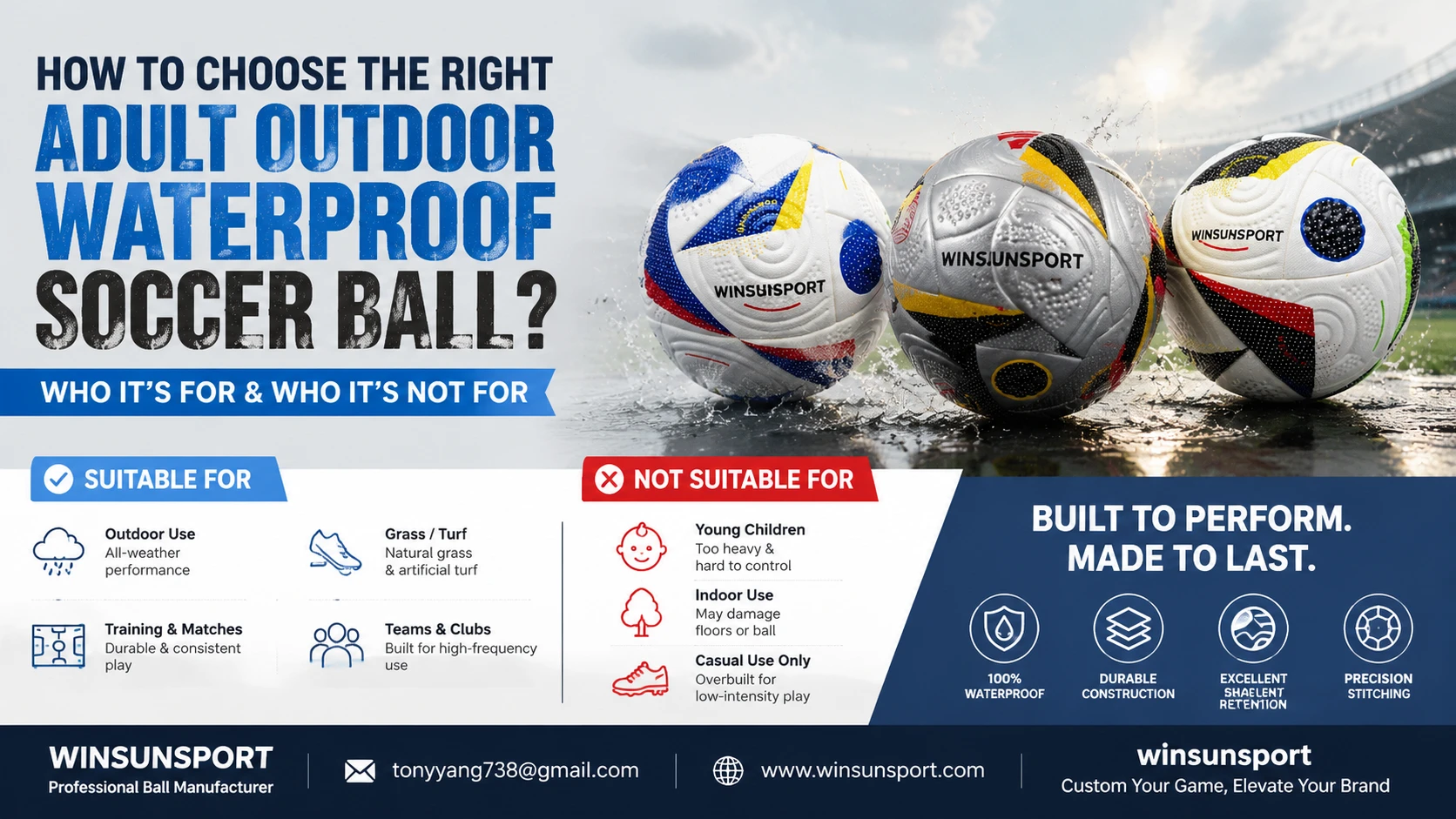
If you still have questions about the inner bladder configuration of the waterproof soccer ball, or want to know the specific parameters of the Adult Outdoor Waterproof Soccer Ball, please feel free to contact us.Tell us your usage scenario and budget, and we will recommend the most suitable solution for you.
Related products:Adult Outdoor Waterproof Soccer Ball