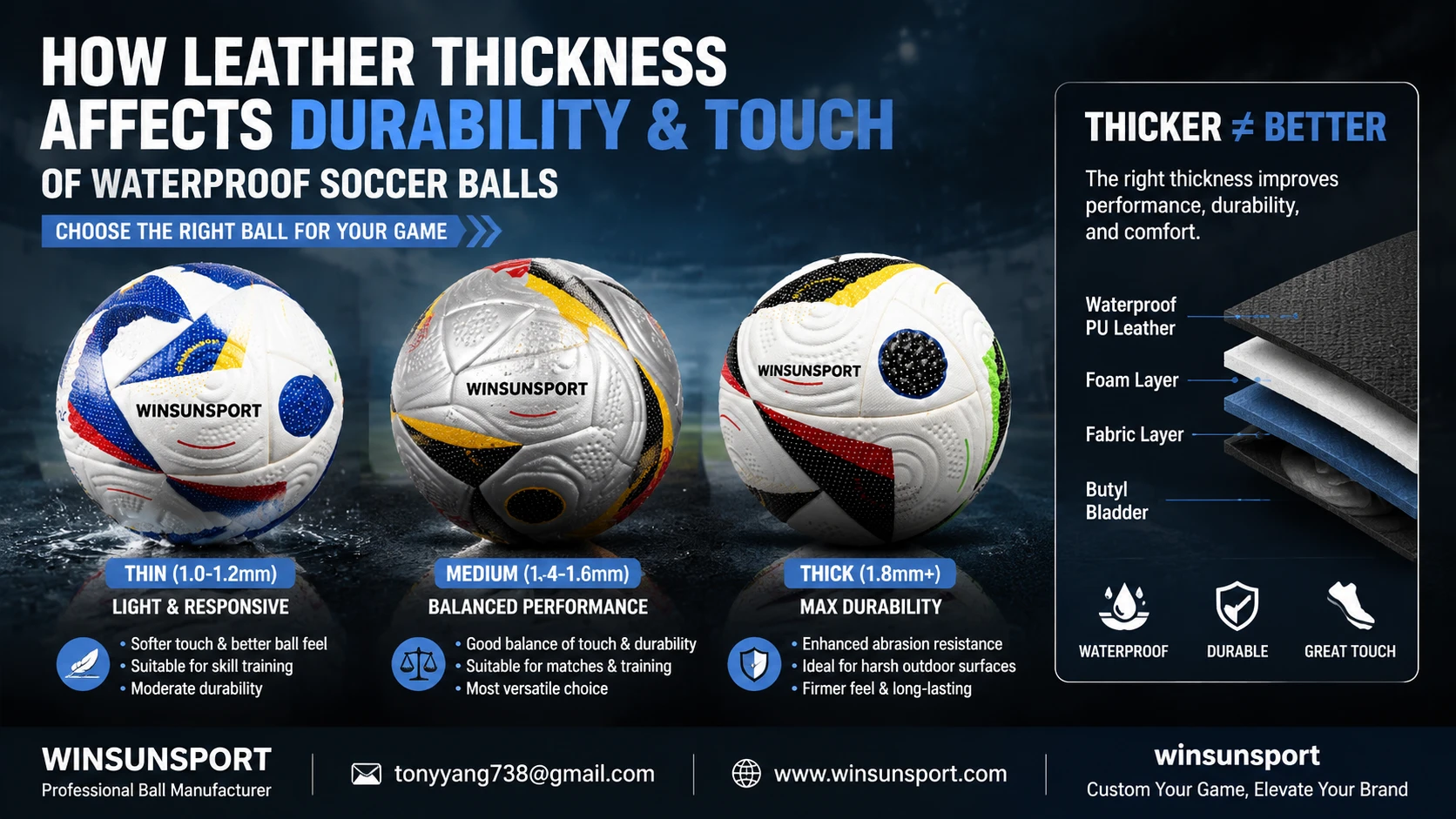
Leather Thickness of Waterproof Soccer Balls: A Trade-off to Consider
When you pick up a waterproof soccer ball, the first intuitive feeling is often the softness, hardness, and thickness of the leather. Many people intuitively think that "thicker leather is more durable, and thinner leather feels better" — this judgment is basically correct, but actual selection requires more careful trade-offs.
How Does Leather Thickness Affect Wear Resistance?
Thicker leather is indeed more resistant to scratches and wear from rough surfaces like sand and concrete. For students and amateur players who often play on concrete, asphalt, or sandy fields, thicker leather (usually above 1.2mm) can significantly extend the lifespan of the ball, reducing the chance of surface cracking or peeling.
But "thick" is not unlimited. Excessively thick leather (e.g., over 1.8mm) brings two problems: first, the ball becomes heavier, affecting its flight trajectory;Second, the flexibility of the leather itself decreases, making it easier to harden or even crack in low-temperature environments. Therefore, there is a reasonable range for improving wear resistance; thicker is not always better.
Key Trade-off: If you mainly play on grass or artificial turf, medium-thickness leather (1.0-1.2mm) is sufficiently wear-resistant and maintains a lighter weight. If you often play on concrete or sandy ground, it is recommended to choose leather above 1.2mm, but you need to accept that the ball will be slightly heavier and have slightly lower elasticity.
How does leather thickness affect feel?
The thinner the leather, the thinner the cushioning layer between the foot and the ball when touching the ball, resulting in a more direct and clear feel. For players who pursue ball control accuracy and passing feedback (such as midfield organizers or technical forwards), thin leather (0.8-1.0mm) allows you to perceive the ball's spin and force more clearly, giving you more confidence when performing actions.
However, the cost of thin leather is that it is more easily scratched by sharp objects and wears out faster on rough surfaces. If you only play occasionally for fun, or mainly buy it for children to play on the grass, the feel advantage of thin leather is not obvious, and it may need to be replaced frequently due to lack of durability.
Key Trade-off: If you have high requirements for ball control accuracy (such as participating in formal matches or high-intensity training), the improved feel brought by thin leather is worth it. If you are just exercising daily or for entertainment, medium-thickness leather offers a better balance between feel and durability.
Next Confirmation Steps
- Clarify your primary playing surface: Grass as main → medium thickness is sufficient;Cement/sand as main → prioritize thicker leather.
- Evaluate your requirements for touch: Is ball control accuracy your top priority?If yes, choose thin leather;If not, medium thickness is more worry-free.
- Confirm with the Winsunsport team: We offer leather thickness customization. You can tell the team your usage scenario (e.g., "play twice a week on concrete, mainly for kids"), and they will recommend the most suitable thickness solution.
How to choose leather thickness for different usage scenarios?
There is no "one-size-fits-all" answer for the leather thickness of waterproof footballs. The key depends on what surface and weather you mainly play on. Below, we break down two typical scenarios to help you decide whether to choose thick or thin.
Rainy Grass Match: Balance is Key
When playing on wet natural or artificial grass, the core contradiction is:If the leather is too thin, the waterproof layer is prone to wear and failure;If the leather is too thick, the ball becomes heavier and the feel becomes numb.。
- Suitable Thickness Range: It is recommended to choose 1.2mm – 1.5mm PU leather material. This thickness ensures sufficient adhesion of the waterproof coating without making the ball as hard as a stone.
- Key Trade-offIf you pursue ultimate touch (e.g., professional matches), choose around 1.2mm, but ensure the leather surface has a wear-resistant coating;If you prioritize durability (e.g., school training), choose 1.5mm, sacrificing some touch for a longer waterproof lifespan.
- Need to confirm with the Winsunsport teamthe type of grass you use (natural grass vs. artificial turf) and the grass blade length, as different surfaces have different friction coefficient requirements for the leather, affecting the optimal thickness selection.
Cement court recreational games: prioritize wear resistance
Cement courts are the "killer" of footballs—the leather directly rubs against the rough surface, the waterproof layer wears off first, and then the bladder gets wet.
- Suitable Thickness Range: It is recommended to choose 1.5mm – 2.0mm thickened PU leather material.The thicker it is, the better the wear layer can withstand the "sandpaper effect" of concrete ground.
- Is a waterproof football wear-resistant on concrete ground? Yes, but with a premise: the wear resistance of a waterproof football mainly comes from the surface treatment of the leather (such as embossing, coating), not the waterproof function itself.The combination of thick leather + wear-resistant surface treatmenthas a significantly longer lifespan on concrete ground than ordinary footballs.But if you play on concrete ground more than 3 times a week, even with thickened leather, the surface may become fuzzy after half a year—this is normal wear, not a quality issue.
- Need to confirm with the Winsunsport team: Is your cement floor smooth or rough?Rough surfaces wear faster and may require customized thicker leather (above 2.0mm) or an added wear-resistant coating.
Will waterproof footballs become hard in winter?
Yes, but the degree depends on the leather formula. Ordinary PU becomes hard at low temperatures (below 0°C), resulting in poor touch and reduced elasticity. Winsunsport's waterproof footballs support customization oflow-temperature resistant PU leather(usually with added plasticizers or special resins), which maintains flexibility around -10°C.
If you use it outdoors in winter, be sure to specify "low temperature use" when customizing, and the team will adjust the leather formula instead of simply increasing the thickness.
Next Confirmation Steps
- Clarify your main usage surface: Grass (natural/artificial), concrete, or mixed?Different surfaces determine the minimum thickness.
- Clarify usage frequencyHow many times a week? How long each time? The higher the frequency, the more you need thicker leather or wear-resistant coating.
- Contact the Winsunsport teamwith the above information, and they will provide leather thickness recommendations (customizable within the range of 1.0mm – 2.5mm) and advise whether a specific inner bladder is needed (e.g., rubber thread bladder is more resistant to low temperatures).
Can the leather thickness be customized?How to match with the inner bladder?
Yes. Winsunsport's waterproof football supports leather thickness customization. You can specify the leather thickness when placing an order, and the factory will adjust the process according to your requirements. This customization needs to be considered together with the inner bladder type, as both jointly affect the ball's durability, touch, and rebound performance.
Winsunsport's leather thickness customization service
Winsunsport offers leather thickness customization, allowing users to choose thinner or thicker leather based on the usage scenario. Thinner leather is suitable for indoor courts or grass matches, providing direct ball touch feedback, but with weaker wear resistance.Thicker leather is suitable for concrete, sand, or high-intensity training, offering better wear resistance and crack resistance, but with a harder feel. There is no "best" thickness, only the most suitable choice for the venue and frequency of use.
Synergy between bladder type (thread bladder/rubber thread bladder/PVC bladder) and leather thickness
Winsunsport offers three types of bladders: thread bladder, rubber thread bladder, and PVC bladder. The matching logic with leather thickness is as follows:
| Bladder type | Features | Suitable leather thickness | Applicable scenarios |
|---|---|---|---|
| Bladder | Uniform rebound, soft feel, good air tightness | Thin to medium thickness | Grass match, training, pursuit of ball control |
| Rubber bladder | Faster rebound, more durable, and resistant to deformation | Medium to thick | Cement floor, sandy ground, high-intensity training |
| PVC bladder | Low cost, hard rebound, short lifespan | Relatively thick | Entertainment, short-term events, limited budget |
How to choose between thread bladder and rubber thread bladder? If you mainly play on grass or indoor courts and value touch and passing accuracy, a butyl bladder is more suitable. If you often play on concrete, sand, or in low-temperature environments and need a ball that is more durable and has crisper rebound, a rubber bladder is a better choice.
PVC bladders are only recommended for extremely low budgets or one-time event scenarios; not recommended for long-term use.
How to determine which leather thickness is right for you?Decision Framework and Next Steps
There is no "best" value for leather thickness, only the choice that "best suits you." The key lies inabrasion resistanceandfeelMake a choice between them. The following framework helps you make a quick decision.
Clarify your core need: durability or feel?
- Choose thicker leather (e.g., 1.2mm or more)
Suitable for: playing mainly on rough surfaces such as artificial turf, concrete, and asphalt. Thicker leather is more resistant to scratches and wear, and the ball is less likely to be damaged by friction. The trade-off is that the ball is relatively hard, the touch feedback is duller, and the feel is more "wooden" when making long passes and shots.
- Choose thinner leather (e.g., 0.8mm-1.0mm)
Suitable for: mainly playing on natural grass, indoor floors, or high-quality artificial turf. Thin leather is softer, providing clearer touch feedback, and more direct response when stopping, dribbling, and making short passes. The trade-off is reduced wear resistance, making it prone to peeling and cracking on rough surfaces.
Evaluate your primary playing surface
| Primary surface | Recommended leather thickness | Reason |
|---|---|---|
| Concrete, asphalt, sand | Thicker (1.2mm and above) | Durability is priority, feel is acceptable |
| Natural grass, indoor floor | Thinner (0.8mm-1.0mm) | Feel first, low wear risk |
| Artificial turf (medium quality) | Medium (1.0mm-1.2mm) | Balances wear resistance and feel, needs fine-tuning based on grass filament length |
| Mixed use on multiple surfaces | Medium-thick (1.1mm-1.3mm) | Offers versatility, but feel is inferior to thin leather |
How to choose in the end? Next step: confirm the action.
- First determine your primary surface: If more than 80% of the time is on rough ground, choose thick leather;If you mainly play on good fields, choose thin leather.
- Then consider usage frequency: For high-frequency users who play more than 3 times a week, prioritize thick leather to extend lifespan;For recreational users who play occasionally, the improved touch from thin leather is more worthwhile.
- Confirm with the Winsunsport team:
Information you need to tell us:
- What surface do you mainly play on (cement, natural grass, artificial turf)?)
- How many times a week do you play?
- Do you care more about durability or touch?
Based on your answer, we will recommend a specific leather thickness and inner bladder combination.
Frequently Asked Questions
Q: Does the leather thickness of a waterproof football affect its waterproof performance? A: Waterproof performance mainly depends on the waterproof coating on the leather surface and the stitching process, not the leather thickness. Both thick and thin leather can be waterproof, but thick leather is more likely to maintain the integrity of the waterproof layer after wear.
Q: Should a children's ball be made of thick or thin leather? A: Children have less strength, so thin leather (0.8mm-1.0mm) is recommended for a lighter feel and easier control. If children mainly play on concrete, choose a medium thickness (1.0mm-1.1mm) for a balance of durability and control.
Q: Does a thick leather football become harder in winter? A: All leather hardens in low temperatures, but the change is more noticeable with thick leather. If using outdoors in winter, it is recommended to choose a medium thickness (1.0mm-1.2mm) with a rubber thread bladder for better flexibility.
Q: I play on both surfaces, how should I choose the thickness? A: It is recommended to choose a medium thickness (1.1mm-1.2mm) and prioritize a thread bladder—the thread bladder provides a softer feel than a rubber thread bladder while maintaining durability, suitable for mixed-use scenarios.
Q: Is leather thickness directly linked to price? A: Not entirely. The cost difference between thick and thin leather is not significant; the price depends more on the leather material (such as PU, PVC), the type of inner bladder, and the customization process.
When choosing thickness, prioritize the usage scenario, then adjust the inner bladder and material according to the budget.
Learn More
Not sure which leather thickness to choose?Contact the Winsunsport team, tell us your playing field, frequency, and preferences, and we will recommend the most suitable combination of leather thickness and inner bladder for you.
Related Products:Adult Outdoor Waterproof Soccer Ball