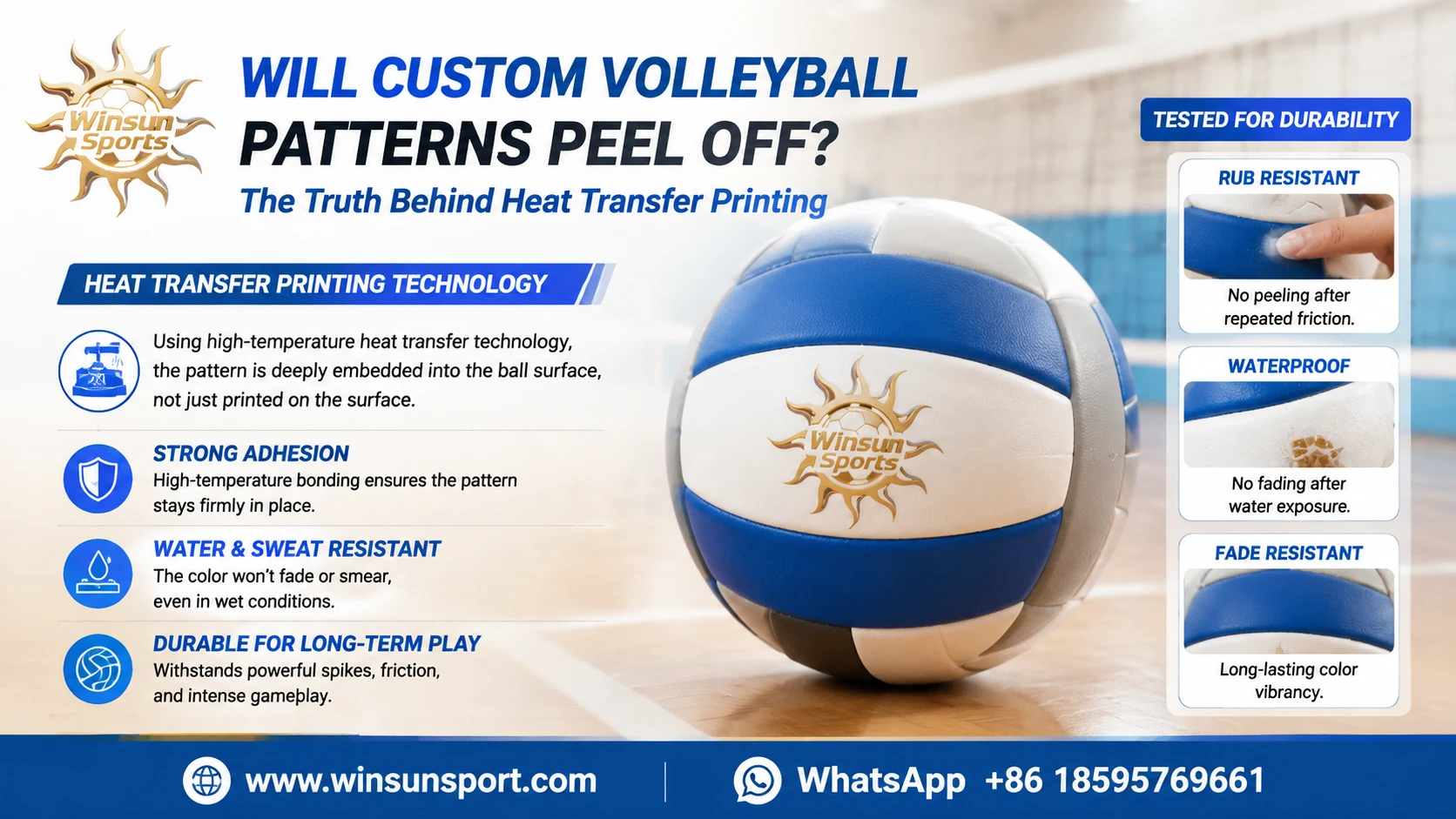
Where does the problem of peeling patterns on custom volleyballs come from?First, distinguish the relationship between printing and the surface material of the ball.
When receiving a custom volleyball, many people's first reaction is to ask, "Is the pattern easy to fall off?" But this question itself needs to be broken down: is the pattern peeling a problem in the printing process, or is the surface material simply unable to "hold" the pattern?
Let's start with the conclusion:Pattern peeling is usually the result of a mismatch between the material and the printing process, rather than the fault of one side alone. The surface material determines how deeply and firmly the ink or transfer layer can adhere;the printing process determines the way the pattern "enters" the surface of the ball. If the two don't match, even the best-looking pattern won't survive more than a few training sessions.
Where does pattern peeling typically occur?
Peeling generally appears at two stages:
- Early use (within 1-2 weeks): If the pattern edges lift or peel off in whole pieces, it's usually because the printed layer only sits on the ball's surface without bonding to the material.This is especially common on smooth, hard surfaces.
- Mid-term use (1-3 months): If the pattern first develops fine cracks and then flakes off locally, it's often because, as the ball surface repeatedly bends under stress, the printed layer and the ball cover have different stretch rates, causing the pattern layer to fatigue and crack before the cover does.
So to determine where the problem lies, you need to look at the timing and pattern of the peeling, rather than broadly blaming it on "poor print quality."
Why PU soft leather is more suitable for heat transfer printing than PVC
The key difference here lies in the surface energy and extensibility of the materials.
PVC (polyvinyl chloride) Its surface is dense and smooth, making it a low-surface-energy material. The ink or adhesive layer in heat transfer printing finds it difficult to "bite" into the material's interior, relying mainly on physical adsorption to adhere to the surface. When the ball is struck and squeezed, its surface constantly deforms, causing the adhesion to gradually weaken and increasing the risk of the pattern peeling off.
This is also why patterns on many cheap PVC printed balls tend to peel off in large sheets after prolonged use.
PU (polyurethane) soft leather is different. Its surface has a microporous structure, allowing ink to partially penetrate the pores during heat transfer, forming a mechanical bond similar to "anchoring";at the same time, the elasticity of PU material is closer to that of the printed layer, so when the spherical surface is bent under force, the pattern layer and the ball skin can stretch and contract synchronously, making it less prone to cracking. In simple terms,PU soft leather does not make the pattern "stick" to the surface, but rather makes the pattern "grow" into the material.。
This is also why Winsunsport's custom volleyball uses microporous anti-slip PU soft leather with heat transfer printing—not just for feel, but to solve the pattern lifespan issue through adhesion firmness. If you are comparing custom volleyballs made of different materials, you can focus on asking whether the other party uses PU or PVC skin, which can better predict the durability of the pattern than simply comparing printing technologies.
How does heat transfer printing make patterns fuse with the PU surface? Principle and advantages explained
Many buyers, when customizing volleyballs, worry about the same issue: after printing, the pattern cracks, peels, or wears off after a few games. To judge whether Winsunsport's PU heat transfer volleyball is reliable, the key is not how 'pretty' the pattern looks, but how the pattern 'grows' onto the ball's surface.
Workflow of heat transfer printing
Heat transfer printing does not 'stick' the pattern onto the ball's surface; instead, through high temperature and high pressure, the ink layer on the transfer film with the pattern is directly 'pressed' into the micro-pore structure of the PU surface layer. Specifically for this volleyball, the process is roughly as follows:
- PU surface pretreatment: The micro-porous anti-slip PU soft leather itself has fine concave dot particles, and the surface is not completely smooth, which provides physical anchor points for ink penetration.
- Transfer film lamination: Cover the pattern film on the designated position of the spherical surface and apply uniform pressure.
- High-temperature heat pressing: At the set temperature, the ink layer softens and penetrates into the micro-pores of the PU surface layer, forming a physical bond with the PU material (some processes also produce chemical bonding). After cooling, the pattern layer and the skin become one.
- Surface treatment: The pattern area is also covered with anti-slip texture, which does not affect the ball's touch and control.
The key difference here is: screen printing is 'ink piled on the surface', while heat transfer is 'ink fused into the surface'.
Why fusion is more wear-resistant than adhesion
The wear resistance of a screen-printed pattern depends on the "adhesive force" between the ink and the PU surface—no matter how firmly it sticks, it remains two interfaces. Under friction, bending, or impact, stress concentrates at the interface, and over time, it tends to peel or crack from the edges.
Heat transfer is different. The pattern layer and the PU skin are microscopically fused into one, with no obvious "boundary line." When the spherical surface is scratched, the wear first acts on the common surface of the pattern layer and the PU, rather than at the seam between the two.
Moreover, since the PU soft skin has a certain elasticity, the pattern layer deforms together with the skin, and it won't crack independently due to repeated compression from the ball.
Practical impact: Under normal indoor court use and without deliberately scratching with sharp objects, the lifespan of heat transfer patterns is usually much longer than that of screen printing, especially in high-friction scenarios such as frequent bumping, spiking, and diving for saves. For high-frequency use environments like school physical education classes and daily team training, this difference is tangible.
Suitability Assessment
| Scenario | Is Heat Transfer PU Volleyball Suitable? | Reason |
| School PE classes, school team daily training | ✅ Suitable | Wear-resistant, pleasant to the touch, and the pattern is not easy to fade |
| Corporate events, team-building souvenirs | ✅ Suitable | Custom patterns are clear and have high long-term preservation value |
| For outdoor concrete courts and rough surfaces | ⚠️ Needs confirmation | PU soft leather is more suitable for indoor use; rough outdoor surfaces will accelerate surface wear |
| Short-term events requiring frequent pattern changes | ❌ Not suitable | Custom heat transfer has higher minimum order quantity and longer lead time than screen printing, making it uneconomical for short-term one-time use. |
Next step: confirm the action: If you plan to use it on outdoor courts, you need to confirm with the Winsunsport team whether the wear resistance of this PU surface on rough ground meets your frequency of use;If it is only for indoor use, the wear resistance advantage of the heat transfer process can basically be trusted.
What scenarios are suitable for custom heat transfer printed volleyballs?Practical applications from campus to competitions
Campus teaching and team training: durability is the top priority
When schools purchase custom volleyballs, the biggest concern is not that the pattern is not attractive enough, but that the ball will peel or delaminate after one semester, or the pattern will wear into a blur. The frequency of use in physical education classes and school team training is much higher than in recreational play. The ball is repeatedly bumped, spiked, rolled on the ground, and casually tossed into ball carts. In such cases, the core value of a heat-transfer printed volleyball lies not in being 'good-looking,' but in the integration of the pattern with the ball surface—the pattern is heat-bonded into the PU skin, not printed and laminated on the surface, so it won't peel off in sheets like screen printing or labels.
Combined with micro-porous anti-slip PU soft leather, the arms are less likely to become red and swollen during prolonged bumping, which is a real plus in school settings where beginners are concentrated.
When purchasing for schools, two key points should be confirmed: first, whether the ball specification is the standard size 5 (circumference 65–67 cm, weight 260–280 g), ensuring that students use the same specification for training and exams;second, whether the custom pattern covers the entire ball surface, and whether fine lines such as school names and team logos remain clear under the heat transfer process. If the pattern includes extremely small text or complex gradients, it is recommended to have the Winsunsport team provide a rendering to confirm clarity before placing the order.
Corporate Team Building and Event Souvenirs: Pattern Durability Determines Gift Value
The logic for corporate team building and event souvenirs is completely different—the ball doesn't necessarily need to be used intensively, but it must be 'presentable.' Sponsor logos, event names, years, and title sponsor brands—these details printed on the ball are themselves a medium of communication. If the pattern peels off after a few games, sponsors will be dissatisfied, and participants will perceive the ball as a cheap giveaway.
The advantage of heat transfer printing is that the pattern is embedded into the ball's surface layer. Combined with seamless thermal lamination, the entire ball has no stitching, giving it a strong integrated appearance. As a souvenir, it won't look out of place on an office desk or at home.
Event organizers also need to consider a practical factor: lead time and minimum order quantity. Custom volleyballs involve design confirmation, production scheduling, and logistics—they won't arrive the day after you place an order. If you're preparing for an event two months away, there's plenty of time.If it's a last-minute restock, be sure to confirm the current schedule and minimum order quantity with the Winsunsport team in advance to avoid the balls not arriving as the event approaches.
Scenarios where heat transfer printed volleyballs are the right choice:
- For school team and PE class balls, the pattern needs to be durable over long-term use, and the ball's feel should remain stable.
- For corporate sports events and anniversary gifts, the logo needs to be clear and the appearance should have a premium texture.
- For commemorative balls for tournaments, the pattern needs to be long-lasting and suitable for long-term preservation.
Scenarios requiring caution:
- Bulk purchases with extremely low budgets that only care about 'being playable' — the heat transfer process costs more than ordinary plain balls.
- The pattern design is not finalized and requires repeated modifications — the customization process will extend the delivery time.
- Long-term use on outdoor concrete or rough surfaces — any volleyball will wear out faster on rough surfaces, and heat transfer patterns cannot withstand scraping by sand and gravel. For such scenarios, it is recommended to use them on indoor courts.
How to confirm the pattern won't peel off?Sample testing is a critical step before purchasing.
Whether the pattern will peel off cannot be determined by looking at product images, nor can it be confirmed solely by the supplier's verbal assurances. The quality of heat transfer printing depends on the adhesion between the ink and the PU leather surface, the control of heat lamination temperature and pressure, and the friction environment during the ball's daily use. These can only be confirmed through actual sample testing.
What should sample testing cover?
After receiving the sample, don't just feel the texture or check the color. Conduct a targeted round of tests following the four steps below:
- Fingernail scratch test: Use your fingernail to scratch moderately along the pattern edges and color block boundaries a few times.If obvious color fading, peeling, or powder shedding occurs, it indicates that the ink adhesion does not meet the standard.
- Damp cloth wipe test: Use a slightly damp soft cloth to wipe back and forth across the pattern surface about 10 times, and observe whether there is any color transfer.This action simulates sweaty hand contact and daily cleaning scenarios.
- Bounce test: Bounce the ball against another ball or a hard flat surface continuously 20-30 times, focusing on observing whether there are cracks or edge lifting in the pattern area.This simulates real impacts during matches and training.
- Placement observation: Place the sample for 3-5 days to check whether the pattern becomes sticky, discolored, or locally raised.This can reveal issues with incomplete ink curing.
During the test, record each result and take photos or videos for documentation. If the sample passes these four steps, the risk of proceeding to bulk ordering will be much lower.
In which situations is it not recommended to directly place a bulk order?
In the following three situations, even if the sample performs well, it is recommended to pause and confirm first:
- The design draft of the pattern is still being frequently modified: If the logo, text, or color scheme has not been finalized, do not rush into mass production.The plate-making and color adjustment costs of heat transfer printing will accumulate with each modification, so it is more cost-effective to place the order after the design is finalized.
- The usage scenario differs greatly from the sample testing environment: If your ball is mainly used on outdoor concrete or rough surfaces, while the sample testing is only conducted on indoor smooth surfaces, the abrasion resistance conclusion will not hold.You need to explain the actual playing surface to the Winsunsport team to confirm whether adjustments to the ink formulation or surface material are needed.
- Large order quantity but budget not yet secured: Bulk customization involves the linkage of minimum order quantity, delivery time, and unit price.If the budget has not been approved yet, do not pay the deposit first, to avoid subsequent breach of contract due to funding issues.
Conversely, if your design is finalized, the usage scenario is clear (such as indoor training or competition), and the budget is confirmed, you can confidently proceed with bulk customization after the sample test passes.
Frequently Asked Questions
Q: Do I need to pay extra for sample testing? A: It depends on the purchase quantity and cooperation method. It is recommended to directly explain your purchase intention and quantity to the Winsunsport team to confirm the sample policy, sampling cycle, and whether the sample fee can be deducted from subsequent bulk orders.
Q: After sample testing passes, will the pattern quality of bulk products be exactly the same as the sample? A: Under the same process and ink system, bulk products and samples should maintain the same quality standard. However, there may be batch-to-batch differences in bulk production. It is recommended to specify the pattern adhesion acceptance criteria in the contract and conduct random inspections on arrival of bulk goods using the sample testing method.
Q: If the pattern still wears off after long-term use of the ball, can it be reprinted? Answer: Re-printing on the surface of a PU volleyball requires redoing the heat bonding process, which is technically difficult and generally not recommended. A more practical approach is to order a few extra replacement balls at the time of purchase, or confirm with the team whether there are more abrasion-resistant ink options available.
Question: Does the size of the printed area affect the risk of peeling? Answer: Large full-surface prints and fine lines have different adhesion performance. Full-surface color blocks require higher ink uniformity and heat bonding pressure. It is recommended to test with the final design area during the sample stage rather than using a scaled-down version.
Learn More
If you are sourcing custom volleyballs for a school, team, or event, feel free to contact the Winsunsport team. Provide your usage scenario, design, and order quantity, and we will help confirm the process solution and sample testing arrangements.
Related Products:Yellow and blue wavy pattern No. 5 PU heat transfer volleyball, customizable logo