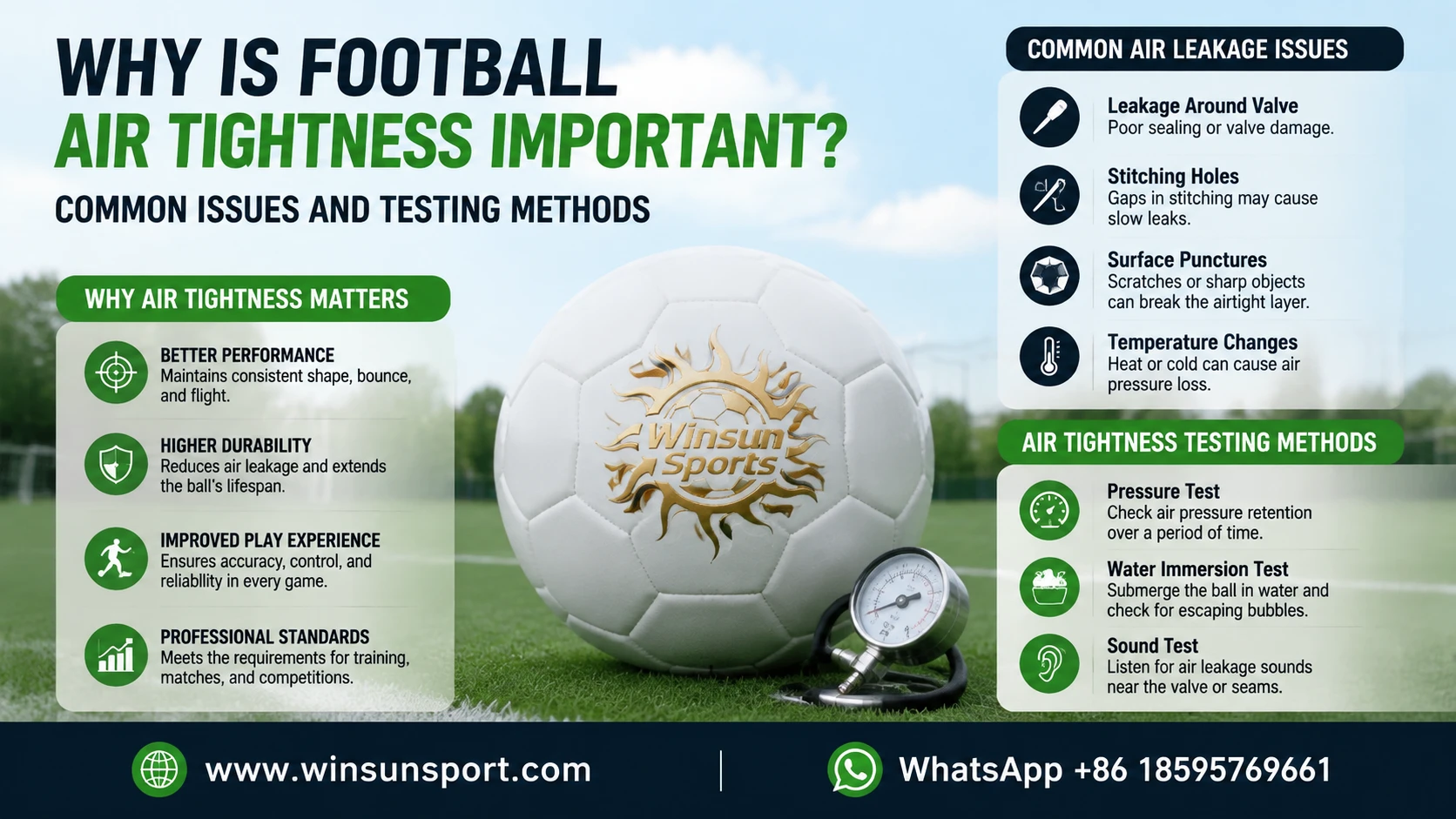
Why can't poor football air tightness be ignored?
How does air tightness affect touch and bounce consistency?
The air tightness of a football directly determines the "feedback" you feel with every touch. A ball with good air tightness maintains stable bladder pressure, delivering a clear, uniform rebound when struck with the instep;a ball with poor air tightness feels "muffled" when kicked—part of the force is absorbed by the ball, reducing the speed and spin of the pass.
More critical is bounce consistency. A ball with poor air tightness often starts losing pressure after just ten minutes of play, causing the bounce height and rebound angle to change. In training, you practice fixed movements, but if the ball responds with a different bounce every time, your technique can be affected.
For the game, this is more lethal: a ground pass that deviates due to unstable bounce can directly alter the rhythm of the attack. The method to judge is simple—hold the ball at about 2 meters height and let it fall freely, observing whether the rebound height is stable;If the rebound difference between two drops is obvious, it indicates that the airtightness has already become a problem.
The disruption of frequent inflation to training and game rhythm
A ball that needs frequent inflation has the most direct impact of interrupting training rhythm. Every 20-30 minutes, you have to stop to find a pump and check the pressure, and a complete set of shooting drills is fragmented. For coaches, this means that each session requires extra time to check ball pressure, rather than spending time on tactical guidance.
The more hidden cost is psychological. Players dare not exert full force during matches—worried that the ball will become softer with each kick, so both passing strength and shooting power have to be 'held back.' This self-imposed limitation directly affects performance.
For school physical education classes or amateur clubs, frequent inflation also means a logistical burden: someone must be assigned to keep the pump, regularly check all balls, and the real cost is management energy.
Judgment advice: If you find that a ball needs inflation more than once a week, or it becomes noticeably soft after just 15 minutes of play following inflation, the airtightness is already substandard. When purchasing, focus on the bladder type—rubber thread-wound bladders and butyl bladders generally have better airtightness than ordinary PVC bladders, but the actual performance also depends on the leather thickness and craftsmanship. It is recommended to confirm with the Winsunsport team the matching solution for bladder and leather suitable for your playing surface (artificial turf, hard court, or natural grass).
What are the key factors affecting a football's airtightness?
Whether a football loses air quickly depends 90% on two aspects: the bladder material and the craftsmanship details. You don't need to understand chemistry; you just need to know what result each option corresponds to.
How the inner bladder material determines air retention capability
Winsunsport offers three types of inner bladders for this football:latex bladder, rubber-latex bladder, and PVC bladder. Their air retention capabilities are progressive:
- PVC bladder: Weakest air retention. PVC material itself has average gas barrier properties, and after two to three weeks of use, the frequency of needing to reinflate will noticeably increase. Suitable for casual leisure play, such as an occasional weekend game.
- Wound bladder: Moderate air retention. The inner bladder is wrapped with a layer of yarn, which helps maintain the ball's shape and provides better air tightness than PVC. Suitable for regular training sessions of 1-2 times per week.
- Rubber wound bladder: Strongest air retention. Rubber material naturally has better gas barrier properties than PVC, and with the yarn layer support, a single inflation can last longer. Suitable for formal training and matches that require stable ball pressure.
The way to judge is simple: If you don't want to pump up the ball before every kick, choose a rubber bladder;If you only play occasionally, a PVC bladder is sufficient and costs less.
The impact of craftsmanship and valve treatment on air tightness
Material is the foundation, but the valve is the main culprit for air leakage. Many balls don't leak from the surface, but from poor sealing around the valve. When purchasing, you can pay attention to two points:
- The elasticity of the valve rubber: Good valve rubber quickly rebounds to seal the opening after the needle is removed.You can press the valve with your hand; the faster and tighter it rebounds, the better the seal.
- The bonding process between the inner bladder and the leather material: If the inner bladder and leather are not tightly bonded, long-term friction will accelerate aging of the inner bladder, indirectly affecting air tightness.Winsunsport supports full-dimensional customization; you can directly confirm with the team the bonding process level corresponding to the inner bladder type you choose.
Next step for confirmation: When inquiring with the Winsunsport team, ask directly—what type of inner bladder the style you plan to choose uses, and whether the valve rubber is ordinary butyl or high-rebound material. Once these two pieces of information are confirmed, you can determine whether this ball meets your air retention needs.
How can you quickly determine whether a soccer ball's airtightness meets the standard?
Soccer ball air leakage is often not sudden but gradual. You don't need professional instruments; you can determine at home whether a ball is worth keeping or needs to be replaced.
Simple inflation and rest test method
This is the most intuitive method and the one closest to actual usage conditions:
- Inflate to standard pressure: Inflate according to the pressure range marked on the ball's surface (usually between 0.6–0.8 bar).Without a pressure gauge, press the ball; it is appropriate if your thumb can press it down about 1 cm.
- Record the initial state: Measure the circumference of the ball with a soft tape measure, or directly mark the highest point on the ball's surface and record the time.
- Let it sit for 24–48 hours: Place it on a flat surface at room temperature, avoiding direct sunlight and heat sources.
- Re-measure and compare: Measure the circumference again or check the pressing feel.If the circumference decreases by more than 2–3 cm, or the ball becomes noticeably softer when pressed, the air tightness does not meet the standard.
Judgment criteria: A football with qualified airtightness should still maintain obvious elasticity after being left standing for 48 hours, and should not feel "noticeably softer" when pressed. If it becomes noticeably deflated within 24 hours, it indicates a problem with the bladder or the air valve.
Key points for airtightness inspection during procurement acceptance
If you are purchasing in bulk (e.g., for schools or clubs), it is impractical to let each ball stand for 48 hours. During acceptance, focus on three key points:
- Air valve inspection: Apply soapy water around the air valve and inflate slowly.Continuous bubbles indicate a poor seal at the air valve—this is the most common site of air leakage and is repairable.
- Bladder odor and feel: When pressing a new ball after unpacking, it should rebound quickly without a hollow sensation.If pressing causes localized softness or a crinkling sound, it indicates poor bladder adhesion, leading to a higher risk of leakage over long-term use.
- Stitching or bonded edges: For machine-stitched balls, check whether the stitches are even and free of skipped stitches;for thermally bonded balls, check the edges for any gaps or delamination.These areas are weak points in air tightness.
A key trade-off: Air tightness testing can only verify "whether it leaks at the moment," but cannot predict long-term lifespan. If you need a ball for high-intensity training (used daily, friction on hard surfaces), the bladder type is more important than initial air tightness—rubber-wound bladders are generally more stable in long-term air tightness than ordinary PVC bladders. Winsunsport's Durable Pro Football offers three bladder options: wound, rubber-wound, and PVC. If you're unsure which bladder suits your usage frequency, explain your usage scenario (weekly usage times, field type) to the Winsunsport team, and they will provide matching recommendations.
Next step for confirmation: After receiving the ball, perform a 48-hour static test before deciding on batch acceptance. If the test reveals a leak, first check the air valve—in most cases, tightening or replacing the valve core will solve the problem, and you don't need to immediately deem the entire ball defective.
How is the air tightness performance of the Durable Pro Football for Field?What procurement scenarios is it suitable for?
The air tightness of a football directly affects the duration of ball pressure retention and the consistency of touch. A ball with poor air tightness becomes soft after being fully inflated and left for two days, distorting the feedback from passing and shooting, which is a burden on the development of technical skills. Durable Pro Football for Field offers three types of bladders: butyl bladder, rubber butyl bladder, and PVC bladder, with air tightness performance progressing from basic to advanced. When purchasing, simply match them according to usage frequency and scenario.
How the three bladders match different air tightness requirements
- PVC bladder: Medium air tightness, lowest cost, suitable for low-frequency use, indoor or soft surfaces.If the ball is used only once or twice a week, a PVC bladder is sufficient; there is no need to spend more on air tightness you won't use.
- Rubber wound bladder: Better air tightness than PVC bladder, more stable rebound feedback, and is the mainstream choice for daily training and school physical education classes, suitable for scenarios with multiple uses per week.
- Wound bladder: Best air tightness, longest pressure retention time, suitable for professional matches and long-duration high-intensity training.If the team trains daily and doesn't want to frequently reinflate, a butyl bladder is more worry-free.
Which procurement scenarios should prioritize air retention
Scenarios that prioritize air retention share a common feature:The ball is used frequently, and users have requirements for consistent feel.。
- School physical education classes: Suitable. With a large number of students and high usage frequency, it's recommended to choose the rubber butyl bladder version, which offers the best balance of air retention and cost. The product supports size and color customization, and balls can be differentiated by grade level.
- Amateur club training (artificial turf/hard court): Suitable. During training, there are many passes and shots. Poor air retention can cause players to misjudge the ball's trajectory. It is recommended to choose the butyl bladder version to reduce interruptions from mid-training inflation.
- Brand OEM/ODM: Suitable. OEM/ODM customization is supported, with customizable logos, colors, and leather thickness, and stable batch supply. Air retention as a core selling point can help brands establish product differentiation.
Scenarios where air retention is not a top priority: If it is only for family leisure, parent-child entertainment, or gift purposes, the ball is used infrequently, and the PVC bladder version is sufficient; there is no need to increase the budget for higher air retention. If the procurement goal is not yet clear—for example, the playing surface, frequency of use, or age group of users has not been determined—it is recommended to clarify these conditions before choosing the bladder, to avoid paying for performance you won't use.
Next step for confirmation: Explain to the Winsunsport team the frequency of use, type of venue, and budget range, confirm the specific differences in pressure retention duration between rubber-wound bladders and wound bladders, as well as the price difference between different inner bladders for bulk purchases, and then decide which tier to choose.
FAQ
Q: Which type of inner bladder is most suitable for school procurement? A: Prioritize rubber-wound bladders. School balls are used frequently but not with extreme intensity per session; rubber-wound bladders offer the best balance between air retention and cost.
If the budget is sufficient and you want to reduce the frequency of inflation, you can upgrade to wound bladders.
Q: What scenarios are suitable for balls with PVC bladders? A: Suitable for low-frequency use, such as family entertainment, parent-child interaction, or gift purposes. If you use it less than twice a week, the airtightness of a PVC bladder is fully sufficient, and there is no need to choose a higher specification.
Q: Can the Durable Pro Football for Field be customized with school logos and colors? A: Yes. This product supports full-dimensional customization, including leather thickness, bladder type, size, and appearance.
When purchasing for schools, the grade color or school emblem can be printed on the ball surface to facilitate distinguishing user groups.
Q: When branding under a private label, how should airtightness be confirmed with the factory? A: It is recommended to first clarify the target usage scenario and pricing range, and then let the Winsunsport team recommend the corresponding bladder solution. Before bulk purchasing, you can request samples to test pressure retention performance, and confirm the specification after verifying the price differences among different bladders.
Learn More
If you are selecting balls for a school, club, or brand project but are unsure which bladder best suits your usage scenario, you can contact the Winsunsport team, specify the weekly usage frequency, field type, and budget range, and we will match you with the corresponding bladder and leather material solutions.
Related Products:Durable Pro Football for Field