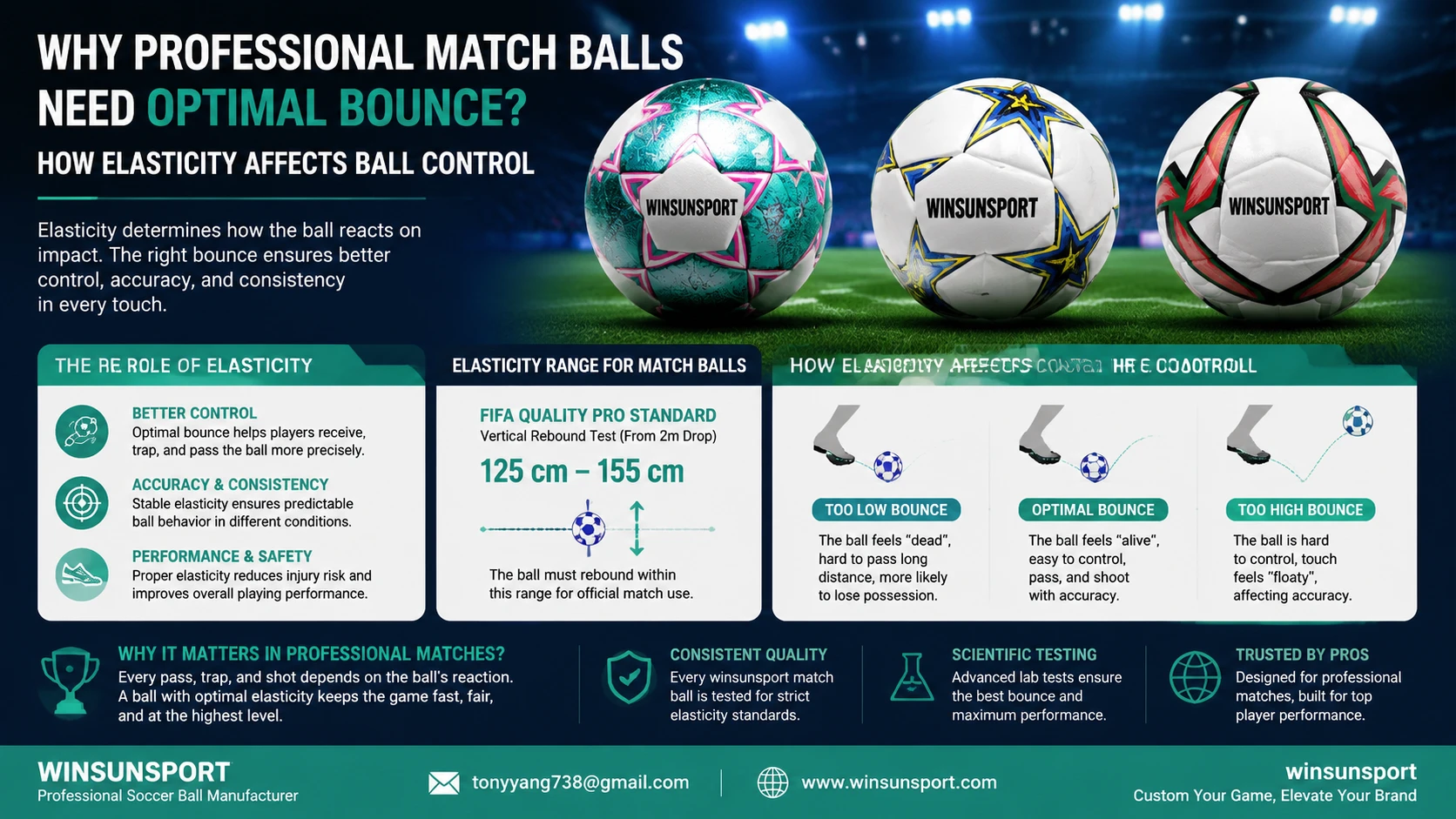
What is "moderate elasticity" in a football?Why is it a core indicator for match balls?
When you pick up a football, the most intuitive feeling besides weight is its bounce when hitting the ground—if it bounces too high, the ball feels "floaty";if it bounces too low, the ball feels "dead". Moderate elasticitymeans that under standard test conditions, the rebound height of the football is neither too high nor too low, providing players with stable and predictable feedback when passing, stopping, and shooting.
Definition and Measurement Method of Moderate Elasticity
FIFA has clear elasticity standards for match balls: when dropped freely from a height of 2 meters, the rebound height on a hard surface should be120 cm to 165 cm(varies slightly with different certification standards). This range is the quantitative boundary of "moderate". Below 120 cm, the ball feels too hard and the touch feedback is sluggish;above 165 cm, the ball's trajectory in the air becomes difficult to control, and it tends to bounce far when stopping.
The measurement method is simple: inflate the ball to standard pressure (0.6-0.8 bar) using an air pump, and repeat the test three times on a flat hard surface to take the average. For match balls, the rebound must fall within this range, and the rebound difference among balls from the same batch must not exceed 5 cm, otherwise players on the field will feel that each ball "feels different."
The impact of elasticity on the flight trajectory and touch feedback of a football
Moderate elasticity directly determines two key experiences:
- Flight trajectory stability: A ball with moderate elasticity, when making long passes or shots, has a recovery speed of the ball's deformation that matches air resistance, resulting in a straighter and more predictable trajectory.A ball with excessive elasticity tends to have a larger rebound angle upon contact with the foot, making it easy to "shoot high";A ball with insufficient elasticity feels like kicking a stone, with a heavy flight arc and rapid descent.
- Clarity of touch feedback: When stopping the ball, a ball with moderate elasticity will "stick" to the foot—because the combination of the ball cover and bladder absorbs some of the impact force and then releases it evenly.If the training ball is too hard, the ball will "bounce away" when stopping;If it is too soft, it feels "sticky" to the foot, making it difficult to release the ball quickly.
Why is this a core indicator for match balls? Because the game is fast-paced and highly competitive, players need to rely on muscle memory to predict every bounce of the ball. A ball with moderate elasticity allows for higher consistency in passing, stopping, and shooting, reducing errors caused by the ball's own characteristics.
Ordinary training balls often sacrifice elasticity precision for durability, with a rebound range that can be as wide as 100-180 centimeters, suitable for repeated juggling and basic practice, but unable to meet the game's requirement for "every touch is reliable."
What does this mean for you? If you are purchasing a football for official matches or high-intensity training, moderate elasticity is a hard requirement that must be met—it directly determines your ball control performance. If you're just playing casually for fun, the elasticity range can be relaxed, but choosing a ball with moderate elasticity can still help you find your rhythm faster and reduce the frustration of the ball not following your foot.
What specific effects do excessive or insufficient elasticity have on ball control and passing?
Excessive elasticity: unstable ball stopping, unpredictable passing paths
When you use your foot or chest to stop a ball with excessive elasticity, the ball will bounce out like a spring instead of obediently sticking to your foot. Specifically:
- Loss of ball control: The ball rebounds with excessive height and angle after hitting the ground, requiring you to adjust your body center of gravity to chase it, making it easy to lose the ball under tight defense.
- Unpredictable passing paths: When passing short, the height and direction of the ball's second bounce after hitting the ground are difficult to predict, making it easy for teammates to misjudge when receiving the ball.This is even more true for long passes or lofted balls; the irregular bounce of the ball after landing can disrupt the offensive rhythm.
- Shooting power is difficult to control: When shooting with power, the ball will deviate from the expected trajectory due to excessive rebound, causing it to go high or wide.
Too little elasticity: long passes are strenuous, shooting power is insufficient
A ball with insufficient elasticity feels like a "dead ball" and lacks vitality:
- Long pass distance is significantly shortened: You need to use more leg strength to kick the ball the same distance, which accelerates fatigue over time, especially affecting midfield players.
- Shots lack penetration: When shooting from distance or volleying, the ball speed drops quickly, making it easier for the goalkeeper to judge and save.The threat from outside the box is greatly reduced.
- Trapping the ball tends to 'eat' it: Although the ball doesn't bounce far when trapping, the touch feels 'dead' and is not conducive to quickly linking up the next move, such as turning or changing direction.
How does moderate elasticity improve ball control stability?
Moderate elasticity means that after the ball hits the ground or the foot, the rebound height and angle are within a predictable and controllable range. The specific manifestations are:
- When stopping the ball: The ball will softly "suck" onto the instep, rather than bouncing away or sticking dead, giving you enough time to observe the situation on the field.
- When passing: Whether short or long passes, the ball path is stable, allowing teammates to predict the landing point and rolling direction when receiving.
- When shooting: Power is effectively converted into ball speed, and the ball will not deviate from the target due to excessive rebound.
Key trade-off: If you mainly engage in high-intensity competitive matches or long-pass training, a ball with too little bounce will make you work harder;If you focus more on short passes and delicate ball control, a ball with excessive bounce will cause frequent mistakes. Professional Game Football The bounce design of Professional Game Football is precisely to balance these two extremes, making it suitable for amateur leagues, youth training, and daily training scenarios that require stable ball control and reliable passing and shooting.
Next Step Confirmation: If you are unsure whether your usage scenario requires adjusting the bounce, you can provide Winsunsport team with your common field type (natural grass, artificial turf, hard court) and main playing style (long ball or ground passing), and they will recommend a matching bladder and leather combination.
How does Professional Game Football achieve moderate bounce?Synergy of Material and Bladder
Professional Game Football achieves moderate bounce through the coordination of surface material and bladder structure, rather than relying on a single design.
Differences in the impact of PU and TPU materials on elasticity
PU material has a softer elasticity, with greater surface deformation upon ball contact and a more "gentle" energy release, making it suitable for game scenarios requiring fine ball control. TPU material offers more direct elasticity and faster rebound speed, making it suitable for training scenarios that require quick ball release. Each material has its own focus, and users can choose based on the usage scenario.
How thread bladders and rubber thread bladders help achieve stable elasticity
The inner bladder affects the consistency of rebound after the ball is compressed. The thread bladder structure uses winding layers to evenly distribute impact force, resulting in a more consistent rebound trajectory. The rubber thread bladder adds a rubber layer on top of the thread bladder, which can absorb high-frequency vibrations while improving air tightness.
Professional Game Football supports free combination of materials (PU/TPU) and bladders (thread bladder, rubber thread bladder, PVC bladder), allowing users to customize bounce feedback according to the usage scenario.
How to choose the Professional Game Football with the most suitable elasticity based on your game scenario?
Professional Game Football offers a variety of material and bladder combinations, but "moderate elasticity" is not a fixed value—it depends on which leather and which bladder you choose. Below are configuration recommendations directly based on scenarios to help you get it right in one go.
Professional high-intensity training: Recommended combination of wear-resistant PU + rubber thread bladder
If you play two to three hours a day in a professional club or school team, the ball wears out quickly and impacts are high. The core needs aredurabilityandStable rebound。
- Choose PU material: PU leather is more wear-resistant than TPU, and is less prone to peeling or cracking on artificial grass or hard ground.Winsunsport's PU thickness can be customized. For training, it is recommended to choose 1.2mm or above for durability.
- Choose rubber thread bladder for the inner bladder: Rubber thread bladder provides more consistent elasticity than ordinary thread bladder, with less deformation after long-term use, maintaining the ball's roundness.This is important for passing accuracy during high-intensity training.
- PVC bladder is not recommended: PVC bladder is relatively hard and stiff, with poor touch, and becomes brittle at low temperatures, making it unsuitable for professional training frequency.
Suitable for: Daily use, average field conditions (artificial grass/hard court), limited budget but not wanting to change balls frequently. Not suitable for: If you need a FIFA-certified match ball (Professional Game Football is not marked as FIFA certified), or pursue top-level touch, this combination is relatively hard; it is recommended to upgrade to a higher-level product.
Youth training: Recommended TPU feel + thread bladder combination to protect developing feet
Youth (especially under 12) have developing foot bones and ligaments.Balls with excessive bounceIt is easy to impact the ankle when catching the ball,and a ball that is too hardaffects confidence in ball control. The key is "moderate hardness and clear touch."
- Choose TPU for the material: TPU is softer than PU, with moderate surface friction, making it easier for teenagers to stop the ball steadily.Winsunsport's TPU can be customized in thickness; it is recommended to choose 0.8-1.0mm to balance durability and feel.
- Choose a regular thread bladder for the inner bladder: The elasticity of the thread bladder is softer than that of the rubber bladder, with a slightly lower rebound height, making it suitable for teenagers to control the ball speed.The rubber bladder rebounds too quickly for children, making it easy for the ball to bounce away.
- Size Note: Size 3 is suitable for ages 6-9, size 4 for ages 9-12, and size 5 for ages 12 and above.If the child has relatively weak strength, it is better to choose a smaller size rather than forcing a larger ball.
Suitable for: School training, youth training camps, parent-child practice. Not suitable for: If the child has already entered high-intensity competitive training (such as U15 and above), the durability of TPU + thread bladder may be insufficient. It is recommended to switch back to PU + rubber bladder.
How to choose a match ball for amateur leagues?
Amateur leagues (such as corporate leagues, community leagues) have flexibility requirements that fall between training and professional matches:It cannot be too hard (affecting ball stopping), nor too soft (affecting long passes).。
- Recommended Combinations: PU material + wire core.This combination has moderate elasticity, neither bouncing too high like a PVC bladder nor being too stable like a rubber thread bladder (amateur players need a bit of "forgiving" elasticity to adjust their touch force).
- Customizable: Winsunsport supports customization of logo, color, and pattern, suitable for club unified procurement, and offers high cost performance after cost sharing.
Suitable for: 1-2 matches per week, medium field conditions (natural grass or better artificial turf). Not suitable for: If you are participating in an amateur league with clear match ball standards (such as requiring FIFA Quality certification), please first confirm the league rules, then contact the Winsunsport team to confirm whether there is a corresponding certified version.
Is the Professional Game Football suitable for professional international matches?
No. Professional international matches (such as the World Cup, continental championships) usually require footballs to pass FIFA Quality Pro or FIFA Quality certification. The product information for the Professional Game Football does not indicate any FIFA certification, so it is not recommended for events requiring official certification.
If you need a certified match ball, please consult the Winsunsport team about whether there is a certified product line.
Frequently Asked Questions
Q1: Should youth training use size 3 or size 4 footballs? A: Use size 3 (circumference 54-56cm) for ages 6-9, and size 4 (circumference 62-64cm) for ages 9-12. If the child has weaker strength, choosing a smaller size is safer;If they can already kick long-distance passes, they can use size 4 in advance.
Q2: Which is more wear-resistant, PU or TPU? A: PU is more wear-resistant, suitable for high-intensity training and artificial turf;TPU is softer, suitable for teenagers and indoor courts. If the surface is rough (such as concrete), PU is the first choice.
Q3: What is the difference between rubber bladder and ordinary bladder? A: Rubber bladder offers more consistent elasticity and less deformation, suitable for high-intensity competition;Ordinary bladder provides softer elasticity, suitable for ball control practice and use by teenagers. Rubber bladder costs slightly more.
Q4: Do amateur league match balls need customization? A: If the club has a need for a unified image, customizing the logo and color can enhance the sense of belonging. Winsunsport supports full customization, but the minimum order quantity is high; it is recommended to purchase uniformly to share costs.
Q5: Does the Professional Game Football have FIFA certification? A: The product information does not indicate FIFA certification, so it is not recommended for events requiring official certification. If you need a certified ball, please contact the Winsunsport team directly to confirm if there is a corresponding product.
Learn More
Want to customize a batch of match balls with moderate elasticity for your team or league?Contact the Winsunsport team, provide your field type, usage frequency, and main playing style, and we will match you with the most suitable PU/TPU material and bladder combination.
Related Products:Professional Game Football