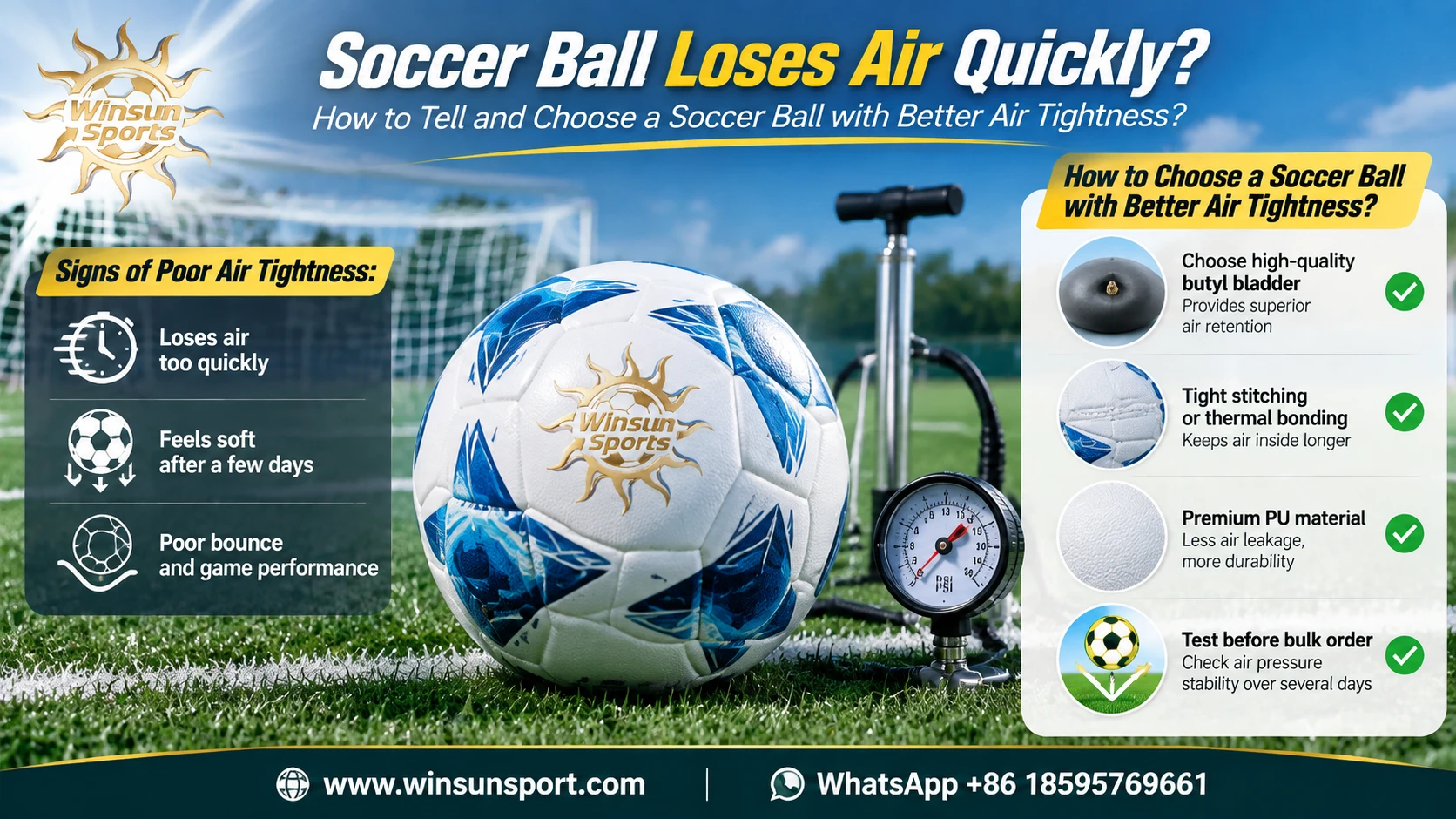
What causes poor air retention in a soccer ball?First, check these three key areas.
A soccer ball leaking air is rarely as simple as "the ball is punctured." In most cases, the problem lies in one of three areas: the bladder, the valve, or the stitching. Once you figure out which part is leaking, you can determine whether the ball can be repaired, needs to be replaced, or should be avoided when purchasing.
How bladder material affects air retention: differences between fabric bladders, rubber-fabric bladders, and PVC bladders.
The bladder is the ball's "air-retention layer," directly determining how long the air lasts. The differences among the three common bladder types essentially lie inAir tightness, elasticity, and costinvolve trade-offs:
- PVC bladder: Air tightness is acceptable, but it tends to harden at low temperatures, with a noticeable decline in elasticity.Suitable for low-frequency use, indoor or room-temperature environments, and it is the cheapest option.If you only kick it around occasionally for fun, a PVC bladder is sufficient;but if you notice the ball becomes noticeably softer after two weeks, this is often normal behavior for a PVC bladder, not a quality issue.
- Rubber-wound bladder: A layer of thread net is wound around the rubber bladder to limit ball deformation and maintain roundness.Its air tightness is better than that of PVC bladders, and the touch is more stable, making it the mainstream configuration for training and amateur matches.If you play 2-3 times a week, a rubber thread-wound bladder is the most cost-effective and stable choice.
- Thread-wound bladder: Here, "thread-wound bladder" usually refers to a higher-density winding process, combined with a high-quality rubber bladder, offering the best air tightness and rebound consistency, and it is also a common configuration for match-grade balls.Its advantage is not that it is "harder to break," but thatafter prolonged high-intensity use, the air tightness degrades more slowly.。
Judgment advice: If you are buying a ball forFor long-term, high-frequency use(school training, regular club activities each week), prioritize rubber bladders or butyl bladders. Don't choose a PVC bladder just to save a few dozen yuan—the hassle of frequent reinflation later will outweigh the price difference.
Valve and stitching craftsmanship: easily overlooked hidden causes of air leakage
If the bladder is fine but the ball still leaks air, the problem often lies in two details:
The valveis the most vulnerable physical opening on a football. A typical sign of valve leakage is: the ball goes soft a day or two after inflation, yet there is no visible damage on the surface. The check is simple—apply a layer of soapy water over the valve; if bubbles appear, the valve seal has failed.
This kind of problem usually cannot be fixed on its own; it is a manufacturing process issue. It is hard to judge from appearance when purchasing, and the only way to reduce risk is through brand quality control and after-sales support.
StitchingIt affects long-term air retention. If the stitches from machine sewing are too dense or too sparse, they will gradually wear out over long-term use, causing micro air leaks at the seams of the ball cover. Hand-stitched balls (especially competition-grade ones) have tighter stitches and maintain air retention longer, but they also cost more.
If you bought a machine-stitched ball, pay attention to whether there are frayed edges or loose threads at the stitching—these are signs of early wear.
Next step to confirm: If you already have a ball that leaks air, first use the methods above to determine whether the issue is with the valve or the stitching;If you are shopping for one, directly confirm with the Winsunsport team which bladder is used in the model you are interested in, what level of valve sealing process it uses, and whether it is machine-stitched or hand-stitched—these three answers basically determine the upper limit of the ball's air retention.
How to quickly determine the air retention of a football? 4-Step Inspection Method
Air leakage is the most common and frustrating problem in football use—having to pump it up after half an hour of play not only interrupts the rhythm but also indicates that the ball's air retention may be problematic. Instead of waiting until you get on the field to find out, it's better to spend a few minutes doing a quick check before purchase or during use. The following method requires no professional tools and can be done at home.
Step 1: Listen for air leaks—after inflating, listen for any hissing sounds.
Inflate the football to the standard pressure (usually recommended at 0.6–0.8 bar, where the ball has slight elasticity when pressed but is not soft), then let it rest for 1–2 minutes. Press your ear close to the surface of the ball, slowly rotate the football, and focus on listening around the air valve and the seams on the ball surface.
If there is a continuous "hissing" sound, it indicates an obvious air leak point. Note the distinction: a brief airflow sound at the valve right after removing the pump is normal; only a hissing sound that lasts more than 10 seconds requires attention.
Step 2: Immersion Test — Observe Bubbles with a Water Film
This is the most intuitive method for locating leaks. Prepare a basin of water (or wet the ball surface), fully submerge the inflated football in the water, or wet the ball surface with water, then slowly rotate it.
- If fine bubbles continuously emerge from a specific spot, that is the leak point, commonly found at the air valve, surface seams, or areas with damaged leather.
- If bubbles attached to the surface float up only when first entering the water, that is normal; wait 10–20 seconds and observe whether bubbles continue to appear.
Step 3: Static Comparison - Overnight Air Pressure Test
If the first two steps reveal no issues, but the ball still deflates after a few days, you can conduct a longer observation. Inflate the ball to the standard pressure, record the current pressure value (using a pump with a pressure gauge), and measure again after letting it sit for 24 hours.
- A pressure drop within 10%–15% is considered normal.
- If it drops more than 30% overnight, the airtightness is clearly insufficient. Even if you cannot find the specific leak point, this ball is not suitable for long-term use.
Step 4: Press and Feel - Rule Out Valve Seal Issues
Sometimes the ball is not leaking, but the valve itself is not sealed properly. After inflation, apply a small amount of soapy water or saliva to the valve area and observe whether bubbles form. If bubbles appear at the valve, try using a valve needle to readjust its position, or replace the valve core.
What can this 4-step inspection method help you determine?
- Before purchase: If the merchant allows, use steps 1 and 2 to quickly filter out balls that are obviously leaking air.
- During use: If the ball leaks air frequently, use step 3 to determine whether it is normal wear or a quality issue.
- It should be noted that: This method can only determine whether there is a leak and roughly where it is, but it cannot quantify the long-term airtightness differences of the inner bladder material.Different bladders (such as thread-wound, rubber thread-wound, and PVC bladders) do differ in their ability to retain air over extended use, but this is not something that can be measured in a few minutes; it takes several weeks of actual use to notice.
If you are choosing a soccer ball and have high requirements for air tightness (such as for match balls or long-term training balls), it is recommended to confirm with the Winsunsport team before purchasing what bladder and valve sealing process the configuration you select uses—these directly determine the ball's air retention performance after six months of use.
How to choose a soccer ball with good air tightness for different usage scenarios?
Choosing a soccer ball should not only focus on the single indicator of "good air tightness." Air tightness determines how long the ball can hold air without leaking, but different scenarios have completely different requirements for feel, durability, and cost. Below, we break it down by three typical usage scenarios.
Professional training and matches: prioritize thread-wound bladders for stable feel.
If you play more than twice a week or have a fixed match rhythm, the ball's air tightness directly affects training quality—repeatedly inflating the ball during a training session is very disruptive. In this scenario,Thread-wound bladderis the preferred choice.
The wound bladder is wrapped by layers of wound yarn around the inner bladder, and the airtightness is more assured due to the multi-layer structure, with a significantly slower air leakage rate than ordinary butyl bladders. More importantly, the wound bladder provides more stable rebound and a crisper touch when striking the ball, giving a more solid feel for long passes and shots. For the outer material, it is recommended to choose PU with a thickness of 1.2mm or above, balancing durability and touch.
Suitable for: players who have regular training sessions, participate in school teams, or play in amateur leagues. Not suitable forFor beginners who play occasionally and are not sensitive to touch, the cost advantage of a butyl bladder is not evident.
For long-term use in schools or clubs: rubber bladders are more wear-resistant and durable.
In scenarios like school physical education classes or club youth training, the wear on the ball mainly comes from ground friction, kicking against walls, and powerful shots, rather than air retention itself. In this case,Rubber-wound bladdera rubber bladder is more suitable than a pure butyl bladder.
While maintaining a certain level of air retention, the outer rubber of a rubber bladder is more resistant to impacts and less likely to be cut by stones or rough surfaces. For the cover material, it is recommended to choose thickened PU or PVC blended material, with a thickness of 1.4mm or more. Although the air retention of such balls is not as good as top-tier butyl bladders, they have the advantage of 'slow air leakage and resistance to damage,' making it reasonable to expect one ball to last a whole semester.
Key trade-offs: The rubber bladder offers a firmer feel underfoot, with less resilience than a butyl bladder. If the primary users are beginners, this firmness can actually help develop proper kicking technique.
Custom gifts or promotional soccer balls: balancing cost and quality
The core requirements for gift and promotional balls are 'looks decent, plays reasonably well, and cost is controllable'. In this scenario,PVC bladderorRubber-wound bladderare sufficient; the key is to spend the budget on visible aspects—surface printing and logo craftsmanship.
Recommended configuration: PVC bladder or rubber thread bladder + regular thickness PU cover. Air tightness only needs to meet daily recreational use; there is no need to pursue competition-grade standards. When customizing, prioritize confirming the printing process (screen printing or heat transfer), as this determines whether the logo will peel off after a few games.
Winsunsport supports full-dimensional customization; you can shift the cost saved on the bladder to the cover craftsmanship, making the gift ball more premium.
Suitable for: Corporate events, campus souvenirs, brand promotion. Not suitable for: If the gift ball is intended for professional players or seasoned enthusiasts, it is recommended to upgrade to a thread bladder configuration; otherwise, they will notice the difference immediately upon kicking.
What to confirm next
Before placing an order, confirm three questions with the Winsunsport team: the thickness of the cover material in millimeters, whether the bladder is a thread bladder or rubber thread bladder, and the type of custom printing process. These three parameters directly determine the ball's touch, durability, and price. Only after confirming them clearly can you place an order with greater confidence that the ball you receive matches your usage scenario.
When choosing a soccer ball with good air retention, in which situations is it not recommended to place an order directly?
A soccer ball with good air retention is indeed worth the investment, but not everyone is suitable for placing an order immediately. In the following two situations, it is recommended that you stop and think clearly first.
Unclear goals: uncertain about usage scenarios and frequency
If you haven't yet figured out who this ball is mainly for, how many times a week it will be played with, and on what type of field, then placing an order now will most likely result in buying the wrong one.
- Who will use it? Children and family play, student training, amateur enthusiasts, and professional competitions all have completely different requirements for air retention and touch.Balls for children need to be lighter and softer, while professional competitions require strict air-tightness standards and stable elasticity.
- Where will it be played? Artificial turf, natural grass, concrete, or indoor flooring?Different surfaces have vastly different requirements for leather abrasion resistance, which directly affects the thickness of leather you should choose.
- How often will it be played? Playing once a week for leisure versus high-intensity training every day poses completely different challenges to air-tightness and durability.
Next steps: First, clearly specify the usage scenario, frequency, and field type, then bring this information to confirm with the Winsunsport team. They will recommend the matching bladder and leather thickness configuration based on your actual usage conditions.
Budget not determined: need to balance cost and quality
For soccer balls with good airtightness, the cost difference mainly comes from the type of bladder (thread-wound bladder, rubber thread-wound bladder, PVC bladder) and the thickness of the leather. If you haven't determined your budget range, it's easy to encounter two situations: either you choose a product with too low a configuration to save money, and the airtightness fails to meet expectations;or you over-invest and pay for performance you won't use.
In what situations is it not worth adding complexity? If your needs are only for daily leisure or occasional entertainment, there's no need to pursue the most high-end custom solution—the airtightness of standard configurations is already sufficient. But if you're using it for professional training or matches, don't skimp on airtightness, because a leaking ball will directly affect training effectiveness and match performance.
Next steps: First set a budget range, then clarify what is the highest priority within that budget—airtightness, abrasion resistance, or feel? List your priorities, then communicate with the Winsunsport team, and they can provide the most reasonable configuration plan within your budget.
Frequently Asked Questions
Q: How do you evaluate the customization capabilities of a football OEM factory? A: Focus on three aspects: whether they offer multiple bladder and leather thickness options, whether they support LOGO and packaging customization, and whether they can recommend configurations based on your usage scenarios. Winsunsport supports full-dimensional customization and multiple process options. You can directly present your usage scenarios and let them provide a matching solution.
Q: In what situations is it not worth adding complexity? A: When your needs are only for daily leisure or occasional use, and you have no professional requirements for air tightness, choosing the standard configuration is sufficient without additional customization. Increased complexity means higher costs and communication overhead, but the improvement in user experience is limited.
Q: Is there a big difference in airtightness between thread bladders, rubber thread bladders, and PVC bladders? A: There is a difference, but the specific difference depends on your frequency and intensity of use. For high-frequency professional use, it is recommended to choose a bladder configuration with more stable airtightness;For low-frequency recreational use, the standard configuration is sufficient.
We suggest explaining your usage frequency to the Winsunsport team so they can recommend the appropriate bladder type.
Q: If the budget is limited, which should be prioritized: airtightness or durability? A: It depends on the usage scenario. If you play on concrete or rough surfaces, prioritize durability, because damage to the ball's outer cover affects its lifespan more than slow air leakage;If it is a flat field and you prioritize stable foot feel, air retention comes first.
Tell the Winsunsport team about your main field type, and they will help you balance these two indicators.
Learn more
If you are selecting a competition-grade soccer ball or have questions about the air retention of your current ball, feel free to share your usage scenarios, frequency, and field type with the Winsunsport team, and we will help you match the appropriate bladder and leather configuration.
Related products:Premium Match Grade Soccer Ball