Why can't volleyball supplier evaluation rely solely on samples and quotations?
When purchasing volleyballs, a qualified sample and a reasonable quotation often create the illusion that 'it's safe to place an order.' But the real issue is that samples represent the supplier's carefully prepared 'optimal state,' while batch delivery reflects the true level of daily production. The gap between the two can be much larger than you might imagine.
Where does the quality gap between batch procurement and individual samples come from?
The quality gap between a single sample and batch products typically stems from three aspects:
Raw material batch variations. Samples may use selected high-quality leather or rubber, but during batch production, different batches of raw materials can have subtle differences in elasticity, abrasion resistance, and feel. For volleyballs, which demand high air pressure retention and consistent feel, such differences can directly affect the user experience.
Stability of the production process. Samples are often meticulously crafted by skilled workers or dedicated teams. During mass production, variables such as production line speed, differing work habits across shifts, adhesive application amounts, and winding tension can all lead to reduced consistency in the finished products.
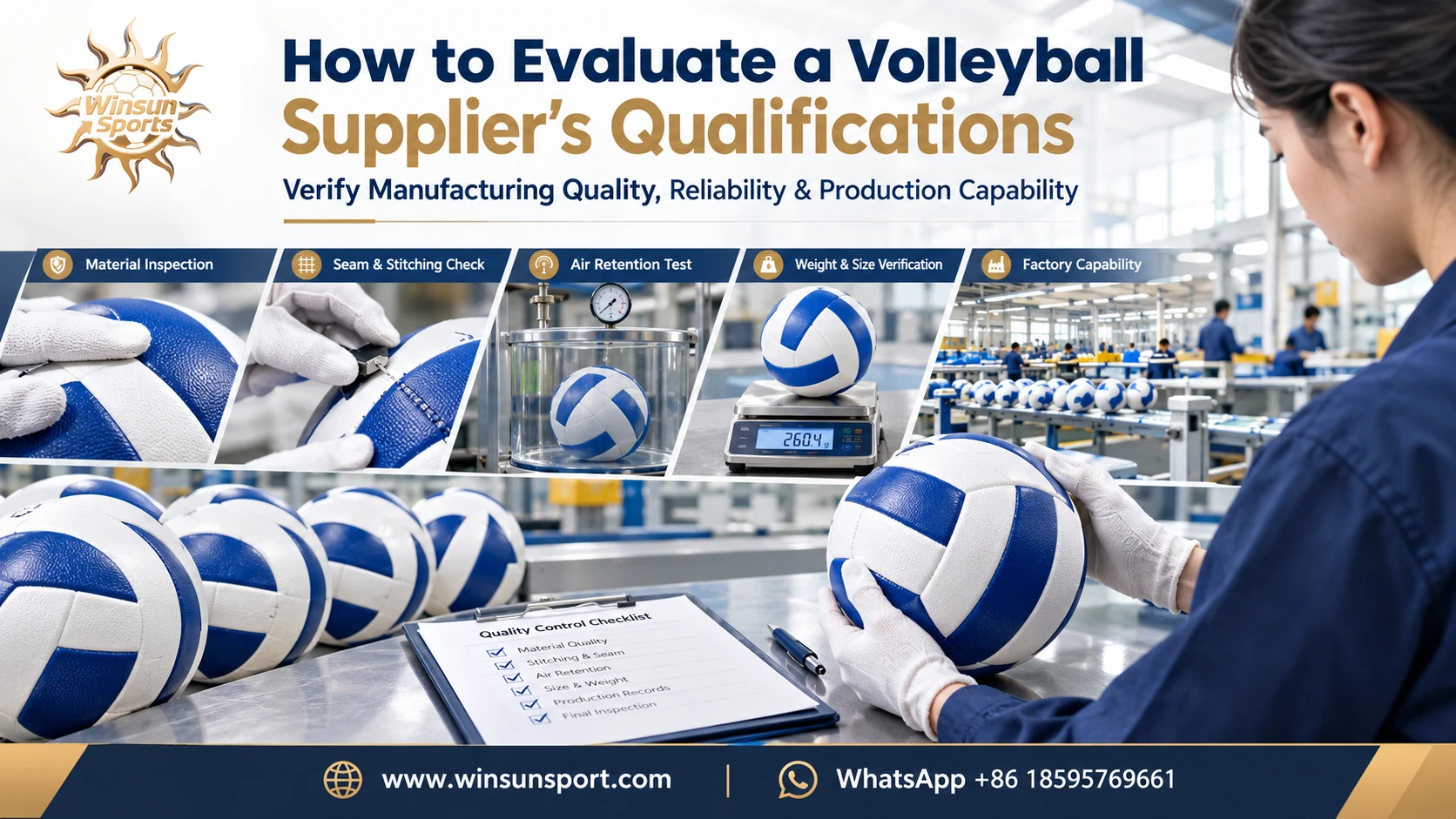
A straightforward way to check this is to randomly select 10 balls from the same batch, weigh them, measure their circumference, and test air pressure retention to see how much variation exists.
Strictness of quality control standards. Whether the supplier can apply the same inspection standards used for samples during mass production is another key variable. Some factories meticulously refine the first article sample but are more lenient in the frequency of random inspections and tolerance ranges for mass-produced items.
The three questions that supplier evaluation really needs to answer
Instead of spending energy on repeatedly comparing samples and bargaining, it is better to evaluate suppliers around the following three core questions:
First, is this supplier's production process controllable? What you need to understand is not whether the other party "can make good balls," but whether they "can consistently make good balls." Specifically, you can examine: Does the raw material have a fixed supplier and an incoming inspection process?
Are there key control points on the production line (such as vulcanization time and air pressure testing)? Is there a complete production batch record available for traceability?
Second, can this supplier's quality control system support your demand scenarios? If your volleyball is used for school physical education teaching, wear resistance and air tightness are the core indicators;if it is used for gifts or decoration, the consistency of appearance and the accuracy of custom colors may be more important. Different usage scenarios correspond to different quality control priorities. Whether the supplier's inspection process covers the indicators you care about is more valuable than its claim of "passing international standards."
Third, when problems arise, is the supplier's response mechanism reliable? If quality fluctuations are found after batch delivery, does the supplier actively investigate the causes, replenish or adjust, or does it shirk and delay? This item is difficult to fully verify before cooperation, but it can be judged through details in communication—for example, whether the other party proactively explains risk points in the production cycle, and whether it is willing to clearly specify quality standards and acceptance methods.
Samples and quotations solve the problems of "can it be made" and "how much does it cost," while supplier evaluation solves the problems of "can it be made stably and well" and "what to do if problems arise." The latter is the real risk in bulk procurement. The next section will elaborate on how to verify a supplier's true capabilities through on-site inspections and systematic questioning.
Assessing production experience: How to determine if a manufacturer truly understands volleyball manufacturing?
When sourcing custom gradient volleyballs, you are not just facing the question of 'can they make it', but rather 'does this factory truly understand volleyballs'. The difference between the two lies in: the former depends on equipment, the latter on experience. The most direct way to judge experience is to look at the depth of understanding of the product line and custom craftsmanship.
Assessing a manufacturer's professional focus through its product line
A manufacturer's product line can reveal its true positioning. You can quickly screen them with three questions:
- Does the product line cover different levels of play? If a factory only makes training balls but claims it can consistently produce match-grade balls, the technical gap in between (weight tolerance, sphericity, rebound consistency) cannot be bridged by simply adding a new production line.Conversely, manufacturers whose product lines span from children's training balls to adult match balls usually have more systematic control over the gradient differences in ball specifications.
- Is there a focus on specific sports categories? A factory that simultaneously produces volleyballs, footballs, basketballs, and rugby balls is not necessarily unprofessional, but volleyball has distinct requirements for surface material and feel compared to other balls.If a factory can clearly explain the different handling of volleyball versus football in terms of panel lamination and bladder pressure standards, it shows a genuine understanding of the sport's demands.
- What is the share of custom products in its business? If customization accounts for only a tiny share, your gradient volleyball order might just be a "side job," and both priority and quality control investment will be compromised.Factories with a high proportion of custom orders typically have production processes and quality control procedures optimized for customization needs.
Gradient customization capability is a touchstone for evaluating production experience.
Gradient color matching may seem like an aesthetic issue, but it is actually a technical one. It directly tests the manufacturer's depth of understanding of materials, processes, and quality control.
When you propose gradient customization requirements to a supplier, pay attention to how they respond to the following questions:
- What is the method for achieving the gradient transition? Is it screen printing, heat transfer, or hand spraying?Different methods affect color saturation and durability.A truly experienced manufacturer will proactively explain how process choices affect the final result, rather than just saying 'we can do it.'
- Does the gradient affect the ball's performance? This is the most critical question.Gradient printing involves ink thickness and coverage area; if not handled properly, it may alter the ball's surface friction coefficient or affect the feel.An experienced supplier will tell you how they control ink layer thickness to ensure the gradient effect does not compromise the ball's bounce and handling—rather than simply answering 'no problem.'
- To what extent can color consistency be guaranteed? Batch stability in gradient processes is more difficult to control than in single-color printing.A professional manufacturer will clearly state the tolerance range for color difference and whether they recommend a pre-production sample confirmation before mass production.
A supplier who truly understands volleyball manufacturing will proactively ask about the usage scenario when you mention gradient customization—whether it's for competition, training, or gifting—because different scenarios place completely different weights on performance versus appearance. If the other party only talks about color effects and not ball performance, it indicates they may be better at "printing things" rather than "making volleyballs."
Next step to confirm: Ask the supplier for a complete list of their product line, and inquire whether gradient customization offers sampling services, and how the sampling cycle and costs are calculated. Through the other party's familiarity with the sampling process, you can quickly determine whether they have truly made gradient volleyballs or are trying it for the first time.
Quality Inspection and Sample Services: Which Verification Actions Can Truly Reduce Procurement Risks?
When procuring customized volleyballs, what you really need to guard against is not "whether the ball will break," but two things:The product you receive is not the same as the sample, andthe gradient color shows obvious deviation during mass production.Below, we will break down the discussion into two parts: inspection nodes and sample confirmation.
Quality Inspection: Verification Nodes from Materials to Finished Products
When requesting inspection information from suppliers, don't just ask 'Is the quality good?' Instead, confirm step by step according to the production process. For custom gradient volleyballs, the following four nodes are the most critical:
- Bladder air tightness— Air leakage in volleyballs is the most common hidden defect.Require suppliers to provide air tightness test data (such as the air pressure retention rate 24 hours after inflation) rather than relying solely on verbal assurances.
- Panel Bonding and Seam Strength—Gradient volleyballs typically use a panel bonding process. Whether the color layer adheres firmly to the ball's base material directly determines if peeling or fading will occur after a few months of use.Ask suppliers to specify the adhesive type and weather resistance test conditions.
- Roundness and Weight Tolerance—Competition balls have strict requirements for roundness and weight, while training balls can be more lenient.You need to first clarify the age group and intensity of use for this batch of balls, then ask suppliers to provide the corresponding tolerance ranges.
- Abrasion Resistance of Gradient Ink/Color LayerThis is a risk point unique to custom gradient volleyballs.If the gradient effect is surface-printed, whether it fades after long-term friction or contact with hard floors requires the supplier to provide abrasion test results.
Key trade-off: The more detailed and numerous the test items, the more the supplier's cooperation reflects their professional level. If the other party can only provide photos of the finished product's appearance and cannot produce any in-process test data, that in itself is a risk signal. However, it should also be noted that different usage scenarios have different testing requirements—children's training balls do not need to be tested item by item according to competition standards, otherwise costs will rise unnecessarily.
Sample Service: A Key Step in Confirming Color Consistency and Performance
The consistency of gradient colors is the most problematic aspect in the procurement of custom gradient volleyballs. The reason is that gradient effects place extremely high demands on the stability of the printing or veneering process, and color differences may occur within the same batch or between different batches during mass production.
When confirming samples, we recommend you do three things:
First, do not confirm just one sample. Ask the supplier to provide 2-3 samples of the same gradient design and compare whether the color transitions between them are consistent. If there are already visible differences between several samples, the differences will only be greater during mass production.
Second, inspect them under both natural light and indoor light. Gradient colors can look very different under different light sources. If you only check samples under office fluorescent lighting during confirmation, and after receiving the goods you find the colors look darker or the transitions look unnatural under outdoor sunlight, it will be hard to determine who is responsible.
Third, confirm the "boundary position" of the gradient. Where on the ball the gradient starts, where it ends, and what proportion of the ball's surface the transition area occupies—these need to be fixed with specific descriptions or drawings, rather than relying on vague statements like "roughly starting from the middle." During sample confirmation, it's best to photograph and archive the confirmed gradient position and effect as a reference for subsequent batch acceptance.
Situations suitable for prototyping first: complex gradient color schemes (e.g., gradients with more than three colors), large purchase quantities, or balls used for brand gifts or competitions (where color consistency directly affects image). Situations where prototyping can be skipped: solid colors or simple two-color stitching, very small purchase quantities, and usage scenarios insensitive to color (e.g., balls for internal training). If you skip prototyping, you need to accept that there may be a certain range of color difference after batch delivery—how large this range is specifically needs to be confirmed with the Winsunsport team regarding the precision their gradient process can achieve, and then you can judge whether it falls within your acceptable range.
Next step: confirm the action: Explain your usage scenario (competition, training, or gifts), the number of gradient colors, and the order quantity to the Winsunsport team, and ask them to provide a sample plan and batch color difference control range under this scheme. Only after obtaining this information can you determine how detailed the sample confirmation process needs to be and which quality inspection checkpoints need to be covered.
Customer feedback and comprehensive judgment: Under what circumstances should you continue to evaluate, and under what circumstances should you decisively give up?
Customer feedback: How to verify the supplier's actual performance capability
To judge whether a volleyball supplier is reliable, you cannot just listen to their introduction; you must verify their actual performance capability. You can obtain real feedback through the following methods:
- Proactively request customer cases: Ask the supplier whether they have prior cooperation records for similar gradient volleyballs or sports balls, and try to contact existing customers to learn about their actual experience.
- Request traceable sample records: Ask the supplier to present color code archives or batch inspection records from previous sample approvals to verify whether their color consistency management is standardized.
- Test response speed and professionalism: Raise specific questions about volleyball size compatibility and gradient process implementation methods to observe whether they provide clear solutions or simply reply with "no problem."
Red flag signals that should be decisively abandoned: These include evading inspection and color difference issues, inconsistency between samples and batch products, slow communication responses, and refusal to provide written specification descriptions.
Comprehensive evaluation conclusion: which signals indicate that the next stage can be entered
When the following conditions are met simultaneously, you may proceed to the sampling or small-batch production stage:
- The usage scenario is clear—whether it is for teaching and training, match play, or gift customization, different scenarios impose different requirements on the ball's size and material.
- Customization expectations are quantifiable—you can specify whether the desired gradient effect is a two-color transition or a multi-color gradient, enabling the supplier to verify their process capabilities.
- Samples can be practically verified—you can physically test the elasticity, feel, and color accuracy, rather than relying solely on images or videos.
If your requirements are still changing frequently, or if the supplier shows obvious color discrepancies and delays during the sampling stage, it is advisable to stop further progress. As the next step, you can contact the Winsunsport team to confirm the customizable range for the required sizes and gradient designs, the sampling lead time, and the conditions for small-batch trial orders before making a final decision.
Frequently Asked Questions
Q: How can you determine whether a supplier's customer feedback is authentic and trustworthy? A: You can ask the supplier to provide customer cases with procurement scales similar to yours, and inquire about the volleyball models purchased by those customers, the customization details, and their repeat purchase situations. If the supplier can only provide vague positive comments without specific cooperation details, their credibility should be discounted.
Q: What should be done if color deviations occur during mass production after sample approval? A: The key is to include acceptance criteria such as color codes and gradient transition positions in the contract or order remarks before placing the order. After the bulk goods arrive, first conduct spot checks and compare them with the sealed samples. If deviations are found, preserve evidence promptly and negotiate rework or compensation solutions with the supplier.
Q: What factors usually limit small-batch trial orders for custom gradient volleyballs? A: They are mainly affected by color complexity, process difficulty, and minimum order quantity. The more gradient colors there are and the finer the transition requirements, the higher the trial order threshold may be.
It is recommended to first clarify the target quantity and effect requirements with the supplier, and then evaluate after obtaining tiered options.
Q: If the usage scenario is not yet determined, is it suitable to contact the supplier now? A: It is recommended to first clarify the core purpose and budget range before contacting. When the scenario is uncertain, the supplier will find it difficult to provide matching size and material recommendations. Early communication may easily result in generic solutions and is not conducive to subsequent price negotiations.
Learn more
If you are evaluating custom gradient volleyball suppliers, you are welcome to contact the WINSUNSPORTS team to describe your usage scenario, the number of gradient colors, and the purchase quantity. We will assist in confirming the customizable scope, sampling lead time, and batch color difference control solutions.