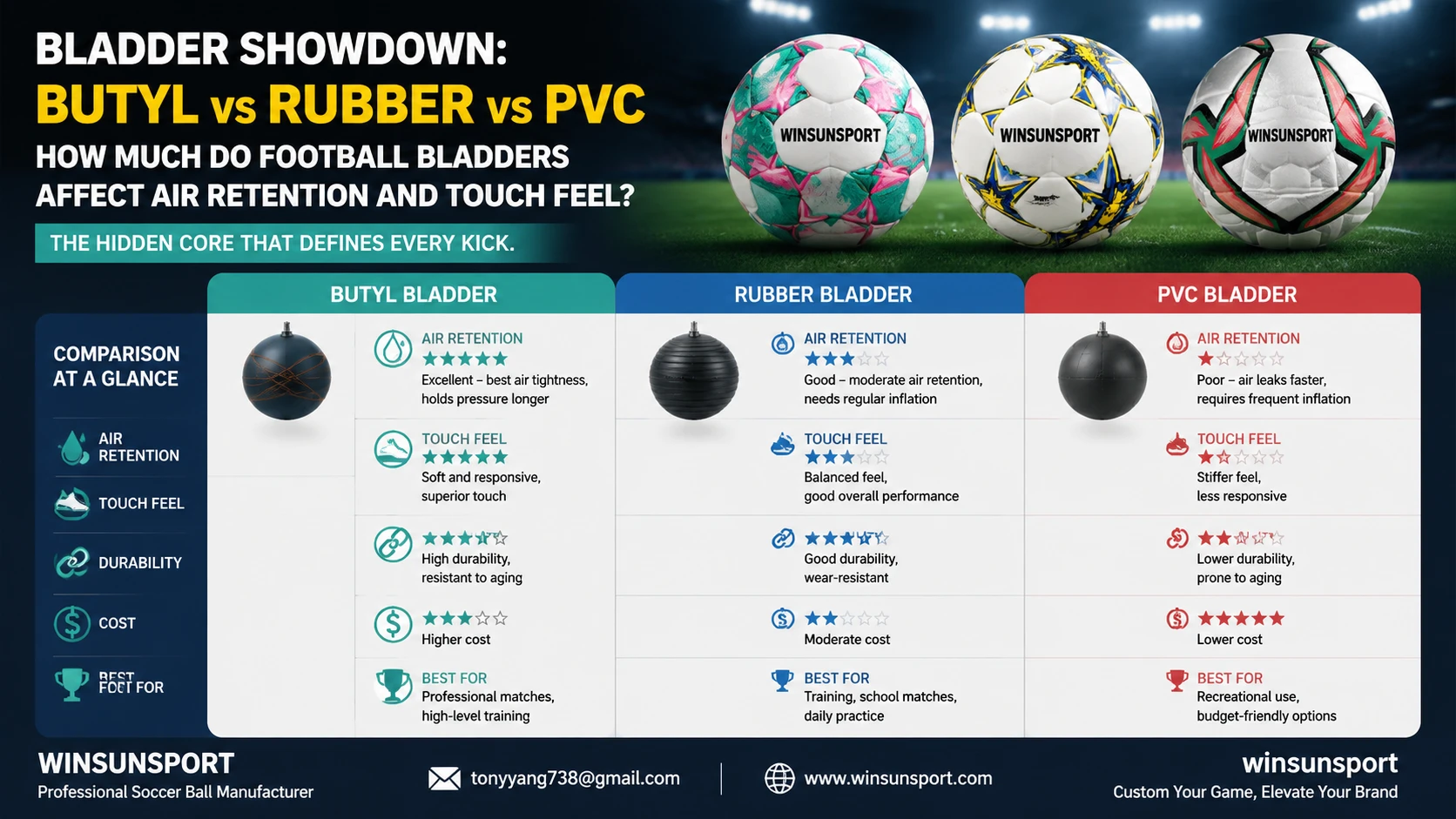
Thread bladder, rubber bladder, PVC bladder: What are the construction and working principles of these three types of football bladders?
The football bladder is the core component that determines the ball's air tightness, rebound stability, and feel. Currently, the mainstream bladders on the market are divided into three types:thread bladder、, rubber bladder, andPVC bladder. The differences in their construction directly determine your experience when playing football—whether the ball feels solid with controlled rebound, or is prone to deformation and air leakage.
Thread-wound bladder: How does multi-layer winding improve air tightness and stability?
The thread-wound bladder is not a single material, but rathera multi-layer cross-winding of high-strength nylon or polyester threads around the outer layer of a rubber or butyl rubber inner bladder,then covered with an adhesive layer. This "skeleton-like" structure serves two main purposes:
- Limiting expansion deformationThe winding threads act like a net to constrain the expansion of the inner bladder after inflation, keeping the ball's roundness and size more stable, preventing it from becoming "bulging" over time.
- Improving air tightness: Multi-layer winding increases the gas escape path. Combined with the low permeability of the butyl rubber bladder itself, a wound bladder football can usually maintain air pressure stability for a longer period (no air leakage for more than a week).
Working principle: When inflating, the bladder expands, and the winding threads are tightened to generate tension;When kicking the ball, this tension works together with the elasticity of the bladder to provide uniform and controllable rebound feedback — the feel is more "solid" and not sluggish.
Rubber Bladder vs. PVC Bladder: The Impact of One-Piece Molding Process on Performance
Both rubber bladders and PVC bladders belong toone-piece molded bladders, there is no winding layer. Their difference lies in the material itself:
| Bladder Type | Construction Method | Core Characteristics | Typical Performance |
|---|---|---|---|
| , rubber bladder | One-piece molded from natural or synthetic rubber | Good elasticity, quick rebound, and tear resistance | Feels 'bouncy', suitable for quick ball release, but air retention is average (needs inflation every 3-5 days) |
| PVC bladder | Injection molded or compression molded from PVC material | Low cost, high hardness, weak elasticity | The foot feel is relatively 'hard', rebound is sluggish, it becomes brittle at low temperatures, and air tightness is the worst (significant air loss within 1-2 days) |
Key difference: Rubber bladders rely on the elasticity of the material itself for rebound, with a simple structure but durable;PVC bladders rely entirely on material rigidity, with the lowest cost but the greatest performance sacrifice. Thread bladders achieve a more balanced performance through 'material elasticity + structural constraint'.
One-sentence summary: Thread bladders are a composite structure of 'skeleton + inner tube', pursuing stability and durability;The rubber bladder is a 'pure elastomer,' pursuing direct feedback;The PVC bladder is a 'low-cost alternative,' suitable for low-frequency recreational use.
Air tightness showdown: Is the thread bladder really better at retaining air than rubber and PVC bladders?
Many students, amateur players, and even parents often hear a saying when choosing a ball: 'The thread bladder has poorer air tightness than the rubber bladder and is prone to air leakage.' This judgment actually confuses the difference between 'air leakage' and 'slow air loss.' Within the normal usage cycle, the air tightness of the thread bladder is not only not inferior, but it is actually the most stable and best at retaining air among the three types of bladders.most stable and best at retaining air.
Where does the airtightness advantage of the thread bladder come from?
The core structure of the thread bladder ismulti-layer nylon/polyester thread winding + inner butyl rubber airtight layer. The role of the winding layer is not sealing, butconstraint—when inflated, the thread layer evenly holds the inner bladder like a net, preventing the rubber layer from overstretching and thinning due to air pressure. The thinner and more stretched the rubber layer, the easier the micropores expand, and the faster the gas leaks.
The winding layer of the thread bladder keeps the rubber layer in a "supported" state at all times, maintaining a stable thickness of the airtight layer, making it harder for gas molecules to permeate.
Actual Performance: A qualified stitched football with a bladder, after being inflated and left for a week, typically experiences a pressure drop within 5%-10%, fully meeting the needs of daily training and matches. For students and amateur enthusiasts, inflating once a week is sufficient.
How is the air retention of rubber bladders and PVC bladders?
- Rubber Bladder (Pure Rubber Inner Bladder): Air retentionMedium。Rubber itself has decent air retention, but a pure rubber bladder lacks a constraint layer. After inflation, the bladder expands uniformly, the rubber layer becomes thinner, and micropores enlarge.The new ball maintains air reasonably well for the first two weeks, but after 2-3 months of use, rubber fatigue leads to a significant decline in air tightness, and it may need to be inflated every 2-3 days.
- PVC bladder (polyvinyl chloride inner bladder): Air retentionWorst。PVC material itself has poorer gas barrier properties than butyl rubber, and PVC bladders typically lack an additional air-tight layer.After inflation, molecular permeation is faster, and it usually becomes noticeably soft within 3-5 days.PVC bladder footballs are more suitable for casual entertainment or low-frequency use, and are not suitable for training or matches that require stable air pressure.
Key trade-off: Who is suitable for which inner bladder?
| Bladder Type | Air tightness performance | Who is it for | Who is it not for |
|---|---|---|---|
| thread bladder | Excellent, inflate once a week | Students, amateur players, youth training who play more than 2 times a week | Users with extremely low budget who only play occasionally |
| , rubber bladder | Moderate, inflate every 2-3 days | Users who play 1-2 times a week and can accept frequent inflation | Users who want peace of mind and don't want to inflate frequently |
| PVC bladder | Poor, needs re-inflation every 3-5 days | Balls for children's play, low-frequency entertainment, and one-time activities | Any scenario requiring stable air pressure |
Next confirmation steps
If you are considering a stitched bladder football but are concerned about air tightness, please confirm the following two points with the Winsunsport team:
- Thickness of the butyl rubber inner layer of the stitched bladder—The thicker it is, the better the air tightness, but it will also be slightly heavier.The butyl layer thickness of a standard bladder is usually between 0.8-1.2mm, which provides sufficient air retention.
- Winding layer density—The more winding layers (commonly 8-12 layers), the better the constraint effect and the more stable the air tightness.
As long as these two parameters are within a reasonable range, the air tightness of a bladder is completely superior to rubber bladders and PVC bladders. Do not be misled by the old notion that "bladders leak air."
Feel Differences: How Do Different Bladders Affect Touch, Control, and Bounce?
The bladder is the "heart" of a soccer ball, directly determining whether your kick feels "muffled" or "crisp." Winsunsport's Professional Game Football offers three bladder options: bladder, rubber bladder, and PVC bladder. Their feel differences are very distinct, and choosing the wrong one will directly affect your ball control experience.
How Does a Bladder Provide a More Consistent Feel?
The core advantage of the wound bladder (thread-wound inner bladder) isstructural stability。 It uses nylon or polyester thread wound around a latex or butyl rubber air bladder to form a uniform tension layer. When you strike the ball, this structure can:
- Reduce inconsistent deformation: Ordinary rubber bladders experience significant local indentation during powerful kicks, causing erratic ball flight;the tension layer of the wound bladder makes deformation more uniform, providing a more "solid" touch feedback, suitable for scenarios requiring precise long passes and ball control.
- More linear elasticity: The rebound height and speed of the thread bladder remain stable under different forces, without the situation of "no response with light kicks, erratic bouncing with heavy kicks".: This is important for ball control training and short pass coordination during matches.
Who is it for: If you often play competitive matches and need to make long passes or shots, the thread bladder allows you to more clearly gauge the force needed for each touch. Not suitable: If you only occasionally play on concrete surfaces for fun, the precise structure of the thread bladder may lose consistency faster after wear on rough ground.
: What are the feel characteristics of rubber bladders and PVC bladders?
- Rubber bladder (including rubber thread bladder): The elasticity is relatively "hard", with direct feedback upon ball contact, suitable for powerful shots.However, its shape recovery speed is slower than that of a wound bladder, making the ball feel "dead" during continuous short passes.The rubber bladder is a compromise—it retains the durability of rubber while improving shape uniformity through a small amount of winding, making it suitable for training grounds and amateur matches.
- PVC Bladder: The worst elasticity, with a "wooden" touch, and almost no shape feedback when controlling the ball.The advantages are extremely low cost and good air tightness (no need for frequent inflation), but the feel is like kicking a piece of plastic, making it unsuitable for scenarios requiring delicate ball control.
Key Trade-off: If you pursuetouch clarity(Knowing where the ball will bounce), choose a butyl bladder; if you care more aboutdurability and low cost(e.g., bulk purchase of training balls for schools), a rubber or PVC bladder is more practical.
Next confirmation steps
- Confirm the usage scenario: Mainly on artificial turf or natural grass?A butyl bladder performs stably on artificial turf, but its feel degrades significantly after wear on concrete surfaces.
- Confirm budget flexibility: The thread bladder has the highest cost, followed by the rubber bladder, while the PVC bladder is the lowest.If the budget allows and you pursue control accuracy, prioritize the thread bladder;if the budget is limited and the focus is on entertainment, the rubber bladder is sufficient.
- Confirm with the Winsunsport team: Are the sizes (size 3/4/5) and materials (PU/TPU/PVC) you need compatible with the selected bladder?Different materials paired with the same bladder will result in different feels (for example, PU leather + thread bladder is softer than PVC leather + thread bladder).
How to choose a bladder based on the scenario?Recommended solutions for training, matches, and leisure
Choosing an inner bladder is not about which is "better," but about which is "more suitable for your current scenario." Below are recommendations based on three typical scenarios, along with explanations of trade-offs.
Professional Training and Matches: Why is the Butyl Bladder a Better Choice?
Target Audience: Players or teams who train more than 3 times a week, have regular match schedules, and require high air retention and consistent feel of the ball.
Recommended Option: Butyl bladder football (the butyl bladder version of Winsunsport Professional Game Football).
Reason:
- Longer-lasting air retention: The bladder is made of multiple layers of wound thread plus a rubber inner bladder, resulting in a gas leakage rate about 30%-50% slower than a pure rubber bladder.This means you don't need to re-inflate before every game; the ball maintains consistent bounce and firmness throughout a full training session or match.
- Stable touch feedback: The thread bladder provides more linear elasticity, so there's no sudden soft or hard spot when striking the ball, making passing and shooting control more predictable.
- Durable and abrasion-resistant: The thread bladder structure can withstand higher impact forces. When training on artificial turf or hard ground, the replacement frequency is significantly lower than that of rubber bladders.
Not recommended for:
- If you only play occasionally for fun, once a week, the durability advantage of a wound bladder is not needed, but the cost is higher.
- If the team has a limited budget and the ball is often lost, a rubber bladder is more cost-effective.
Youth Training and Amateur Leagues: The Balanced Approach of Rubber Bladders
Target AudienceTarget users: Children under 12, amateur league teams, school physical education balls.
Recommended OptionRecommended product: Rubber bladder football (Winsunsport rubber wound bladder or pure rubber bladder version).
Reason:
- Protecting developing feetThe elasticity of a rubber bladder is moderate, not as "overly bouncy" as a wound bladder, reducing impact on young players' ankles and knees.At the same time, the feel of a rubber bladder is softer, making it easier to control, suitable for players whose skills are still developing.
- High cost performance: The price of a rubber bladder is about 60%-70% of that of a wound bladder. In amateur leagues and training, the ball is used heavily and wears out quickly, so the replacement cost of a rubber bladder is lower.
- Key to reducing replacement frequency: If your main concern is "how to make training balls more durable", the answer ischoose a rubber wound bladder(i.e., rubber inner bladder with one layer of wound thread).It has 20%-30% better air tightness than a pure rubber bladder and is cheaper than a pure wound bladder, making it the "sweet spot" for training scenarios.
Not recommended for:
- If the team participates in official leagues with referees (e.g., city/district level matches), it is recommended to use a wound bladder, because the game pace is faster and the flight trajectory of the ball is more demanding.
- If a young player has entered professional team training (more than 5 times per week), a wound bladder can better match the training intensity.
Frequently Asked Questions
Q1: What type of bladder should be chosen for youth training footballs? A: Prioritize rubber bladders or rubber wound bladders. Rubber bladders have soft elasticity, protecting developing feet;Rubber wound bladders offer better durability, suitable for training 2-3 times per week.
It is not recommended to use pure wound bladders for children under 12, as the bounce is too high, which is not conducive to basic ball control training.
Q2: What type of bladder should be chosen for amateur league footballs? A: If the league has referees and a fixed schedule, it is recommended to choose a thread-wound bladder—the game pace is fast, and the flight trajectory of the thread-wound bladder is more stable. For community friendly matches or corporate leagues, a rubber bladder is sufficient and costs less.
Q3: How to reduce the frequency of replacing training balls? A: Two key points: first, choose a rubber thread-wound bladder (not a pure rubber bladder), which improves air tightness by about 20%-30%;second, after each training session, deflate to 0.6-0.7 atmospheres (do not fully deflate), which can extend the bladder's lifespan. If the training ground is hard court or artificial grass, prioritize styles with a leather thickness customized to 1.2mm or more.
Q4: For casual recreational play, which bladder should I choose? A: A pure rubber bladder or PVC bladder is sufficient. The PVC bladder is the cheapest, but its airtightness is poor; you need to pump it up after two or three kicks.The rubber bladder is slightly more expensive but more durable.
If you only play occasionally, a PVC bladder is sufficient.
Q5: Can a stitched football be used in official matches? A: The Winsunsport Professional Game Football is not FIFA-certified, so it is not recommended for international or national official events. However, it is fully usable for city/district-level leagues, inter-school matches, and club internal games.
If the event organizer has certification requirements, please confirm with our team in advance whether a certified version can be customized.
Learn More
Not sure which bladder suits your training or match scenario?Tell the Winsunsport team your usage frequency, field type, and budget, and we can help you match the most suitable Professional Game Football solution.
Related Products:Professional Game Football