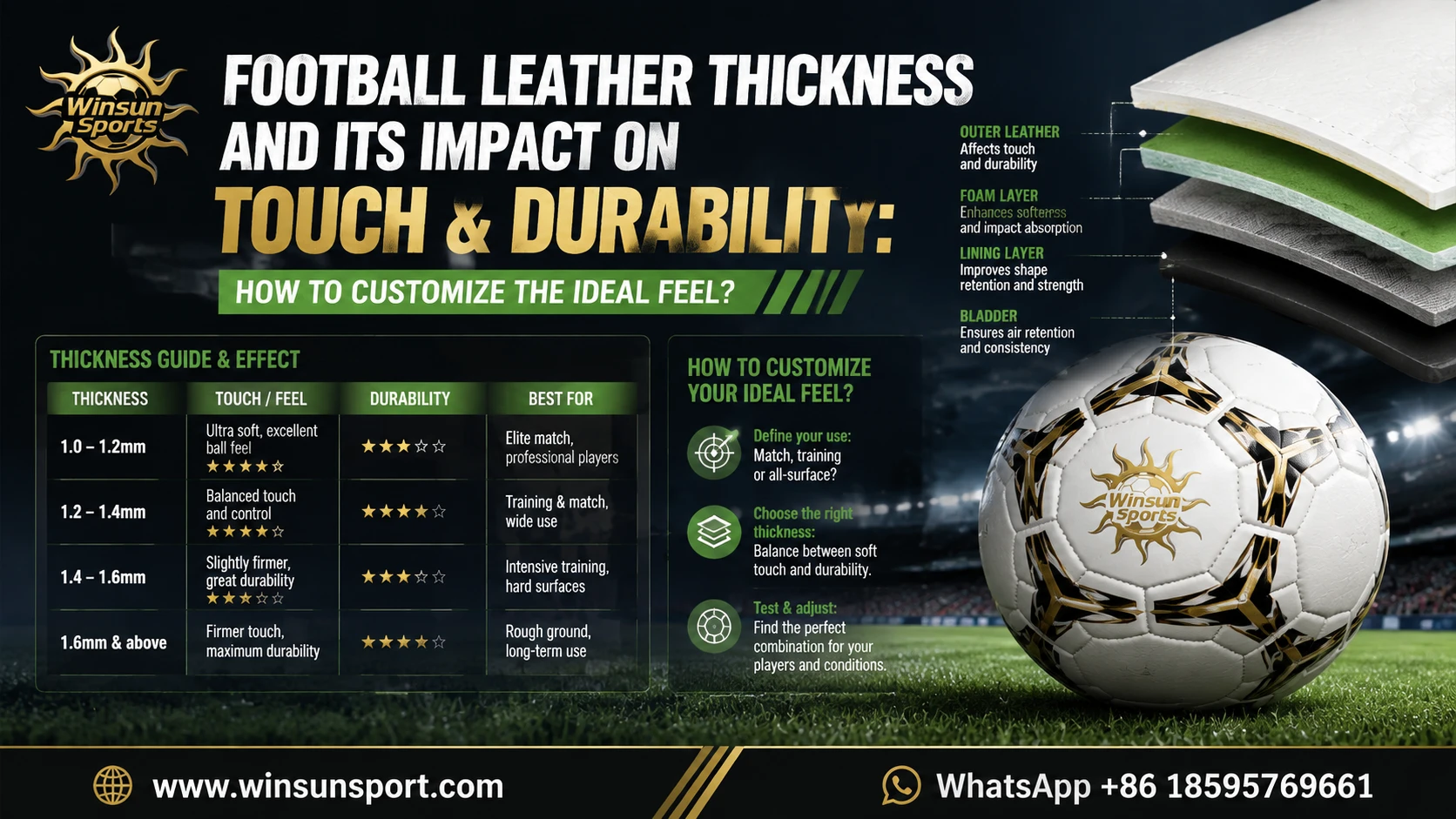
How does football leather thickness affect both touch and durability?
When choosing a football, many people assume that "thicker leather means more durable" and directly pick the thickest one. This intuition is only half right—thickness does affect durability, but its relationship with touch is more complex, and they often conflict with each other.
Leather thickness and touch: why is thicker not always better?
The touch of a football is essentially the comprehensive experience of the leather absorbing impact and providing rebound feedback at the moment the foot contacts the ball. The thicker the leather, the thicker the cushioning layer, and the more the force is dispersed upon contact, making the feedback feel more "muffled" and "dull." This is not good for players who pursue precise passing and control—you need to clearly perceive the ball's position and the point of force, and thick leather blurs these signals.
Conversely, thinner leather provides more direct contact and a crisper feel, allowing you to sense a finer contact surface when trapping and chipping the ball. But the trade-off is that thin leather requires higher manufacturing precision; if the inner bladder or stitching is not sturdy enough, thin leather is actually more prone to deformation.
So the first trade-off here is:Do you want 'clear feedback' or 'soft cushioning'? The former suits players who seek ball control, while the latter suits beginners or children—whose foot strength control is not yet refined, and thicker leather can reduce pain when kicking.
Leather Thickness and Durability: Balancing Wear Resistance and Toughness
'Thicker is more durable' largely holds true in terms of wear resistance—thicker leather can withstand more friction against the ground and shoe surface, and indeed holds up better on rough artificial turf or concrete. But durability is not only about thickness; it also depends on the material and structure of the leather itself.
An easily overlooked point: if overly thick leather is paired with a rubber bladder of average elasticity, the ball's weight distribution may become uneven over long-term use, which can actually accelerate localized wear. Moreover, thick leather becomes heavier after absorbing water on rainy days, increasing the tension on the stitching and raising the risk of seam failure.
So the second trade-off is:Durability = leather thickness × leather material × bladder elasticity × stitching craftsmanship, where thickness is just one of the multipliers. Winsunsport's Premium Match Grade Soccer Ball offers customization of leather thickness, and you can also choose between a butyl bladder, rubber bladder, and PVC bladder—different bladders have a significant impact on the ball's rebound and deformation resistance. Thickness and bladder should be selected together, rather than focusing solely on thickness.
How do you determine the right thickness for yourself?
It's more reliable to work backwards from your usage scenario than to choose based on "the thicker, the better":
| Usage Scenario | Recommended choice | Reason |
| Professional matches / High-intensity training | Thin to medium thickness | Clear ground feel, precise ball control, good field conditions, low wear pressure |
| Long-term school / club use (artificial turf, concrete) | Medium to thick | Prioritize durability, but avoid the thickest option to prevent excessive loss of ground feel |
| Children / Beginners | Thicker | Better cushioning, doesn't hurt when kicking, prioritizing building interest |
| Gifts / Display | Based on appearance and customization needs | Durability is not the core concern, thickness has little impact |
Next step to confirm action: When contacting the Winsunsport team, ask two questions directly—1) What type of field do you commonly use (natural grass, artificial turf, concrete)? 2) Are the primary users adults or children? These two answers basically lock in the thickness range.
Then ask, "With this thickness, which inner bladder gives the best rebound?" to fine-tune both feel and durability at the same time.
How should leather thickness be chosen for different usage scenarios?
There is no "best" value for leather thickness, only the "most matching" range. Thickness directly determines two things: the clarity of feel transmission and the surface's resistance to wear. These two involve a physical trade-off—thicker leather withstands kicking better, but feedback on ball contact becomes duller;thinner leather provides more direct feel, but its lifespan shortens.
So the starting point for selection is not the thickness number, but your frequency of use and field conditions.
Professional matches and training: seeking a balance between touch and elasticity
If you play matches on regulation fields or train with the ball multiple times a week, it is recommended to keep the leather thickness in the thin to medium range. The advantage of this range is that you can clearly feel the deformation of the leather surface upon contact, the contact between the instep and the ball during passing and shooting feels more "attached to the foot," and it is easier to make fine adjustments when trapping and controlling the ball. For midfielders and wingers who need to handle the ball frequently, this difference in feedback is perceptible in actual play.
But one prerequisite must be noted: thinner leather places demands on the field. If you mainly play on natural grass or high-quality artificial turf, the risk of wear is manageable;if the field is hard and the turf granules are coarse, the lifespan of thin leather will be significantly shortened. In professional scenarios, it is more recommended to use it with a thread bladder or rubber thread bladder. The airtightness and rebound consistency of the inner bladder will directly affect whether the thin leather can deliver its expected elasticity.
For long-term use in schools and clubs: prioritize wear resistance and durability.
For high-frequency use scenarios such as school physical education classes, school team daily training, and club youth training, the leather thickness should be chosen on the thicker side. The reason is simple: in these scenarios, the ball is kicked by players of different skill levels, the contact points are not fixed, and it is often used on concrete, plastic, or even dirt surfaces, so surface wear and abrasion are the main sources of loss. Thicker leather can significantly extend the replacement cycle of the ball, making the cost per use lower.
The trade-off here is: thicker leather feels more 'solid', and the rebound feedback is not as sensitive as thin leather. This has little impact on beginners, but players who have already developed a feel for the ball will need an adaptation period. If the team has both long-term trained players and beginners, a compromise can be considered—choose medium-thick leather and pair it with a rubber thread bladder to compensate for rebound response, so that both durability and feel can be balanced.
Next step to confirm actionBefore placing an order, it is recommended to clarify two pieces of information with the Winsunsport team: your main playing surface type (natural grass, artificial turf, concrete, or mixed), and the expected weekly usage time and number of players. These two conditions directly determine which end the leather thickness should lean toward, and also help the factory decide whether adjustments need to be made to the bladder configuration.
How does the Premium Match Grade Soccer Ball achieve thickness customization?
Thickness customization is not as simple as making the leather thicker or thinner; it directly affects two things you truly care about: touch (the feedback upon contact) and durability (how long it lasts without breaking). Winsunsport's Premium Match Grade Soccer Ball makes leather thickness an optional parameter, paired with different bladders, allowing you to find your own balance between 'soft and bouncy' and 'firm and stiff'.
Free combination of leather thickness and bladder type
Let's start with the conclusion: leather thickness can be customized, but it does not work independently; it must be considered together with the bladder type.
- Leather thickness: Thicker leather is generally more wear-resistant, suitable for rough fields and long-term use;Thinner leather offers more direct ball contact, suitable for players who seek precise touch feedback.However, thin leather will significantly shorten the lifespan when frequently striking hard surfaces.
- Bladder Type: Winsunsport offers three options: butyl bladder, rubber butyl bladder, and PVC bladder.Butyl bladder provides more natural elasticity and softer touch;rubber butyl bladder strikes a balance between elasticity and durability;PVC bladder offers better air retention, suitable for long periods without inflation or high-frequency use.
The key trade-off lies here:For durability, prioritize thicker leather with a rubber or PVC bladder;For a match-level touch, choose moderately thin leather with a thread-wound bladder. There is no 'thickest is best' or 'thinnest is best'—only the combination that matches your usage scenario.
From sample to mass production: how to control the customization process
Many buyers worry that OEM factories only do contract manufacturing and don't care about quality. In fact, evaluating customization capability depends on three points:
- Whether they provide a sample confirmation step: Before placing an order, make a sample first, actually kick it and feel it, to confirm whether the thickness and bladder combination meet expectations.This is the most direct way to verify.
- Can the process parameters be adjusted?Thickness customization is not simply about changing materials; it involves lamination processes, stitching tension, air-tightness treatment, and other steps.The factory needs to be able to explain the impact of each parameter adjustment on performance, rather than just saying "it can be customized."
- Production consistencyAfter the sample is satisfactory, whether mass production batches maintain the same standard depends on the factory's quality control process.It is recommended to clarify the sampling standards and acceptance methods when placing the order.
Who is suitable for thickness customization? If you have clear site conditions (such as artificial turf, concrete, natural grass) and usage frequency, customization can significantly enhance the experience. **Who is not suitable?
** If you are still unsure about your preferred foot feel, or if your usage scenarios change frequently, it is recommended to choose the standard configuration first, to avoid discovering after customization that it is not suitable.
Next step: Explain to the Winsunsport team your main playing surface, weekly usage frequency, and preferred foot feel direction (soft-bouncy or firm-stiff), and let them recommend a matching scheme for leather thickness and inner lining based on these three factors.
How to determine whether you need customized leather thickness?
Customizing leather thickness is not a mandatory question, but a trade-off. The judgment criteria are simple:Does your usage scenario have clear requirements for foot feel or durability that the standard thickness cannot meet?
Three situations suitable for custom thickness
1. Professional training or match balls
If you play football more than 3 times a week and have a clear sense of touch feedback and power transmission, custom thickness can help you find the balance point where "the ball doesn't float when dribbling and doesn't feel dull when shooting." Such users usually can tell whether they want a softer or harder ball, rather than saying "it's fine either way."
2. Specific user groups or climate conditions
Children and teenagers have weaker leg strength, and overly thick leather can increase the burden of kicking the ball;In cold regions, leather becomes harder and more brittle, and appropriate thickening can extend its lifespan. In both cases, it is worth communicating the specific usage environment with the Winsunsport team before deciding on the thickness direction.
3. Gift or commemorative purposes
If this ball is intended for display, signature collection, or occasional kicking rather than frequent play, customizing with slightly thicker leather can enhance the texture and durability in storage, with only a modest increase in cost, but the overall sense of quality will be noticeably different.
When customization is not recommended and budget boundaries
When customization is not recommended:
- For daily leisure or occasional kicking—The standard configuration is already sufficient; you likely won't notice the difference that custom thickness brings.
- If you're not sure about your preferences—If you've never seriously compared the feel of different thicknesses, play a few games with the standard version first, then decide whether to adjust.
- If your budget is very tightCustomization itself is not expensive, but if you also want to customize the logo, packaging, and inner liner at the same time, each item adds to the cost.
A balanced approach when the budget is limited:
Prioritize spending on theinner linerrather than the leather thickness. The inner liner determines airtightness and elastic recovery, while the leather thickness determines feel and durability. For most users, the upgrade in the inner liner is more noticeable.
If the budget only allows for one customization, upgrade the inner liner first and keep the leather thickness standard.
Key trade-off: Custom thickness addresses the question of "does the feel feel right," not "is the ball durable." If durability is what you're after, first confirm the leather's abrasion resistance rating itself, rather than simply making it thicker—overly thick leather can actually affect elasticity, which is counterproductive.
Next step to confirm: Tell the Winsunsport team your frequency of use, field type (artificial turf/natural grass/hard court), the age group of players, and the aspect of the standard model you're least satisfied with (too hard/too soft/not durable enough), and let them base their thickness recommendation on these conditions, rather than just quoting a number.
FAQ
Q: Will custom leather thickness affect the ball's weight? Yes. Thickening the leather usually increases the weight of the ball, which may affect its flight trajectory and elasticity.
If you are sensitive to weight, you need to confirm the matching solution for thickness and weight with the team simultaneously, rather than deciding on thickness alone.
Q: What is the approximate price difference between standard thickness and custom thickness? This depends on the leather grade you choose and the custom quantity, so there is no uniform figure. It is recommended to directly provide your budget range and usage scenario to the Winsunsport team, and they will offer a corresponding configuration solution.
Q: I am buying for a child; should I choose thinner or thicker leather? Children have weaker leg strength, and overly thick leather can increase the burden of kicking, so generally a thinner or standard thickness is recommended. However, you should also consider the field where the child plays—if they often play on rough surfaces, too thin leather will accelerate wear.
You also need to tell the team the children's ages and the main venue.
Q: Can the thickness be changed back after customization? It cannot be adjusted after production is completed. If you are unsure about your preference, it is recommended to purchase the standard version for trial first, and then customize in bulk after confirming your needs, to avoid dissatisfaction after a one-time investment.
Q: Does customized thickness significantly improve durability? It depends on the baseline you compare against. If the standard thickness already suits your usage scenario, the durability improvement from thickening is limited;But if you use it frequently and the venue surface is rough, appropriate thickening can indeed extend its lifespan.
The key is whether your playing surface is truly "severely worn," rather than simply pursuing thickness.
Learn More
If you are selecting balls for a team, school, or club, feel free to contact the Winsunsparts team. Provide your playing surface type, usage frequency, and player age group, and we will offer matching recommendations for leather thickness and bladder based on these conditions.
Related Products:Premium Match Grade Soccer Ball