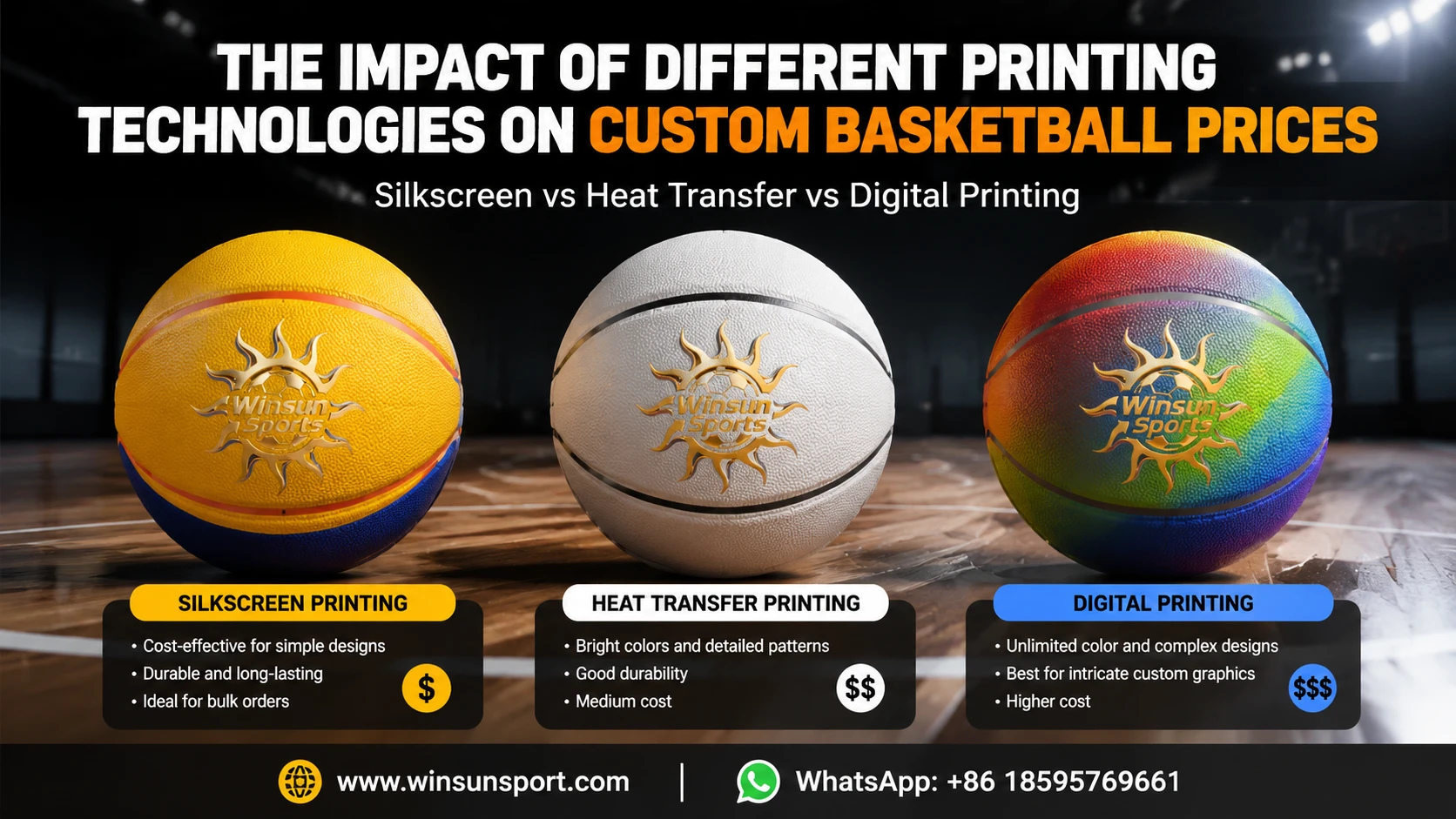
Why does the printing process become the watershed in custom basketball pricing?
For the same custom basketball, prices range from tens to hundreds of yuan, and the difference often lies not in the ball itself, but in how the pattern on the ball's surface is printed. The printing process determines three things: how detailed the pattern can be printed, how many colors can be printed, and how long it can last without peeling—these three factors directly determine the cost.
Pricing logic of three processes from a cost structure perspective
Currently, there are three mainstream printing processes for custom basketballs, and their cost logic is completely different:
Screen printing (silk screen printing): Lowest cost, suitable for large areas and simple color block logos. Its pricing logic is "charged by color"—each additional color requires an additional screen, and the more colors, the more expensive the plate fee. If you only need single-color or two-color team names or numbers, screen printing is the most economical choice.
But its shortcomings are also obvious: gradients, shadows, and photo-quality patterns are basically impossible, and details become blurry when there are too many.
Heat transfer printing: The cost is moderate, suitable for patterns of medium complexity. It first prints the pattern on a transfer film, then transfers it to the ball surface through high temperature and high pressure. Compared to screen printing, heat transfer printing can present more color layers and details, and the pattern adheres better to the ball surface, making it less prone to peeling at the edges.
The pricing logic is 'based on area and complexity' — the larger and more detailed the pattern, the higher the cost of film material and labor. If you want to print a team emblem with a gradient, heat transfer printing is the most cost-effective compromise.
Digital printing: Highest cost, but almost no design limitations. It sprays directly onto the ball's surface like a printer, allowing photos, gradients, and complex illustrations to be fully reproduced without the need for plate-making, and for small-batch customization, the unit price advantage is actually more apparent. Its cost is concentrated in equipment depreciation and ink consumables; the more complex the pattern and the richer the colors, the higher the cost.
If you need to customize a batch of collector-grade basketballs with player photos or complex artistic patterns, digital printing is one of the key options that can achieve this.
How to Match Process Selection with Usage Scenarios
The process is not just a price tag; it directly determines whether the ball can hold up in actual use:
- Training and teaching balls: With frequent hitting, friction, and sweat erosion, pattern abrasion resistance is the top priority.Silk-screen printing has a thicker ink layer and actually offers decent abrasion resistance, but only if the pattern is simple.If you need to print a complex logo on training balls, heat transfer printing is recommended, as it provides a better balance between abrasion resistance and color performance.
- Match balls: In addition to abrasion resistance, feel must also be considered.An overly thick printing layer can affect the ball's surface friction, and large silk-screen ink areas tend to become slippery when wet.For match balls, heat transfer or digital printing is recommended, as their ink layers are thinner and have less impact on the ball's surface feel.
- Gift and collectible balls: These balls are used infrequently but displayed frequently, so pattern precision and color reproduction are the key factors.The visual effect of digital printing far exceeds the other two processes. Although the unit price is higher, in gift scenarios, "how valuable it looks" matters more than "how much it costs."
Next step: confirm the requirements: Before requesting a quote from the Winsunsport team, clarify two things first—is your design solid colors or does it include gradients/photos? Are these balls for high-frequency use or mainly for display? These two answers directly determine which process you should choose and also determine the quote range.
If you are unsure which category your design falls into, send the artwork to us, and the team will directly provide matching process recommendations and corresponding quotes based on the design complexity.
Screen printing, heat transfer, digital printing: a comparison of durability and color performance among the three processes.
The printing process of custom basketballs directly determines two things: how long the ball lasts and how good the pattern looks. These two factors are precisely the key differences that matter most in the three scenarios of competition, training, and gifting. Let's start with the conclusion: **There is no universally best process, only the choice that matches your usage scenario.**
**
Screen Printing: Strong Durability, but Limited Detail
Screen printing involves scraping ink directly onto the ball surface through a mesh screen, resulting in a thicker ink layer with strong adhesion. If you ask, "Are screen-printed basketball patterns prone to peeling?" — under normal indoor and outdoor court conditions, screen printing is the most wear-resistant among the three processes, and the pattern edges are less likely to lift, making it suitable for competition and training balls that are frequently dribbled and shot.
But the trade-off is detail. Screen printing is suitable for logos or text with clear color blocks and bold lines. If the pattern has fine gradients, small text, or complex portraits, screen printing may appear stiff and even have jagged edges. **If you are printing simple logos like a team crest or school abbreviation, screen printing is the most cost-effective choice.
**
Heat transfer: smooth color transitions, suitable for medium-complexity designs
Heat transfer uses heat and pressure to transfer the design onto the ball surface, with ink penetrating the surface layer, resulting in finer color transitions than screen printing, capable of producing gradients and halftone effects. In terms of feel, heat-transferred designs are almost flush with the ball surface, with no noticeable raised texture, so your fingers won't feel any bumps when dribbling over the design area.
In terms of durability, heat transfer is not as resistant to extreme wear as screen printing—prolonged use on rough concrete courts may cause localized wear on the design, but it is perfectly adequate for regular indoor training and games. If your design includes gradients, multi-color transitions, or medium-complexity patterns, and is mainly used indoors or on smoother courts, heat transfer is a balanced compromise between durability and aesthetics.
Digital printing: most vibrant colors, but durability needs careful evaluation
Digital printing directly sprays the design onto the ball, offering the highest color saturation and fidelity among the three processes, capable of producing photo-realistic effects and extremely fine gradients. If you want to customize gift balls or commemorative balls with rich colors, complex illustrations, or portraits, digital printing offers the strongest visual impact.
However, note that the ink layer of digital printing is relatively thin, and under frequent friction and prolonged sun exposure, its durability is weaker than that of screen printing and heat transfer printing. It is more suitable for gifts, commemorative items, displays, or light training scenarios, rather than high-intensity game balls. In terms of feel, digitally printed patterns are close to the ball surface itself, with almost no tactile difference.
How to choose: Match your usage scenario accordingly
| Usage scenario | Recommended process | Core reason |
| Professional competitions, high-intensity training | Silk screen printing | Strongest wear resistance, patterns are not easy to fall off |
| Amateur leagues, daily training | Heat transfer printing | Good color performance, sufficient durability |
| Gifts, souvenirs, brand promotion | Digital printing | Brightest colors, good visual effect |
| Children's parent-child, light entertainment | Heat transfer or digital printing | Low usage intensity, with more emphasis on aesthetics |
Feel comparison: Screen-printed patterns feel slightly raised to the touch;Heat transfer and digital printing are almost flush with the ball surface. If you particularly care about the dribbling feel, heat transfer and digital printing are closer to the bare ball touch.
Next step: confirm the requirements: Provide your design artwork to the Winsunsport team (solid colors or gradients? Any small text? ), the primary playing surface (indoor or outdoor concrete), and the expected frequency of use. Based on the surface material of the Custom Match Grade Basketball, they will help you determine which process can achieve your expected durability and visual effect in actual use.
Pattern complexity and budget: When to choose screen printing, heat transfer, or digital printing?
Choosing the process based on pattern complexity: From single-color logos to full-color gradients
Pattern complexity is the first dividing line in selecting a process. The judging criterion is simple: the fewer the colors and the simpler the details, the more suitable screen printing is;The more colors and the more complex the gradients, the more you need heat transfer or digital printing.
Screen printing: Suitable for single-color or two-color logos. If your logo has only 1-2 colors, with clear edges and no gradients, screen printing is the most cost-effective choice. It has saturated colors and good abrasion resistance, making it suitable for mass production.
However, each additional color requires an extra screen, and when the number of colors exceeds 3-4, costs rise rapidly, and gradient effects are basically impossible to achieve.
Heat transfer printing: suitable for medium-complexity patterns with color transitions. When the pattern has 3-5 colors or simple gradient color blocks, heat transfer printing is a more stable choice. It first prints the pattern onto a transfer film, then applies it to the basketball surface through heat pressing, without the need for color-by-color screen making, so the unit price increase for multi-color patterns is smaller than with screen printing.
The downside is that the pattern edges have a slight raised feel, and there is a possibility of peeling after long-term intense friction.
Digital printing: suitable for full-color gradients and patterns with rich detail. If the pattern has continuous gradients, light and shadow transitions, or even photos or complex illustrations, only digital printing can reproduce them. It has no limit on the number of colors, but the unit cost is significantly higher than the previous two.
Choose the process based on budget and quantity: from large-batch gifts to small-batch customization
| Your situation | Recommended process | Reason |
| Single-color logo, customizing more than 500 pieces | Silk screen printing | After amortizing the plate-making fee, the unit price is the lowest and it is wear-resistant |
| 3-5 color patterns, customizing 100-500 pieces | Heat transfer printing | Avoids multi-color plate-making fees, offering the best overall cost |
| Full-color gradient, custom 50-200 pieces | Heat transfer or digital printing | When quantity is small, the unit prices of the two are close; it depends on precision requirements. |
| Photo-quality patterns, any quantity | Digital printing | Only it can reproduce them; accept a higher unit price. |
Answering the three specific questions you care about:
- The logo is very simple; which option is the most cost-effective? Screen printing. The premise is that there are no more than 2-3 colors and no gradients, and the quantity is preferably over 200 pieces; otherwise, the plate-making cost spread over each ball is not worthwhile.
- The pattern has a gradient. Can screen printing do it? Basically, it can't be done. Gradients in screen printing need to be simulated with halftone dots, which looks stiff and costs more. For gradient patterns, consider heat transfer or digital printing directly.
- I only want to customize 50 basketballs. Which method is more cost-effective? When the pattern is single-color, the unit price difference between screen printing and heat transfer is not significant, and heat transfer is more convenient.For multi-color or gradient patterns, choose heat transfer directly, unless you need photo-quality effects, then consider digital printing.
Key trade-offs: The smaller the quantity, the more you should choose a process with a low plate-making threshold (heat transfer is preferred).The larger the quantity, the more obvious the unit price advantage of screen printing. When a design falls into a gray area like "3-color gradient," send the artwork to the Winsunsport team, and they will provide a more precise quote comparison based on the actual number of colors and printing area.
Common Misconceptions and Cost Control Tips for Custom Basketball Printing Processes
Misconception 1: Believing that a more expensive printing process is always better
Many buyers, when customizing basketballs, instinctively choose the most detailed and "premium" printing method, thinking that this justifies the cost. However, the choice of printing process should be driven by the intended use case, not by the budget ceiling.
- Silk screen printing: Low cost, thick ink layer, good abrasion resistance, suitable for large color blocks and simple logos.The downside is weak performance in gradients and fine details.
- Heat transfer printing: It can present rich colors and gradient effects, with high pattern precision, suitable for complex designs.However, the coating layer may peel off under long-term high-intensity use, making it more suitable for gifts and training balls rather than professional game balls.
- Digital printing: No plate making is required, suitable for small batches and multi-style customization, but the unit cost is higher, and color adhesion and wear resistance are usually not as good as screen printing.
Judgment logic: If the basketball is for amateur leagues or daily training, screen printing is often the most durable choice;If it is for gifts or collection purposes, the visual effect of heat transfer is more worth investing in. Don't choose a process that doesn't match the intensity of use just to 'look high-end'—a worn pattern is uglier than a simple one.
Misconception 2: Ignoring the relationship between plate fees and minimum order quantity
A quote for custom basketballs typically consists of two parts:plate fee (tooling/plate-making fee)andper-ball printing fee. The plate fee is a one-time investment, and when spread across each ball, the total cost varies with quantity.
| Quantity | Plate fee amortization | Actual impact |
| Small quantities (e.g., within 50 pieces) | Plate fees account for a high proportion, significantly driving up the cost per ball | Digital printing may be more cost-effective because it waives plate fees |
| Medium batches (e.g., 200-500 pieces) | Plate fees are effectively amortized, and the unit price advantage of screen printing or heat transfer becomes apparent | Screen printing is usually the most economical |
| Large batches (over 1,000 pieces) | The impact of plate fees is negligible, and the main comparison is on unit printing prices | There is room for price negotiation, but also confirm whether materials will be changed to reduce quality. |
Key reminder: When inquiring, do not just ask "how much is one ball?" Instead, ask separately aboutthe mold fee, the minimum order quantity, and how the unit price changes once the minimum order quantity is exceeded.Some suppliers hide the mold fee in a high unit price, claiming "no mold fee" on the surface, but the actual unit price is not cheap.
What costs should be confirmed with suppliers when making an inquiry?
To avoid budget overruns, it is recommended to confirm the following four items directly with the Winsunsport team in your inquiry:
- Whether the mold fee includes design modifications— Whether additional fees will be charged if the design draft requires multiple revisions.
- Price tiers corresponding to the minimum order quantity— The unit price differences across various quantity brackets, rather than just a single quote.
- Sample fees and confirmation process— Whether sampling is mandatory before mass production, and whether sample fees can be deducted from the bulk order.
- Whether logistics and tariffs are included in the quote— Especially for overseas orders, shipping and customs clearance costs can account for 10%-20% of the total cost, so be sure to list them separately in the quotation.
How to avoid unnecessary expenses
- First determine the purpose, then choose the process: For competition balls, prioritize wear resistance; for gift balls, prioritize visual appeal. Do not mix the two.
- Reserve 10%-15% of the budget for sample confirmation: Sampling can reveal issues such as pattern scaling and color deviation, which is much cheaper than reworking a bulk order.
- Avoid frequent design changes: Every modification may involve new plate fees or sampling fees, so try to confirm internally before finalizing the design.
- If the budget is very tight, prioritize cutting process complexity over materials: The leather and structure of a basketball determine its feel and durability; printing is only a surface layer.Saving on printing costs does not affect the playing experience, but saving on materials directly reduces quality.
Frequently Asked Questions
Q: What are the main "hidden costs" of custom basketballs? A: Mainly plate fees, sample fees, design modification fees, shipping costs, and possible customs duties. Among these, plate fees and shipping costs are the most easily overlooked. When requesting a quote, be sure to ask the supplier to list them separately.
Q: With a limited budget, which should I choose between screen printing and heat transfer? A: If the design is a simple logo or text, choose screen printing—it is durable and has a lower unit price. If the design has gradients or fine details, choose heat transfer, but be prepared for the possibility that the design may wear off after long-term, high-intensity use.
Q: How can I control costs when the custom order quantity is very small (e.g., 50 pieces)? A: First, ask the supplier whether digital printing is available (no plate fees), or inquire about shared template options. If screen printing is necessary, confirm the plate fee amount and calculate whether the cost allocated to each ball is acceptable.
Q: How can I determine whether a supplier's quotation is reasonable? A: Ask the supplier to break down the quote into four items: plate fee, printing fee, ball cost, and logistics fee, then compare the total price changes across different quantity tiers. If the supplier only provides a vague "flat price," it is difficult to judge its reasonableness; we recommend directly requesting an itemized quotation from the Winsunsport team.
Learn More
If you are planning a custom basketball project, whether for game balls, training balls, or gift and souvenir balls, feel free to send your design drafts and usage scenarios to the Winsunsport team. We will provide matching process recommendations and itemized quotations based on your design complexity, quantity, and usage intensity.
Related Products:Custom Match Grade Basketball