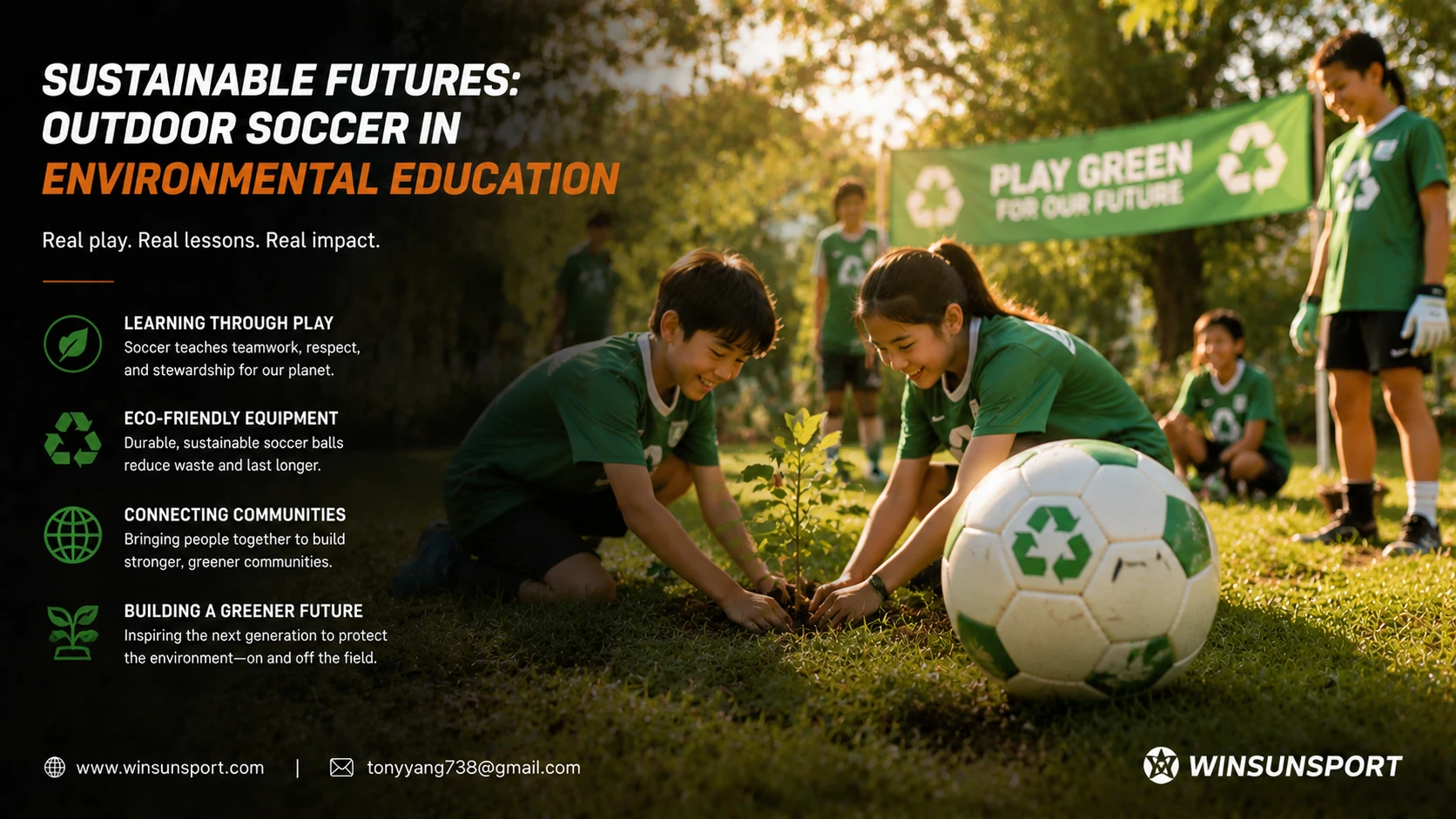
Why is durability and ruggedness considered a practical foundation for environmental education?
In environmental education, a genuinely durable piece of equipment is itself a vivid teaching tool. The 'durable and rugged' characteristics of the Winsunsport Daily Use Outdoor Football allow it to directly serve long-term teaching, transforming the concept of resource conservation into an observable, tangible case study.
How Product Features Translate into Educational Value
Educational settings often require equipment to withstand high-frequency use. The durable design of this football directly reduces the replacement frequency within the same teaching cycle. This means that to achieve the same training objectives, the resource inputs required for raw materials, production energy consumption, and transportation are correspondingly reduced.
An educator can point to a football that has been used for a long time but remains intact and explain to students: this itself is a continuous, tangible practice of resource conservation.
The Sustainable Logic Behind Durability Design
Choosing a durable soccer ball embodies the sustainable approach of reducing waste by extending the product's lifecycle. Compared to frequently replaced consumables, a long-lasting soccer ball avoids multiple cycles of production and disposal throughout its entire use period. This provides an excellent entry point for discussing the environmental topic of the 'full lifecycle of a soccer ball,' guiding students to think about the practical significance of product durability in reducing waste.
Of course, the environmental benefits of this practice are directly related to the longevity and intensity of use in the teaching scenario.
Which environmental education themes can be vividly presented through soccer activities?
Based on the characteristics of the Daily Use Outdoor Football—its durability, comfortable feel, and moderate elasticity—the following cases demonstrate how to concretely integrate environmental themes into soccer curriculum and activity design, addressing the question of 'how to do it specifically.'
From Material Circulation to Team Responsibility: Curriculum Design Cases
A 90-minute eco-friendly football class can be centered around the 'equipment lifecycle'.
- Explain material circulation: Start with the football under the students' feet.Show its composition, such as synthetic leather and inner bladder, explain the path of materials from raw materials to finished products, and then to disposal after use, intuitively introducing the concept of 'circular economy'.
- Build team responsibility: Link environmental responsibility to pitch maintenance.Through a 'responsibility circle' activity, have students jointly inspect the pitch, pick up debris, and wipe the football, understanding that maintaining the sports environment is also part of team responsibility.This segment can naturally connect to the football's own characteristic of being 'sturdily made' for easy cleaning and maintenance.
Plan a football day event centered on sustainable development.
Design a half-day 'Sustainable Football Carnival' that integrates sports, education, and community engagement.
- Core ActivitiesInclude skill challenges, environmental knowledge quizzes, and an 'Old Ball Recycling Station'.Participants can use old footballs to enter a lucky draw or exchange for small gifts.
- Combining Experience and EducationUtilize the football's characteristics of 'comfortable foot feel' and 'moderate elasticity' to ensure a positive experience in the challenge events.Incorporate explanations of knowledge points such as water conservation (bringing your own water bottle) and solid waste sorting into the event.
- Integration and ExtensionThis activity plan can be easily integrated with a community's existing football projects or be part of a promotional campaign, for example, by inviting potential customers to participate and experience the product while conveying the brand philosophy.
These cases can be adjusted based on actual circumstances, prioritizing 1-2 easy-to-implement points for a trial.
How to integrate eco-friendly football activities into existing educational or community systems?
The key to integrating eco-friendly football activities into existing systems lies in 'embedding' rather than 'adding new'. Below are specific strategies for integration and key points for gaining support.
Integration Strategies with School-based Curricula or Club Activities
The core is to find natural connection points between existing activities and the eco-friendly theme, avoiding additional burdens.
- As an extension of existing curriculum: There is no need to open a separate course. A brief discussion on the sustainability of sports equipment can be introduced at the end of a physical education class or club activity. The product featuresfull-dimensional customizationcapabilities, allowing for the printing of environmental slogans, making it a visual teaching aid. Itswear-resistant and durableproperties perfectly support the viewpoint that extending the lifespan of items is environmentally friendly.
- Themed Upgrade of Existing Activities: Designate a regular football training session or match as a "Green Challenge". The core training content remains unchanged, with only the addition of eco-friendly interactions in the rules (e.g., discussing how to keep the field clean). ProductSolid Workmanship, which ensures a basic experience and allows the focus of the activity to remain on the theme itself.
Key Points for Assessment and Gaining Internal Institutional Support
When presenting the value to management or funders, the focus should be on measurable benefits and actionable plans.
- Emphasizing the Achievement of Multiple Objectives: Clearly stating that the activity can simultaneously serve multiple goals such as physical education, environmental education, and enriching institutional culture.The customizable nature of the product facilitates the creation of event souvenirs bearing the institution's logo, making the outcomes visible and easy to promote and summarize.
- Demonstrating Low Risk and High Cost-Effectiveness: Explaining that the activity primarily utilizes existing venues and time, requiring no large additional budget.Depending on the usage scenario and budget, differentinner bladder types (such as thread bladder, PVC bladder) can be chosen to balance cost and durability, avoiding the hidden costs of frequent replacements.
Suggested Next Steps: Before developing a full plan, you can start with a small-scale thematic workshop as a pilot. Use the activity records and participant feedback as initial material to demonstrate value to internal decision-makers.
Which organizations is this plan suitable for?Where are the budget and risk boundaries?
Implementing the plan of 'using outdoor football for environmental education' is not suitable for all organizations. It is suitable for institutions with clear integration goals and follow-up usage plans, but not for attempts that remain at a conceptual level or have vague needs.
Recommended and Not Recommended Application Scenarios
The most suitable organizations have the following characteristics:
- Have a clear integrated teaching or activity plan: For example, a school plans to offer 'environmental-themed physical education classes,' using soccer as a teaching vehicle to incorporate knowledge points such as material science (e.g., recycled materials) and carbon footprint into the curriculum;Or a community center plans to host an 'environmental carnival,' customizing soccer balls as environmental-themed activity props and souvenirs.
- Clear target users and scenarios: Clearly know which age group (e.g., lower elementary school) and what intensity (daily teaching training vs. one-time event souvenir) the soccer balls will be used for.This directly determines the specific requirements for the soccer ball's size, weight, and durability.
- Have clear expectations for subsequent maintenance or utilization: For example, the soccer ball may be used long-term as a class asset after the event, or repeatedly appear as a fixed prop for environmental education courses.This requires the product itself to have sufficient durability (e.g., 'wear-resistant and tough').
The following situations require careful consideration or a simpler approach:
- The goal is merely to 'add an environmental gimmick': If there are no subsequent teaching activities or promotional plans to carry this concept, simply purchasing a batch of custom soccer balls may not achieve true environmental education effects, and the value of the investment is limited.
- The requirements are still frequently changing: If the event theme, target group, and final use (whether for intense competition or static display) are all not yet determined, investing in customized production at this time may face high risks of changes and cost waste.
Cost Considerations and Next Steps
The main cost of this project is not the unit price of the football itself, butthe comprehensive costs incurred bycustomization services and small-batch production. Core costs typically include:
- Design and mold-making fees: This is the starting point for customization.If a completely new pattern, color, or special process (such as embossing with specific eco-friendly materials) is used, it may involve design fees and mold development costs.
- Product manufacturing costs: The cost per soccer ball will vary depending on the thickness of the leather you choose, the type of bladder (such as a stitched bladder, rubber stitched bladder, or PVC bladder), and the complexity of the customization process.
- Communication and Logistics Costs: Ensuring that all details (dimensions, patterns, materials) are consistent with expectations from the design draft to the physical sample and finally to the final delivery requires an investment of communication time.
Main Riskslie in: Insufficient confirmation of key parameters such as design, dimensions, and materials in the early stages may lead to the final product not matching the actual needs of the educational activity scenario. For example, selecting a soccer ball that is too heavy or too hard for a children's activity.
Suggested Next Steps: Before contacting us for a consultation, please try to clarify the following questions first. This will greatly improve communication efficiency and help you obtain a more precise plan and quotation:
- Core Objective Confirmation: What is the primary role of this batch of soccer balls in the environmental education project: as a teaching tool, an event souvenir, or a promotional medium?
- Target Users and Scenarios: What are the age and athletic background of the primary users?Will the soccer balls be used for organized training or interactive games in large-scale events?
- Customization Intentions: Are there any preliminary ideas for patterns, slogans, or environmental theme designs?Are there specific requirements for the size and weight of the soccer balls?
With these answers for consultation, we can jointly assess how well your project requirements match our customization solutions, and clarify the specific value corresponding to each cost.
Frequently Asked Questions
Q1: If I have a limited budget but need a customized eco-themed product, what feasible options are available? A1: You can communicate with us to explore the possibility of 'light customization' based on our existing soccer ball models. For example, using a standard soccer ball and only customizing it with specific eco-slogans, event logos, or thematic designs.
This typically significantly reduces design and mold costs while meeting the core needs of brand promotion and thematic expression.
Q2: We plan to use this soccer ball long-term in our school's environmental education courses. How can we evaluate whether its durability is sufficient? A2: You can inform us of the frequency and intensity of use in your courses, such as 'two physical education classes per week, lasting for one year'. Based on this usage scenario, we will recommend the most suitable leather thickness and bladder combination (such as materials with better wear resistance), and provide relevant process explanations to help you determine if it meets your expectations for long-term use.
Q3: What is the typical production lead time for custom soccer balls? Will it affect my event schedule? A3: The production lead time depends on the complexity of the design and the order quantity.
Standard pattern printing has a shorter production cycle, while customization involving special materials or complex processes requires more time. We recommend that you allow sufficient time buffer in your project plan for custom production and logistics (typically at least 4-6 weeks are suggested), and confirm the specific delivery schedule with us before placing an order.
Learn More
Integrating environmental concepts into lively and fun soccer activities is an effective attempt at educational innovation.If you have an initial plan for your organization's needs, please feel free to contact us at any time.Provide your specific use case, target audience, and customization intentions, and we will provide you with a tailored product solution and cost assessment.
Related Products:Daily Use Outdoor Football