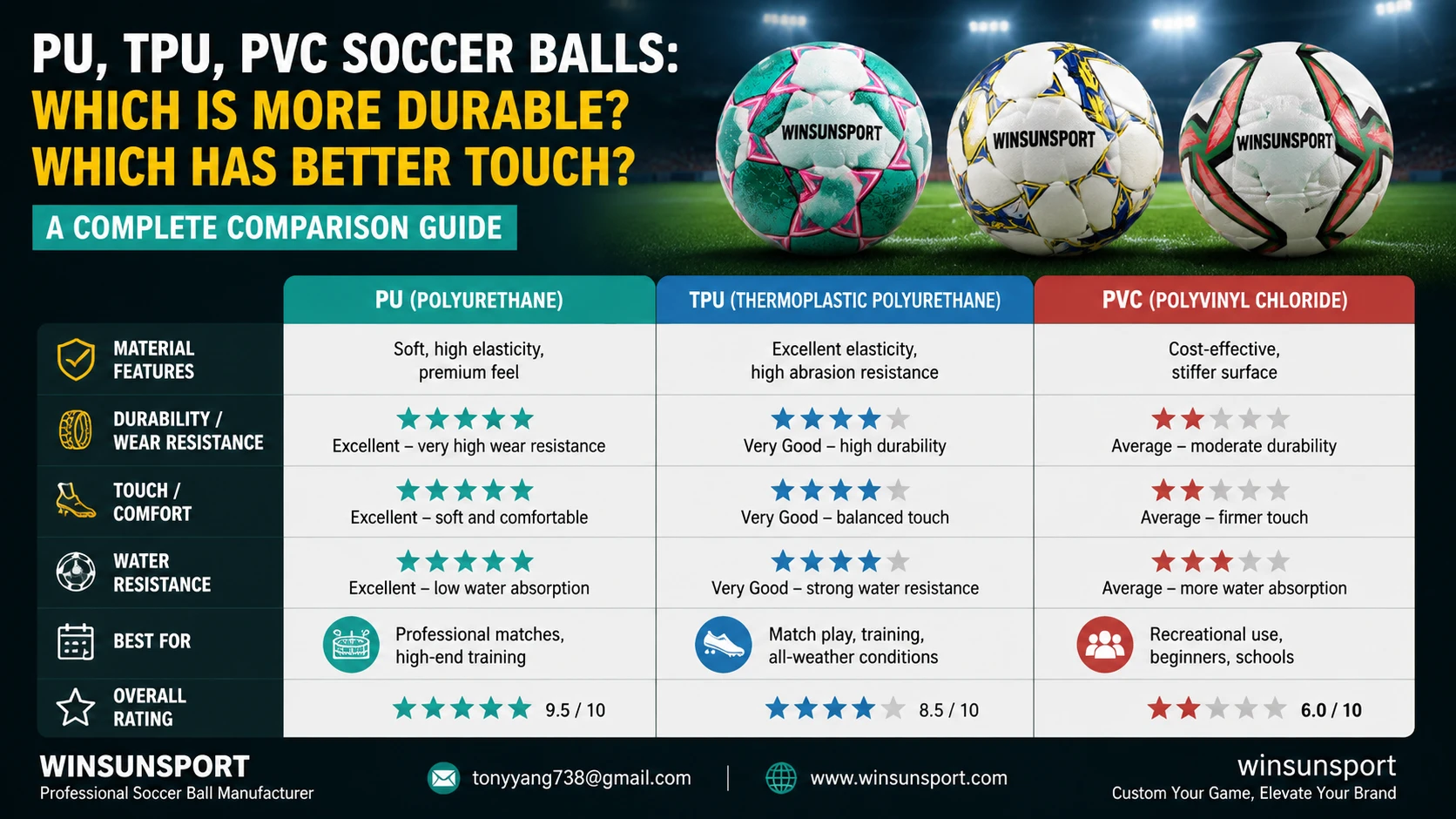
PU, TPU, and PVC: Three Types of Soccer Ball Materials – What Are They?
When choosing a soccer ball, the material is a core factor affecting feel, durability, and price. The three most common soccer ball materials on the market are PU, TPU, and PVC, each with its own strengths for different scenarios. Here's a quick breakdown of the differences to help you decide which one suits you best.
PU Soccer Balls: Wear-Resistant and Durable, Ideal for Training
PU (polyurethane) is a synthetic leather with a soft and flexible surface. Its advantages arewear resistance and tear resistanceEven when repeatedly kicked on rough artificial turf or concrete, it is not prone to peeling or deforming. At the same time, PU has moderate elasticity, providing a feel that is neither too hard nor too soft when controlling the ball, making it suitable for daily training and amateur matches.
If you mainly play on outdoor fields and with high frequency, PU material is a cost-effective choice—it is more durable than TPU and offers better touch than PVC.
Suitable for: Students, amateur teams, and users who need a "durable" training ball. Not suitable for: Competitive players seeking ultimate touch (PU is relatively hard and less refined than TPU).
TPU Soccer Ball: Comfortable Touch, Match Weapon
TPU (Thermoplastic Polyurethane) is an upgraded version of PU, lighter, softer, and with a finer surface texture. Its core advantage iscomfortable foot feel—clear feedback when touching the ball, uniform elasticity when shooting with power, suitable for match scenarios requiring precise ball control. TPU's abrasion resistance is slightly lower than PU, but much stronger than PVC, performing best on natural grass or high-quality artificial turf.
If you participate in official matches or have requirements for ball control feel, TPU is a more professional choice.
Suitable for: Match players, youth training (protecting foot development), enthusiasts who pursue foot feel. Not suitable for: Frequent use on rough concrete surfaces (TPU surface is prone to wear).
PVC Soccer Ball: Is It Worth Buying?
PVC (polyvinyl chloride) is a plastic material, the cheapest, but hard, slippery, and poor in elasticity. Its advantages areCheap, waterproof, suitable for toddlers or temporary use on rainy days. But PVC balls feel stiff when kicked, are prone to slipping, and become brittle and crack in low temperatures.
Unless the budget is extremely low or only for recreational purposes, it is not recommended—a good PU or TPU ball lasts longer, and the overall cost is actually lower.
One-sentence summary:
- Training, outdoor abrasion resistance → Choose PU
- Competition, foot feel priority → Choose TPU
- Occasional play, extremely low budget → Choose PVC (but PU entry-level is recommended first)
Next step: confirm action: If you are unsure which material suits your field and frequency, contact our team with your usage scenario (e.g., "training on artificial grass 3 times a week"), and we will help you match the most suitable material and specifications.
Abrasion resistance comparison: In training scenarios, which material is more durable?
In training scenarios, the abrasion resistance of a football directly affects replacement frequency and long-term costs. For high-intensity training and youth development, material selection needs to be based on specific usage intensity.
PU material: Wear-resistant and durable, reducing replacement frequency
PU (polyurethane) has a dense, tear-resistant surface that is less prone to pilling or cracking under frequent friction. For several hours of high-intensity training daily, PU footballs typically maintain good condition for longer, reducing replacement frequency. Its cost is slightly higher than other materials, but when spread over the usage cycle, it may be more cost-effective.
Suitable for scenarios such as daily training in professional clubs and high-frequency use by school football teams.
How do TPU and PVC compare in terms of wear resistance?
- TPU (Thermoplastic Polyurethane): Wear resistance is close to PU, but it is lighter and softer.On artificial grass or hard courts, the wear rate is slightly faster than PU, and cracks may first appear at the seams.Suitable for moderate-intensity training (e.g., 3-4 times per week). If used for daily high-intensity training, the replacement cycle will be shortened.
- PVC (Polyvinyl Chloride): Average wear resistance. The surface is hard and has poor elasticity. It is prone to cracking and peeling on rough ground or in low temperatures. Only suitable for occasional leisure use or low-intensity youth beginner training (1-2 times per week); under high-intensity scenarios, replacement frequency is higher.
Suggestions to reduce replacement frequency: Choose material based on training intensity — PU for high intensity, TPU for medium intensity, PVC for low intensity or limited budget;Avoid prolonged use on gravel, concrete, or in rain/snow to extend the lifespan of all materials.
Feel and bounce comparison: In match scenarios, which material offers better ball control?
During a match, every touch directly affects passing accuracy and shot quality. For amateur leagues or club brand promotion scenarios, you don't need FIFA-certified bounce consistency, but you need the material to strike a balance between feel and bounce — too hard and it dampens power, too soft and it loses energy. Below is a direct comparison of the actual performance of PU, TPU, and PVC materials in matches.
TPU material: comfortable touch, moderate elasticity, suitable for match ball control
TPU (Thermoplastic Polyurethane) is currently the mainstream choice for amateur match balls. Its feel lies between the softness of PU and the hardness of PVC, with a certain surface friction that prevents the ball from "slipping away" when stopping, yet provides sufficient rebound when passing. In terms of elasticity, TPU offers linear rebound height and speed, and does not become significantly harder due to humidity or low temperatures, which is practical for amateur league grass or artificial turf fields.
Suitable match scenarios: If you need a ball that balances control stability and durability, TPU is the safest choice. It will not absorb excessive water and become heavy on wet fields like PU, nor turn into a "stone" in cold weather like PVC.
Unsuitable match scenarios: If you pursue an extremely soft foot feel (e.g., for small-sided indoor ball control), PU may be more responsive;If your budget is very low and you only play occasionally, PVC can suffice, but ball control accuracy will decrease.
How do PU and PVC perform in terms of foot feel?
PU (Polyurethane): Softest foot feel with the most gentle elasticity. Advantages: Strong cushioning when stopping the ball, suitable for players who need delicate ball control;Disadvantages: Average abrasion resistance, prone to peeling on rough artificial turf, and becomes heavier after absorbing water, affecting elasticity. Suitable for: Youth training or club brand promotion (PU can print fine patterns when customized), but if the game frequency is high, the lifespan is not as good as TPU.
PVC (Polyvinyl Chloride): The feel is relatively hard, the rebound is fast but not uniform enough. The advantages are low cost, waterproof, and wear-resistant;The disadvantages are that it becomes significantly harder at low temperatures, and the ball tends to "fly off" easily when controlling, making it unsuitable for games requiring stable passing and control. Suitable for: For recreational or low-intensity training, not recommended for official amateur leagues.
Key Impact of Elasticity on Ball Control
Greater elasticity is not always better. In a game scenario,Moderate elasticitymeans:
- Passing: The ball leaves the foot at a controllable speed, making it easier for teammates to predict the landing point.
- Ball control: Upon contact, the ball does not bounce too far, reducing the time needed for secondary adjustments.
- Shooting: Energy transfer is direct when exerting force, without losing power due to excessive deformation.
The elastic curve of TPU is closest to natural leather, which is why it is the first choice for amateur matches. If you are unsure which material suits your field and level,Next step: Contact the Winsunsport team, specify your match field type (natural grass/artificial turf/hard court) and budget range, and they will recommend a matching TPU or PU solution and inform you of the custom minimum order quantity.
Quick Reference Table: Which to choose for match scenarios?
| Material | Feel | Elastic Performance | Match Suitability | Recommended Scenarios |
|---|---|---|---|---|
| TPU | Comfortable, with a sense of friction | Moderate, linear rebound | ★★★★★ | Amateur leagues, club promotion |
| PU | Soft, strong cushioning feel | Soft, slightly slow | ★★★★☆ | Youth training, fine ball control |
| PVC | Hard, brittle, slippery | Fast but uneven | ★★☆☆☆ | Recreational, low-intensity training |
Key trade-off: If you only buy one ball for matches and training, choose TPU;If the budget allows for different scenarios, use TPU for matches, and PVC or PU for training.
How to choose based on the scenario?Ball selection suggestions for training, matches, and leisure
Choosing a soccer ball is not about the more expensive the better; the key is where you play, how long you play, and who is playing. Below, we break it down by three common scenarios to help you find the right fit directly.
Training scenario: Choose PU material, wear-resistant and durable
Training balls have the highest consumption, and the core requirement isdurable to kick and not worry about damage. PU material (the main option for Professional Game Football) is very stable in this regard—the leather thickness can be customized, and the inner bladder can be either a rubber thread bladder or a PVC bladder, with impact resistance and wear resistance superior to TPU balls in the same price range. Suitable for:
- Youth Training: It is recommended to choose a size 4 ball (ages 5-12) or a size 3 ball (under 8 years old); the smaller the size, the better for ball control practice.PU material has moderate elasticity, not too hard, and is more friendly to developing ankles.
- Club Daily Training: Size 5 PU ball, with long wear cycle, reducing replacement frequency.
Not Suitable: Professional international competitions (not FIFA certified, not recommended for official events).
Match scenario: Choose TPU material, prioritize feel
Match balls require clearer touch feedback and more stable flight trajectory. TPU material has a softer surface and stronger friction, suitable for:
- Amateur leagues: Budget suggestion: 150-300 yuan per ball (allocate based on usage frequency, highest budget for match balls).TPU balls have better grip on wet surfaces and a finer touch than PU.
- Custom team logo: The minimum order quantity is usually 50-100 pieces (please confirm with the Winsunsport team), suitable for unified procurement to share costs.
Not Suitable: High-intensity training (TPU wear resistance is not as good as PU, frequent kicking can cause peeling).
Leisure and entertainment: Choose PVC material, cheap and worry-free
If you only play casual weekend games or kick around in the park, PVC material offers the best cost performance. Waterproof, stain-resistant, not afraid of sand and gravel ground, the downside is that it feels hard and has high elasticity. Suitable for:
- Parent-child activities, school recess
- Gifts, souvenirs, decorative ornaments (supports full customization of logos and colors)
Not Suitable: Any formal training or match (poor feel, easily affects ball control judgment).
Is there a ball that can be used for both training and matches?
Yes, but there are trade-offs. The PU version of the Professional Game Football can balance amateur matches and training—durability is sufficient, and touch is above average. But if you have high requirements for match touch (e.g., playing league matches weekly), it is recommended to buy separate balls for training and matches: use PU for training and TPU for matches.
If mixed, the PU ball's touch feedback during matches will be slightly inferior.
Frequently Asked Questions
Q1: Should youth training use size 3 or size 4 footballs? Children under 8 use size 3 (circumference 54-56 cm), ages 5-12 use size 4 (circumference 62-64 cm), and ages 12 and above use size 5. Choosing the wrong size can affect ball control habits; it is recommended to go one size larger based on the upper age limit.
Q2: With a limited budget for amateur leagues, how to choose between PU and TPU? If the field is natural grass or high-quality artificial turf, prioritize TPU (better touch);If it is a gravel field or old artificial turf, choose PU (wear-resistant, to avoid TPU surface being worn out).
Q3: What is the minimum order quantity for custom team logos? Winsunsport supports customization; the minimum order quantity depends on the process and size. It is recommended to contact the team directly for the specific minimum order quantity. The minimum order quantity for regular PU/TPU custom balls is between 50 and 100.
Q4: Can PU balls be used in official matches? It can be used for amateur leagues, school matches, and friendly games, but it is not recommended for professional international matches that require FIFA certification. The Professional Game Football is not marked with FIFA certification and cannot meet the requirements of such competitions.
Q5: Is a PVC ball suitable for gifting? Suitable. PVC balls have low cost and can be customized with logos and colors, making them suitable as corporate gifts, event souvenirs, or decorative ornaments.
However, if giving to someone who plays football, it is recommended to choose PU or TPU, as the feel is noticeably different.
Learn More
Not sure which material and specification best suit your usage scenario?Contact the Winsunsport team, provide your field type, usage frequency, and budget, and we will help you match a customized solution for Professional Game Football.
Related products:Professional Game Football