Before OEM custom all-terrain football, clarify these 3 selection questions first
The first step in custom football is not choosing colors or printing logos, but first thinking clearly about where the ball will be played, who will play it, and how often it will be played. These three questions directly determine which leather, which bladder, and which specification you should choose—if you choose wrong, no matter how beautiful the customization is later, it will be wasted in the end.
Question 1: What is the main playing surface?
The playing surface is the primary variable in selection. Cement floors, dirt fields, plastic tracks, and natural grass have completely different wear patterns on football surfaces.
If you mainly play oncement floors or dirt fieldsWhen used, ordinary footballs do wear out quickly—this is not an illusion. Rough surfaces continuously scrape the ball's surface, and ordinary PU or PVC ball covers will show fuzzing and cracking after dozens of uses. The abrasion resistance of an all-terrain football mainly comes from the thickness of the cover material and the surface treatment process. The cover thickness of Winsunsport's All Terrain Universal Football can be customized, meaning you can choose a thicker cover solution for concrete surfaces, reducing the frequency of replacement from the source.
But note:"All-terrain" does not mean "infinitely abrasion-resistant"。 It solves the problem of "the same ball can be used on multiple surfaces," not "it will never wear out on concrete." If your usage scenario is 100% concrete and very frequent, you should prioritize abrasion resistance in your selection, rather than pursuing the balance of "all-terrain."
Checklist:
- Single venue (e.g., only on a school concrete playground) → prioritize wear-resistant solutions; no need to pay for multi-surface adaptability.
- Multi-surface rotation (e.g., youth training team on concrete today, grass tomorrow) → all-terrain solutions are more cost-effective, saving on ball replacement costs.
- Primarily indoor hard courts → an all-terrain ball with moderate elasticity can be used, but confirm whether the surface allows the use of a standard-size football.
Question 2: What is the frequency of use and the age group?
These two questions are actually one and the same—frequency of use determines how much you are willing to pay for durability, and age group determines the ball's specifications.
Let's talk about specifications first. The difference between youth and adult balls is not just 'a bit bigger or smaller,' but also weight, circumference, and air pressure standards. The common specification correspondence is: Size 5 (adults and U13 and above), Size 4 (U9-U12), Size 3 (U8 and below).
The most direct impact of choosing the wrong specification is the touch experience—if the ball is too large or too heavy, young players cannot develop the correct feel;if the ball is too small or too light, it feels wrong for adults as well. Winsunsport's all-terrain football covers multiple specifications; when customizing, simply tell the team the age group.
Next, consider frequency. Playing once a week versus training two hours daily results in vastly different wear and tear on the ball. In high-frequency usage scenarios, although the initial purchase price of an all-terrain football is higher than that of a regular ball, its superior air retention and abrasion-resistant leather reduce replacement frequency, making it more economical in the long run.
For low-frequency use, there is no need to pursue top-tier abrasion-resistant configurations; the standard solution is sufficient.
Quick assessment:
- Children's parent-child entertainment, low-frequency use → standard specifications + regular leather is sufficient, no need for thickening.
- Students' daily training, more than 3 times per week → thickened leather + rubber bladder, focus on air tightness.
- Professional practitioners, high intensity every day → full-dimensional customization, with leather, bladder, and craftsmanship all following the highest standards.
Before these three questions are clearly answered, it is not recommended to directly enter the customization process. The venue determines the leather direction, the age group determines the specifications, and the frequency determines the budget allocation. If you are unsure about any of these items—for example, "our venue is a mix of concrete and plastic, but we are not sure of the ratio"—that's fine. Just tell the Winsunsport team the actual usage conditions, and they will provide a matching solution based on the specific venue combination.
Selection is not a one-time decision. First confirm the basic conditions, then discuss customization details.
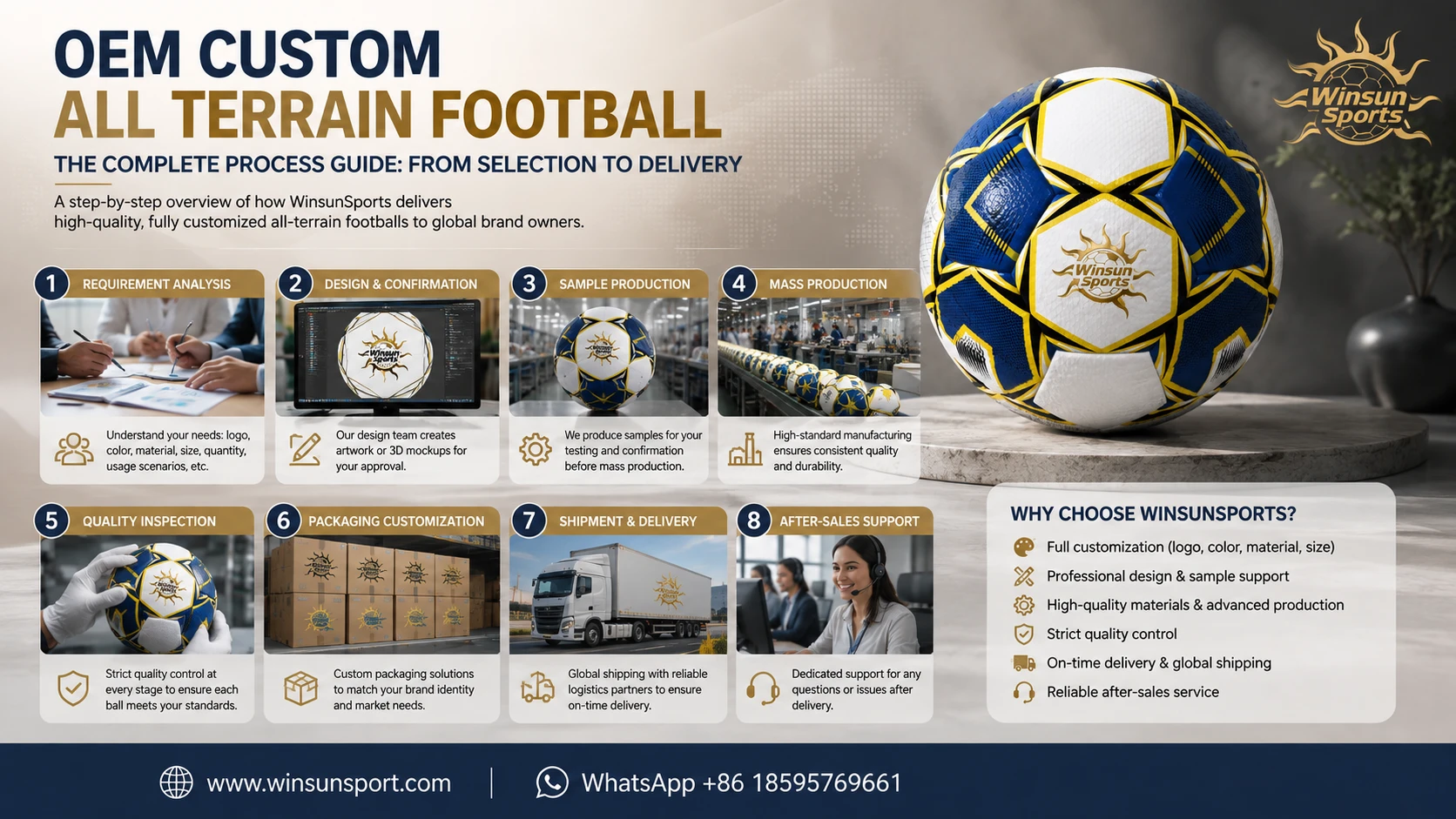
OEM Customization Process Breakdown: Key Steps from Requirement Communication to Sample Confirmation
The process of customizing a football may seem complex, but only two stages truly determine success: requirement communication and sample confirmation. The former turns vague ideas into executable parameters, and the latter verifies whether these parameters are actually implemented. Skipping either step may lead to problems in subsequent mass production.
Step 1: Requirement Communication - Convert Venue, Frequency, and Budget into Parameters
Many customizers initially only say, "I want a durable ball." This statement cannot be directly used to place an order. You need to work with the Winsunsport team to break down your requirements into three specific dimensions:
The venue and frequency of use determine the thickness of the leather. If the ball is mainly used on school cement playgrounds or street dirt courts, the leather thickness must be prioritized, with wear resistance and durability as the core indicators;If it is mainly used on grass or indoor hard courts, a balance can be struck between thickness and feel. Frequency of use is equally critical—high-intensity training more than three times a week and occasional recreational play have completely different requirements for the leather.
When communicating, directly telling the team "how many times a week we train on cement courts" is far more effective than saying "we need something durable."
The age of the users determines the specifications. Youth and adults use different ball specifications, which directly affects the ball's size and weight. If it is for children or family scenarios, the softness of the ball must also be considered to avoid injury risk from excessive hardness.
Tell the team the age range and number of users, and they will provide corresponding specification recommendations.
The budget determines the depth of customization. Full-dimensional customization means you can choose everything from the leather material to the logo craftsmanship. But every customization option comes with a cost.
It is recommended to clearly state your budget ceiling during communication so the team can help you determine which customization items are worth keeping and which can be simplified. For example, gift and souvenir scenarios may prioritize logo craftsmanship and appearance design, while competitive training scenarios should allocate funds first to the leather material and inner lining.
Step 2: Sample Confirmation - Verification of Leather Thickness, Inner Lining, and Logo
The sample is the final gate before mass production. After receiving the sample, do not just look at the appearance; verify each item in the following order:
First, test the thickness and abrasion resistance of the leather. Press and bend the leather by hand to feel the thickness and rebound. If conditions allow, perform a short friction test on a surface similar to actual use.
The leather thickness of the All Terrain Universal Football is customizable, and the thickness confirmed at the sample stage is the standard for mass production; there is no room for ambiguity here.
Next, verify the bladder type. This product offers three options: wound bladder, rubber wound bladder, and PVC bladder. The wound bladder offers elasticity closer to that of a match ball, the rubber wound bladder provides better durability, and the PVC bladder is more economical.
During the sample stage, kick the ball a few times to feel the air retention and touch—good air retention means a single inflation lasts longer, which is important for high-frequency training scenarios. If the sample visibly leaks air within a few days, it indicates a problem with the liner selection or the manufacturing process, which needs to be adjusted promptly.
Finally, check the logo craftsmanship. Different techniques (printing, embossing, embroidery, etc.) vary greatly in durability and visual effect. Lightly scratch the logo surface with a fingernail to confirm it does not easily come off.
If the logo is a core requirement (for example, in gift or promotional scenarios), this step is especially important.
The key to sample confirmation isto inspect with clear standards.。 It is recommended that before receiving samples, you confirm in writing with the Winsunsport team the acceptance criteria for each parameter—leather thickness range, liner type, and logo craftsmanship details. This way, when the sample arrives, you only need to check it item by item against the standard, rather than judging whether it is 'good' based on feeling.
If a sample fails to meet a certain standard, directly feedback to the team, explain the specific gap (for example, 'the leather is 0.3mm thinner than confirmed'), and they will adjust and re-sample. Spending an extra week on this step can avoid large-scale rework after mass production.
Mass Production, Quality Inspection, and Delivery: How to Ensure Batch Footballs Match the Sample?
After sample confirmation, whether mass production can replicate the sample quality is the most problematic link in OEM customization. Football is a product combining manual and mechanical work. Leather thickness, bladder type, stitching stitch pitch, and air pressure retention rate can all fluctuate during mass production. To ensure batch consistency with the sample, the core lies in three points: whether process parameters are locked in writing, whether there are inspection checkpoints for key processes, and whether acceptance is conducted according to unified standards before delivery.
Process Stability Control in Mass Production Stage
Locking down the sample parameters is the first step. After sample confirmation, require the supplier to document key parameters such as leather thickness, bladder type (thread-wound, rubber-wound, or PVC bladder), stitching process, and printing method in the production specification sheet. Without written locked-in parameters, the supplier may make adjustments during mass production due to different raw material batches, leading to deviations in feel or durability.
Pay attention to First Piece Production Review (FPPR). Before mass production, require the supplier to produce a batch of first pieces and compare them with the approved sample. Focus on three key checks: consistency of leather feel, tight and even stitching, and whether the circumference and weight after inflation are within standard ranges.
Only after the first pieces pass should mass production proceed, avoiding rework of the entire batch.
Confirm the sampling frequency for critical processes. The stitching and bonding processes in football production have the greatest impact on durability. It is recommended to clarify the supplier's sampling inspection ratio for the stitching process and the testing method for bladder airtightness.
For a football with good airtightness, the pressure loss after 24 hours should be within an acceptable range; the specific value needs to be confirmed with the supplier regarding their factory standard.
Quality Inspection Standards and Delivery Acceptance Key Points
Delivery acceptance is not about counting quantities but about sampling inspection according to standards. It is recommended to specify the following acceptance dimensions in the contract:
- Appearance: Whether the printed pattern position is accurate, whether there is color deviation, and whether there are obvious defects on the leather surface.
- Sewing quality: Whether the stitch spacing is uniform, and whether there are skipped stitches or exposed threads
- Air tightness: After inflation, let it sit for 24 hours, and check whether the air pressure drop is within the range promised by the supplier
- Weight and circumference: Whether it conforms to the standard range for that specification (different age groups have different ball specifications, so it needs to be confirmed in advance)
Regarding minimum order quantity and delivery time: The minimum order quantity for OEM customization usually depends on the complexity of the process—the more printing processes and the more special the leather material, the higher the minimum order quantity. Lead time is affected by production scheduling and raw material procurement cycles, and generally includes four stages: raw material stocking, production, quality inspection, and transportation. These two figures have no fixed values and need to be confirmed item by item with the supplier based on your customization plan (leather, inner lining, printing process, packaging).
It is recommended to ask about the MOQ and lead time for the corresponding plan during the sampling stage to avoid discovering after the sample is approved that the quantity cannot be met or the time is insufficient.
Suitable/Not suitable assessment:
- Suitable: buyers with clear usage scenarios (such as school cement playgrounds, youth training multi-field training), requirements for durability, and a willingness to make decisions based on long-term costs rather than single purchase prices
- Not suitable: buyers who are still frequently adjusting design plans, have no clear expectations for specific specifications, have very tight delivery schedules, and cannot accept the supplier's production cycle
Next steps: provide the Winsunsport team with your usage venue, age group, expected purchase quantity, and target delivery time, ask them to provide the MOQ, lead time, and mass production quality inspection standard checklist for the corresponding plan, and then decide whether to proceed with the sampling process based on that.
Is OEM customization right for you?— Conclusion and Boundary Recommendations
At this point, what you need to do is not continue comparing specifications, but answer one question:Is the specific problem you need to solve already clear?
3 Situations Suitable for Customization
- The usage scenario is clear and fixed— For example, school concrete playgrounds, youth training on multi-surface fields, or street and dirt fields.You know exactly what surface the ball will be played on, who will play with it, and how many times a week it will be used. In this case, customizing an all-terrain football can directly address the core pain point of 'ordinary balls wearing out too quickly.'
- There is a plan for bulk or long-term procurement— For teams, schools, and training institutions to purchase balls in bulk, or for batch production as gifts or commemorative items.The upfront communication cost of customization can be amortized, and standardized specifications facilitate future replenishment.
- Clear performance or appearance requirements for the ball— For example, specific leather thickness, inner bladder type (thread bladder/rubber thread bladder/PVC bladder), or the need to print team emblems, logos, or specific color schemes.You know exactly what you want; customization is just about bringing your requirements to life.
Two situations where customization is not recommended
- Unclear goals— You haven't yet decided who the ball is mainly for, on what surface it will be used, or how long it is expected to last.At this point, customization only adds to decision-making costs. It's better to try the standard version first, clarify your needs, and then consider customization.
- Frequently changing expectations—The intended users, site conditions, or quantities are still being adjusted.Customization requires locking in specifications. If requirements keep changing, the cost of communication and revisions will far exceed the price of the ball itself.
Regarding price: All-terrain footballs are more expensive, but are they cost-effective in the long run?
It depends onfrequency of use and degree of field wear。 If the ball is used frequently on concrete or sandy fields, ordinary balls may wear out and crack within a few months, while the durable leather and airtight design of all-terrain footballs can significantly extend the replacement cycle, making the per-use cost lower in the long run. But if you're just kicking it around on the grass occasionally for fun, a regular ball is more than enough, and the extra customization cost may not pay off.
Budget Allocation Advice: For high-wear, high-frequency scenarios, prioritize abrasion-resistant models and allocate your budget to the leather and bladder;For low-frequency leisure scenarios, there's no need to pursue full specifications—save the money instead.
Final Decision
- OEM Customization Recommended: When your target users, playing field, quantity, and expected lifespan are all clear, and existing standard models can't fully meet your needs.
- OEM Customization Not Recommended: You are still in the comparison stage, or your requirements may change significantly within six months.First confirm the above conditions, then submit your usage scenarios and specification requirements to the Winsunsport team and let them provide a matching solution.
FAQ
Q: Our school playground is concrete. An ordinary football wears out in one semester. How long can an all-terrain custom ball last? A: The wear-resistant material of all-terrain footballs is specifically designed for rough surfaces, but the specific lifespan depends on the choice of material thickness and frequency of use. It is recommended to inform the Winsunsport team of the field conditions and weekly usage hours, and they will recommend suitable material specifications based on this information.
Q: Our youth training team rotates training on different fields. Can one ball be suitable for both grass and hard surfaces? A: All-terrain footballs have moderate bounce and comfortable feel, and are designed to adapt to multiple surfaces. However, grip and bounce feel vary across different surfaces. We recommend first confirming which types of surfaces the youth training team primarily practices on, then have the team assess whether adjustments to leather thickness or bladder type are needed.
Q: How much more expensive are custom balls compared to regular ones? Is it really more cost-effective in the long run? A: The custom price depends on choices such as leather, bladder, and printing process, so a uniform figure cannot be provided.
The key to determining cost-effectiveness is replacement frequency: if regular balls only last a few months under your usage conditions, while custom balls can last over a year, then the long-term cost is actually lower. You can tell the team the replacement cycle of your current balls and let them help you estimate.
Q: What are the differences in specifications between youth and adult balls? How should you choose when customizing? A: Different age groups correspond to different sizes and weights; balls for teenagers are usually smaller and lighter.
When customizing, it is necessary to specify the age group of the users, and the team will match the corresponding specifications based on the target users.
Q: If my requirements are not clear now, can I postpone customization? A: Yes, it is possible. It is recommended to first clarify the usage scenario, target users, and expected lifespan before starting customization.
If your requirements are still changing, rushing into customization may increase communication costs.
Learn More
If you still have uncertainties about the customization of all-terrain footballs—such as complex field conditions, cross-age user groups, or the need to meet both training and gift purposes—simply share your usage scenarios and procurement plans with the Winsunsport team, and they will provide matching recommendations for leather, bladder, and specifications based on your specific situation.
Related Products:All Terrain Universal Football