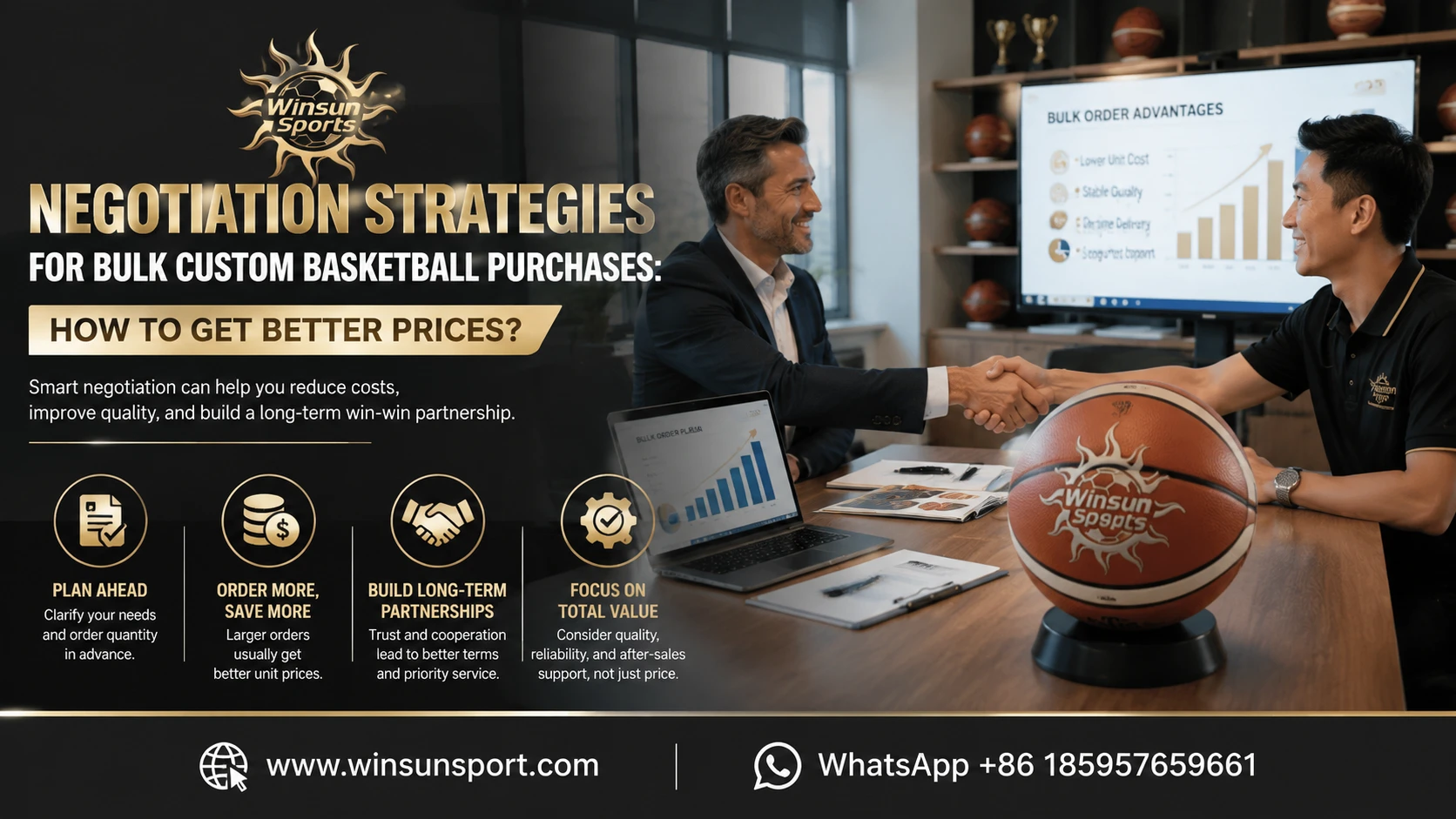
What preparations should be made before negotiating for bulk customized basketballs?
At the negotiating table, the ones who suffer the most are often not those with insufficient budgets, but those whose needs are not clearly thought out. Every price quoted by a supplier corresponds to a specific set of parameters—material, printing process, minimum order quantity, and delivery time. If you go in with a vague idea of "wanting to customize a batch of basketballs," the other party can only quote in the way that is most favorable to themselves.
Therefore, the first thing before negotiation is not to compare prices, but to break down your needs to the point where they can be directly turned into order terms.
Clarify your own needs: deduce specifications and budget from the intended use.
First, answer one question: in what scenarios will this batch of basketballs ultimately appear? This answer directly determines which parameters you should pay for.
- For professional competition: There are strict requirements on ball weight, circumference, and rebound consistency, with the highest material and craftsmanship costs.If your purchase quantity does not meet the factory's minimum order threshold, the unit price will rise noticeably. At this point, you need to think clearly in advance: are you willing to pay a premium for the "competition-grade" standard?
- Daily training/amateur leagues: Durability matters more than ultimate feel.Consider making trade-offs on the surface material and allocate the budget to printing craftsmanship—after all, the clarity of team names and logos is the core of these balls' recognizability.
- Gifts/promotional use: Performance parameters are not the focus; custom appearance and packaging are the main cost drivers.At this point, the negotiation focus should be on the number of printing colors, pattern complexity, and packaging format, rather than the ball core material.
- Children/Family Scenarios: Size and weight are hard requirements, but there is no need to pursue top-tier materials.Clearly define the age group to avoid paying for performance you won't use.
For budget allocation, it is recommended to work backwards in this order: first determine the performance baseline corresponding to the intended use, then calculate how much the quantity can amortize customization costs, and finally reserve 10%-15% for unforeseen expenses such as sample confirmation and logistics tariffs. Many buyers only focus on unit price, ignoring one-time costs such as sampling fees, mold fees, and shipping costs—these are precisely the parts that can be negotiated for reduction or sharing.
Market Research: Understand the Reasonable Price Range for Custom Match Grade Basketball
Before contacting suppliers, you need to establish your own price reference framework. But here's a practical issue: the price of a custom basketball is not a single number, but a combination of 'base ball price + printing process fee + mold/sampling fee + quantity allocation'. So when researching, don't just ask 'how much per ball', but ask clearly:
- Minimum order quantity threshold: What are the unit price tiers for different quantity levels?If the quantity doubles, how much can the unit price drop?
- Printing process differences: How big is the cost gap between single-color screen printing and color heat transfer?Does the pattern precision requirement affect the yield rate?
- Ownership of sampling costsWill the sample fee be refunded after the bulk order is confirmed?How many revisions are included in the sampling fee?
- Delivery flexibilityWhat is the price difference between standard delivery and expedited delivery?Does your usage timeline allow you to choose a slower but cheaper delivery option?
By comparing prices with these specific questions in mind, you will get comparable quotes. If a supplier only gives a vague total price, it means they haven't taken your needs seriously—this itself is a negotiating signal.
Next step: confirm the action: Prepare a requirements list including purpose, quantity, printing requirements, and expected delivery date, and send it to the current website team to confirm the customization plan and quotation structure for Custom Match Grade Basketball. Key questions to ask: What is your minimum order quantity? How are sample fees calculated?
What are the unit price tiers for different quantity ranges? Once you have these three answers, your negotiation baseline is established.
How to break down supplier quotes to find real room for negotiation?
When you receive a quote for custom basketballs, don't rush to look at the total price. First, let's ask: what exactly does this price include? Many buyers suffer losses not because the unit price is high, but because the quotation is vague, leading to continuous additional charges later.
What cost items are hidden in the quotation?
A qualified quotation for custom basketballs should at least break down the following four parts:
1. The cost of the ball itself. This is the foundation, but note: even if it's called a "game-level basketball," differences in the bladder, winding yarn, and surface material can result in cost differences of more than double. If the quotation only says "PU basketball" without specifying the exact weight, whether it's a butyl bladder or rubber bladder, the price is not comparable.
2. Customization process fees. Printing method (screen printing, heat transfer, hot stamping), number of colors, and pattern complexity—each of these affects the price. Printing a single-color logo versus a full-color gradient pattern can result in a 3-5 times difference in process costs.
The quotation must list "printing/customization fees" separately, rather than lumping them into the unit price.
3. Mold or plate fees. If your pattern requires a new plate, or the spherical surface has special structures, there will be a one-time mold fee. Whether this fee should be charged and how much depends on whether your design falls within the factory's existing process capabilities.
4. Packaging, logistics, and miscellaneous fees. The packaging method for each basketball (plain box, color box, mesh bag), the logistics method corresponding to the minimum order quantity (sea freight, air freight), and whether taxes are included—all of these must be clearly stated in the quotation. Many "low prices" are quoted without freight and taxes.
Which costs are negotiable? Which are fixed?
Areas where you can strive for discounts:
- Volume tier pricing. Above the minimum order quantity, there is usually clear tiered pricing.If you can commit to an annual total volume and place orders in batches, many suppliers are willing to price at a higher tier.
- Simplified processes in exchange for discounts. Reducing the number of colors, shrinking the printing area, and switching to standard packaging can all directly cut process costs.Asking 'How much can the price drop if I only print a single-color logo?' is often more effective than directly negotiating the total price.
- Adjusting logistics methods. If you're not in a hurry, choosing sea freight over air freight can save a significant amount.Provided you're willing to wait.
Basically fixed parts:
- Sphere material cost. This is a hard cost, and suppliers have little room to concede.If the other party gives you a significant discount on materials, be wary that they may have switched to lower-grade materials.
- Mold/tooling fees. One-time investment, usually not varying with quantity.But if you reorder later, you can negotiate to "spread the tooling fee into the first order" or "waive the tooling fee for reorders".
- Taxes and compliance fees. There is no room for negotiation on this part, but it should be clearly listed in the quotation to avoid "surprises" later.
Next step to confirm: After receiving the quotation, first check it item by item against the four categories of costs mentioned above. If any item is missing, ask the supplier to provide it. Then ask yourself two questions: Can I increase my quantity to the next tier?
Can I simplify my design by one tier? If both answers are "yes," you have two more bargaining chips in hand. If the quotation doesn't even include material specifications and custom process details, don't discuss price first—get the details filled in, then negotiate meaningfully.
MOQ, Lead Time, and Payment Terms: Which Negotiation Points Can Help You Reduce Costs?
When purchasing custom basketballs, the unit price is only part of the cost. What truly affects the total cost is often the combination of three terms: MOQ (minimum order quantity), lead time, and payment terms. Only by understanding their interrelationship can you find the real room for negotiation.
MOQ Negotiation: Where Is the Balance Point Between Quantity and Unit Price?
MOQ directly affects the unit price, but its mechanism is not linear. In the cost structure of custom basketballs, the costs of tooling, printing setup, and manual labor for first-article approval are fixed, and these costs are spread across every ball. So when the quantity increases from 100 to 300 balls, the unit price drop is usually significant;but from 1,000 to 3,000 balls, the price reduction narrows noticeably because the fixed costs have already been fully amortized.
Two points are worth focusing on during negotiation:
- Find the "inflection point" of the unit price curveAsk the supplier directly: from what MOQ does the unit price drop the most?If the supplier offers three price tiers of 200, 500, and 1000, you will find after comparison that the price drop from 500 to 1000 may be much smaller than that from 200 to 500.If your demand is between 300-400 units, you can try negotiating at the 500-tier unit price, but promise repeat purchases in the future—this is more acceptable than hard-pressing the unit price.
- Use "long-term cooperation" to gain MOQ flexibilityIf your actual demand is only 200 units, but the MOQ is 500 units, do not give up directly.You can propose placing a trial order of 200 units first, while promising that if the quality meets standards, you will continue to place orders in subsequent quarters.For suppliers, a stable expectation of repeat purchases is more valuable than the profit from a single order.
Lead time and payment terms: overlooked cost optimization opportunities
Delivery time and payment terms are not directly reflected in the unit price like MOQ, but they have a significant impact on capital occupation and risk costs, especially for bulk purchases.
Regarding delivery time, the key is not "the faster the better," but "the more certain the better." The production process for custom basketballs includes ball manufacturing, printing, drying, and quality inspection. During peak season, production capacity is tight, and delivery time may extend from 30 days to 60 days. If your usage scenario has a clear deadline (such as event opening day or activity schedule), it is recommended to specify "compensation clauses for delayed delivery" in the contract, rather than just a vague estimated delivery time.
Additionally, you can ask the supplier if there is a "partial delivery" option—delivering a portion first to meet urgent needs, with the rest following the original schedule, which often does not require additional charges.
Payment termsare a negotiation lever that many people overlook. The common payment method is 30% deposit + 70% balance paid before shipment. If you can accept any of the following conditions, they can be used in exchange for a price discount:
- Increase the deposit ratio(e.g., 50%) to reduce the supplier's capital pressure
- Shorten the payment cycle, for example, change from payment before shipment to full payment within 7 days after order placement
- Accept a longer production schedule, allowing the supplier to arrange your order during idle production capacity periods
These concessions mean lower capital risk and more flexible production scheduling for suppliers, so they are usually willing to make corresponding concessions on unit price or MOQ. Conversely, if you insist on cash on delivery or ultra-short lead times, these costs will ultimately be passed back to you in the form of a premium.
Practical advice: calculate the total cost before negotiating
Before contacting the Winsunsport team, first list your complete requirements: exact quantity, expected delivery time, budget cap, and usage scenario (match balls vs. training balls vs. gifts). Then confirm in the following order:
- First confirm the MOQ and corresponding unit price, and clarify how much the unit price drops for each tier increase in quantity
- Then discuss the delivery timeConfirm the price difference between standard lead time and expedited lead time, and whether partial shipments are feasible.
- Finally, discuss the payment terms.Use the deposit ratio or payment cycle to trade for price concessions.
These three terms are interconnected—if you give ground on one, you can gain leverage on another. Treating the negotiation as a holistic package rather than haggling item by item often yields better combined terms.
From one-time purchases to long-term partnerships: How to secure ongoing discounts through supplier relationships?
A single purchase negotiates unit price; a long-term partnership negotiates the cost structure. If you purchase custom basketballs every year—whether for team uniform updates, league balls, quarterly restocking for training institutions, or annual corporate gift plans—the value of the supplier relationship goes far beyond a simple "loyalty discount."
What signals indicate that a supplier is worth long-term cooperation?
When judging whether a custom basketball supplier is worth a long-term commitment, don't just look at the first quote. You need to observe signals at three levels:
First, the level of cooperation in the sample and prototyping stage. The core risk of custom basketballs lies not in mass production, but in print clarity, surface material feel, and print adhesion. A supplier worth long-term cooperation will proactively point out issues in your design draft that may affect the printing effect during the prototyping stage, rather than accepting everything as is and making you bear rework costs after mass production.
If the other party can provide specific modification suggestions during the first sample (such as color difference control range, matching of pattern size with ball surface curvature), this is a more important signal than price.
Second, the way they respond to order fluctuations. The procurement cycle for student leagues often peaks at the start of the school season, and training institutions may stock up intensively before winter and summer vacations. You can ask tentatively: if an additional 200 units are ordered on short notice, how long would it take?
If a batch has printing defects, what is the handling process? Long-term partners will not treat "rush orders" and "after-sales service" as reasons for extra charges, but will incorporate them into regular services.
Third, whether they proactively offer cost optimization suggestions. For example, when your design has large areas of gradient colors, does the supplier tell you that switching to color block stitching can reduce the defect rate? When your quantity reaches a certain threshold, do they proactively inform you that you can switch to a more economical printing process?
Only suppliers willing to help you save money are worth binding with long-term orders.
Framework Agreements and Annual Procurement Plans: Locking in Long-Term Discounts
The essence of a framework agreement is to trade "certainty" for "discounts." Suppliers are willing to offer concessions because you commit to future purchase volumes, which reduces their risk of idle capacity and sales costs.
In practice, you can do this:
First estimate the annual total, then negotiate tiered pricing. Don't just ask "How much for 500 units?" Instead, tell the supplier: "We expect to purchase 1,500 units this year, placing orders in three batches of 500 each. If we sign an annual framework, how would the pricing work?"
This way, the supplier can optimize raw material procurement and production scheduling based on your total volume, and the price they offer you is usually better than the quote for a single batch of 500.
Clearly define the price lock-in period. The framework agreement should specify: how long is the price locked? If raw material prices fluctuate significantly, what is the price adjustment mechanism?
It is generally recommended to lock in prices for 6-12 months, while also stipulating that any price adjustment requires mutual confirmation from both parties, rather than unilateral notification by the supplier.
Include service terms in the agreement. The price benefits of long-term cooperation are not just lower unit prices, but also include: priority production scheduling, free spare parts (for example, an extra 1%-2% of spare balls per batch), annual reconciliation and unified invoicing, and free revision fees for design changes. The combined value of these terms is often more significant than the unit price discount.
Set up annual review milestones. Review every six months or once a year: Has the actual purchase volume met expectations? What is the quality complaint rate?
If targets are met, you can negotiate further discounts for the next year;If not met, both parties can adjust the scope of cooperation rather than being rigidly tied together.
Scenarios suitable for long-term cooperation: You have a stable annual procurement plan (even if orders are placed in batches), have continuous quality requirements for basketballs, and want to reduce the communication cost of inquiries and price comparisons each time.
Scenarios not suitable for long-term cooperation: You only purchase occasionally, each demand varies greatly (e.g., this time it's for competition balls, next time it's for gift balls), or your budget approval process does not allow signing cross-year agreements—in such cases, one-time price comparison is more flexible.
If you are unsure whether your purchase volume justifies a framework agreement, you can directly explain your estimated annual quantity and batch plan to the Winsunsport team, and let them provide a quotation based on the total volume. Then compare it with the total cost of single purchases, and the difference will naturally become clear.
Frequently Asked Questions
What is the general minimum order quantity for custom basketballs?
The minimum order quantity varies by factory and process, and there is no unified standard.Usually, the minimum order quantity for single-color printing is lower than that for multi-color printing, and complex patterns or special processes can raise the threshold.It is recommended to directly ask the supplier for unit price tiers at different quantity levels to find the best balance for you.
Can the sample fee be refunded?
Whether the sample fee can be refunded depends on the supplier's policy.A common practice is that after the batch order is confirmed, the sample fee can be deducted from the payment for the goods;If the order is canceled, the sample fee is usually non-refundable.It is recommended to clarify the fee ownership and the limit on the number of modifications before making samples.
How to judge whether a quotation is reasonable?
Do not just look at the total price; check each cost item one by one: ball material (PU/rubber/genuine leather), printing process (screen printing/heat transfer), mold fee, packaging and logistics costs.If the quotation lacks these details, ask the supplier to supplement them before negotiating.
Can the delivery time be expedited? How are the costs calculated?
Most suppliers offer expedited services, but they will charge extra fees or increase the unit price.It is recommended to clearly specify in the contract the price difference between standard delivery and expedited delivery, as well as the compensation clauses for delayed delivery.If your timeline is not tight, choosing standard delivery is more economical.
Learn More
If you are planning bulk customized basketball procurement, feel free to contact the Winsunsport team. Submit your intended use, quantity, printing requirements, and expected delivery time, and we will provide you with a clear quotation structure and customization plan.
Related Products:Custom Match Grade Basketball