Why is football abrasion resistance testing crucial for procurement decisions?
If you are purchasing training balls in bulk for a team, school, or club, the most direct pain point is that "the ball wears out quickly." The value of abrasion resistance testing lies precisely in turning the vague question of "how long it will last" into a quantifiable cost judgment.
Abrasion resistance directly affects usage cost and replacement frequency.
The replacement frequency of training balls depends on two factors: the wear intensity of the usage scenario (e.g., concrete vs. grass) and the abrasion resistance of the ball cover material itself.
- High-wear scenarios (concrete, asphalt):Ordinary footballs may show surface fuzzing and seam cracking within 2-3 months, requiring replacement.In contrast, footballs that pass abrasion tests (e.g., those using thickened PU or TPU materials) can have their service life extended to 6-12 months.
- Low-wear scenarios (natural grass, artificial turf): The difference in abrasion resistance is not obvious, but seam strength and air tightness are more critical.
Key trade-off: The better the abrasion resistance of a football, the thicker the leather and slightly higher the hardness, which slightly sacrifices feel. If your training scenario is mainly on grass, then "abrasion resistance" is not the primary indicator;But if it's on concrete or frequent use, spending 20%-30% more on a wear-resistant model can actually save more than 50% of the annual ball replacement cost.
Lab tests vs. actual use: How to establish correlation?
Laboratory abrasion tests (such as drum friction, Martindale test) simulate standardized wear, but in actual use, factors such as kicking force, ground roughness, and weather also come into play. Therefore, test data cannot be directly equated to "can be used for X months", but rather providesa relative comparison:
- A test value that is 1 times highermeans that under the same usage conditions, the lifespan is likely about 1 times longer.
- Passing the testonly indicates that the football will not fail quickly under standard wear, and does not mean it can withstand extreme conditions (such as sharp gravel ground).
Next confirmation step: Provide your main usage field type (cement, grass, plastic?) to the Winsunsport team. ), weekly usage duration (hours/week), and single purchase quantity. Based on these conditions, they will recommend a matching leather thickness and inner bladder solution (e.g., rubber thread bladder vs PVC bladder), and inform you of the expected replacement cycle for that solution under similar scenarios.
This way, you can directly calculate:How much more money to spend to replace balls fewer times。
Suitable for: Schools, youth training camps, and amateur clubs with limited budgets but high usage frequency and average field conditions. Not suitable for: Professional teams that only play on professional grass fields, have extremely high requirements for touch, and do not mind frequent ball replacement.
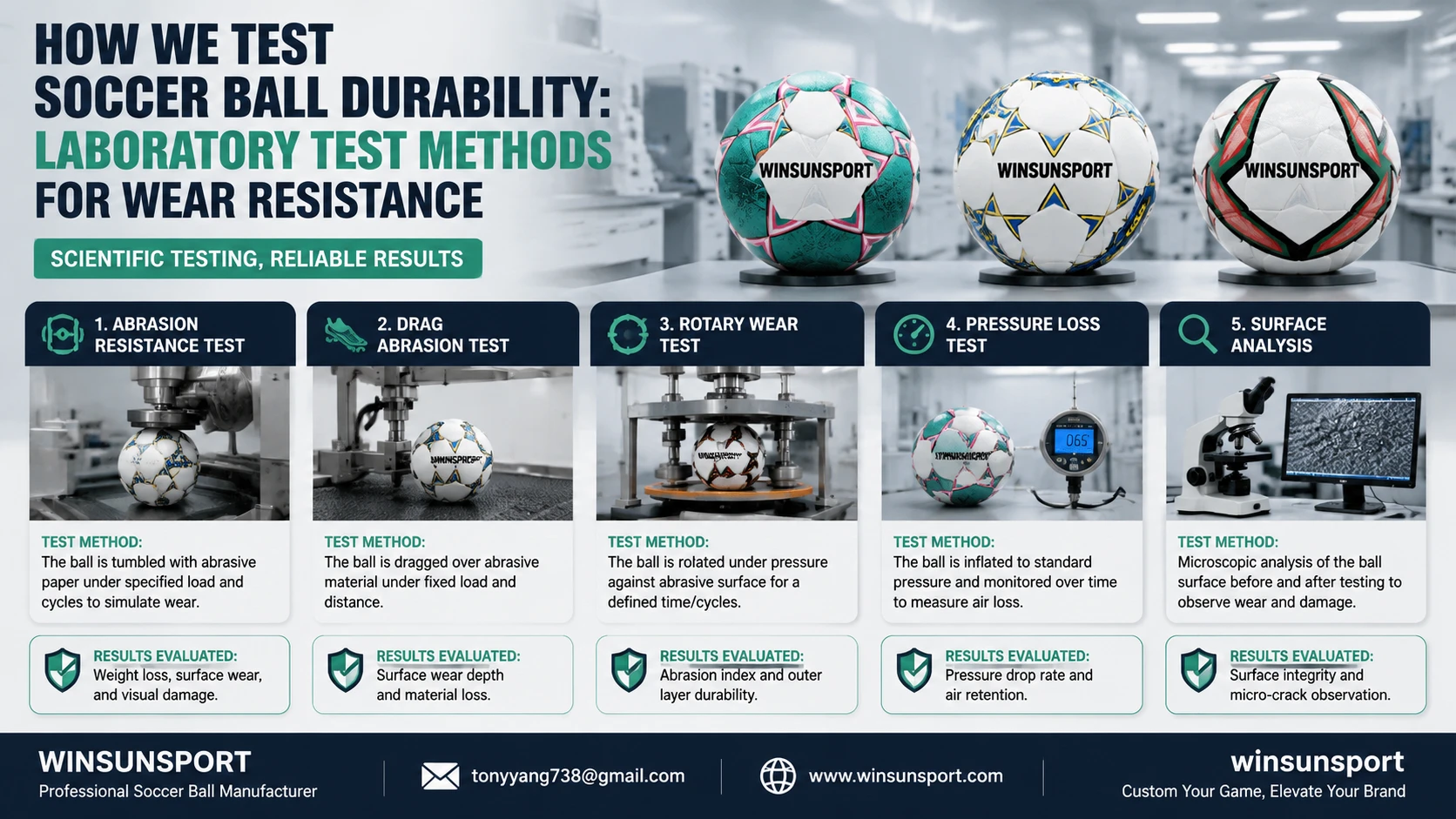
How do laboratories test the abrasion resistance of footballs?Analysis of Three Core Methods
Football abrasion resistance is not judged by "feel." Laboratories use three core methods to simulate real-world usage scenarios, helping you predict how long a ball can last. Understanding these methods allows you to interpret test reports and avoid being misled by vague claims like "abrasion-resistant."
Friction Test: Simulating Turf and Ground Wear
This is the most direct abrasion test. In the laboratory, a machine repeatedly rubs the football surface against standard turf (or simulated ground), typically under a set pressure (simulating a player's weight) and for a set number of cycles (e.g., hundreds to thousands of cycles). After the test, the material is inspected for pilling, cracking, color fading, or significant thickness reduction.
Result Interpretation: The higher the number of rubs and the lighter the surface damage, the stronger the abrasion resistance of the leather. But note: different laboratories may use different rubbing media (turf type, roughness), so when making horizontal comparisons, confirm whether the test conditions are consistent.
Impact Test: Simulating Kicking and Collision
A soccer ball is repeatedly kicked, hit against walls, and dropped during a game. The impact test uses a mechanical arm or pneumatic device to repeatedly strike the ball with a fixed force and angle (typically simulating a shot or long pass). After the test, check whether the ball is deformed, seams are cracked, or the leather shows cracks.
Result Interpretation: The higher the number of impacts and the more intact the ball structure remains, the better the impact resistance. This test directly relates to whether the ball will bulge or come unstitched after a few kicks.
Air Retention Test: Simulating air-holding ability after long-term use
Durability is not just about 'the leather not tearing,' but also whether the ball can maintain its shape and air pressure over time. The air retention test inflates the ball to standard pressure and lets it sit for 24-72 hours, measuring the pressure drop. The smaller the drop, the better the seal of the bladder and seams.
Result Interpretation: A ball with poor air retention needs re-inflation after a few days of play, and is prone to deformation over long-term use, affecting touch and flight trajectory.
Trade-offs and Decision Value of the Three Tests
| Test Method | Simulated Scenarios | Key Indicators | Significance for Ordinary Users |
|---|---|---|---|
| Friction Test | Turf/Ground Friction | Surface Wear Degree | Determine if the ball cover is prone to scuffing or pilling |
| Impact Test | Kicking and impact | Structural integrity | Determine if the ball is prone to bulging or seam opening |
| Air tightness test | Long-term storage and repeated use | Air pressure retention rate | Determine if the ball requires frequent inflation |
Key trade-off: If mainly used on natural grass or high-quality artificial turf, the friction test is more important;If you often play on concrete, asphalt, or rough ground, impact testing and air tightness testing are more critical — because the ground is hard, the ball structure is more prone to damage.
Next confirmation step: Ask the current website team: Has this football undergone the three tests mentioned above? What are the test conditions (number of frictions, impact force, air tightness duration)? If no tests have been done, you can request parameters such as leather thickness, bladder type (thread bladder/rubber thread bladder/PVC bladder), and combine them with your usage scenario (e.g., how many times per week you play, what kind of field) to determine whether the wear resistance is sufficient.
How do material and bladder affect wear resistance test results?
Wear resistance testing not only considers material hardness but also involves surface integrity and bladder air tightness. Different combinations have their own advantages and disadvantages; there is no single "most wear-resistant" solution.
Performance differences of PU, TPU, and PVC materials in testing
- PU: Balanced performance in abrasion tests, with a soft and flexible surface that absorbs some impact and is not prone to cracking, but the coating will gradually wear down after prolonged friction on rough surfaces.Suitable for scenarios that require both feel and durability.
- TPU: Harder than PU with better scratch resistance, but excessive hardness may cause brittleness at low temperatures.Suitable for high-intensity training environments with rough surfaces.
- PVC: Lowest cost, short-term abrasion resistance may be comparable to PU, but it tends to harden and crack after long-term use.Suitable for low-frequency use or leisure scenarios with a limited budget.
Key trade-off: On grass or artificial turf, PU offers a good balance of wear resistance and feel;On cement courts where scratch resistance is a priority, TPU is more suitable;PVC is only suitable for occasional use.
Indirect effects of thread bladder, rubber bladder, and PVC bladder on air tightness and wear resistance
The bladder does not directly participate in surface friction, but it affects the ball's deformation recovery ability, indirectly influencing wear performance:
- Thread bladder: Good air tightness, fast and uniform rebound after deformation, and in wear tests, the surface force is more dispersed, reducing localized wear.Suitable for balls that require stable feel and long-term air tightness.
- Rubber bladder: Moderate air tightness, good elasticity, but air tightness decreases quickly after prolonged use.Suitable for training scenarios with limited budget but requiring some durability.
- PVC bladder: Relatively weak air tightness, prone to hardening and air leakage at low temperatures, slow recovery from deformation, and surface wear accelerated by local dents.Only suitable for indoor or short-term use.
Next confirmation step: If the ball needs to maintain air tightness and surface integrity after 3-6 months of high-frequency use, it is recommended to confirm with the Winsunsport team whether a thread bladder combined with PU or TPU material is optional. For occasional use, a PVC bladder paired with PVC material offers the lowest cost, but long-term wear resistance is limited.
How to choose the right soccer ball based on test results?
Selecting a ball based on test results essentially involves matching the usage scenario with the material and size. The following are selection recommendations for training and match scenarios.
Training scenario: prioritize wear-resistant PU
Training balls need to withstand repeated kicks against walls and ground friction, making wear resistance the primary consideration. PU material is more wear-resistant than TPU, suitable for high-intensity training 2-3 times per week. The feel is slightly harder, but the elasticity is moderate, which does not affect basic skill practice.
If the field is artificial turf, the PU football performs stably in laboratory tests, reducing the frequency of replacement.
Match scenario: prioritize TPU for feel
Official matches require high passing and control accuracy. TPU material has a softer surface and clear touch feedback, suitable for scenarios requiring precise feel. However, TPU has average abrasion resistance. If the field is rough, significant wear may appear after one match. It is recommended for match use only, and clean and store promptly after the game.
Size selection reference: Size 3 ball (circumference approx. 58cm) suitable for children aged 6-9;Size 4 ball (circumference approx. 63cm) suitable for teenagers aged 10-13;Size 5 is suitable for ages 12 and above, including adults. If the user falls between age groups, choose the smaller size if technical skills are the main focus, and the larger size if physical confrontation is the main focus. Our Professional Game Football is available in PU, TPU, PVC materials and sizes 3, 4, 5. You can initially narrow down your options based on the above suggestions, then confirm with our team whether the specific leather thickness and bladder configuration match the intensity of use.
Frequently Asked Questions
Q1: Can the same ball be used for both training and matches? Yes, but there are trade-offs. If sharing, it is recommended to choose PU material, which has better abrasion resistance than TPU. Although the feel is slightly harder, it can meet the needs of amateur matches.If pursuing precise passing and control during matches, it is recommended to configure separate balls.
Q2: Is size 3 ball only suitable for children? Not exactly. Size 3 balls are also commonly used for skill training or small-sided games. Adults can also choose them if they need to practice dribbling or indoor ball control.
Q3: What scenarios are PVC soccer balls suitable for? PVC material is the cheapest, but its air tightness and feel are poor. It is only suitable for occasional leisure or children's play, and is not recommended for formal training or matches.
Q4: What is the minimum order quantity for custom team logo soccer balls? Customization (logo, color, pattern) has a minimum order quantity requirement. Please confirm the specific quantity with the team. For personal use, simply choose the standard models.If the team purchases uniformly, bulk customization can reduce costs and improve recognition.
Learn More
If you are selecting balls for a team, school, or club, please submit your usage scenarios (field type, weekly usage hours, purchase quantity) to the Winsunsport team. We will recommend the matching Professional Game Football material, bladder, and size plan, and inform you of the expected replacement cycle to help you calculate long-term usage costs.
Related Products:Professional Game Football