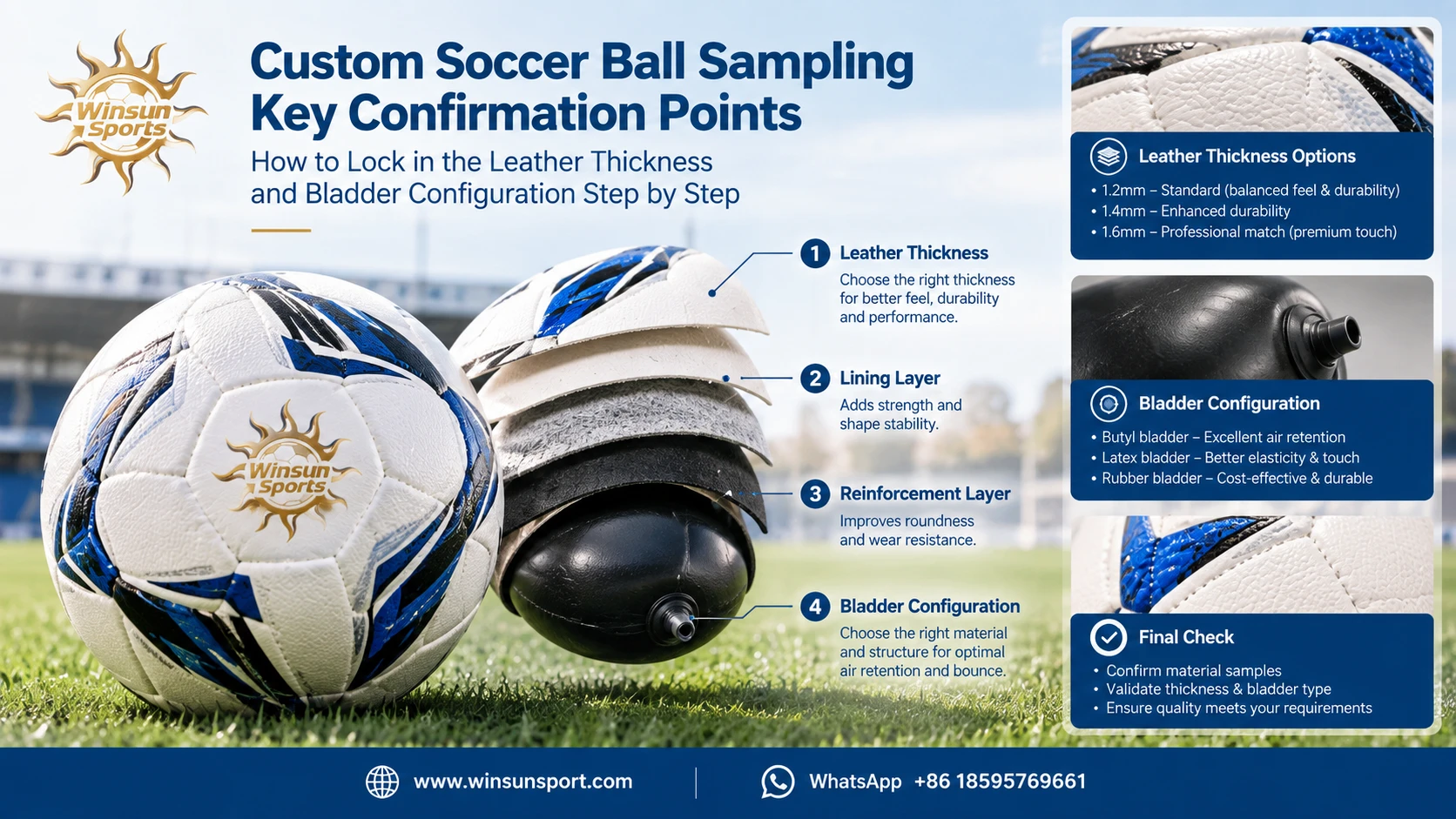
What exactly is being confirmed in custom soccer ball sampling: why leather thickness and bladder must be locked down item by item
Sampling is not about choosing colors and printing a logo. For customizable balls such as Premium Match Grade Soccer Ball, sampling really needs to lock down two sets of specifications:Leather thicknessandbladder configuration. They determine the ball's feel, bounce, and durability performance, and also determine whether the sample can be reproduced during mass production.
The first layer of the sampling confirmation checklist: translate verbal requirements into acceptable specifications
"A bit softer underfoot," "not too bouncy," "needs to be wear-resistant"—these descriptions cannot be used to place an order directly. During the sampling stage, they need to be translated into verifiable items:
- Leather thickness: confirm the specific thickness value, rather than "a bit thicker/thinner."Thickness directly affects ball touch feedback and wear performance, and it is also the item most prone to batch-to-batch variation during mass production.
- Bladder type: choose one of thread bladder, rubber thread bladder, or PVC bladder, and write it clearly into the specifications.The bladder determines air tightness and rebound characteristics; changing the bladder is equivalent to changing the ball.
- Matching relationship between the two: The same thickness paired with different bladders will result in noticeably different feel and bounce.When confirming, both must be recorded as a pair; they cannot be agreed upon separately by verbal agreement.
- Acceptance baseline: Based on the signed sample ball, it is clearly defined that subsequent batches are to be reproduced according to the thickness and bladder of this sample.
Why "determine the bladder first, then determine the leather thickness" is a more reliable confirmation sequence
The bladder is the skeleton of the ball; once it is determined first, the baseline for rebound and airtightness is fixed;then adjusting the leather thickness is fine-tuning the feel and durability on the established skeleton. Conversely, if the leather is chosen first, the feel will shift overall when the bladder is changed later, and the earlier sampling will have been done in vain.
Confirming only the appearance of one sample ball is not enough, and the reason is also here: the appearance cannot reveal the bladder type, nor can it accurately measure whether the thickness matches what was agreed. If the appearance passes but the specifications are not locked in, what often appears after mass production is invisible problems such as decreased airtightness and inconsistent elasticity.
The next step is very specific: explain the usage scenario to the Winsunsport team (competition, training, or gift souvenir), confirm the corresponding leather thickness value and bladder type, and require dual locking with written specifications plus a signed sample ball before proceeding to mass production.
How to confirm leather thickness customization: the triangular balance among feel, wear resistance and durability, and weight
Leather thickness is not better the thicker it is: the trade-off between comfortable feel and wear resistance and durability
As thickness increases, wear resistance and durability usually gain the advantage, but the feel becomes harder, and the ball weight is also harder to control;As thickness decreases, ball contact becomes softer and elasticity is closer to moderate, at the cost of faster wear under long-term high-frequency use. The three cannot all be maximized at the same time, so the choice should return to the usage scenario: high-frequency training on hard courts can lean toward wear resistance, while technical training and daily leisure should prioritize a more reliable comfortable feel.
How to describe leather thickness requirements in reproducible language during sampling
Don't just say "a bit thicker" or "a bit thinner." Break the requirements into three sentences for the sampling party: first, the usage scenario, explaining the main venue and training frequency;second, the feel preference, explaining whether you want the ball contact to be softer or harder, and whether you care more about abrasion resistance or foot feel;third, a comparison reference. If there is a reference ball, directly state "a bit softer than it" or "close but more abrasion-resistant." At the same time, confirm the combination of leather thickness and bladder type (thread bladder, rubber thread bladder, PVC bladder). The two together determine the foot feel and elasticity. If only one is locked in, the sampling result may still deviate from expectations.
How to choose among the three bladder types: scenario matching of thread bladder, rubber thread bladder, and PVC bladder during sampling
The bladder determines the feel, rebound, and air retention performance of the ball after inflation, and it is also the part most easily overlooked during the sampling stage and the hardest to rework during mass production. This competition-grade soccer ball from Winsunsport offers three configurations: wound bladder, rubber wound bladder, and PVC bladder. The logic for choosing is not "which one is better," but which one matches your usage intensity and budget structure.
What usage scenarios are wound bladder, rubber wound bladder, and PVC bladder each suitable for?
Wound bladder: Wound yarn structure, typically more stable air retention and shape retention, with a firmer feel. Suitable for match balls, high-frequency training balls, and OEM customization that requires consistent feel across batches—for example, when a club purchases both training-tier and match-tier balls before the season, using a wound bladder for the match tier makes it easier to control feel differences between different batches.
Rubber wound bladder: Balances air retention and durability, with good resistance to repeated inflation and deflation and long-term use. Suitable for scenarios with high usage frequency such as daily fitness and teaching training, where match-grade feel is not required, and it is also a relatively cost-effective choice in tiered purchasing of training balls.
PVC bladder: Lower cost, suitable for casual entertainment, gifts and souvenirs, promotional activities, decorative ornaments, and other uses that do not have high requirements for air tightness and foot feel. If the ball is mainly used for display or low-frequency use, a PVC bladder can reduce the cost per ball;but if it is used for high-frequency play, air retention and rebound will degrade faster, making it less cost-effective instead.
What questions must be asked clearly when confirming the bladder during sampling?
- Usage intensity: How many times per week is it used, indoors or outdoors, and is it used for official matches?This determines the dividing line between thread bladders and rubber thread bladders.
- Whether to procure by tier: Do training balls and match balls use the same bladder?A tiered configuration is usually more reasonable than using high-end specifications throughout.
- Matching of leather thickness and bladder: Different leather thicknesses affect the overall feel of the ball, and the bladder selection must be locked in together with the leather thickness; they cannot be confirmed separately.
- Air tightness expectations: How often is it acceptable to re-inflate?This directly affects the choice of bladder type.
- Sample verification method: After sampling, what standard is used to judge whether the bladder is qualified—how long it is left before pressure testing, who confirms it, and whether configuration changes are allowed after confirmation.
Once the bladder is locked in during the sampling stage, adjusting it in mass production will affect the leather, structure, and delivery schedule. It is recommended to organize the above questions into a confirmation checklist and submit it together with the leather thickness to the Winsunsport team, so they can provide a matching solution based on your specific usage scenario.
How to confirm workmanship and batch consistency during the sample stage: why sealing samples and retaining samples cannot be skipped
After the leather thickness and bladder configuration are locked, there is another type of issue at the sample stage that is easily skipped: whether the workmanship itself can be reproduced stably. Thickness and bladder are parameters, while workmanship is execution—even if the parameters are correct, stitch tension, ball roundness, and fit flatness may still drift from batch to batch.
Workmanship items to confirm during the sample stage: from stitching to ball roundness
In addition to leather thickness and lining, it is recommended to confirm the following items one by one on the sample:
- Stitching: Whether the stitch spacing is uniform, whether there are skipped stitches or loose threads, and whether the closing is secure.
- Sphere roundness: After inflation, observe from multiple angles to see whether there are local bulges or collapses.
- Panel fit: Whether the seams are flat, and whether there is edge lifting, misalignment, or obvious glue marks.
- Inflation and airtightness performance: After inflating to the agreed pressure, let it stand and observe to determine whether it remains within a reasonable range.
- Surface treatment: Check whether the printing or logo position matches the confirmed draft, and whether the edges are clear.
If any single item is unstable on the sample, it will only be magnified in mass production.
Sealed samples and retained samples: turn "this ball" into the acceptance benchmark for subsequent mass production
After sample confirmation is passed, if no sample is sealed and no sample is retained, subsequent mass production acceptance will only have parameters to compare, and workmanship differences cannot be checked against anything. A sealed sample is the physical benchmark jointly confirmed by both parties, while a retained sample is the reference piece kept by one's own side. If either is missing, when the mass production goods arrive, "it's different from the sample" becomes a case of each side saying whatever it wants.
In practice:
- The sealed sample should be confirmed by both parties and retained by each party, avoiding custody by only one side.
- Retained samples should be marked with the confirmation date, configuration (leather thickness, bladder type), and the corresponding order.
- During bulk inspection, the sealed sample should be used as the reference to judge whether stitching, roundness, and fit are at the same level.
For clubs, wholesalers, and private-label parties, this step directly determines whether subsequent after-sales disputes can be quickly characterized. Skipping it saves only a little time in the sampling stage, at the cost of having to rebuild trust for every batch. Solid workmanship and batch consistency require establishing a communication mechanism during the sampling stage, rather than waiting until bulk goods arrive to make up for it.
Common issues
Are sealed samples and retained samples the same thing? Not exactly. A sealed sample is an acceptance benchmark jointly confirmed by both parties, while a retained sample is a reference piece kept by one's own side.
The two can be produced in the same batch, but their uses differ: sealed samples are used for comparison in case of disputes, while retained samples are used for routine spot checks.
Do all workmanship items need to be confirmed at the sample stage? It is recommended to go through all of them. If any one of stitching, roundness, fit, airtightness, or surface treatment is unstable on the sample, there is no way to be more confident about consistency in mass production batches.
The specific degree of confirmation depends on your usage scenario—match balls and gift balls have different tolerances.
Can bulk production still be adjusted after the sealed sample? The sealed sample is the baseline, not immutable. If bulk production truly needs adjustments, the sealed sample should be reconfirmed and updated to avoid mixing old and new baselines.
How long should retention samples be kept? At least cover the warranty or after-sales period of the corresponding order. For the specific duration, it is recommended to confirm with the Winsunsport team before placing the order, based on your sales or usage cycle.
How do you determine whether workmanship items meet the standard? There is no unified numerical standard. The key is to lock down the observable state when the sample is confirmed, then use the sealed sample to compare against bulk production. If you have specific requirements for any aspect of the workmanship, it is recommended to inform the team before sampling so that they can be specifically confirmed on the sample.
Learn more
If you are preparing for a custom soccer ball purchase, it is recommended to first clarify the usage scenario, training frequency, feel preferences, and budget structure, and then communicate with the Winsunsport team about the matching solution for leather thickness and bladder type.Based on the working conditions and specifications you submit, we can assist in confirming the sampling specifications, sample sealing process, and key points for bulk acceptance, so as to front-load customization risks before signing the contract.