Why do some footballs wear out and crack after just a few months of play?
A football that shows wear or even cracks after a few months of play is usually not a matter of 'bad luck,' but rather a difference in the type of damage, with completely different causes behind each. Understanding this is key to determining whether the problem lies with the ball itself or whether the usage environment exceeds its designed tolerance.
Surface Wear vs. Structural Failure: Two Common Types of Football Damage
Surface wearis the most common and easily observable type of damage. Its typical signs include:
- Large areas of scuffs and fuzzing on the ball's surface, with patterns and colors gradually fading
- The surface layer becomes thinner, even exposing the inner fabric or foam layer in some areas.
- Wear is concentrated in areas that frequently contact the ground, such as the bottom and sides of the ball.
The direct cause of this damage is friction. Artificial turf, concrete, and asphalt surfaces all accelerate surface wear—especially the rubber granules on artificial turf, which act like sandpaper on the ball's surface during sudden stops and direction changes. If your playing surface is hard and rough, surface wear is almost inevitable; it's just a matter of time.
Structural failureis completely different. Its typical signs include:
- The ball deforms and no longer remains perfectly round.
- The seam opens or cracks, exposing the inner bladder
- Air retention decreases, and the ball goes flat within days of inflation
- Bumps appear on the ball's surface, making it uneven
Structural failure is usually not caused by a single factor, but more often results from the combined effects of material fatigue, process defects, and usage conditions. For example, prolonged use near sharp objects, over-inflation, or impacts exceeding the ball's tolerance can all lead to structural damage.
Durability is not a single metric: it is the combined result of materials, structure, and craftsmanship
Many people only look at the word "abrasion-resistant" when choosing a ball, but in actual use, the lifespan of a ball depends on the coordination of multiple factors:
| Influencing factors | What affects it | What to look at when judging |
| Leather material and thickness | Surface abrasion resistance, tear resistance | Leather type, thickness parameters |
| Inner bladder type and quality | Air tightness, ball shape retention | Inner bladder material (e.g., thread bladder, rubber thread bladder, PVC bladder) |
| Ball construction (machine-sewn / hand-sewn / thermally bonded) | Whether the seams are prone to peeling or cracking | Construction type, seam strength |
| Usage environment | Actual wear rate | Court type, frequency of use, inflation habits |
In other words, whether a ball is durable is not determined by a single parameter, but by the combined effect of materials, construction, and workmanship. A ball with a wear-resistant surface will not last long if the bladder has poor air retention;A structurally sound ball, if the cover material is too thin, will quickly become 'disfigured' on rough surfaces.
So, when you find a ball that wears out in a few months, don't jump to conclusions. What you need to confirm is: **Where is it damaged? On what type of surface was it used?
Are the inflation and usage habits normal? ** The answers to these questions determine whether you should switch to a more durable ball or adjust your usage habits. If you're unsure which configuration suits your usage scenario, you can tell the Winsunsport team the type of surface you usually play on, the frequency of use, and the main users (e.g., children or adults). They will help you confirm the appropriate cover thickness and bladder combination based on these conditions.
Cover Thickness and Material: The First Line of Defense in Determining Abrasion Resistance
Many people choose a football by first looking at the brand, then the pattern, but what truly determines how long a ball can last on concrete or artificial turf is the thickness of the leather. This parameter is not as conspicuous as the appearance, yet it is the first watershed for wear resistance.
How leather thickness affects wear performance
The wear of a football mainly occurs at the moment the outer surface rubs against the ground. The thicker the leather, the longer it takes for the surface to wear through, and the stronger its resistance to scratching and cracking. But thickness is not always better—overly thick leather makes the ball heavier, reduces elasticity, makes the touch feel dull, and slows feedback during passing and shooting.
Here lies a key trade-off:Wear resistance and touch are inversely related.。 Thin leather offers clear touch and direct power, but wears out quickly on hard ground.Thick leather is durable and resistant, but requires sacrificing some touch feedback. So "how thick is appropriate" depends on where you mainly play, not just chasing a number.
Requirements for leather thickness in different usage scenarios
School physical education classes: High frequency of use, uneven field conditions (both concrete and plastic tracks), and users are mainly teenagers with limited kicking power. In this scenario, prioritizethicker leather, such as wear-resistant PU or PVC materials above 1.2mm, sacrificing a bit of feel for a longer service life. For school bulk purchases, the cost of replacing balls is more sensitive than the feel.
Hard court training (cement, asphalt): This is the harshest scenario for football wear. It is recommended to choosestyles with thickened wear-resistant layers, while also paying attention to the stitching process between the leather and the bladder—if the thick leather is not stitched firmly, the glue will open earlier than the wear through. The leather thickness of Durable Pro Football for Field supports customization. For hard court training scenarios, you can directly request a thicker option from the team, and they will match a specific thickness plan based on your court type.
Artificial turf: Wear is between natural grass and hard court; standard thickness is sufficient, no need to deliberately increase thickness, otherwise it will affect the feel.
Professional matches: Match balls require higher elasticity and touch than abrasion resistance; usually choose medium-thin leather. Such needs focus more on the coordination of the bladder and craftsmanship; thickness is not the primary consideration.
Next step: confirm the action
If you have already clarified the usage scenario, the next step is to confirm two things: one is thespecific material of the court(cement, asphalt, plastic, or artificial turf), and the other isFrequency of use and duration per session—The wear and tear from kicking once a week is completely different from kicking two hours every day. Share this information with the Winsunsport team, and they can provide specific leather thickness recommendations based on the customization capabilities of the Durable Pro Football for Field. If you only play casually occasionally, the standard thickness is sufficient, and there is no need to add extra budget for wear resistance you won't use.
Bladder type and stitching process: hidden factors affecting durability
When choosing a football, many people focus on the outer surface, but what truly determines how long a ball can last is often the invisible bladder and stitching. Surface wear may still allow continued use, but if the bladder leaks or the stitching breaks, the ball is essentially finished.
Durability differences among rubber bladders, rubber-wrapped bladders, and PVC bladders
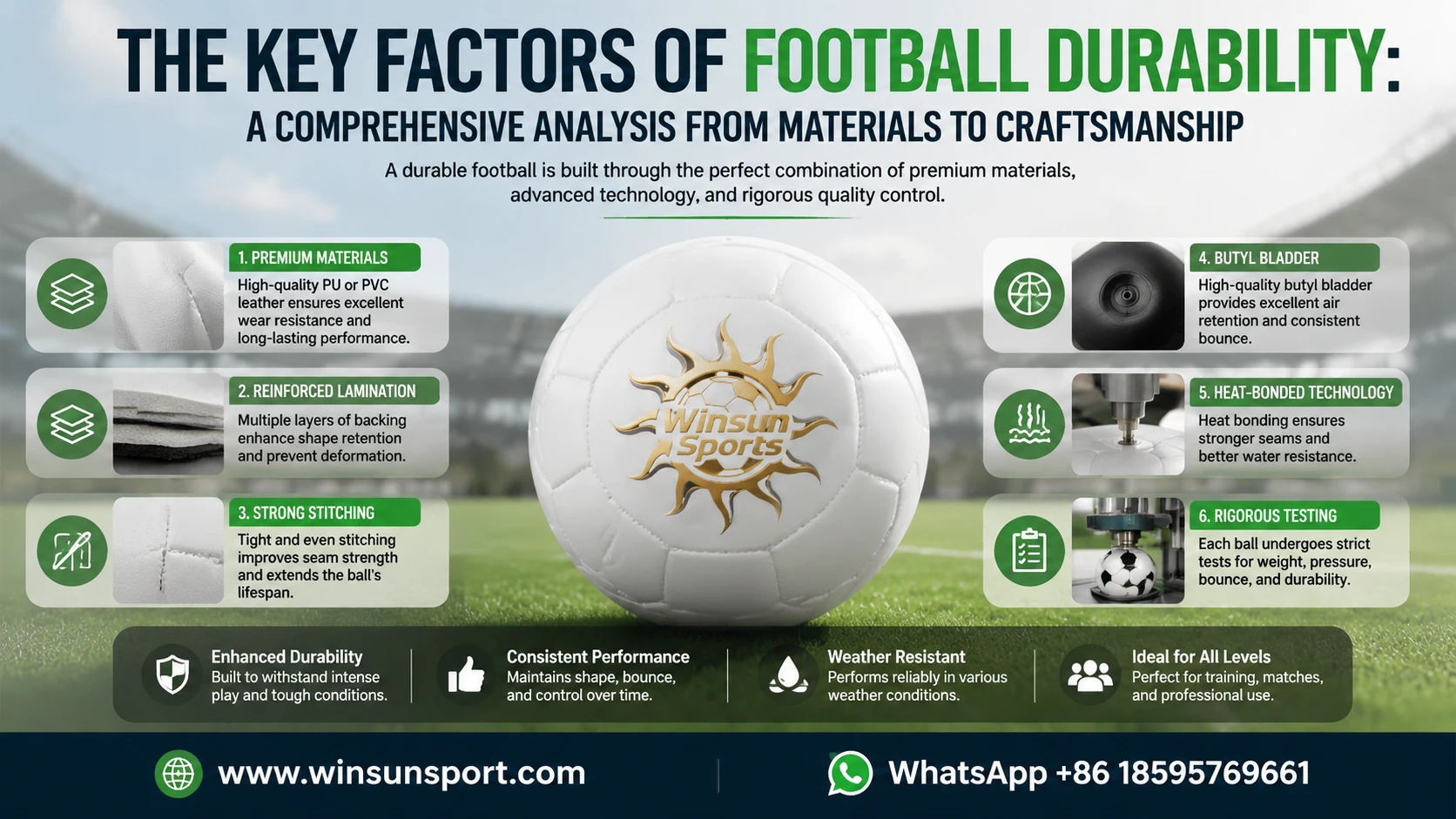
The bladder is the "airbag" of a football, responsible for sealing in air and maintaining ball pressure. Winsunsport's Durable Pro Football for Field offers three bladder options—wound bladder, rubber-wound bladder, and PVC bladder—each with a different durability logic:
- Wound bladder: Nylon or polyester threads are wound around the rubber airbag and coated with rubber to set the shape.The winding layer restricts ball deformation, helping maintain roundness and elasticity even after prolonged use, with good fatigue resistance, making it suitable for high-frequency, high-intensity usage scenarios.The downside is that it is the most expensive.
- Rubber-wound bladder: It retains the winding structure, but the thread density or rubber coating process is simplified, resulting in durability between that of wound and PVC bladders, suitable for users with moderate training volume and certain requirements for touch.
- PVC bladder: A one-piece molded plastic inner bladder, with the lowest cost and acceptable air tightness, but after long-term use, micro-cracks may appear due to material fatigue, causing slow air leakage, suitable for low-frequency use scenarios.
Key points to judge: For high-frequency, high-intensity use, prioritize a butyl bladder;for low-frequency or backup scenarios, a PVC bladder is sufficient.
How does the stitching process determine the structural strength of a football?
The stitching process determines whether the ball can maintain its integrity under force. The strength performance of the three mainstream processes differs:
- Machine stitching: Machine stitching ensures uniform stitches and high production efficiency.Strength depends on thread quality and stitch density, meeting daily training needs, but after prolonged friction on rough surfaces, the threads may wear out and break first.
- Hand stitching: Manual threading and stitching, with each stitch pulled tight by hand, embedding the thread deeper, offering better resistance to seam opening than machine stitching, suitable for professional matches and heavy training, but with higher cost and longer production time.
- Thermal bonding: High temperature is used to bond the leather panels onto the bladder, eliminating thread wear issues, providing a smoother surface and better waterproofing, but the adhesive layer may age and peel under extreme temperatures or prolonged sun exposure.
Practical significance: When playing on artificial turf or hard ground, the stitching is the first point of wear; hand-stitching or high-quality thermal bonding is more durable than ordinary machine stitching;For use only on natural grass or indoors, machine stitching is sufficient.
| Usage Scenario | Recommended Bladder | Recommended Stitching Process |
| High-frequency training (more than 3 times per week) | Wound bladder | Hand-stitching or high-quality thermal bonding |
| Medium frequency (1-2 times per week) | Rubber-wound bladder | Machine stitching (dense stitches) |
| Low-frequency / children / gifts | PVC bladder | Machine stitching |
Next step: confirm the action: Confirm with the Winsunsport team the specific stitching process, stitch density, and number of thread winding layers for the selected model, as these parameters directly affect price and actual lifespan.
Choose durability configurations based on usage scenarios: In which situations is it worth investing in higher costs?
There is no 'best' durability configuration for footballs, only 'matching' ones. The prerequisite for spending your budget wisely is to first understand where the wear mainly comes from in your usage scenario, who is playing, and how much you care about the ball's performance. Below, we break it down by two typical scenarios.
School physical education classes and amateur training: cost-effectiveness first
School physical education classes and amateur training share a common point: high frequency of use, large number of users, uneven field conditions, and wide variation in players' skill levels. In such cases, durability matters more than touch.
How should you choose a soccer ball for school physical education classes?
Focus on three key points: abrasion resistance, air retention, and safety. Abrasion resistance corresponds to the thickness of the leather and the surface treatment process; air retention corresponds to the quality of the bladder; safety requires confirming that the ball has no sharp seams and that the material is non-toxic. For teenagers and children, the weight and size of the ball should also match the age group, rather than directly buying a standard size 5 ball.
How to solve the problem of rapid wear on hard courts?
Hard courts (cement, asphalt) cause several times more wear on soccer balls than grass fields, especially when the ball's surface rubs against the ground; thin leather will quickly peel and crack. There are two solutions: one is to choose a style with thicker leather or a wear-resistant coating; the other is to accept the 'consumable' positioning—when training on hard ground, the ball's lifespan is inherently short, so there is no need to significantly increase the budget for extreme durability; just make do with what is sufficient.
Suitable/Unsuitable Judgment:
- Suitable: School bulk purchases, youth interest classes, and amateur enthusiasts playing casually.In such scenarios, choose a basic wear-resistant model, focusing on leather thickness and price, without spending extra on high-end bladders or competition-level elasticity.
- Not suitable: If you expect a ball to maintain good feel after more than two years of use on hard ground, no football can achieve that. This is not a product issue but a matter of physical wear and tear.
Professional Matches and Brand Customization: Performance and Consistency First
Professional competition and brand OEM customization are another type of logic: the former demands stable performance, while the latter requires reproducible quality.
What are the requirements for professional competition balls?
The core of a competition ball is not "durability" but "consistency"—the bounce and feel must remain stable throughout the entire game and across different balls. This depends on the type of bladder (rubber-wound bladders rebound more uniformly than ordinary PVC bladders) and the consistency of the leather material craftsmanship. If you are organizing an official competition, you need to verify whether parameters such as the ball's weight, circumference, and rebound height are within standard ranges, rather than only focusing on wear resistance.
What should brand owners pay attention to when customizing with their own branding?
The key to OEM/ODM customization is whether your brand logo and colors printed on the wear-resistant leather material can withstand long-term use without fading or cracking. This involves the compatibility between the printing process and the leather material; not all leather materials are suitable for all printing methods. In addition, batch consistency for bulk supply is important—there should be no noticeable differences in feel and weight between the first and second batches.
Before customization, you need to confirm the minimum order quantity, printing process options, and sampling cycle with the team.
Suitable/Unsuitable Judgment:
- Suitable: Teams with clear competition needs and requiring stable performance;Merchants with brand image to maintain and needing bulk customization.Such scenarios are worth investing higher costs in, because what you are buying is not just "a ball" but "a batch of balls with consistent performance."
- Not suitable: If you only play a friendly match occasionally, or if brand customization is still in the trial stage and you are not sure whether to continue purchasing, do not pursue high-end configurations first; it is safer to validate demand with basic models.
Key Trade-offs and Budget Boundaries
| Decision Points | Choose the simple option | Choose the complete option |
| Frequency of use | 1-2 times per week, informal | More than 3 times per week, formal matches |
| Venue | Mainly grass | Mainly hard court and artificial grass |
| Users | Children, beginners | Experienced players, professional teams |
| Customization needs | None or minimal | Brand logo, batch consistency |
| Budget sensitivity | High, seeking adequate functionality | Medium-high, pursuing stability |
In what situations is it not worth adding complexity? When your usage scenario is 'occasional kicks, no fixed venue, participants of varying skill levels,' you won't feel the performance improvements brought by high-end bladders and custom craftsmanship, and the extra money spent yields no return. Conversely, if you are organizing a league or building a brand, cutting this cost will expose problems during use—inconsistent ball feel, peeling prints, and large batch variations. These rework costs far exceed the initial investment.
So how do you finally choose? First answer three questions: What surface will the ball be played on? Who is playing?
How much do you care about 'consistent performance'? The clearer the answer, the easier it is to decide which configuration tier to choose. If you can't clearly answer these three questions yet, start with the basic wear-resistant model, and after using it, decide whether to upgrade based on actual wear and experience.
Frequently Asked Questions
Q1: When a school purchases footballs with a limited budget, which configuration should the money be spent on first? Leather thickness. In school settings, the ball surface wears out the fastest, so thicker leather directly extends the lifespan, which is more cost-effective than upgrading the bladder.
For the bladder, just ensure it has normal air retention.
Q2: When playing on hard ground, is it possible to have both wear resistance and good touch without sacrificing either? Yes, but it will require accepting higher costs. Wear-resistant coatings and thicker leather will increase the ball's weight or hardness, and balancing the feel requires more complex leather structure design.
If the budget is limited, prioritize wear resistance and put the feel second.
Q3: Should professional match balls and training balls have the same durability configuration? They should not. Match balls should prioritize more consistent elasticity and feel, with durability only needing to meet normal court use;Training balls, on the other hand, should prioritize durability because training frequency is high and court conditions are poor.
Mixing them will result in neither being satisfactory.
Q4: When customizing a brand, how can we confirm that the printing won't peel off quickly? You need to confirm with the team the matching solution between the leather material and the printing process, and request a sample for abrasion testing. Different leathers have different ink adhesion, and this issue must be verified before mass production; it cannot be left to guesswork.
Q5: If the usage scenario is still changing (for example, you're not sure whether you'll compete in matches in the future), how should you choose? Choose the basic model. When the scenario is uncertain, the worst thing is to pay in advance for "possible needs."
Start with the basic model for a while, and upgrade once the needs become clear. The cost of upgrading is far lower than the waste of buying the wrong configuration from the start.
Learn more
If you already know your usage venue, frequency, and budget range, you can directly contact the Winsunsport team, inform them of the specific working conditions (venue surface material, age group of users, weekly usage frequency), and they will help you match the leather thickness and bladder solution based on the customization capabilities of the Durable Pro Football for Field.
Related Products:Durable Pro Football for Field