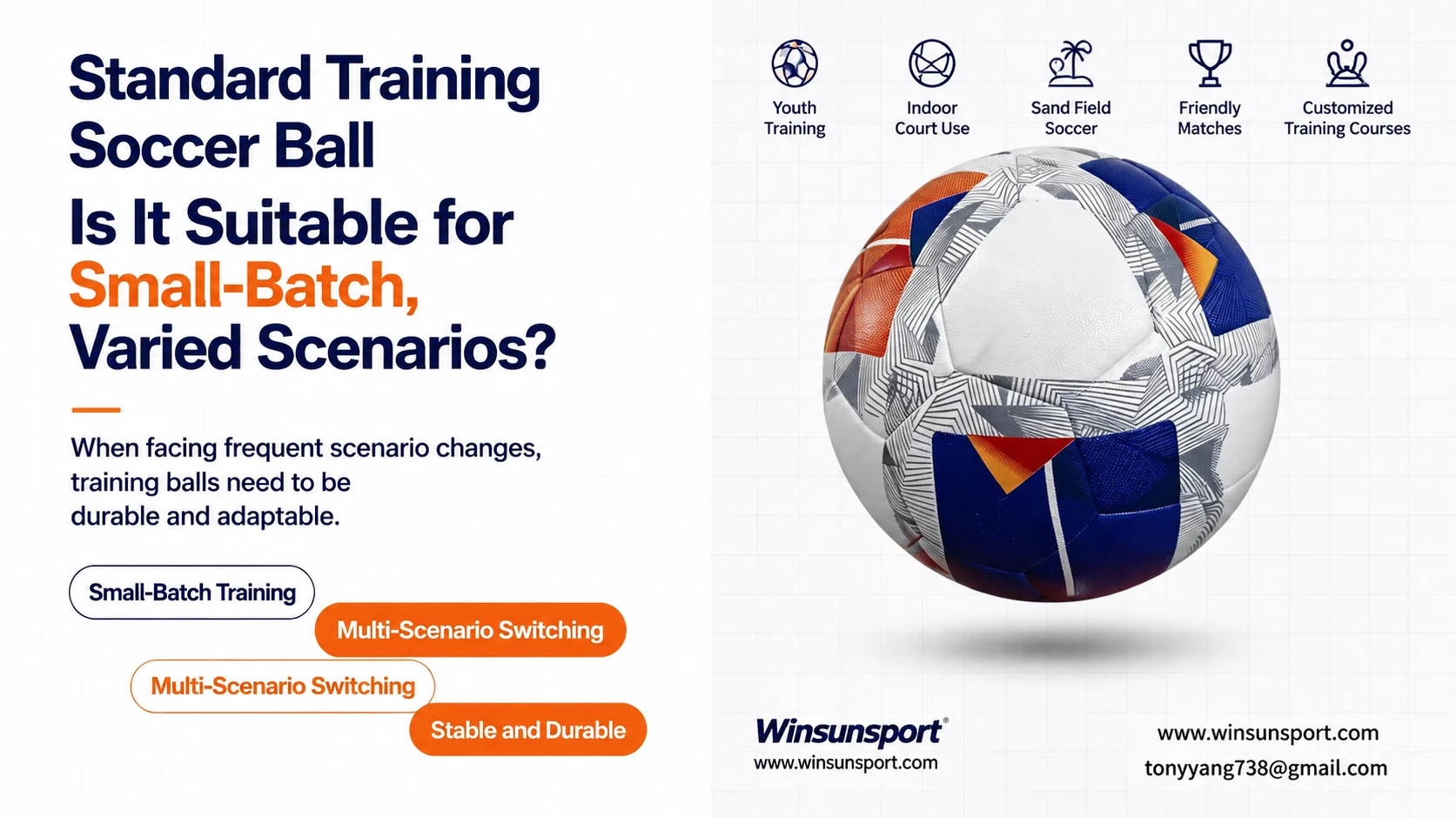
What is a "small-batch, high-variation scenario"?What special requirements does it impose on soccer ball suppliers?
"Small-batch, high-variation soccer ball procurement" refers to a scenario where the purchaser requires a small quantity (e.g., 50-500 units), but demands frequent changes or multiple styles in terms of the soccer ball's specifications (size, material), design (pattern, color), or craftsmanship.
Examples of typical small-batch, high-variation procurement scenarios
This type of procurement is common for the following needs:
- Event Customization: Customizing a small number of soccer balls with different themes as souvenirs for school clubs, corporate events, or community competitions.
- Training and TestingAmateur clubs or youth training institutions purchase in batches to compare footballs with different feels and materials.
- Gift PromotionEnterprises produce football gifts with unique logos and designs for specific promotional projects.
The core contradiction in such scenarios: Flexibility needs vs. Supplier responsiveness
For the purchaser, the core requirement is the supplier'scustomization flexibilityandrapid response capabilityThis means that suppliers need to:
- Accept low minimum order quantities (MOQ)and be willing to take on small orders.
- Possess rapid prototyping and changeover capabilitiesto adapt to changing designs and specification requirements.
- Ensure production consistency in small batchesto guarantee the reliability of each batch of products.
This places high demands on the supplier's production line flexibility, the agility of their order processing workflows, and the communication and conversion capabilities of their sales and technical teams. Therefore, when selecting a supplier, evaluating theircapability and willingness to provide customization servicesis crucial.
How does the core customization capability of the Winsunsport Standard Training Soccer Ball match small-batch requirements?
For teams requiring small-batch, highly variable customized soccer balls, the core concerns are material flexibility and the stability of basic quality. The configuration of the Winsunsport Standard Training Soccer Ball provides direct support for this.
Material flexibility brought by "leather thickness customization" and "multiple bladder types"
The product's material configuration allows adjustments to be made according to specific needs. "Leather thickness" is customizable, allowing the durability and lightness of the soccer ball to be balanced according to the intended use, for example, to meet different requirements for training intensity or children's use. At the same time, the "bladder" offers three options: "wound bladder," "rubber wound bladder," and "PVC bladder."
These three types of bladders each have their own characteristics in terms of cost, elasticity, and usage intensity, providing practical flexibility in material combinations for small-batch production to match different feel or budget requirements.
What do "solid workmanship" and "good air tightness" mean when frequently switching designs?
When frequently switching designs in small-batch production, the "solid workmanship" and "good air tightness" emphasized in the product list are key to ensuring basic performance. This refers to the reliability of the soccer ball's basic structure and sealing process, which can reduce the risk of quality fluctuations that may arise from changes in production batches or design adjustments. Specifically, "good air tightness" directly relates to the product's air retention performance, ensuring that soccer balls from different batches can maintain a stable state after inflation.
Combined with the durability represented by "solid workmanship," this provides a basis for maintaining consistency in basic qualities such as wear resistance and air retention during the small-batch customization process.
Decision Boundary: Under what circumstances is it recommended/not recommended to use it to handle small-batch, high-variability needs?
For the "small-batch, high-variability" demand scenario, the core decision point for using the Standard Training Soccer Ball is:Whether your "variability" consists of known options or unknown exploration.
Recommended Scenarios: Custom orders with clear objectives and stable designs
If you fall into the following categories, this ball is a reasonable and efficient choice:
- Requirements are finalized: The soccer balls you are customizing for a team, club, or event have their size, quantity, printed content (team logo, slogan, numbers), and even color combinations all confirmed and will not be modified.
- Small and clear batch size: The required quantity is not large (e.g., a few dozen to a few hundred), and this quantity is fixed and will not increase or decrease significantly.
- Accept standard processes: Your customization needs are mainly reflected in the patterns and text. For core specifications like 'leather thickness', you can accept existing mature options provided by the supplier, such as wire cores, rubber wire cores, or PVC cores.Existing mature optionsare available, with no need for special research and development.
In this case, you only need to provide the clear design drafts and the confirmed quantity to the Winsunsport team, and they can directly arrange production using their full-dimension customization production capabilities. The 'high variability' here refers to the possibility that you may have multiple future orders with different design requirements, rather than repeatedly modifying the design within a single order.
Scenarios not recommended or requiring caution: Exploratory phases with vague goals and frequent changes in requirements.
The following situations require caution or consideration of alternative options:
- The design is in an exploratory stage: You roughly know you want to make a soccer ball with a 'team logo', but the specific style, font, color placement, etc., of the logo are still under internal discussion and modification, and have not been finalized.
- Quantity is strongly linked to the plan: You want to first understand the price and process differences between 'printing 100 balls' and 'printing 200 balls' before deciding on the final quantity.This will make the quotation and production preparation process complex and error-prone.
- There are special and unknown requirements for materials: For example, you need to print on a special material that has never been used before, and you are unsure of the effect. This requires sample testing and falls within the scope of research and development.
Why is caution needed? The production process for the Standard Training Soccer Ball relies on the finalized input information (design drawings, quantities, material specifications). Frequent changes to requirements in the early stages will force the supplier to repeatedly adjust quotes, prepare documents, and may even lead to additional communication and sampling costs due to an unstable plan, slowing down the entire project timeline.
What should I prepare before consulting the supplier?
Regardless of whether you ultimately choose this product, to receive accurate and efficient feedback, please prepare the following information before contacting Winsunsport:
- Clear design drafts: Vector files or high-resolution images containing all visual elements such as logos and text, with colors specified (preferably with Pantone color codes).
- Confirmed quantities: A clear purchase quantity, or at least a convincing quantity range.
- Clear product specifications: Confirm the size of the soccer ball (e.g., standard size 5, children's size 3) and the acceptable bladder type (e.g., rubber wound bladder).
- Brief description of the usage scenario: Simply state the primary purpose of the ball (e.g., training, competition, souvenir), which helps the supplier understand your quality requirement priorities.
- Budget range: Optional, but providing a budget range can help the supplier recommend a more suitable combination of leather thickness and craftsmanship for you.
With these prepared, you can quickly assess whether the current product matches and keep the communication focused on solutions.
Frequently Asked Questions
Q1: I only have a general idea, like "make a promotional ball for my company," without a specific design. Can I still consult directly? Yes, but the focus of the consultation should be on "confirming the cooperation process and design support capabilities." You can ask the supplier if they provide design services or templates, and how long it typically takes from the initial idea to the final draft.
This will help you assess the overall timeline and complexity of the project.
Q2: If my design is complex, requiring multiple processes like hot stamping and 3D embossing, can this ball meet those requirements? The product explicitly supports "multiple optional processes," but complex process combinations will increase production difficulty and cost. You need to inform the supplier of your specific design intent (including process details) so they can assess technical feasibility and provide an accurate quotation.
Do not assume that all complex processes can be achieved just because "customization is supported".
Q3: I only need 50 this time, but I might frequently need several hundred of different styles in the future. Is this a good time to try? Very suitable. This small batch order of 50 units is an excellent opportunity to test the supplier's customization capabilities, quality, delivery time, and communication efficiency.
If this collaboration goes smoothly, you will have a reliable partner for future multiple orders and various style requirements.
Q4: The article says "changes" are divided into known and unknown. If I have known options but am still hesitating about which one to choose, which category does that fall into? This belongs tothe decision-making period where the target needs to converge., rather than a vague exploration phase. The correct approach is: with youralternatives(for example, debating between Design A and Design B, or 100 units versus 150 units) directly contact the supplier, requesting them to provide separate quotes for thesespecific, limited options.
This is much more efficient than describing a vague concept.
Further understanding
If you are planning a custom soccer ball project, whether for school events, corporate gifts, or team training, please feel free to share your specific designs and requirements with us.Our team can provide you with professional customization plans and quotes based on your specifications and quantities.
Related Products:Standard Training Soccer Ball