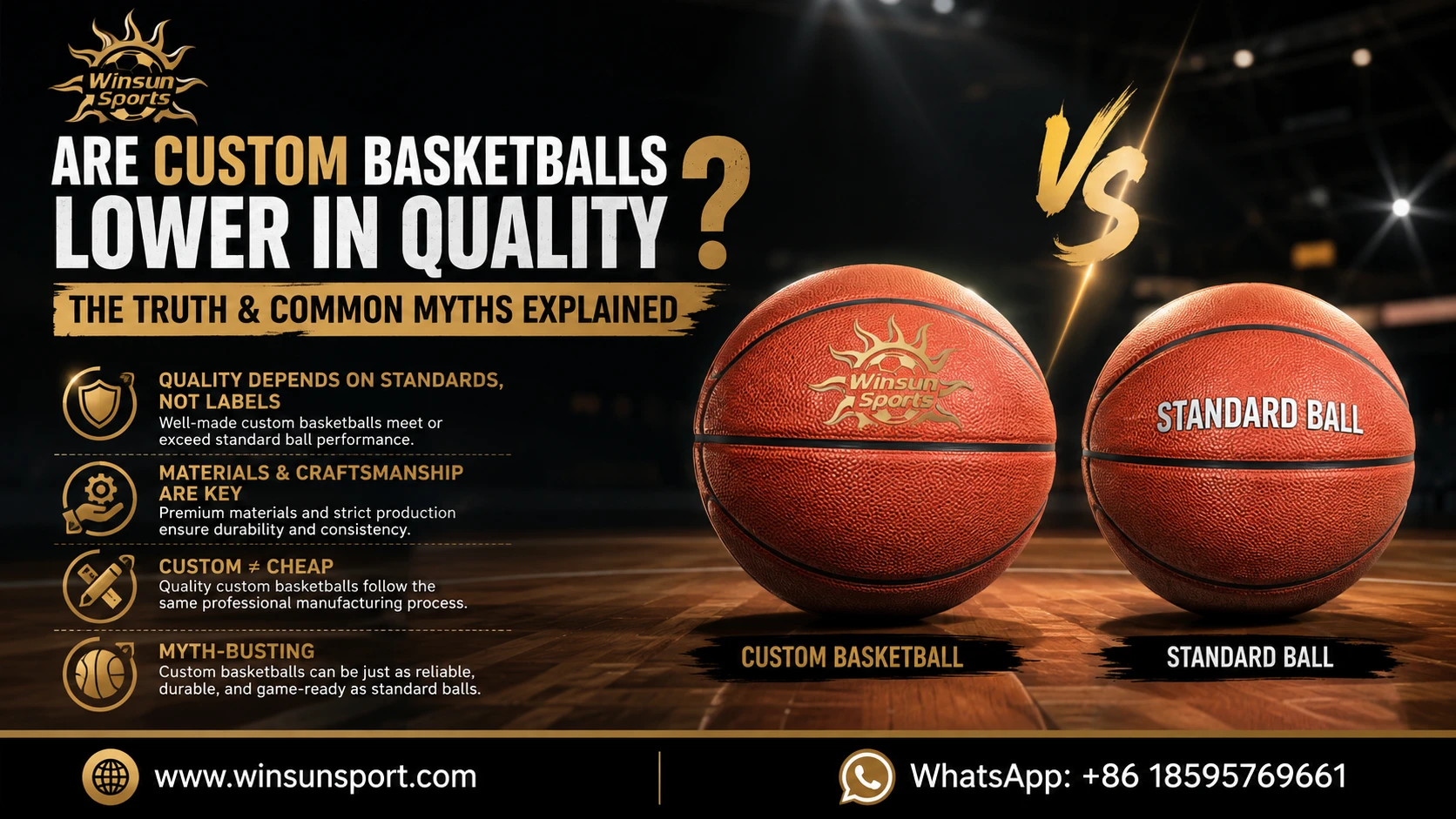
Is the quality of custom basketballs poor?First, understand what determines quality.
Many people worry when choosing custom basketballs: after printing a logo or changing the color scheme, will the ball's quality be compromised? This concern is understandable, but the question itself is asking in the wrong direction. The quality of a custom basketball does not depend on whether it is customized or not, but on the material, structure, and craftsmanship of the ball itself.
Core variables of basketball quality: material, structure, and craftsmanship.
The feel, bounce, abrasion resistance, and air pressure retention of a basketball are mainly determined by the inner bladder, winding layer, mid-layer, and cover material. The airtightness of the butyl bladder, the uniformity of the winding layer, whether the cover is PU or rubber, and whether it is a moisture-absorbing or abrasion-resistant formula—these determine the durability and feel of the ball on different courts. The precision of the manufacturing process determines whether the ball is "round," whether the weight is uniform, and whether the rebound is stable, which depends on the vulcanization process, panel gluing process, and quality control standards during production.
These factors do not change before or after customization, because customization is surface treatment on the finished ball, not remaking a new ball.
Custom logo is just a surface process and does not change the ball's performance.
Whether it is screen printing, heat transfer, or hot stamping, the logo is just a pattern added to the surface of the ball, without changing the internal structure and physical properties of the ball. What really needs attention is whether the printing process affects the original anti-slip texture and wear-resistant layer of the surface—if the printing layer is too thick or the process is rough, the logo area may feel harder and crack faster. But this is a matter of process selection, not a high-probability result of "customization."
Taking Winsunsport's Custom Logo Competition Basketball as an example, this ball offers customization services based on a competition-grade ball body. The material and process grade of the ball body itself are consistent with the standard version. The custom logo is a post-process step and does not change the ball's elasticity and feel. The key to judging the quality of a custom ball is to first confirm the material and process grade of the ball body itself, and then confirm the method and position of the custom printing, rather than equating "customization" with "poor quality."
Quality Comparison Between Custom Basketballs and Standard Balls: The Difference Lies Not in Customization, but in Material Selection and Craftsmanship
Many buyers worry that the word "custom" implies a compromise in quality—this is a common misconception. Customization itself does not alter the physical properties of a basketball; what truly determines whether a ball performs well and lasts long is the material and manufacturing process of the ball itself. In other words, for balls coming off the same production line, whether a logo is printed and whose logo it is have no fundamental impact on elasticity, feel, or abrasion resistance.
Under the same material and process, custom balls and standard balls perform identically.
The quality differences in basketballs mainly stem from three aspects: the surface material (PU, PVC, genuine leather, or rubber), the carcass structure (butyl bladder and winding process), and the bonding or stitching method. These factors determine the ball's rebound rate, feel, air retention, and resistance to deformation. The customization process—whether printing a team name, event logo, or corporate emblem—occurs after the ball is formed and is a surface finishing step that does not interfere with the aforementioned core structure.
Therefore, to determine whether a custom ball meets competition or training standards, the correct approach is to ask clearly what its corresponding 'standard ball model' is. Taking Winsunsport's Custom Logo Competition Basketball as an example, its performance benchmark comes from its competition-grade ball configuration, and customization merely overlays visual elements on this benchmark. If you receive a custom ball and feel the touch is off, the problem almost always lies in the material grade selected, not because 'printing text made it worse'.
Printing process affects logo durability, but not ball durability
The only aspect of a custom ball that truly needs separate evaluation is the printing method of the logo. Common processes include screen printing, heat transfer, and hot stamping, which differ in abrasion resistance and crack resistance. Under high-frequency use or outdoor concrete court conditions, a low-cost screen-printed logo may show wear or peeling within months, but this only affects appearance, not the ball's elasticity or structural lifespan.
Here is a point that is easy to confuse:Ball durability and logo durability are two different things. Ball durability depends on the thickness of the surface wear layer and the air tightness of the bladder, while logo durability depends on the printing process and ink quality. If you are purchasing custom balls for long-term training or competition, we recommend confirming two points with the Winsunsport team: first, what material the ball surface is made of and whether it is suitable for indoor or outdoor use;second, the expected lifespan of the printing process you choose under the corresponding court conditions.
Once these two points are confirmed, you can accurately determine whether this custom ball meets your usage cycle requirements.
Next step for confirmation: Clarify your usage scenario (indoor wooden floor, outdoor plastic, or concrete), weekly usage frequency, and the duration for which the logo needs to remain intact, then provide these three conditions to the Winsunsport team to request a matching material and process solution. The answer obtained this way will be much more accurate than asking vaguely 'Is the custom ball durable?'
Which scenarios are suitable for custom basketballs?Which scenarios are not recommended?
Whether a custom basketball is suitable depends on whether your usage goals are clear and whether the usage scenario is fixed. Below are direct recommendations by scenario.
Suitable for customization: corporate gifts, game balls, training balls, brand promotion
Corporate gifts and brand promotion: When there is a clear recipient (customers, employees, partners), custom logo basketballs can serve as gifts or souvenirs, with each use providing brand exposure. The prerequisite is that the recipient is clear and they will actually use the ball.
Match balls: Official balls customized by event organizers, can be printed with event logos, team names, and year, meeting the needs for uniformity and recognition. Suitable premise: the event specifications, ball quantity, size, and printing position have been determined. If the event plan is still being adjusted, it is recommended to confirm the design draft before placing an order.
Training balls: Bulk customized training balls for schools, training camps, or clubs, printed with team names or numbers for easy identification and management, reducing loss from mixing up balls. Suitable premise: high frequency of use, predictable wear and tear, and the value of customized identification can be continuously realized.
Brand promotion and OEM manufacturing: When sports brands need OEM production, customization falls under the supply chain cooperation path, and the core is comparing suppliers' responsiveness and craftsmanship.
Customization not recommended: unclear goals or frequently changing design needs
Unclear goals: If it has not been determined yet who these balls are for, what games they will be used in, and how long they will be used, the design confirmation, sampling, and modification steps in the customization process will repeatedly consume time and budget. It is recommended to clarify the purpose and target users first, then start customization.
Frequently changing designs: Basketballs are durable goods, and the printed pattern accompanies the ball throughout its entire usage cycle. If it is expected that the logo, color scheme, or slogan will change in the short term, each batch of customized balls may become obsolete; in such cases, standard balls are a more stable transitional choice.
Conclusion boundary: If your core need is simply "having a ball to play with," with no requirements for patterns or brand exposure, the standard basketball procurement process is shorter and costs are more controllable. The value of custom basketballs lies in the additional information carried on the ball's surface—only when brand exposure, team affiliation, or event recognition have practical significance to you is the extra time and budget worth it.
How to determine if a custom basketball is right for you? Three decision criteria
Custom basketballs are not a substitute for "standard balls," but a solution matched on demand. To determine if it suits you, you don't need to understand materials science or compare dozens of parameters; you only need to answer three questions.
Criterion 1: Clarify the usage scenario and performance requirements
The quality of a custom basketball depends on the materials and craftsmanship you choose, not on the act of "customization" itself. In other words, the reliability of a custom basketball is entirely determined by the specifications you confirm when placing your order.
First ask yourself: what is this ball mainly used for?
- Daily training or teaching: requires wear-resistant rubber or PU material, with focus on the abrasion resistance of the surface and consistency of feel.These scenarios demand high air tightness and roundness, but there is no strict requirement for competition certification.
- Official matches: requires confirming whether the ball's size, weight, and rebound performance meet the standards of the corresponding event.If you need the official match ball, you must confirm the competition specification parameters with the supplier during the sampling stage, rather than inspecting them after the finished product is delivered.
- Gifts or souvenirs: Performance requirements can be relaxed, but the fineness of appearance, packaging integrity, and logo presentation effect are more important.At this point, you are not buying a "ball," but a "carrier for the logo."
How to determine: Write the usage scenario in one or two sentences, such as "weekly middle school boys' basketball training three times a week, requiring durability and stable feel," and then use this statement to confirm the material and specification matching plan with the supplier. If you cannot even clearly describe the usage scenario, the customization plan will likely be over-engineered or insufficient.
Standard 2: Confirm printing process and logo durability requirements
This is the most underestimated part of custom basketballs. Many people think that "printing a logo" is the same thing, but in reality, the durability of different processes varies greatly.
You need to confirm two questions:
- What will the logo go through: Is it placed in a gym as decoration, or is it repeatedly bounced, rubbed, or even used on outdoor concrete courts?The former has low requirements for print durability, while the latter must choose a more penetrating printing process, otherwise the logo will peel off after a few months.
- How long do you want the logo to last: If it is a commemorative ball for a one-time event, ordinary screen printing may be enough;If it is a promotional ball for long-term corporate use, a more durable process solution is needed.
How to determineDo not directly ask "which process is the best," but instead tell the supplier "under what conditions and for how long this ball will be used," and let the other party recommend a process based on your usage conditions. If the supplier only quotes a price without asking about the usage scenario, you should be wary.
Standard Three: Evaluate Customization Quantity and Collaboration Complexity
There is no unified minimum order quantity threshold for customized basketballs, but the quantity directly affects two things: unit price and process complexity.
- Large quantity and stable demand: suitable for a complete customization process, from sampling to mass production, with lower cost per ball and easier access to process attention.
- Small quantity and clear demand: customization is still possible, but you need to confirm whether the process options and unit price under small batches are within budget.At this time, it is recommended to focus on core needs—for example, only doing logo printing without pursuing complex processes.
- The requirements are still changing frequently: for example, the team name is not finalized, the design draft is still being revised, and the quantity is uncertain—in such cases, it is not advisable to rush into placing an order.The customization process requires confirming the design draft, material, craftsmanship, and sampling; any change in any of these steps will extend the timeline.
How to determineIf you have clear answers to the four questions of "what you want, who it is for, how long it will be used, and what the budget is," then the customization plan is worth pursuing;if any of these items is still undecided, complete them first before consulting, otherwise the quotes and proposals you receive will have limited reference value.
Frequently Asked Questions
Q1: Is the quality of customized basketballs reliable? Reliability depends on the materials and craftsmanship you choose, not on "customization" itself. The production process for customized balls is essentially the same as that for standard balls; the difference lies in whether you can confirm the specifications during the sampling stage.
It is recommended to ask the supplier for samples or prototypes to actually test the feel, air tightness, and printing effect before placing a bulk order.
Q2: How to choose a reliable custom basketball supplier? The key is not whether they say "we have good quality," but whether they recommend solutions after understanding your usage scenarios. A reliable supplier will proactively ask about usage conditions, expected lifespan, quantity budget, and provide corresponding material and process recommendations.
If the other party only quotes prices without asking about your needs, the probability of problems later is higher.
Q3: Is small-batch custom basketball feasible? It is feasible, but you need to clarify the process options and unit price changes under small batches. It is recommended to focus on core needs, such as only single-color logo printing, to avoid extra costs and communication costs brought by complex processes.
The specific minimum order quantity and price will be confirmed after you provide your quantity and usage scenario to the Winsunsport team.
Q4: Can custom basketballs be used in official competitions? It depends on whether the specifications you choose meet the standards of the corresponding event. If you need a game ball, you must specify the event requirements (size, weight, rebound, etc.) during the sampling stage, rather than assuming that "custom balls can be used in games" by default.
It is recommended to directly state your event type when consulting, so the team can confirm a specification matching plan.
Learn More
If you are planning a custom basketball procurement, it is recommended to first sort out the usage scenario, frequency of use, and expected logo lifespan, and then bring this information to the Winsunsport team for consultation to obtain a matching material and craftsmanship solution.
Related Products:Custom Logo Competition Basketball