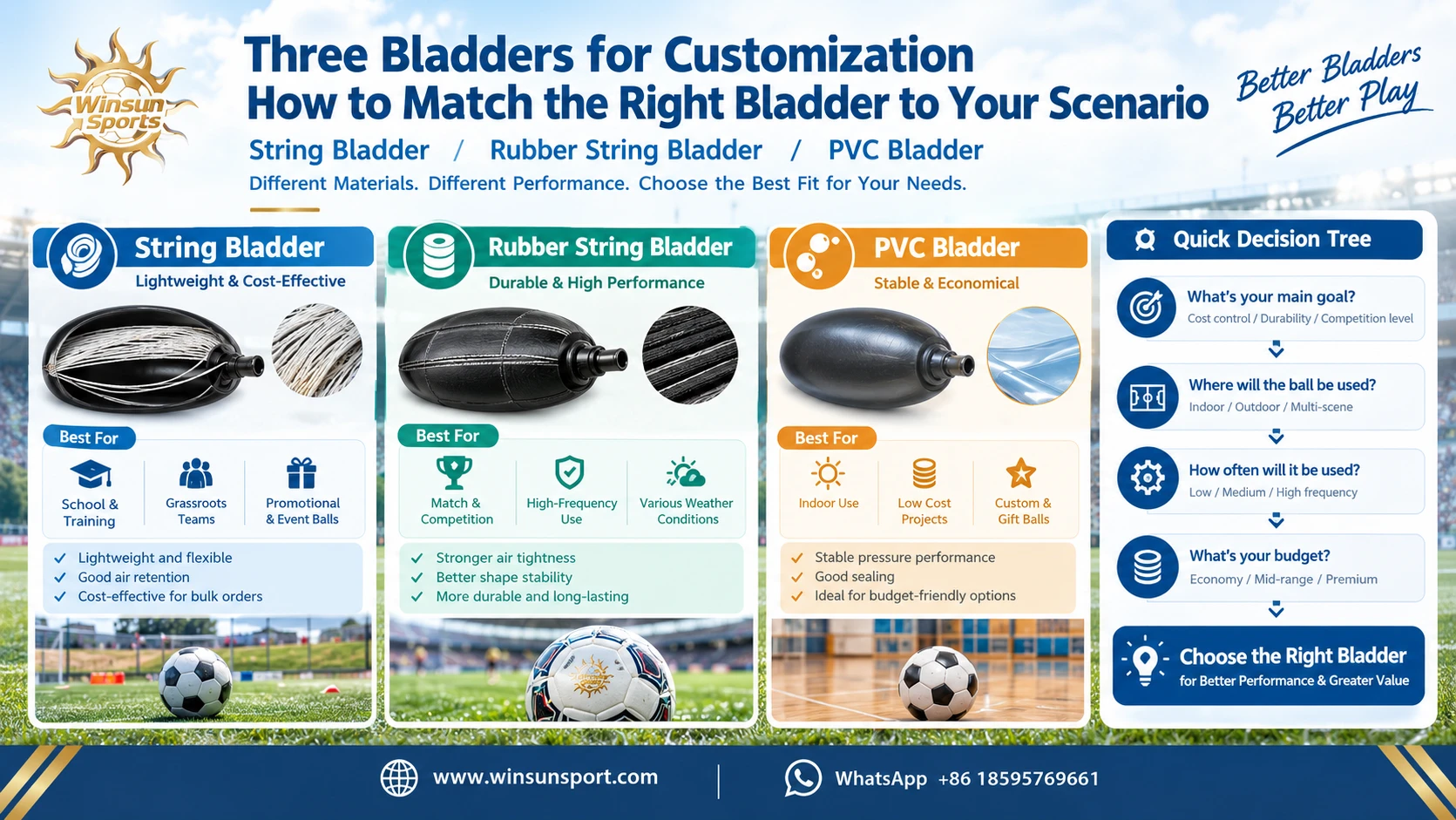
What are thread bladders, rubber bladders, and PVC bladders respectively?First understand how the three types of bladders work.
The bladder is the base layer for a soccer ball's air retention and rebound. No matter how thick the leather is, if the bladder retains air poorly, the ball will become soft and its bounce will feel floaty after just a few training sessions. Therefore, when customizing soccer balls, the bladder, like the leather thickness, is a core specification.
What role does the bladder play in a soccer ball: the underlying source of air retention, rebound, and touch feel.
The bladder is hidden inside the leather and mainly does three things:
- Air locking: Maintains the internal air pressure of the sphere and determines how often air needs to be added.
- Provides rebound: The ability to recover its shape after compression, affecting bounce height and ball exit speed.
- Transmits feel: The softness or hardness of the bladder and its recovery rhythm are perceived when the foot contacts the ball.
These three factors constrain one another: a structure with good air tightness tends to be stiffer, while a solution with a soft feel may compromise air retention. Choosing a bladder is essentially about finding the balance point among air tightness, elasticity, and feel that suits the intended use scenario. The thickness of the leather also affects touch and abrasion resistance, and needs to be considered together with the bladder.
Typical conceptual differences among the three types of bladders: what thread bladder, rubber thread bladder, and PVC bladder each emphasize
Thread bladder: The interior uses a wound thread layer as the skeleton, relying on the thread layer to constrain the shape, assist in air retention, and provide rebound. The structure is relatively complex, usually corresponding to a feel consistency closer to that of match balls, suitable for scenarios with stable requirements for bounce and ball-touch feedback.
Rubber thread bladder: On the basis of a rubber bladder, it combines a thread layer structure, balancing the elasticity of the rubber itself with the shape constraint of the thread layer. The balance between air tightness and rebound is the main orientation, commonly found in training and match dual-purpose configurations that need to balance durability and feel.
PVC bladder: A bladder mainly made of PVC material, with a relatively simple structure and greater room for cost control. Its advantages lie in price and basic usability, making it suitable for scenarios with low usage frequency, short replacement cycles, or budget priority;for occasions with high requirements for air tightness and long-term elastic consistency, careful evaluation is needed.
There is no safer or better choice among the three types of bladders, only differences in scenario suitability. Winsunsport's Premium Match Grade Soccer Ball offers three bladder options: thread bladder, rubber thread bladder, and PVC bladder, with customizable leather thickness. Subsequent chapters will provide corresponding soccer bladder customization configuration judgments based on scenarios such as training, matches, gifts, and cross-border transportation.
High-frequency training, official matches, rough fields, cross-border transportation: which bladder approach should each of these four scenarios match?
Even for the same soccer ball, different usage scenarios lead to completely different priorities for the bladder and leather thickness. Configuration and scenario mismatch is the real waste.
High-frequency training and multi-person rotation: prioritize wear resistance and durability with a controllable replacement rhythm.
Training balls are consumed quickly, used by many people, and have a short replacement cycle, so the core requirements are wear resistance, durability, and a controllable replacement rhythm. For the bladder approach, prioritize a solution with a solid structure that can withstand repeated inflation and deflation and high-intensity kicking; the leather thickness direction can lean thicker to extend service life. In this type of scenario, there is no need to pursue match-level consistency of touch; it is more practical to reserve the budget for replacement stock.
Official matches and consistent touch: prioritize good air tightness and moderate elasticity.
Match balls have higher requirements for air tightness and elasticity consistency—only when air pressure remains stable can the touch be consistent, and only then can the feedback from passing and shooting be predictable. For the bladder approach, priority should be given to a solution with good air tightness and moderate elasticity; the leather thickness direction should focus on precise control rather than simply making it thicker. If the feel of a batch of match balls varies, the problem is often the airtightness of the bladder rather than the leather surface.
Rough surfaces and cross-border transport: Concrete and gravel surfaces accelerate leather wear, so the leather thickness should be on the thicker side, with wear resistance as the priority, while the bladder must withstand more frequent inflation maintenance;Long-distance transport and storage involve changes in temperature, humidity, and air pressure. Bladders with poor airtightness are more likely to lead to complaints of insufficient air pressure after arrival. The bladder approach should prioritize a solution with excellent airtightness, while leather thickness must also balance the ability to maintain the ball's shape and avoid deformation from long-term stacking pressure.
Judgment boundaries: If you cannot determine the frequency of use, surface type, and transport and storage conditions, do not rush to lock in a bladder type—these three conditions directly determine whether to prioritize wear resistance or airtightness. Tell the Winsunsport team your specific usage scenario, and we can confirm which combination of bladder and leather thickness better matches your actual needs.
How does leather thickness customization work with the bladder?Thickness is not a case of the thicker the better; the key lies in the balance between the usage scenario and the feel.
Leather thickness and the bladder are not two independent options, but a set of configurations that must be locked in together. For the same ball, if the leather is thickened and the bladder is on the softer side, the feel becomes dull and the rebound slows down;if the leather is on the thinner side and the bladder is on the harder side, the ball-contact feedback is direct, but under long-term high-intensity use, deformation and surface fatigue are more likely to occur. What thickness truly determines is the distribution ratio among feel, weight, and durability.
The logic of matching leather thickness with the bladder: the triangular relationship among feel, weight, and durability
- Emphasis on feel and ball-control feedback (matches, teaching demonstrations): the leather should not be too thick; pair it with a wound bladder or rubber wound bladder so that the deformation and rebound at the moment of ball contact are more predictable.
- Emphasis on wear resistance and replacement cycle (daily training, public equipment): The leather is appropriately thickened, combined with a bladder that provides stable air retention, spreading wear over a longer service life, at the cost of a slight increase in weight and a slightly duller feel.
- Low usage frequency (gifts, commemorative items, decoration): Thickness prioritizes serving a crisp appearance; there is no need to thicken for durability, and the bladder can be selected according to display requirements.
When thicker leather is needed, and when thinner leather is actually more suitable
Cases requiring thickening: balls for high-frequency training, rough fields, shared use by many people without dedicated maintenance, and when a longer replacement cycle is desired. The benefit lies in the surface's abrasion resistance and resistance to deformation, at the cost of sacrificing some feel sensitivity.
Cases where thinner is preferable: match/teaching balls focused on feel and ball control, balls for children and beginners, and technical training that requires quick feedback. Thin leather paired with a suitable bladder can deliver a clearer ball touch, but it places higher demands on bladder airtightness and workmanship—thin leather has lower fault tolerance, and an unstable bladder will magnify the problems.
During the sampling stage, it is recommended to lock down three things at once: leather thickness, bladder type, and target usage scenario. Adjusting any one of these three alone will change the balance point between feel and durability. For the specific configuration, you can combine usage frequency, pitch conditions, user group, and expected replacement cycle, and confirm and seal samples item by item with the Winsunsport team during the sampling stage—this is more reliable than deciding on thickness first and then working backward to the bladder.
In which situations is it not recommended to increase configuration complexity?First determine whether your scenario truly requires a custom bladder.
Each additional layer of bladder and leather thickness will increase the number of sampling rounds and the lead time accordingly. First determine whether the scenario truly requires it.
Simple scenarios do not require over-configuration: the selection logic for casual entertainment, gifts and commemorative items, and decorative ornaments
For casual entertainment, daily fitness, parent-child interaction, as well as gifts and commemorative items, promotional giveaways, and decorative ornaments, the core requirements are that the appearance is on point, it can be used normally, and the quantity and delivery time are controllable. Equipping such scenarios with more complex bladder combinations means the extra cost cannot be exchanged for a corresponding improvement in experience, and instead lengthens the sample confirmation cycle. Spheres for gifts and ornaments are left standing still for long periods, so the focus should be on appearance presentation and overall workmanship, and there is no need to add extra for dynamic performance.
When a more complete solution should be chosen, and when it is not worth adding complexity
Situations that justify a more complete solution: clubs or school teams making centralized purchases before the season, where training balls and match balls need to be tiered, with the training tier focusing on wear resistance and replacement rhythm, and the match tier focusing on consistent feel and air tightness;Brand owners doing private-label production and downstream parties with clear requirements for batch consistency, where the combination of bladder and leather thickness needs to be locked in at once to avoid drift in subsequent batches;In scenarios involving high-frequency use, long-term storage, or cross-border transportation, air tightness and sphere stability directly affect the complaint rate.
Situations where added complexity is not worth it: when the goal is not yet clearly defined but configuration is already being discussed, and it is still uncertain where it will be used, who will use it, or how often it will be replaced;Expectations are still changing frequently—today you want a competition-grade sample, tomorrow you want to cut costs and go the gift line route—at this point, adding configuration will only cause repeated sampling and blur the boundaries of responsibility. In addition, for procurement that does not plan to conduct spot checks after arrival and directly puts goods into storage for distribution, no matter how detailed the configuration is, it cannot stop batch issues from flowing downstream. Establishing the acceptance inspection process first is more effective than upgrading the bladder.
Final boundary: When one clear configuration can solve the main usage problem, stop there;Only add more when usage intensity, batch consistency, or long-term storage conditions truly impose higher requirements. If you are unsure, tell the Winsunsport team the purpose, frequency of use, quantity, delivery time, and whether OEM branding is needed, and they will determine which combination of bladder and leather thickness matches your scenario.
Frequently asked questions
Q: I'm just buying it as a gift or as a promotional giveaway. Do I need to specify the bladder type? A: Usually not. For this kind of use, appearance and overall workmanship matter more. Just explain your needs clearly, and the team will provide a matching configuration based on the gift scenario.
Q: For a training ball, if I want it to be more durable, should I just choose the most complex bladder combination? A: Not necessarily. Durability depends on usage intensity, court conditions, and replacement frequency; the configuration is only one part of it.
It is recommended to first explain the weekly usage frequency and court type, then determine whether an upgrade is needed.
Q: For OEM customization, why does a more complex configuration actually mean higher risk? Answer: The more configuration items there are, the greater the number of rounds for sample confirmation and the difficulty of locking them down. If downstream requirements for batch consistency are high, the more reliable approach is to lock in one set of configurations as early as possible and keep them stable, rather than adjusting repeatedly.
Question: How do I determine whether I belong to the category of "should adopt a complete solution" or "a simple configuration is enough"? Answer: Look at three points—whether the intensity of use is high-frequency, whether batch uniformity is required, and whether it will be stored for a long time or transported across borders. If none of the three points stands out, a simple configuration is usually enough;if any one point clearly holds true, then confirm with the team whether a more complete combination of bladder and leather materials is needed.
Learn more
If you are preparing to customize soccer balls and are unsure whether to choose a thread bladder, rubber thread bladder, or PVC bladder, and are also unsure how leather thickness should be matched, you can tell the Winsunsport team the purpose, frequency of use, field conditions, purchase quantity, and delivery time.During the sampling stage, we will assist you in locking down the liner type and leather thickness item by item, reducing the risk of configuration mismatches and subsequent batch drift.