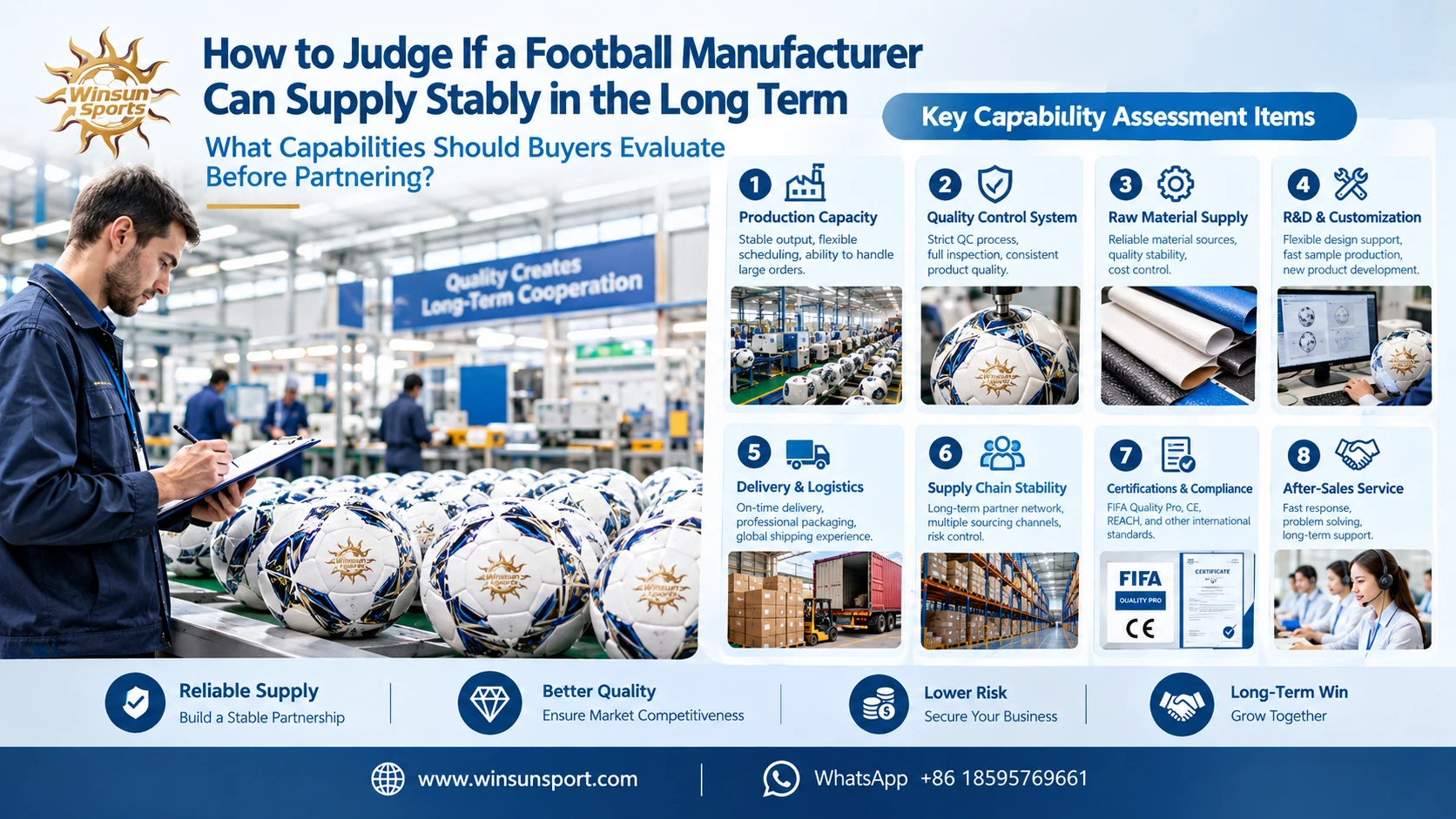
What long-term stable supply really means: it's not large production capacity, but consistency in every delivery
Buyers often equate "long-term stable supply" with a manufacturer's large production capacity. But large production capacity only indicates how much can be delivered at one time; it does not indicate whether the next batch will still be the same ball. For evaluating long-term stable supply from a football manufacturer, true stability means: when the same configuration is ordered repeatedly, the delivered leather feel, air retention performance, softness or firmness underfoot, and workmanship details all fall within an acceptable range, and the delivery time can be clearly stated in advance.
Three verifiable signals of stable supply: locked configuration, batch consistency, and communicable delivery time
Locked configuration. After sample confirmation, whether leather thickness, bladder type (thread bladder, rubber thread bladder, PVC bladder), etc. form written specifications, and whether subsequent repeat orders are executed according to the same specifications. If every order requires re-confirmation, it means the configuration has not been locked, and the prerequisite for batch consistency in custom footballs is lacking.
Batch consistency. Don't just look at the sample; look at the second and third batches. A verifiable approach is: for each batch received, spot-check air tightness, roundness, foot feel softness/hardness, and appearance workmanship, and compare them with the first batch's retained sample.
The retained sample is the baseline for judging consistency.
Delivery times are negotiable. Stability does not mean always fast; it means the manufacturer can inform you in advance of the production schedule, whether peak season will cause delays, and how long in advance they will notify you of changes. Only when delivery information is transparent can the buyer arrange downstream shipping.
Why a good sample does not mean stable bulk production: the stage where buyers are most likely to misjudge
Samples are usually produced in small batches with individual attention, and the leather cutting, bladder assembly, and inflation resting may all be more meticulous than in mass production. Once it enters mass production, the variables increase: differences in the feel of leather from different batches, bladder supply switching, worker shift changes, and rushing to compress resting time can all cause fluctuations in air tightness and foot feel. What buyers most easily misjudge is precisely taking "satisfied with the sample" directly as "no problem with mass production," skipping the two steps of configuration locking and batch sampling inspection.
So to evaluate long-term supply capability, the key is not to ask "how large is your production capacity," but to ask: can the configuration of this ball be fixed? What standard is used for acceptance on repeat orders? How far in advance will changes in delivery time be notified?
Once these three points are clearly confirmed, then discuss price and quantity.
Customization capability assessment: whether leather thickness and bladder configuration can be locked according to the order
From sampling to sealed sample: how leather thickness and lining type become acceptable specifications
During evaluation, it is recommended to ask follow-up questions along this chain:
- What basis is used to measure thickness: Is it the thickness of a single layer of leather, or the overall thickness after lamination?With different bases, the same number can correspond to very different hand feel.
- What is the tolerance range: Customization does not mean every piece is accurate to the same value; it is necessary to confirm the allowable fluctuation range in mass production and how out-of-range cases are handled.
- Whether a sealed sample is retained: After the sample is confirmed, each party shall retain one signed sample as the benchmark for comparison in subsequent batches.Without a sealed sample, acceptance inspection has no reference object.
- What is the acceptance inspection action?: After arrival, is it sampling thickness testing, or only appearance and air pressure checks?This determines whether the thickness specification can truly be locked down.
If the supplier can only give descriptions like "approximately" or "usually it is," it means the thickness has not yet been specified, and the risk of batch drift will increase during long-term supply.
Optional inner bladder does not mean interchangeable: applicable differences among thread bladders, rubber thread bladders, and PVC bladders
Thread bladders, rubber thread bladders, and PVC bladders are three different configurations, not three price tiers of the same ball. During evaluation, the focus is not on asking "what types are available," but on clarifying the intended use positioning and consistency assurance for each type:
- Thread bladder: Usually associated with scenarios requiring high foot feel and airtightness, it is necessary to confirm whether the winding process is stable and whether it is consistent between batches.
- Rubber thread bladder: It is necessary to clarify the combination of rubber material and winding method, as well as the air pressure retention performance after long-term storage.
- PVC bladder: The cost structure is different, making it suitable for scenarios with more budget sensitivity, but it is necessary to confirm whether elasticity and durability match the actual use.
Key follow-up questions:Can a single order lock in a single bladder type and keep it consistent in subsequent repeat orders? If a supplier switches bladder types between different batches without prior notice, the balls the buyer receives will have uncontrollable differences in feel and lifespan.
The buyer also needs to provide the supplier with usage scenarios, usage intensity, and storage conditions, so that the supplier can recommend matching leather thickness and bladder configurations based on these, and write them into the order terms.
Batch consistency and delivery communication: how to use a question checklist to assess suppliers
Assessing a supplier's batch consistency and delivery communication capabilities cannot rely on visiting showrooms and listening to promises; you need to make them answer with specific mechanisms. The checklist below can be taken directly into the factory or a video conference.
What to ask about batch consistency: the traceability chain from raw material batches to finished product sampling inspection
Start by asking about raw materials: are leather, bladders, and yarn stored by batch and are batch numbers recorded? When changing batches, is a first-article confirmation performed? Then ask production: if the same order is completed over several days, how can you be more confident that the feel of products from different shifts is consistent?
Finally, ask shipping: at what ratio is sampling inspection of finished products done, and which items are checked—appearance, roundness, airtightness, or feel?
The key is not to hear "we control it very strictly," but to get the other party to state a traceable chain:which batch of raw materials, which line, which shift, which sampling inspection record。 If the other party can only answer "no problem," it indicates that a traceability mechanism may not have been established. For the buyer, this means that when batch differences appear later, you cannot locate the cause or demand targeted corrective action.
Delivery communication mechanism: milestone feedback is more reliable than verbal promises
Delivery reliability is not about whether they can deliver on time, but abouthow long it takes them to tell you when a problem arises, and in what manner they tell you。 You can ask: Is the production schedule broken down into several milestones: raw materials in place, start of production, semi-finished products, packaging, and shipment? Who provides feedback at each milestone, through what channel, and how long a delay triggers an alert?
One signal you can use to judge is: whether the other party proactively provides amilestone feedback tableorregular progress updates, rather than waiting for you to follow up. If a supplier only gives you a final delivery date and provides no feedback in between, then once there is a problem with raw materials or production capacity, you often only find out close to the delivery date, and your room to restock and adjust downstream plans will be squeezed.
For long-term procurement, batch consistency determines the return rate, and delivery communication determines your inventory and delivery rhythm. These two capabilities cannot be fully confirmed through a single factory audit. It is advisable to first use a small batch order to test whether the other party's traceability records and milestone feedback are actually delivered, and then decide whether to scale up.
Who to recommend and who not to recommend: what situations are suitable for deeper cooperation, and what situations are not worth adding complexity
The prerequisite for deeper cooperation is not "this factory looks good," but that your needs are stable enough for you to clearly specify the configuration, batch, and after-sales responsibility. If you cannot clearly explain these three things, the deeper the cooperation, the greater the room for disputes later.
Profile of a supplier suitable for deeper cooperation: configuration can be locked, batches can be traced, and after-sales responsibility can be attributed
- Configurable and lockable: You can clearly define the leather thickness, bladder type (thread bladder, rubber thread bladder, PVC bladder) and the corresponding usage scenarios, rather than "make a batch first and see."The earlier the configuration is locked, the more controllable the deviation between sample confirmation and bulk delivery.
- Batch traceability: What you want is not one good batch of balls, but consistency in every batch.When a club purchases training balls and match balls at the same time before the season, the training tier focuses on durability and replacement rhythm, while the match tier focuses on whether the feel and air tightness are consistent. This kind of tiered demand is suitable for long-term cooperation with a football manufacturer that can stably reproduce configurations.
- After-sales attribution: When air tightness or workmanship problems occur, it is possible to identify whether the issue lies in the batch, storage, or usage stage, rather than making a vague return.Cross-border transportation and long-term warehousing bring changes in air pressure, temperature, and humidity. Only suppliers willing to cooperate in defining responsibilities during delivery and acceptance are worth deepening cooperation with.
Situations where adding complexity is not recommended: procurement with frequently changing requirements or that only looks at unit price
- Requirements are still changing frequently: today they want training balls, tomorrow they switch to gift commemorative models, and the day after they change the bladder configuration again.At this point, locking down configurations and batches is meaningless. A small-batch trial order to validate the direction is more cost-effective than directly discussing long-term cooperation.
- Procurement that only looks at unit price: the unit price is low, but the replacement frequency is high, which in training scenarios actually drives up the total cost over the usage cycle.If procurement decisions only compare unit prices and do not account for sampling inspection and after-sales handling costs, deeper cooperation will only amplify the problems caused by low prices.
- No plan to conduct sampling inspection upon arrival: Skipping acceptance inspection and directly warehousing and distributing means batch issues will flow downstream, and the cost of returns and reputation damage is far higher than the inspection step saved.Under such a process, there is no basis for discussing long-term stable supply.
The budget should be calculated based on the total cost over the usage cycle, but it does not have to be done all at once: the training layer focuses on durability and replacement rhythm, the competition layer focuses on consistent feel and airtightness, while also reserving costs for sampling inspection and after-sales handling. If the current need is only for casual entertainment or gifts and commemorative items, it is more reasonable to control the budget by unit price, and there is no need to pay for extra complexity for long-term supply capability.
Frequently Asked Questions
Q: We only use it for on-campus teaching and training. Do we need to negotiate it as a long-term cooperation? A: When the usage for teaching and training is stable and the replacement rhythm is predictable, it is worth discussing configuration locking and batch consistency;If it is just a one-time supplementary batch, it can be handled as a single purchase.
Q: After the custom sample is confirmed, can we place a bulk order directly? A: Sample confirmation only resolves whether this one piece is correct. For bulk production, you also need to confirm whether the leather thickness and lining configuration can be reproduced in subsequent batches. It is recommended to verify with a small batch first before discussing long-term volume.
Q: How do you judge whether a football manufacturer is worth deeper cooperation? A: See whether it can work with you to clarify three things: specifications, batches, and after-sales attribution. Only when all three can be put into specific agreements should you discuss deeper cooperation;if any one of them is vague, just maintain a simple purchasing relationship for now.
Q: When the budget is limited, should priority be given to training balls or match balls? A: It depends on the main use. If daily training is the main use, prioritize the durability and replacement rhythm of the training layer;if there are matches or requirements for a professional feel, then reserve budget for the air tightness and consistency of the match layer.
For specific layering options, confirm with the Winsunsport team.
Learn more
If you are preparing an inquiry for custom soccer balls, you can first organize the usage scenario, target quantity, leather thickness specification, and bladder type; the Winsunsport team will use this to help match a configuration plan and provide acceptance recommendations for sampling and repeat orders.