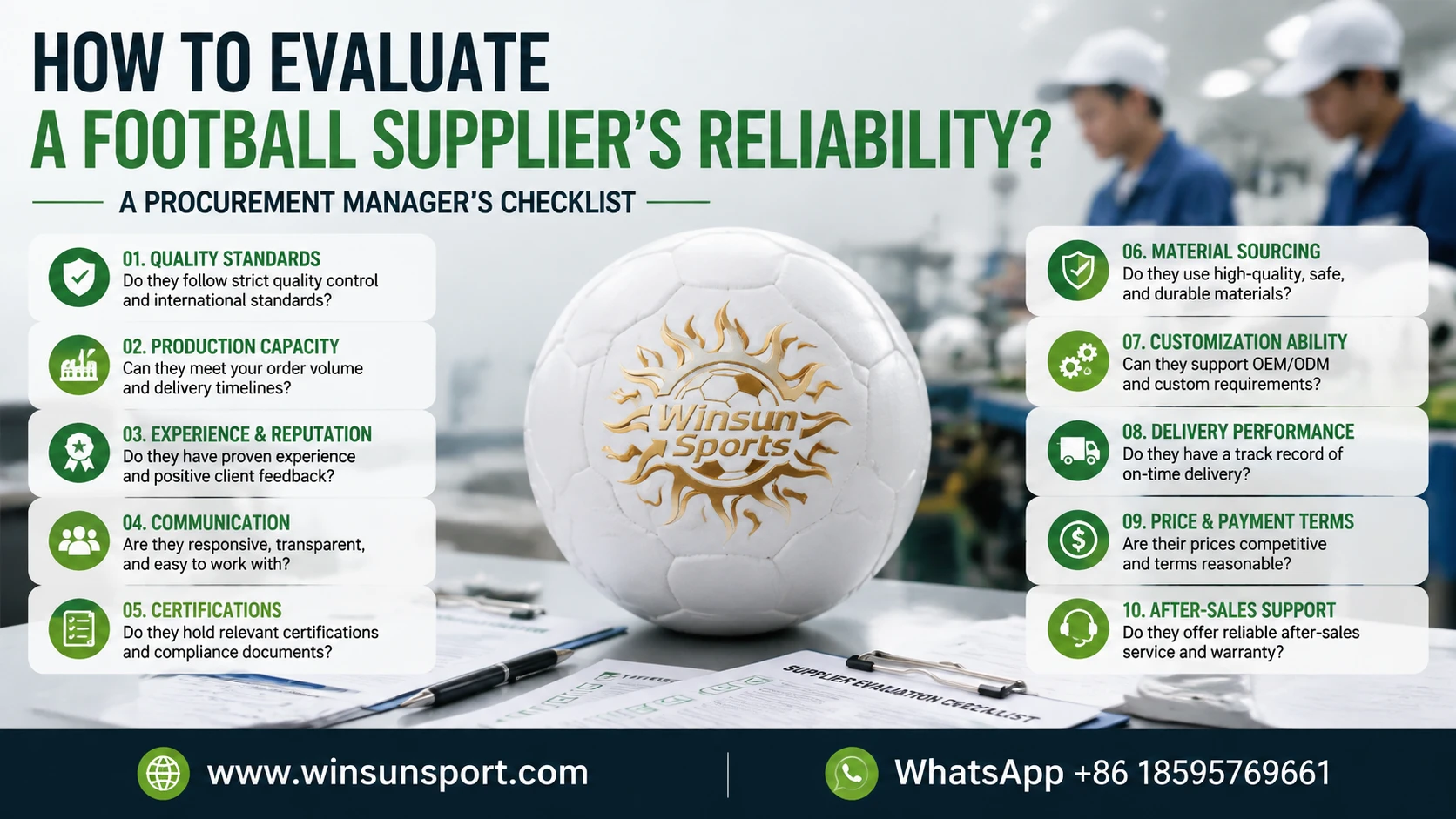
Why is supplier reliability more important than the unit price of a single product when purchasing footballs?
When purchasing footballs, the unit price is the easiest indicator to compare, but it is also the most likely to mislead decision-making. The procurement cost of a football is not just the price at the moment of purchase, but the total cost over its entire life cycle. If the supplier is unreliable, the unit price difference saved will often be paid back double in subsequent losses, restocking, and communication costs.
Looking at the long-term impact of supplier evaluation from a procurement mistake.
Suppose you purchase a batch of footballs at a price 15% below market price; on the surface, the budget control looks excellent. But three months later, a chain reaction like this may occur:
- Unstable quality: The thickness of the football leather in the same batch varies, and some balls show glue failure or deformation after two weeks of use. Frequent ball changes during training disrupt the pace of the class.
- Delivery Delays: Due to insufficient supplier capacity or scheduling chaos, orders for the back-to-school season are delayed by two weeks, forcing adjustments to physical education plans and emergency purchases from retail channels at higher unit prices.
- No After-Sales Support: When quality issues arise, suppliers shirk responsibility with excuses like "no returns on customized products" or "improper use," leaving you to bear the cost of losses, find new suppliers, and repeat the entire evaluation process.
These risks combined can make the per-ball cost 20%-30% higher than if you had chosen a reliable supplier from the start, not to mention the time and effort you personally invest in coordination. Price is explicit, but reliability is implicit—and it is often the implicit costs that determine the success or failure of procurement.
The Underlying Logic of Reliability Assessment: Full-Chain Risk from Product to Delivery
To judge whether a supplier is professional, you cannot only look at the samples or quotation sheets they provide. The capability of a reliable supplier is reflected in every link from product parameters to delivery and fulfillment.
To judge professionalism from product parameters, focus on three key points:
- Whether the leather thickness and material can be clearly specified。A professional supplier can clearly explain what usage scenarios (training, matches, children's balls) correspond to different leather thicknesses, rather than vaguely saying "good quality."If the other party cannot even clearly explain the applicable differences in leather thickness and bladder types (thread bladder, rubber thread bladder, PVC bladder), the quality is likely to be uncontrollable in subsequent batch deliveries.
- Bladder type and air retention testing standards。The bladder directly determines the ball's elasticity and air retention duration.Professional suppliers will proactively explain the pros and cons of different inner containers, as well as whether there is an air-tightness testing process, rather than just emphasizing unverifiable conclusions like 'excellent air-tightness'.
- Boundaries of Customization Capability。If you need to customize the logo, color, or size, can the supplier clearly inform you of the minimum order quantity, sample production cycle, and color difference control range?These parameters directly determine whether your project can be completed on schedule.
To judge professionalism from the delivery process, look at three actions:
- Whether they proactively offer samples or small-batch trial order plans, rather than pushing for large orders from the start;
- Whether they clearly communicate production cycles, logistics milestones, and contingency plans for unexpected situations;
- Whether they clearly specify quality acceptance standards and after-sales handling procedures in the contract.
Who should prioritize supplier reliability? For customers such as schools, clubs, and brands that need bulk purchasing and long-term repeat orders, supplier reliability is almost more important than any single product specification. **Who can be more flexible?
** For individuals buying one or two soccer balls for personal use, simply choose from in-stock items with clear product specifications; there is no need to go through a full supplier evaluation process.
Next confirmation steps: Ask the current website team for the leather thickness options for this series of soccer balls, the applicable scenario descriptions corresponding to the bladder types, and the minimum order quantity and sampling lead time for custom orders. Once these three pieces of information are confirmed, you can determine whether this supplier is worth adding to your long-term partnership list.
Five core dimensions for evaluating soccer ball suppliers: a complete checklist from production capacity to after-sales service
When procurement managers evaluate football suppliers, the two things they fear most are: samples passing but bulk production failing, or the first batch delivering smoothly but subsequent batches having quality fluctuations. To avoid these pitfalls, you cannot just look at samples and quotation sheets; you need to conduct systematic verification from five dimensions. Taking customizable footballs like the Durable Pro Football for Field as an example, each dimension has specific questioning methods and verification actions.
Production capacity and quality control: How can you confirm that the supplier can stably produce footballs that meet requirements?
Production capacity is not about how large the factory is, but whether it can stably produce goods that meet standards within your delivery time. You need to confirm three things:
- Capacity and scheduling: Ask about the factory's monthly capacity, current order saturation, and whether your order volume will affect normal scheduling.If the other party says "we can do it anytime," be wary—only small workshops without a scheduling concept would answer that way.
- Quality Control Points: Key quality control points in football production include leather cutting, inner bladder air tightness testing, stitching/gluing processes, and finished product inflation and pressure retention testing.What you need to ask is: at which stage are these tests performed, what is the sampling rate, and how are non-conforming products handled.Durable Pro Football for Field offers three inner bladder options: thread-wound, rubber thread-wound, and PVC. The air tightness testing standards and costs vary for different bladders, so you need to confirm the specific testing methods and acceptance criteria with the factory.
- Batch Consistency: Ask the supplier to provide batch inspection records from previous similar orders.If they cannot provide them, at least include in the contract that "a test report must be provided before each batch shipment, and the buyer has the right to conduct random inspections."
Customization Capability and Lead Time: Four Questions You Must Confirm in OEM/ODM Projects
Durable Pro Football for Field supports full-dimensional customization, including leather thickness, bladder type, size, color, logo printing, etc. But "supporting customization" and "being able to deliver stably according to your requirements" are two different things. In OEM/ODM projects, you must confirm the following four questions with the supplier:
1. What is the minimum order quantity (MOQ) for customization? Different customization items may have different MOQs. For example, changing the color may require a minimum of 500 pieces, but printing the logo may require a minimum of 1000 pieces.
If the MOQ for a certain customization item is much higher than your purchase quantity, you need to consider whether it is worth increasing inventory costs for it.
2. Where are the process boundaries for customization? Not all designs can be realized. For example, leather thickness can be customized, but what is the thickness range?
What usage scenarios are the three types of inner liners suitable for? Does logo printing support screen printing, heat transfer, or embroidery? These process boundaries determine whether your design plan needs adjustment.
It is recommended to directly provide your design draft and usage scenario to the Winsunsport team to confirm process feasibility.
3. How are the sampling cycle and sampling fee calculated? Confirm how many days sampling takes, whether it is charged, and whether the sampling fee can be deducted from the bulk order. More importantly: how can you be more confident that the sample and the bulk production will be consistent?
Require the supplier to state in the contract that "bulk production must be carried out according to the confirmed sample standards."
4. How is the delivery lead time calculated? How many days are needed from sample confirmation to bulk shipment? Does this lead time include holidays and transportation time?
If your usage scenario has a clear deadline (such as school opening or event hosting), you should agree on liability for delay in the contract.
After-sales service: the dimension most easily overlooked but with long-term impact on cooperation
Football is a consumable item, especially in school physical education classes and amateur club training scenarios, where wear and tear and air leakage are highly likely. You need to confirm the supplier's after-sales policy:
- Warranty scope: Within what period of normal use can you get a free replacement for issues like peeling, air leakage, or deformation?What is the replacement process, and who bears the shipping costs?
- Restocking convenience: If you need to restock the same football after six months, will the supplier retain your customized pattern files?Are the minimum order quantity and unit price for restocking the same as for the initial order?
- Usage Guide: What field types and usage frequencies are suitable for different bladder and leather thicknesses?Can the supplier provide clear selection recommendations rather than leaving you to trial and error?
Suitability Assessment
When to Choose Durable Pro Football for Field: Your usage scenario is clear (e.g., school physical education classes, amateur club training, brand OEM/ODM), with requirements for durability and air retention, and you need customized sizes, colors, or logos. Its three bladder options and customizable leather thickness allow you to make tiered procurement based on field type and budget.
When Not Suitable: If your procurement goals are still changing frequently (for example, you are not sure whether it is for competition or training, or you are not sure about the procurement quantity), or what you need is not just the football itself but a complete sports equipment solution, it will be more efficient to clarify your needs first and then discuss supplier evaluation.
Next confirmation steps: Provide the Winsunsport team with your usage scenarios (field type, frequency of use, age of users), target procurement quantity, and customization requirements (size, color, logo process), and ask them to give specific recommendations on leather thickness and bladder selection, as well as the corresponding MOQ and delivery lead time. This way, you can turn "evaluating suppliers" into a concrete matching plan.
Which procurement scenarios are suitable for choosing Durable Pro Football for Field?In which cases is it not recommended?
Schools, clubs, and brand owners: adaptability analysis of three typical scenarios
School physical education classes: The key to ball selection is durability, safety, and size matching. The durable leather material of Durable Pro Football for Field and the optional inner bladder structures (thread bladder, rubber thread bladder, PVC bladder) can withstand frequent impacts on concrete and plastic courts, and support customized sizes and colors, making it convenient to distinguish balls by grade. It is suitable for procurement managers to place bulk orders at the beginning of the semester, once equipping training balls for different grades.
If the school budget is extremely tight and only pursues 'just can kick', the customization attributes and workmanship standards of this product may exceed needs, and a basic model can be considered.
Amateur club artificial turf training: The wear on the ball surface from artificial turf is much higher than natural grass, and the field is harder, with direct feedback on feel. The wear-resistant and durable characteristics of this product exactly correspond to high-frequency training scenarios, and moderate elasticity can also reduce the difficulty of ball control caused by hard ground rebounds. It is recommended to choose the rubber thread bladder version, which has more stable air tightness and is not easy to soften after long-term training.
If the club training frequency is extremely low (less than once a week), or the field is natural grass, the wear-resistant advantage is not so critical, and you can choose another based on feel preference.
Brand OEM customization: Supports full-dimensional customization (logo, color, leather thickness, inner bladder), with stable batch supply, suitable for gifts, promotional campaigns, or building your own brand. Note: The minimum order quantity and lead time directly affect cost; different combinations of leather thickness and inner bladder result in significant unit price differences. Before OEM, clarify whether the target market is children or adults, and whether the main sales channel is online or offline, then determine the specification combination to avoid a single-spec initial inventory and subsequent slow sales.
Boundary of supplier evaluation: When is a more complex customization solution needed?
If the procurement needs involve the following situations, Durable Pro Football for Field may be just the starting point rather than the end:
- Need for specific certifications or competition standards: If the product is intended for official leagues or must meet specific association standards, first confirm whether the current specifications meet the target event requirements, then decide whether to upgrade the customization solution.
- Multiple specifications in parallel, tight delivery schedule: If the brand owner requires multiple sizes, various leathers, and different inner bladder combinations simultaneously, with phased delivery, it is necessary to confirm with the team whether production capacity and scheduling can cover the requirements.
- Long-term brand visual consistency: If the OEM products need to maintain visual consistency across categories (e.g., footballs, jerseys, equipment bags), football customization is only one part; the overall supply chain coordination needs to be evaluated.
Conclusion boundary: If your scenario is bulk procurement for schools, high-frequency training for amateur clubs, or a first OEM trial order for a brand owner, and you have clear expectations for specifications and budget, the Durable Pro Football for Field is a suitable choice. If your need is 'to see what can be done first' or 'standards are not yet defined', it is recommended to first clarify the size, playing surface, target audience, and budget range, then confirm the specific specification combinations and minimum order quantity with the Winsunsport team, avoiding premature commitment to a solution when requirements are not yet defined.
How to use this evaluation checklist to make the final procurement decision?
The evaluation across the five dimensions ultimately comes down to one decision: whether this Durable Pro Football for Field is worth purchasing. Converting the evaluation results into comparable scores only requires a simple table.
From Evaluation to Decision: Converting the Five Dimensions into Comparable Scoring Criteria
Score each dimension on a scale of 1 to 5, where 5 means it fully meets your requirements and 1 means it does not meet them at all. When scoring, do not rely on intuition; instead, judge based on your actual usage scenarios.
| Evaluation Dimension | Criteria for a Score of 5 | Criteria for a Score of 3 | Criteria for a score of 1 |
| Wear-resistant and durable | Mainly used on artificial turf and hard courts, with high frequency of use | Average field conditions, moderate frequency of use | Mainly used on natural grass, with low wear pressure |
| Air tightness | Requires long continuous training or matches without changing the ball | Occasional breaks, can add air in between | Short single-use duration, minimal impact on air tightness |
| Foot feel and elasticity | Users are sensitive to ball touch feedback and require stable, consistent elasticity | Has requirements for foot feel but not overly demanding | Mainly used for decoration, gifts, or low-intensity entertainment |
| Workmanship and durability | Expected usage period exceeds one season, and budget is limited | Can accept replacement once per semester or every six months | Used very infrequently, differences in workmanship are not noticeable. |
| Custom adaptation | Need unified team logo, specific size or color scheme | Have customization needs but can accept standard models | No customization needed at all, standard models are sufficient |
Scoring method: Add the scores of the five dimensions, with a total of 25 points. Above 20 points, this product matches your needs very well, and you can proceed directly to supplier communication;15-19 points, the match is moderate, and you need to confirm with the supplier whether adjustments can be made for the low-scoring dimensions;Below 15 points, it indicates that your core needs may not be within the strengths of this product. It is recommended to first clarify which indicators you value most.
Next steps: What key questions should you ask the supplier?
After completing the scoring, contact the Winsunsport team with the following questions. These questions directly determine whether the solution is feasible, so do not skip them.
Regarding product adaptation:
- My playing surface is artificial turf. What leather thickness in millimeters is most suitable?How do I balance durability and feel?
- What is the difference in lifespan between thread bladders, rubber bladders, and PVC bladders in actual use?What frequency of use is each suitable for?
- If the users are mainly teenagers or children, what size and weight options are available?
Regarding customization options:
- What is the minimum order quantity for custom logos and color schemes?How long does the sampling cycle and mass production cycle each take?
- What is the price gradient for different leather thicknesses and inner liner combinations?Which configuration tier can I choose within my budget?
Regarding procurement assurance:
- What is the production capacity and delivery time for bulk supply?If I need to replenish stock later, is it possible to place additional orders with the same batch and specifications?
Frequently Asked Questions
Q: If all five dimensions score around 3, does that mean I shouldn't choose this product? No. A total score of around 15 indicates that the product meets basic usage needs, just without outstanding advantages.
At this point, you should return to the original usage goal: if it's just for daily fitness or casual entertainment, a score of 15 is sufficient;if it's for professional competitions or long-term high-frequency training, it is recommended to confirm with the supplier whether the performance in corresponding dimensions can be improved by customizing the leather thickness and inner bladder.
Q: With a limited budget, which dimension should be prioritized? It depends on the usage scenario. For school procurement or youth training, prioritize durability and workmanship, because the frequency of use is high and wear is fast;For amateur club training, prioritize feel and bounce, because they directly affect the training experience;If it is for gifts or promotional purposes, prioritize custom adaptation, and other dimension requirements can be relaxed.
Q: How far in advance should I place an order for custom footballs? This depends on the complexity of the customization. Simply changing the color scheme and logo is usually faster than adjusting the leather thickness and inner bladder structure.
The specific timeline needs to be confirmed with the Winsunsport team. It is recommended to reserve time for both sample confirmation and mass production in your procurement plan to avoid affecting your usage schedule.
Q: How do I determine whether I need a standard or custom football? Standard footballs are suitable for individuals or small groups with a single usage scenario, no brand identity requirements, and small purchase quantities. Custom footballs are suitable for schools, clubs, and brands that need a unified image, specific specifications, or bulk purchases.
If you only need one or two for personal use, the standard version is sufficient;if you need team uniformity or brand exposure, the customized version is more suitable.
Learn More
If you are evaluating football procurement solutions for a school, club, or brand project, feel free to contact the Winsunsport team with your usage scenarios and customization needs, and we will assist you in confirming the specification combinations, minimum order quantity, and delivery lead time.
Related Products:Durable Pro Football for Field