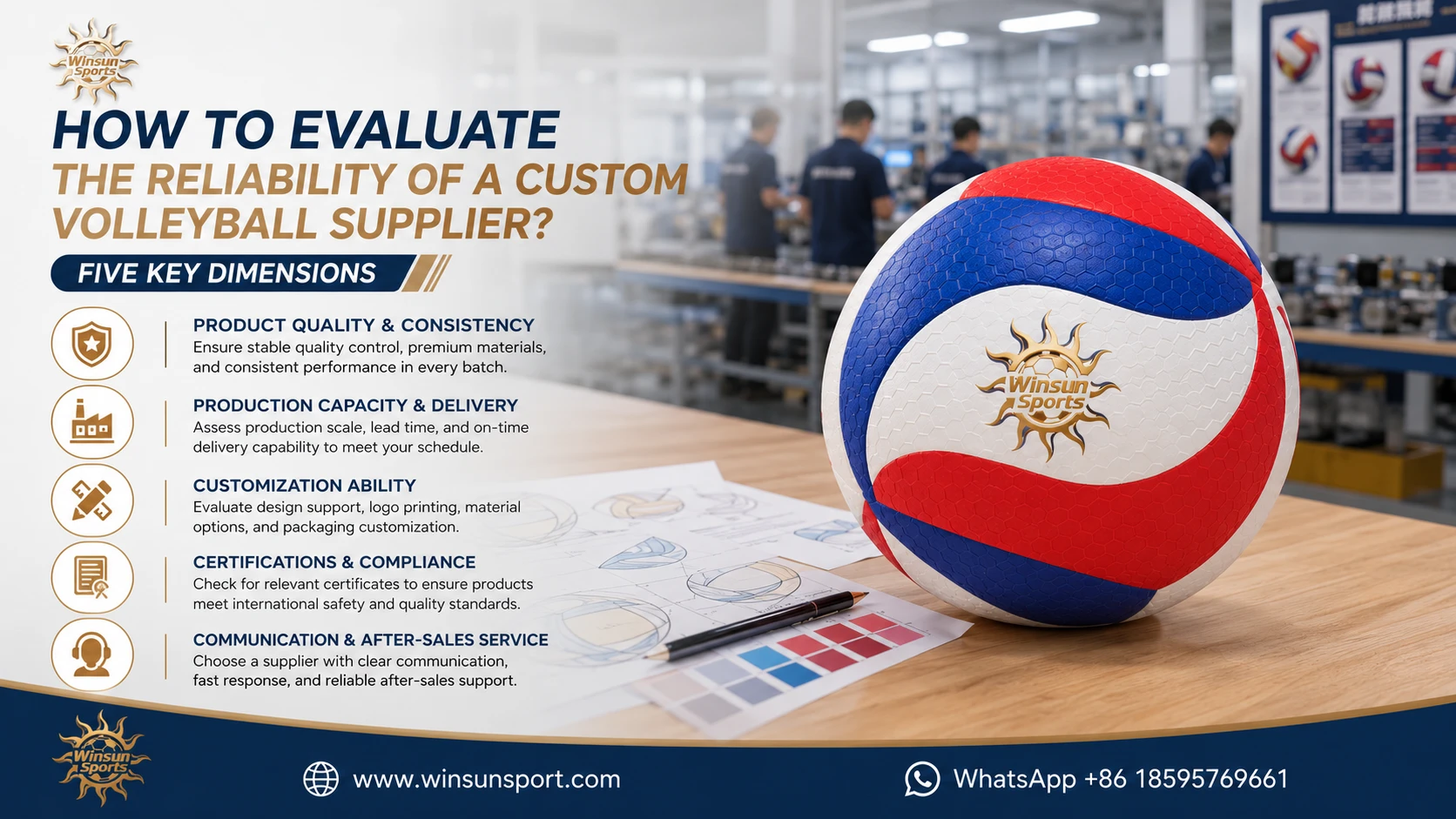
Why is it said that evaluating a custom volleyball supplier cannot be based only on samples and quotes?
When purchasing custom volleyballs, upon receiving the sample, the feel was good, the printing was clear, and the colors were accurate, making it easy to make a decision on the spot. But samples are only the side the supplier wants you to see; what truly determines whether the cooperation goes smoothly is often hidden beyond the samples and the quotation sheet.
Good samples do not equal batch stability: the quality gap from a single ball to full batch production
The samples were hand-picked, and may even have been produced with a separate machine setup and dedicated production supervision. During mass production, the same process may yield completely different results across different batches and in the hands of different operators. Specifically, you need to confirm these issues in addition to the samples:
- Print Color Difference: The logo on the sample has vibrant colors. Can the same color code be maintained in mass production?Will there be visible color differences between different batches?
- Ball consistency: Can the weight and circumference of mass-produced balls be controlled within the standard range?If some balls in a batch are heavier and some lighter, the feel will be inconsistent during training and matches.
- Durability of the outer cover and inner bladder: The samples are fine when first received, but after several weeks of continuous use, will the PU cover be prone to wear and the inner bladder prone to air leakage?This requires the supplier to provide explanations of materials and workmanship, rather than just looking at the condition of new balls.
Next, confirm the action: Request the supplier's batch production quality sampling standards, such as how many units are sampled per batch, which indicators are tested (weight, circumference, rebound, air tightness), and how non-conforming products are handled.
Low quotation does not mean low total cost: hidden communication and rework costs
The unit price on the quotation is only the explicit cost. Volleyball customization involves multiple stages such as pattern design, printing position, color matching, and packaging. Any miscommunication in any stage can lead to rework and delays.
A low quotation usually means the supplier has cut corners in the following areas:
- Design confirmation process: Without dedicated design liaison personnel, revisions are slow, confirmation cycles are long, and the time cost of back-and-forth communication often exceeds the savings from the lower unit price.
- Sample production limit: Low-cost options may include only one free sample, with additional modifications requiring extra fees. Volleyball printing effects (especially light-colored patterns on dark balls) often require multiple adjustments to achieve the desired result.
- After-sales response: If quality issues are found after bulk delivery, the return and exchange process of low-cost suppliers may be slow, and you may even need to bear round-trip shipping costs.
Key trade-offs: If the purchase quantity is small, the pattern is simple, and color accuracy requirements are not high, the low-cost option may suffice.However, if complex patterns, multi-color printing, or the need to arrive before the event are involved, communication efficiency and after-sales response are more important than unit price.
Next, confirm the action: When comparing prices, include the number of samples, whether design modifications are charged, and how quality issues after bulk delivery are handled in the inquiry sheet. Ask suppliers to respond clearly, then compare total costs.
Dimension 1: Is the printing process durable?Will the logo fall off after a few games?
Logo peeling on custom volleyballs is usually directly related to the printing process. To assess process durability, first distinguish among three mainstream methods:
Heat transfer printing: The pattern is first printed on a film, then transferred to the ball surface through high temperature and high pressure. Its advantage is high color reproduction and the ability to create gradients and complex patterns, but there is a physical interface between the film layer and the PU surface, and after prolonged friction or bending, the edges may lift. It is suitable for scenarios with limited budgets and low usage frequency.
Silk-screen printing: Ink is directly scraped onto the ball surface, and adhesion depends on the compatibility between the ink and the PU material. Abrasion resistance is acceptable, but pattern details and color layering are not as good as heat transfer; large color blocks may result in a thicker ink layer and a stiffer feel.
Seamless high-temperature heat lamination: The pattern layer is fused with the PU surface at high temperature, without an additional adhesive layer or stitching. This process creates a tighter bond between the logo and the ball surface, making it less prone to delamination when bent, and is currently one of the more durable options for volleyball customization. The Winsunsport volleyball uses this high-temperature seamless heat lamination process, combined with a stitch-free design, avoiding the problem of premature wear at traditional seam lines.
How can you judge printing durability through sample testing? Don't just take the supplier's word for it; get samples and run two tests:
- Friction test: Use your fingernail to scrape firmly across the logo edge 10 times. It passes if there's no peeling or color fading.Heat transfer and screen printing may reveal problems at this step.
- Bend test: Fold the ball firmly at the logo area and hold for 5 seconds, repeat 10 times, and observe whether the pattern cracks or separates from the surface.This simulates the deformation the ball undergoes when struck hard during a game.
Key trade-offs: If the balls are for frequent use by a school team or club, seamless high-temperature heat bonding is a more reliable choice;If it's just for event souvenirs or occasional play, heat transfer offers better cost-effectiveness. Before placing an order, confirm with the Winsunsport team whether samples can be provided for both tests, and whether bulk orders use the same craftsmanship as samples—some suppliers use good craftsmanship for samples but switch to cheaper processes for mass production. This must be clearly stated in the contract.
Dimension 2: Are the ball's material and performance up to standard?Is PU soft leather really durable?
When buyers see "PU soft leather," they often worry it's a cheap substitute. In the context of indoor volleyball, this judgment needs to be reconsidered.
PU soft leather vs. genuine leather: performance comparison in indoor volleyball scenarios
On indoor hardwood floors, PU soft leather generally outperforms genuine leather in durability and ease of maintenance.
| Comparison Item | PU Soft Leather | Genuine Leather |
| Abrasion Resistance | Surface microporous structure is not prone to cracking | After long-term use, surface cracking may occur |
| Sweat Absorption and Anti-Slip | Microporous anti-slip particles perform consistently | Slippery when dry, requires regular maintenance |
| Weight stability | Almost no water absorption, constant weight | Significant weight gain after moisture exposure |
| Maintenance cost | Just wipe it | Requires humidity-controlled storage and regular care |
The key factors affecting the lifespan of PU volleyballs areCraftsmanship and structure, rather than the material itself. This Winsunsport volleyball uses high-temperature seamless heat-bonding technology with no stitching, structurally eliminating the common cause of scrapping in traditional stitched balls—"thread unraveling."
Performance from specifications: size, weight, bladder, and yarn winding layer
This volleyball is a standardsize 5 adult professional volleyball, with key parameters as follows:
- Ball circumference 65–67cm, weight 260–280g: Conforms to the standard range for size 5 balls.Circumference affects flight trajectory and blocking judgment; if too light, the ball drifts easily, and if too heavy, it increases wrist strain.
- Butyl rubber airtight inner bladder: Airtightness is superior to ordinary natural rubber, maintaining inflation longer after pumping, reducing the hassle of frequent re-inflation during training.
- Multi-layer thickened nylon fiber winding yarn: Determines the ball's ability to maintain its shape.Whether the wound yarn layer can quickly restore the ball to a perfect round shape after hard hits depends directly on its thickness and winding density;Balls with insufficient winding are prone to deformation after extended use.
Selection Advice: For school procurement or long-term training use, PU soft leather combined with seamless heat bonding and multi-layer wrapped yarn is a reliable choice for indoor settings. You can confirm the number of yarn layers and the warranty period with the supplier. Beginners should choose PU soft leather, as its shock-absorbing properties are more forgiving than genuine leather, reducing the impact on the wrists when catching the ball.
Dimensions 3, 4, and 5: How to comprehensively weigh MOQ, delivery lead time, and supplier qualifications?
The first two dimensions help you determine whether the product itself is up to standard, but what truly determines whether the cooperation can proceed smoothly is often the latter three things: whether the MOQ fits your budget, whether the delivery lead time meets your schedule, and whether the supplier is reliable. These three factors are interrelated and need to be weighed together.
Balancing MOQ Flexibility and Inventory Risk
There is no industry-wide standard MOQ for custom volleyballs; it varies greatly among different factories due to differences in processes and production line arrangements. Custom balls made with high-temperature seamless hot-patch technology typically have a higher minimum order quantity than ordinary printed balls, because hot-patching requires separate plate making and machine adjustment, and this cost is factored into the unit price of each ball.
You need to first clarify the nature of your procurement:
- Unified procurement by schools or teams: Generally, the quantity is large, so the minimum order quantity is usually not an obstacle. Instead, what you need to pay attention to is—whether there is space to store the extra inventory and whether the style might become outdated across semesters.
- Event souvenirs or club activities: The quantity is small but the requirements are unique. At this point, you should ask clearly: What is the minimum order quantity?If you cannot meet it, are there options for group ordering or simplified processes?How much will the unit price increase?
The key trade-off is:The lower the minimum order quantity, the higher the cost per ball;The higher the minimum order quantity, the greater the inventory risk. If you are purchasing for the first time and are unsure about the actual frequency of use, it is recommended to start with a trial batch at the minimum order quantity, and then reorder after confirming the quality of the balls and the pattern effect. If the budget is sufficient and the usage scenario is clear (such as using uniform balls for school-wide physical education classes), ordering the full quantity directly can secure a better unit price.
Delivery Cycle Assurance: Time Management from Sampling to Bulk Arrival
The production process for custom volleyballs involves two key additional steps compared to purchasing finished balls:Pattern confirmation and samplingThese two steps are often the most time-consuming and prone to repeated revisions.
A reasonable timeline expectation is:
- Design confirmationAfter providing the logo and artwork, the factory will produce a mockup, which typically takes 2-3 business days.
- Sample confirmationThe physical sample is shipped out, and including shipping time, it generally takes 5-7 business days.It is recommended not to skip this step—the actual colors and effects of spherical printing may differ between viewing images and inspecting the physical sample.
- Mass production: After sample confirmation, the production cycle depends on the quantity and typically takes 10-15 working days.
- Logistics and Shipping: Domestic express delivery takes 2-4 days, while cross-border logistics requires an additional 7-15 days.
From order placement to receipt of goods, allowing a total of 3-4 weeks is relatively safe. If you have a specific event or school start date, it is recommended to work backward from that date and confirm the current production schedule with the website team before ordering—during peak season when capacity is tight, the cycle may be extended.
What aspects should be examined when evaluating a supplier's qualifications?
For customized products, supplier qualifications are not just about the business license, but more importantly, whether it can demonstrate itsstable delivery capability for custom processesSpecifically, focus on four points:
- Custom cases and physical references: Request to see photos or physical samples of similar custom volleyballs, focusing on whether the pattern edges are clear, color reproduction, and whether they peel off after long-term use.
- Match of process description: Confirm whether the process described by the other party (such as high-temperature heat lamination, screen printing, heat transfer) matches the complexity of your pattern.Gradient colors and fine lines require higher process standards.
- After-sales handling mechanism: Ask clearly how printing defects or obvious color differences will be handled after bulk arrival—whether it is a replacement or refund, and how responsibility is defined.
- Communication response speed: During the customization process, the design draft needs to be confirmed repeatedly, and a supplier with slow response will prolong the entire cycle.
FAQ
Q: What is the minimum order quantity for customized volleyballs? The MOQ varies depending on the process and factory scheduling. The MOQ for customized balls using thermal bonding is usually higher than that for ordinary printed balls. For the specific quantity, you need to confirm the minimum order threshold and corresponding unit price with the current website team based on your purchase quantity and pattern complexity.
Q: How long does it take from ordering to receiving the goods? It is recommended to reserve 3-4 weeks. Among them, design confirmation takes 2-3 days, sampling 5-7 days, and mass production 10-15 days, plus logistics time.
If you have a specific event date, it is recommended to contact us in advance to confirm the current production schedule.
Q: Will the custom pattern easily peel off after printing? This depends on the process and the surface material of the ball. This product uses PU soft leather combined with high-temperature heat lamination process, ensuring good adhesion between the pattern and the ball surface.
However, actual durability also depends on usage frequency and field conditions. It is recommended to request a physical sample for abrasion testing during the sampling stage.
Q: What if I cannot meet the minimum order quantity? You can ask if there are alternative solutions to lower the MOQ, such as simplifying the pattern process or adjusting the size specifications. However, note that lowering the MOQ usually means the cost per ball increases, so you need to weigh whether the total budget is acceptable.
Q: What if quality issues are found after bulk delivery? Before placing an order, be sure to confirm the after-sales handling mechanism with the current website team, including color difference standards, defect judgment standards, and the reshipment process. It is recommended to keep the pre-production sample as a reference for batch acceptance.
Learn More
If you are planning a custom volleyball procurement for a school or team, feel free to submit your design, quantity, and expected delivery date. The Winsunsport team will provide process advice and MOQ solutions.
Related Products:Red, blue, and silver striped No. 5 professional indoor volleyball, customizable logo