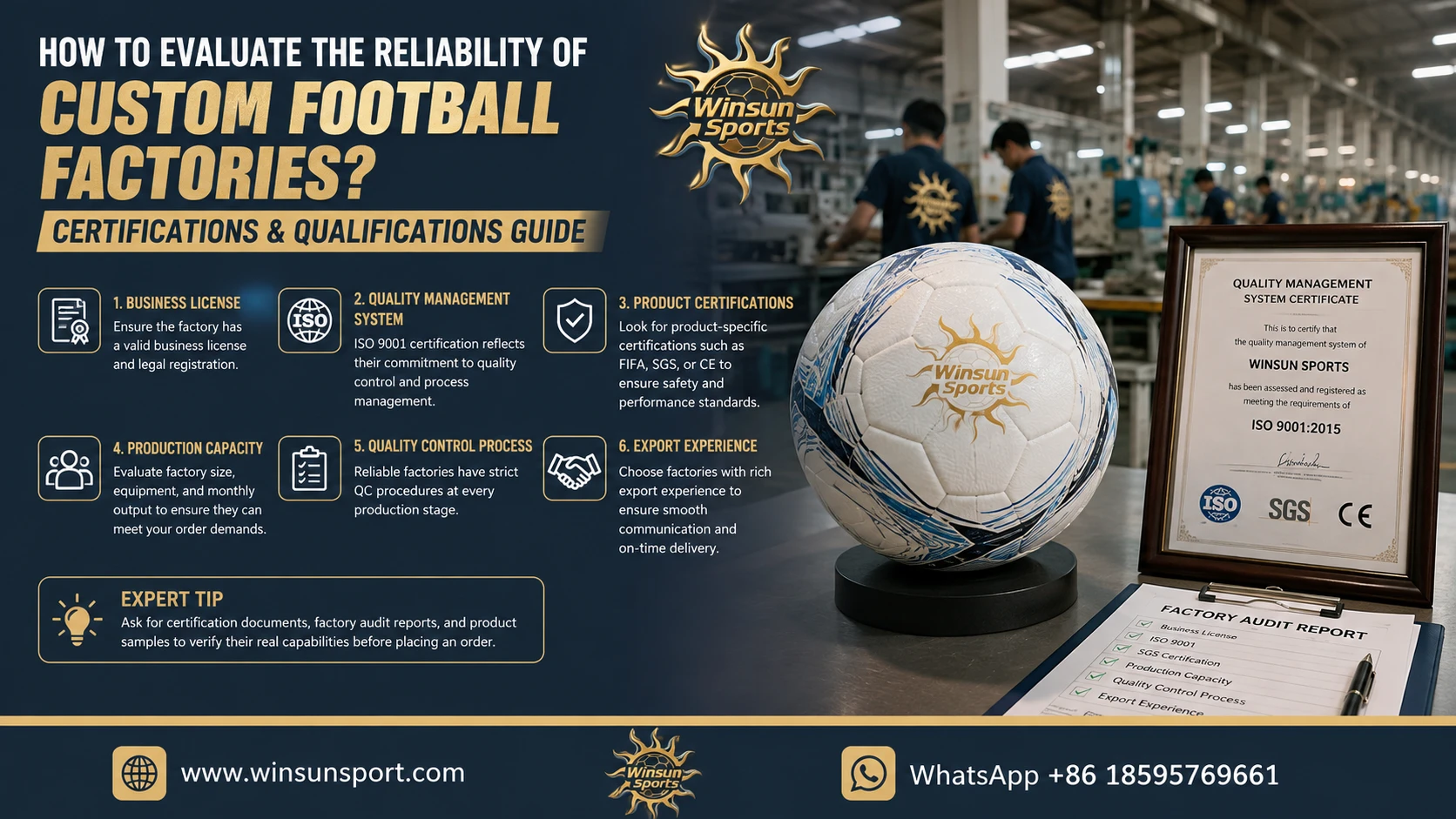
Why is certification documentation the first threshold for evaluating a custom soccer ball factory?
When sourcing custom soccer balls, certification documentation is the fundamental basis for judging whether a factory has stable production capabilities. For customized products like the Black base with silver dots and red striped pentagram customizable No. 5 PU soccer ball, it is necessary to distinguish the different roles of two types of documents.
The difference between factory-level certification and product-level certification: what should be looked at respectively?
Factory-level certification(such as ISO 9001, BSCI) proves the factory's management system and social responsibility compliance. ISO 9001 indicates that the factory has quality control processes, while BSCI involves labor rights and environmental standards. This type of certification answers the question of 'whether this factory is reliable', but does not directly prove the quality of a specific soccer ball.
Product-level test reportFor a specific soccer ball, test items such as abrasion resistance, rebound, air tightness, and print adhesion each correspond to actual performance in use. The logic is:Factory-level certification is the entry ticket; the product-level test report is the acceptance checklist. If a factory only has an ISO certificate but cannot provide a product test report, it means it may not have conducted quality verification for the customized ball model.
For this customized PU soccer ball, which specific test reports should the factory be required to provide?
For the Black base with silver dots and red striped pentagram customizable No. 5 PU soccer ball, it is recommended to focus on the following test items:
| Test items | Corresponding usage risks | Suggested requirements |
|---|---|---|
| Abrasion resistance test | Surface peeling or cracking due to field friction | Provide abrasion resistance cycle data for this PU leather material |
| Rebound rate test | Ball feel too hard or too soft, affecting passing and shooting experience | Provide measured rebound rate values |
| Air tightness test (24-hour pressure drop) | The ball leaks air quickly and needs repeated inflation. | Provide 24-hour pressure drop test records. |
| Print adhesion test | Custom LOGO and patterns peel off or fade. | Provide adhesion test results between ink and PU leather surface. |
Among them,Print adhesion testis the most easily overlooked item for custom balls. The large black spliced panel of this ball is the main printing area. If the printing layer does not adhere firmly, the team badge or sponsor logo may fall off after a few games.
Verifying the authenticity of certificates: Do not just look at copies. The ISO 9001 certificate should include the name of the issuing body (such as SGS, TÜV, BV). Go to the official website of that body and check the certificate number.BSCI can be verified by entering the factory ID on its official platform. Also check that the factory name and address on the certificate match the contract entity, and request the original data of the test report.
If the factory can only provide the conclusion page and cannot provide the original data, the credibility of the report should be judged with caution.
Besides looking at certificates, why do factory audits and sample tests better reflect the true level of the factory?
A certificate can only prove that a factory is "capable" of producing to a certain standard, but it cannot prove that "this batch" of goods will be delivered to the standard you require. Especially for custom footballs, the printing process, stitching precision, and leather thickness—these aspects that directly affect the user experience—are precisely where certificates fall short. Factory audits and sample testing are the two key steps that turn "paper compliance" into "physical compliance."
Video factory audit or on-site factory audit: which production processes should be the focus of inspection?
If conditions permit, prioritize a video factory audit—most factories now accept this method, and it is low-cost while covering key checkpoints. Whether on-site or via video, focus on four key processes:
- Printing workshop: Check whether the printing equipment uses screen printing or heat transfer, and inspect the brand and storage conditions of the ink/dye.Custom footballs are most prone to printing fading and cracking; the age of equipment and operational standards directly affect the lifespan of the finished product.
- Stitching workstation: Footballs are stitched manually or semi-automatically; check whether workers align according to the pattern and whether the stitching tension is consistent.Misaligned stitching can cause the ball to deform, affecting its flight trajectory.
- Quality inspection process: Ask what tests are performed before shipment—how long is the inflation pressure held?Is printing adhesion checked on every ball?Are there sampling inspection standards?If they can't answer, it means quality control relies on luck.
- Leather material warehouse: Check the thickness and batch markings of the PU leather.If the same batch of goods mixes leather from different batches, there will be subtle differences in color and feel, especially noticeable on large pure black panels.
From the Black base with silver dots and red striped pentagram customizable No. 5 PU soccer ball, we can see the key points of quality control for custom printing.
The core customization area of this ball isthe large pure black panel, which is precisely the area where printing quality control is most prone to issues. Pure black backgrounds have extremely low tolerance for defects—slight color differences, particles, and bubbles are immediately visible on a dark base. During factory audits, for such large-area dark-colored customizations, two additional points must be confirmed:
- Ink coverage and adhesion: When printing colored team emblems or logos on black substrates, light-colored inks (such as white or yellow) need sufficient coverage to avoid showing the base.Request the factory to provide printed samples on dark panels of the same color series, and test adhesion by scratching with fingers or using tape, rather than just looking at color swatches.
- Printing registration accuracy: Large-area pure black panels mean there are no reference lines at the edges of the printing area, making pattern misalignment very obvious.Confirm whether the factory has positioning jigs or CCD vision positioning equipment, rather than relying on workers' naked-eye alignment.
How should sample testing be done to be meaningful? Don't just order a plain ball to check the appearance. Ask the factory to print your actual design on a black backing panel identical to your final design,then do three things: inflate it and leave it for 48 hours to check pressure retention;scratch the printed design with your fingernail a few times to see if the color fades;roll it a few times on rough ground to see if the printed layer wears off.These three tests cover 90% of daily usage risks.
These three items can cover 90% of daily usage risks.
Who should skip the factory audit and place an order directly? If your order quantity is very small (for example, a few dozen pieces), you have low requirements for printing precision, and your budget is limited, sample confirmation is sufficient. But if you are purchasing in bulk for a school team, event customization, or corporate gifts, with considerable quantity and amount, the factory audit step cannot be skipped—it confirms not just "can they do it," but "will this batch of goods have problems."
Which factory qualifications and product details directly determine the long-term user experience of customized footballs?
When purchasing customized footballs, what truly determines whether this batch of balls can still be used normally after half a year is the leather material and the bladder.
The impact of PU material and bladder selection on durability
PU, TPU, and PVC materials differ significantly in wear resistance and feel:
| Material | Abrasion resistance | Feel | Applicable scenarios |
|---|---|---|---|
| PU | Good | Moderate hardness, clear touch on the ball | Training, school team matches, amateur leagues |
| TPU | Best | Firmer, with strong elastic feedback | High-intensity matches, frequent use |
| PVC | Average | Firmer and slippery | Low-intensity recreation, children's beginner |
Regarding the inner bladder, the thread bladder is formed by winding multiple layers of yarn, providing uniform elasticity and good air retention.The rubber-wound bladder balances air retention and elasticity, with durability superior to ordinary rubber bladders.PVC bladders have the lowest cost, but they are prone to slow air leakage or deformation after a period of use. For daily training of school teams, it is recommended to choose wound bladders or rubber-wound bladders; for corporate team building or souvenir purposes, PVC bladders are sufficient to meet basic needs.
Assessing the practical durability of custom soccer balls from the Black base with silver dots and red striped pentagram customizable No. 5 PU soccer ball
This product features a high-toughness, wear-resistant PU surface with a thickened treatment, and a high-density particle anti-slip layer on the surface, balancing wear resistance and grip, suitable for high-frequency use scenarios such as school team training and amateur matches. However, it should be noted that PU also comes in grades—differences in leather thickness, particle density, and coating technology can result in a twofold difference in actual lifespan.
When purchasing, it is recommended to: ask for the specific leather thickness and particle density, clearly include the bladder type in the procurement contract, and require the factory to provide samples from the same batch for kicking and stepping tests to observe whether the surface peels or the stitching cracks. Only after confirming these parameters can the long-term user experience of custom soccer balls be ensured.
How to use a checklist to screen out unqualified custom football factories before making an inquiry?
In the procurement process for custom footballs, the most expensive part is not the sample fee, but the moment you receive a batch of balls with misprinted team logos, peeling or fading colors, or delivered three weeks late, and you still have to grit your teeth and hand them out to your players. Spending twenty minutes going through the checklist below before making an inquiry can help you avoid most of the pitfalls.
5 Must-Ask Questions: From Certifications to After-Sales Terms
Don't start by asking, "What can you do?" Instead, ask the following five specific questions first. How the other party answers will tell you more than the content of the answers themselves:
- "What is the thickness and weight of the leather material for this ball? Can it be written into the contract?” The most common place for cutting corners in custom balls is the leather material."Do you want PU or TPU, and what thickness? Put the specific requirements directly into the contract terms.If the other party is vague and says "roughly the same" or "industry standard," directly downgrade them.
- What printing process is used?How many times has the abrasion test been conducted?” Large-area LOGO customization is most prone to color fading.Ask clearly whether it is screen printing, heat transfer printing, or sublimation printing, and whether abrasion resistance tests have been done.If the other party says "our quality is very good" but cannot provide test data, ask for samples to test abrasion yourself.
- What is the color difference control standard between samples and mass production?” The LOGO color of custom footballs will inevitably differ from what is seen on screen; the key is how significant the difference is.Ask the other party whether they accept production based on the sample color after sample confirmation, and how to handle color differences beyond the acceptable range in bulk production.
- "How is the delivery cycle calculated? What are the penalties for delays?” School team leagues and corporate team-building events have fixed dates; a one-week delay ruins the entire event.Clarify from which date the production cycle starts (sample confirmation date or deposit receipt date), and whether there are penalty clauses for delays.
- "How is after-sales service handled?How are compensations handled for air leakage, seam opening, and color fading respectively?” Football is a consumable, but it is abnormal if more than 5% of a batch has quality issues.Ask clearly how long the warranty period is, at what ratio replacements or refunds are provided, and who bears the shipping costs.
When should you raise your requirements for the factory?When can the process be simplified?
Not all purchases require equally strict audits; the key lies in your usage scenario and risk tolerance.
Situations that require strict audits:
- Large-volume purchases (e.g., more than 500 units), because errors are magnified and return/exchange costs are extremely high
- Complex multi-color logos or gradient patterns on the ball surface, which are difficult to print
- For souvenirs used in official competitions or distributed to the public, the quality directly represents your brand image.
- There is a strict delivery date, for example, the items must be present on the day of the event.
Situations where the process can be simplified:
- Small batch trial orders (e.g., 20-50 pieces) to first verify quality and effect, then decide whether to scale up.
- Simple one-color or two-color LOGO with low printing risk.
- Used for daily training rather than formal occasions, with less stringent requirements for details.
- Sufficient time is available, and repeated adjustments after sampling are acceptable.
Quality clauses that must be included in the contract: Leather material and thickness, printing process and color difference range, delivery date and liability for delay, warranty period and compensation ratio for quality issues. These four items are indispensable; the rest of the terms can be flexible.
If you are unsure which category your situation falls into, or whether this custom black-background silver-star pentagon ball suits your usage scenario, directly explain your purchase quantity, playing field, and LOGO complexity to the Winsunsport team, and they will provide corresponding sampling and review suggestions.
Frequently Asked Questions
What certification documents for custom footballs should be mainly checked?
Mainly check factory-level certifications (such as ISO 9001, BSCI) and product-level test reports.Factory-level certifications prove the management system, while product-level test reports directly reflect the football's wear resistance, rebound, air tightness, printing adhesion, and other performance. Both are indispensable.
How can I verify the authenticity of certification documents?
Check the name of the issuing organization on the certificate (such as SGS, TÜV, BV), and verify the certificate number on the organization's official website;BSCI can be verified by entering the factory ID on the official platform.Also check that the factory name and address on the certificate match the contract entity, and request the original data of the test report.
What key aspects should be focused on during a factory audit?
Focus on the printing workshop (equipment and ink), lamination station (registration and stitching), quality inspection process (factory testing items), and leather warehouse (thickness and batch labeling).For large-area dark-colored customization, additionally confirm ink coverage and printing registration accuracy.
How should sample testing be done to be meaningful?
Ask the factory to print the actual pattern on a panel identical to your final design, then do three things: inflate it and leave it for 48 hours to check pressure retention;Scratch the printed pattern with your fingernail to see if the color fades;Roll it a few times on rough ground to check for wear.These three items cover most daily use risks.
In which cases can factory audits be simplified?
Small trial orders (20-50 pieces), simple logos in one or two colors, for daily training rather than formal occasions, and when you have ample time to accept repeated adjustments.In these cases, sample confirmation is sufficient, and strict factory audits are not necessary.
Learn More
If you are customizing footballs for a school team, event, or corporate procurement, feel free to contact the Winsunsport team.Tell us your purchase quantity, playing surface, and logo complexity, and we will provide corresponding sampling suggestions and audit support to help you reduce procurement risks.
Related products:Black base with silver dots and red striped pentagram customizable No. 5 PU soccer ball