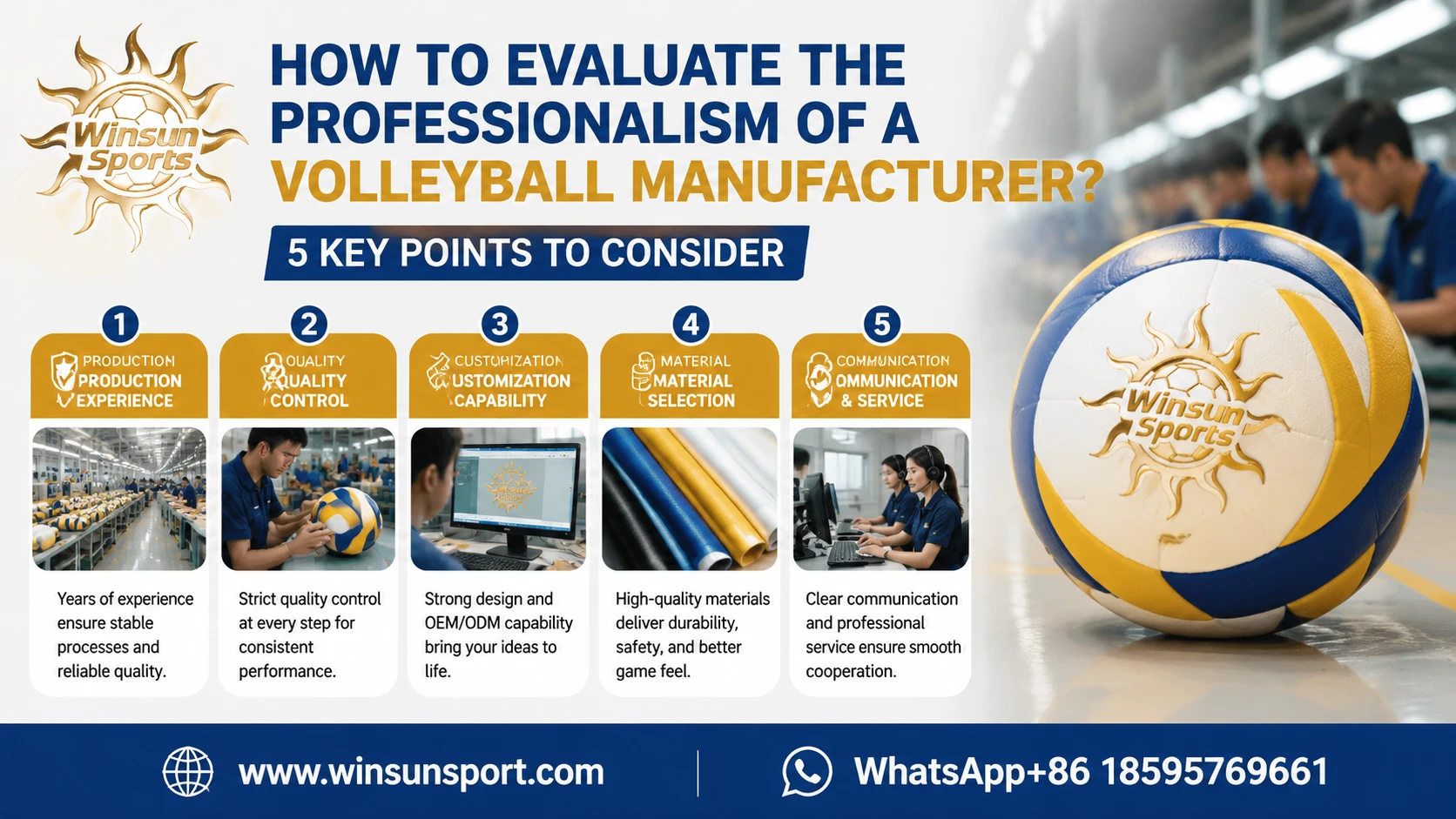
Why should you evaluate the professionalism of the manufacturer before purchasing custom volleyballs?
Custom volleyballs are not standard products; the supplier's capability directly determines the quality of the finished product.
A custom volleyball is essentially a different thing from a finished ball you pick up from the shelf at a sporting goods store. Finished balls are mass-produced by factories according to fixed formulas, and quality fluctuations are backed by the brand;However, for custom volleyballs, from the ball material, inner bladder structure, to surface printing, every step may deviate from the regular production line due to your personalized needs. This means that the manufacturer you choose is not just 'producing' the ball, but also making technical decisions for you at multiple stages.
Take surface printing as an example. Ordinary printing only requires printing a logo on a flat surface, but a volleyball is a curved sphere with anti-slip granular texture on its surface. If the manufacturer lacks experience in heat-applied patches and curved surface printing, the printed patterns may have edges that lift, colors that appear dull, and may even start peeling after a few weeks of use.
Another example is the bladder: the difference in air retention between a butyl rubber airtight bladder and a regular rubber bladder is not visible to the eye; it can only be noticed after actual use over time—and by then, the return or exchange period has already passed.
So, custom volleyballs are not as simple as 'picking a design and placing an order.' Materials, craftsmanship, printing, and quality control—any deficiency in any of these areas will directly reflect in the final product. This is why the first step in procurement is not comparing prices, but rather assessing whether the manufacturer has the capability to turn your requirements into a qualified ball.
Evaluating a manufacturer's professionalism is essentially about reducing procurement risks.
People who procure custom volleyballs typically do not buy just one. For school physical education classes, team training, or corporate events, orders are often for dozens or even hundreds of balls at a time. At this scale, the risks are cumulative: if the ball material is substandard, students will feel the wrong touch when practicing, affecting teaching effectiveness;if the printing peels off, the school emblem on event souvenirs will be blurred, affecting the image of the school or enterprise;if the inner bladder leaks, the time and communication costs of after-sales rework far exceed the unit price difference saved initially.
Evaluating a manufacturer's professionalism essentially comes down to answering three questions: **Has it made similar products before? Can its production line consistently replicate the same quality? If problems arise, does it have the capability to solve them?
** Unless these three questions are clarified, no matter how low the price, it's just a number on paper.
Specifically, for inspection actions, you can start from these directions: ask the manufacturer to specify the exact specifications and sources of the ball material;Confirm whether the printing process is hot lamination or screen printing, and the corresponding abrasion resistance test standard;Understand whether the minimum order quantity and production lead time match your procurement plan;If possible, request sample balls with the same process and actually play a few times before deciding. This information doesn't require you to become a volleyball manufacturing expert, but it can help you filter out most factories that lack customization capabilities.
For Winsunsport's yellow-blue wave contrasting volleyball, it uses an 8-panel integrated hot lamination process, microporous anti-slip PU soft leather, and a butyl rubber airtight inner bladder. These parameters already point to a certain level of process threshold. But whether your procurement scenario, budget, and usage frequency match the positioning of this ball still needs to be judged based on your specific needs—this is exactly what the next section will elaborate on.
Inspection Point 1: Production Equipment and Process Capability Determine the Basic Quality of the Volleyball
When purchasing volleyballs, many people first look at the leather material and then the pattern, but what truly determines whether a ball lasts one semester or three to five years often lies in the craftsmanship. Behind the craftsmanship lies the manufacturer's investment in production equipment.
Thermal bonding vs. stitching: How equipment differences affect durability
Traditional stitched volleyballs use needle and thread to sew the panels together, requiring low equipment barriers, so even small workshops can do it. But the stitching is a natural weak point—under prolonged hitting, friction, and sweat erosion, the seams are the first to unravel. Deformation of the ball and lifting of the panels usually start near the stitching.
Thermal bonding is completely different. It relies on high-frequency heat pressing equipment, where the edges of the panels are melted at high temperatures and pressed together, without needle and thread. The equipment investment is far higher than that of a stitching production line, but in return you get:
- Seamless construction: Eliminates the weakest point of stitching that is most prone to damage, allowing for more uniform force distribution across the ball.
- Better air retention: The sealing of heat-bonded seams is superior to needle holes, maintaining bladder pressure longer.
- Smooth surface: No seam grooves, providing more consistent ball handling and reducing dust accumulation.
From a durability perspective,with the same grade of leather, heat-bonded volleyballs typically have a significantly longer lifespan than stitched ones....especially suitable for high-frequency training and outdoor court use.
Craft details of the Winsunsport yellow-blue wave-pattern volleyball
Taking the Winsunsport yellow-blue wave-pattern volleyball as an example, it uses an 8-panel one-piece thermal bonding process, with no stitching visible on the surface. Combined with multi-layer thickened nylon fiber winding yarn and a butyl rubber airtight inner bladder, it forms a three-layer structure of "thermal-bonded cover—wound yarn layer—airtight inner bladder." The direct benefits of this structure are: the cover is less prone to delamination, the inner bladder is less likely to leak air, and the ball recovers its roundness more quickly after impact.
How to determine whether a manufacturer has thermal bonding production capability
An on-site factory audit is the most direct method, but if conditions are limited, you can quickly assess this through the following questions:
- Request the model and quantity of thermal pressing equipment—The heat-bonding production line requires dedicated high-frequency heat presses, and the number of machines directly reflects the production capacity ceiling.
- Ask about the leather cutting method.—Heat-bonding processes typically use CNC cutting, and cutting precision affects the flatness of the bonding.
- Request a cross-section sample of the finished product.—Cut open a finished ball to observe whether the fusion at the heat-bonding joint is uniform, and whether there are bubbles or delamination.
- Confirm whether there is an independent quality inspection step.—Heat-bonding processes are sensitive to temperature and pressure parameters, so seam strength needs to be tested on each ball.
If you plan to purchase in bulk, it is recommended to directly ask the Winsunsport team about the specific configuration and quality control process of the heat-bonding production line, and confirm whether their equipment capacity matches your order size and delivery schedule.
Inspection Point 2: Material Selection and Specifications - Do They Match Your Usage Scenario?
When purchasing a volleyball, the material and specifications directly determine the ball's actual performance. This section breaks down key parameters into their practical significance for your usage scenario.
PU Soft Leather, Bladder, and Wound Yarn: Three Key Materials Affecting Feel and Durability
Surface Material: Winsunsport's volleyball features micro-porous anti-slip PU soft leather, with fine concave dots on the surface to enhance friction, maintaining stable ball control even with sweaty hands;it also offers a soft touch with some shock-absorbing effect, making it suitable for beginners practicing long-duration bumping drills. In contrast, PVC leather is harder and smoother, with lower cost, but the feel is stiffer, and it tends to slip in sweaty or dusty environments, making it more suitable for low-frequency use or budget-constrained scenarios.
Inner bladder material: The airtightness of a butyl rubber inner bladder is superior to that of a latex bladder, allowing it to maintain air pressure longer after inflation and reducing the hassle of frequent re-inflation before training.
Winding layer: Multiple layers of winding enhance the ball's roundness and resistance to deformation, preventing bulging under repeated impacts, which directly affects the volleyball's lifespan.
What the standard size 5 specification means for campus teaching and team training
This Winsunsport volleyball is a standard size 5 adult specification, with a circumference of 65–67 cm and a weight of 260–280 g. This specification is the common standard for campus physical education classes and team training: students use the same size from daily practice to competition, ensuring consistent feel;and teams do not need extra adaptation during training due to competition rules. It should be noted that if the users are lower primary school students or children's training institutions, a size 5 ball may be too large and heavy. It is recommended to confirm whether the specification plan needs to be adjusted.
Inspection Points 3 to 5: Sample Quality, Customer Cases, and After-Sales Service—How to Verify Quickly?
After discussing materials, craftsmanship, and specifications, the next three inspection points are what truly set suppliers apart. Samples don't lie, cases represent experience, and after-sales service determines whether you'll have peace of mind later.
Sample Testing: Not Just Feel the Texture, but Also Check Print Adhesion and Roundness
When you receive a custom volleyball sample, don't just bounce it a couple of times and call it good because the feel seems fine. You need to do four things:
1. Roundness check. Place the ball on a flat table and gently press the top with your palm while rolling it slowly. If the ball shows obvious bouncing or trajectory deviation during rolling, it indicates uneven winding of the bladder or inadequate heat-bonding process.
A standard size 5 ball should have very minimal roundness error, and no obvious eccentricity should be visible to the naked eye.
2. Print adhesion test. This is the most easily overlooked step for custom balls. Gently scrape the edge of the printed pattern with a fingernail, then firmly rub the pattern surface with a dry cloth.
If color fading, peeling, or edge lifting occurs, it indicates that the ink or heat transfer process is substandard—such a ball will have a smudged pattern after just two weeks of play. Balls like Winsunsport, which use high-temperature seamless heat-bonding technology, have patterns fused into the outer layer, so normal scraping should not cause them to come off.
3. Actual experience with the anti-slip layer. Microporous anti-slip PU leather is not just about feeling tacky to the touch. You can do a simple test: hold the ball with slightly sweaty palms and see if you can still grip it;then place the ball on a table, press it with your palm, and rotate it to feel whether the resistance is uniform.
If the anti-slip particles are unevenly distributed, you may experience localized slipping when catching the ball.
4. Cross-verification of weight and elasticity. Use an electronic scale to confirm the weight is within the 260–280g range, then drop it freely from a height of 1.8 meters onto a hard surface and record the rebound height. Test the same ball three times consecutively; the rebound height difference should not exceed 5 centimeters—if the difference is too large, it indicates unstable quality in the airtight bladder or the wound yarn layer.
Customer Cases and After-Sales Service: How to Determine if a Supplier Is Worth Long-Term Cooperation
Samples verify 'can they do it,' while cases and after-sales service verify 'are they reliable.'
When reviewing cases, focus on three questions:
- Do they have experience with similar scenarios? If they have handled custom orders for school teams, campus events, or corporate team building, it shows they understand the timelines for bulk delivery, the artwork approval process, and the mechanism for reordering to cover losses.If their cases are all small retail orders, you should question their ability to deliver on large-volume orders.
- How long have the balls in the cases been used? Ask the supplier to provide feedback from customers who have used the balls for more than six months or even a year.What volleyballs fear most is not that new balls are hard to play with, but that after two months they deform, separate, and fade in pattern.Only suppliers who can provide long-term usage feedback are trustworthy enough for long-term contracts.
- Is the customization process clear? Experienced manufacturers will proactively tell you: how many rounds of design confirmation are needed, how long the sampling cycle is, and what the allowable color difference range is between mass production and samples.If the other party cannot even explain these processes clearly, the subsequent communication cost will be high.
The criterion for after-sales service is simple:
- When quality issues arise in batch orders, is it a replacement or a repair? How long does the replacement take?
- Is peeling of printed patterns under normal use covered by the warranty?
- Will subsequent orders follow the original design files, or will re-sampling be required?
A special note here: different suppliers have very different definitions of "normal use." Some count training wear and tear as man-made damage, while others offer free replacement within six months for non-man-made quality issues. These terms must be confirmed in writing before placing an order, not just through verbal promises.
Suitable/Unsuitable Assessment:
- If your purchase volume is in the dozens or more and usage frequency is high (school team training, match balls), it is worth spending a week on sample testing and case verification—the rework cost of choosing the wrong supplier is far higher than the upfront investigation cost.
- If you are only buying a few trial packs or small batches for testing, still conduct sample testing, but you can be more lenient on case studies and after-sales, focusing mainly on confirming the return and exchange policy.
Frequently Asked Questions
Q: How long will the printed pattern on custom volleyballs last? It depends on the printing process and the intensity of use. For balls where the pattern is fused into the surface using a heat-transfer process, under normal indoor training use, the pattern's lifespan is basically the same as the ball's.
However, if used on rough surfaces or exposed to prolonged sunlight, the pattern will wear out faster. We recommend confirming with the Winsunsport team before placing an order whether your usage scenario falls within the process's applicable range.
Q: Will there be differences in quality between samples and mass production? It is possible. Samples are usually made individually and inspected one by one. The consistency of quality control during mass production depends on the supplier's inspection process.
It is recommended to specify the batch sampling standard and the maximum defect rate in the contract, and after receiving the bulk goods, sample-inspect roundness, weight, and print adhesion proportionally.
Q: If the school needs to purchase in batches, can subsequent orders maintain the same design? Yes, but only if the supplier retains your original design files and production parameters. Winsunsport supports subsequent orders based on the original design files without the need for re-sampling.
It is recommended to confirm the retention period of design files and the minimum order quantity for additional orders when placing the first order.
Q: Is this size 5 volleyball suitable for middle school students? The standard size 5 ball is the general specification for adult and middle school and above competitions, weighing 260–280g with a circumference of 65–67cm, meeting the requirements of domestic middle school physical education classes and school team training. If it is for lower elementary grades, we recommend consulting the Winsunsport team to see if there is a smaller size adaptation solution.
Q: For corporate team building customization of 50 balls, how long does it take from design to delivery? The time depends on the speed of design confirmation and the supplier's current production scheduling. The general process includes design confirmation, sample confirmation, mass production, and logistics transportation.
For the specific timeline, it is recommended to provide your event date directly to the Winsunsport team so they can work backward to plan the production schedule and confirm whether it can be met.
Learn More
If you are purchasing custom volleyballs for a school, team, or event, please share your usage scenario, order quantity, and expected delivery time with us.The Winsunsport team can assist in confirming the suitable process adaptation solution and production schedule based on your specific needs.
Related Products:Yellow and blue wavy pattern No. 5 PU heat transfer volleyball, customizable logo