Why is durability the first indicator to confirm when purchasing footballs?
When buying a football, most people first look at the price, then the brand, and only thirdly at whether it can withstand kicking. But what truly determines whether a ball is worth it is precisely this last, easily overlooked indicator. The reason is simple: a football is a consumable item, not a decorative piece.
A ball is repeatedly kicked, stepped on, smashed, and worn on grass, concrete, and plastic courts; durability directly determines the real cost per game you play—not the price tag on the shelf.
What hidden costs come with poor durability?
A ball that is not durable may seem to save money on the surface, but in reality, it shifts the cost elsewhere:
- Replacement frequency doubles: Low-durability balls may start to peel or crack after just a few weeks of play on rough ground, and the cost of buying two or three balls a year far exceeds that of one good ball.
- Training experience is interrupted: Deformed, deflated, or unevenly weighted balls cause erratic pass trajectories and a dull feel when shooting.For students or amateurs practicing basic skills, this 'bad habit builder' is worse than not playing at all.
- Maintenance time is occupied: Frequent pumping, checking for leaks, and dealing with peeling edges consume the time of coaches or parents.
So, to judge whether a ball is good, don't first ask 'how much does it cost,' but ask 'how long can it last and how many games can it be used for.'
What core components jointly determine durability?
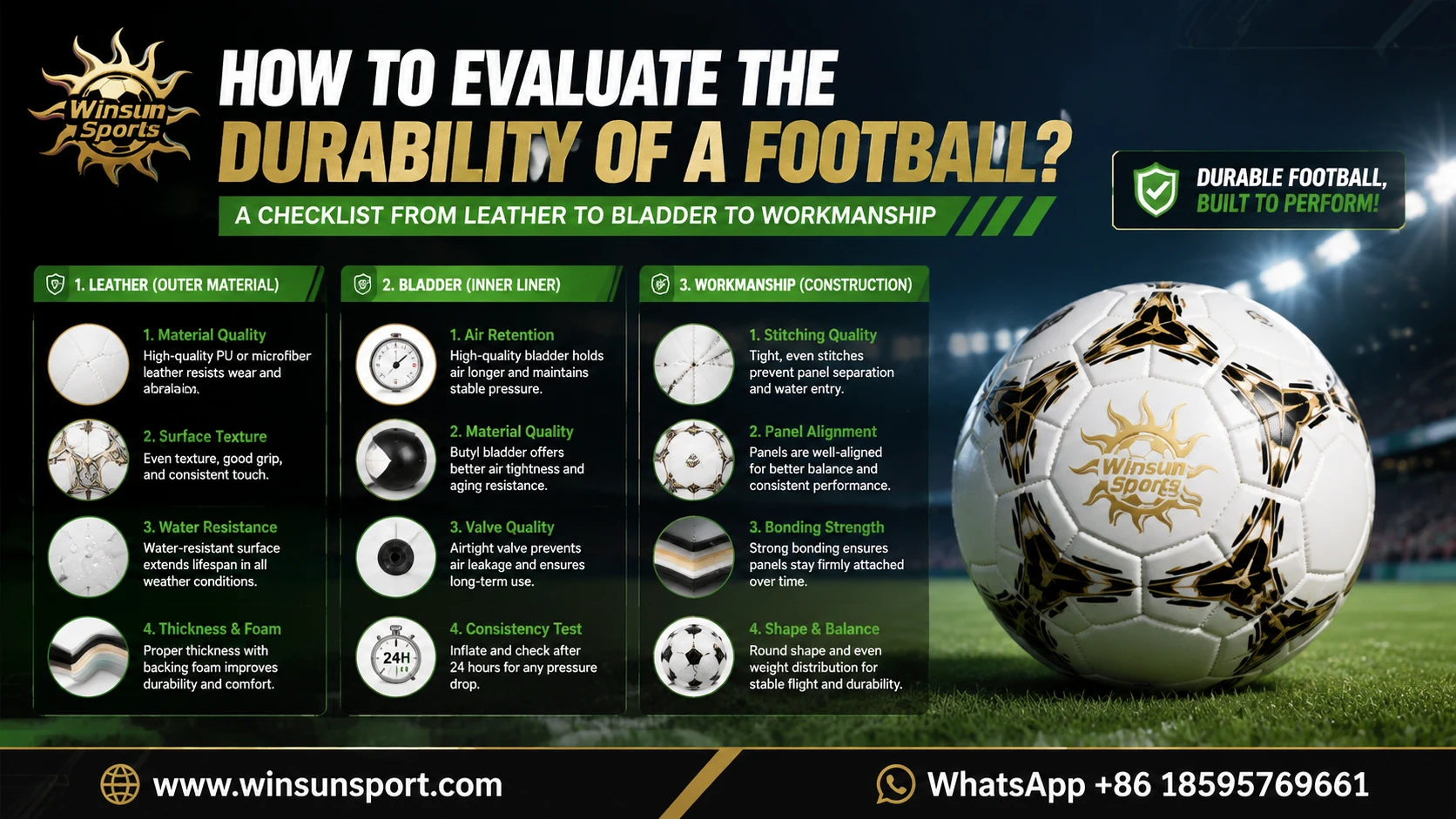
The durability of a football is not a single metric, but the combined result of three components:
Leather material: This is the part that directly contacts the ground and the foot. The thickness and material of the leather determine abrasion resistance and tear resistance. Leather that is too thin feels soft underfoot, but cannot withstand friction on concrete surfaces;leather that is too hard is durable but sacrifices comfort.
The key is to find a thickness balance that matches your usage scenario.
Inner bladder: This is the core factor that determines whether the ball "holds air". Common types include thread bladder, rubber thread bladder, and PVC bladder. Thread bladder has the best air tightness, but the cost is high;PVC bladder is cheap, but its air tightness deteriorates quickly;Rubber thread bladder is the middle option, balancing air tightness and cost.
If you buy a ball for long-term use rather than one-time events, the bladder type deserves more attention than the brand logo.
Workmanship: This includes the stitching method of the panels, the bonding process, and the overall structural strength. A well-made ball deforms uniformly under force, without local bulges or seam cracking.
This is also why you can't judge a ball just by brand or price—big brands have low-end lines, and small factories can also produce highly durable balls. The key is not 'who made it,' but 'what materials and what processes were used.' Winsunsport's Premium Match Grade Soccer Ball is designed around these three dimensions: the leather thickness is customizable, and the bladder offers three options—thread-wound, rubber-thread, and PVC—allowing buyers to choose a durability configuration that matches their actual usage scenarios, rather than paying for performance they won't use.
Next step: confirm the action: Before deciding to purchase, clarify two questions—what surface will your ball mainly be used on? How many times per week do you expect to use it? With these two answers, communicate with the Winsunsport team to confirm which leather thickness and bladder combination best suits your scenario.
How do you inspect the leather and the bladder?Two key parts that determine feel and durability
When buying a football, most people look at the appearance first, but what truly determines how long the ball can be played and whether the feel is solid is the leather and the bladder. If these two are chosen incorrectly, no amount of good craftsmanship later can make up for it.
Leather thickness and material: How to balance durability and feel?
Let's start with the conclusion:Thicker leather isn't necessarily more durable, but too thin is definitely not durable. Thickness is just one variable; material and craftsmanship are equally important.
- Thick leather: Better abrasion resistance, suitable for hard surfaces such as concrete and rough artificial turf.The downside is that the ball becomes heavier and the rebound feedback becomes duller, with a "wooden" feel; more adaptation is needed for trapping and chipping.
- Thin leather: Direct touch and clear control feedback, suitable for grass and indoor courts.However, abrasion resistance decreases, and it is prone to peeling and cracking on hard surfaces.
- Material differences: PU leather is softer and fits the foot better than PVC, but it is more expensive;PVC is stiff and cheap, but it tends to harden and become brittle at low temperatures.
How to check? Press the ball surface with your hand to feel the rebound speed and softness/hardness;then gently scratch the surface with your fingernail to see if it leaves marks easily. If the merchant specifies the leather thickness, directly ask about the suitable playing surface—choose the thickness configuration based on the ground you mainly play on,rather than blindly pursuing "the thicker, the better."
Bladder types: who are wound bladders, rubber wound bladders, and PVC bladders suitable for?
The bladder determines the football's airtightness, elasticity, and touch feedback. The differences among the three types of bladders are quite practical:
| Bladder Type | Feel Characteristics | Durability | Best For |
| Wound Bladder | Uniform elasticity, soft touch, natural rebound | Good air tightness and long lifespan | For advanced players seeking touch feel, match balls |
| Rubber thread bladder | Between the two, moderate elasticity, slightly harder than thread bladder | Good durability, high cost performance | Daily training, long-term school use |
| PVC bladder | Elasticity is on the harder side, with direct touch feedback | Air tightness is average, and it tends to leak slowly after long-term use. | For those with a limited budget, low-frequency use, or children just starting out. |
Key trade-offs: Butyl bladder offers the best feel, but it is the most expensive;PVC bladder is cheap, but if you play more than twice a week, you may need to inflate or replace it after six months. Rubber butyl bladder is the balance point for most scenarios—covering training, teaching, and amateur matches.
How to check? Check the bladder material in the product specifications, or ask the seller directly. If the merchant only says "inner bladder" without specifying the type, ask further, "Is it a wound bladder or a rubber wound bladder?" If they cannot answer, be cautious.
How to choose based on your scenario?
- Competitive matches / Professional training: Choose a wound bladder with medium-thick PU leather, balancing feel and durability.
- Long-term use in schools / clubs: Rubber wound bladder with thickened PU leather, wear-resistant and cost-controllable.
- Children / Family recreation: PVC bladder or rubber wound bladder with slightly thinner leather is sufficient; the key is light weight and not too much bounce.
- Gifts / Collectibles: Leather thickness and bladder type are not the primary considerations; appearance customization and packaging matter more.
Next step: confirm the action: Clarify your main playing surface (grass or hard ground) and weekly usage frequency, then confirm the optional configurations for leather thickness and inner bladder with the Winsunsport team—these two factors directly determine whether the ball lasts "two years" or "six months."
Workmanship and Air Retention: How to Judge Whether a Soccer Ball Is Sturdy and Durable Through Details?
You don't need professional instruments to judge whether a soccer ball is durable. Hold the ball in your hands, spend two minutes checking three areas, and you can filter out most poorly made products.
Stitching Craftsmanship and Surface Inspection Points
First, check whether the stitching "bites" into the leather. Turn to the seams of the football and observe whether the stitching is even and the stitch spacing is consistent. For a qualified machine-stitched football, the stitch spacing is usually around 8-10 stitches per inch, with the thread lying close to the edge of the leather, without skipped stitches or loose threads.
If you see exposed thread ends, crooked stitches, or feel looseness when gently pulling the thread with your hand, the durability of this ball is questionable—under high-frequency kicking and shooting, these weak points are often the first to crack.
Next, check whether the edges of the leather panels are smooth. Gently run your fingernail along the seams to feel if there is an obvious step. For a well-made football, the height difference between adjacent leather panel edges is minimal, and it feels like a continuous curved surface to the touch.
If the edges are uneven, it indicates insufficient cutting precision, and such balls will wear out faster on hard ground.
Finally, press the surface of the ball to check its rebound. Press the ball surface firmly with your thumb, then release and observe how quickly the indentation recovers. A quick recovery indicates a tight bond between the cover material and the bladder;if it recovers slowly or even shows slight wrinkles, there may be a risk of delamination between the cover and the bladder, which can lead to bulging over long-term use.
Quick Air Tightness Check Method
Air tightness directly determines how long a ball will last you. A ball that leaks air quickly requires pumping before every use, which is not only troublesome, but frequent inflation and deflation also accelerates the aging of the valve.
The most practical check: inflate the ball fully and let it sit for 24 hours. Inflate to the standard pressure, note the initial feel (press the surface to gauge firmness), then after a day, press the same spot again. If it becomes noticeably soft, the airtightness is poor.
For a qualified soccer ball, the air pressure loss over 24 hours should be controlled within 10%-15%, and it should be almost imperceptible to the touch.
Quick screening method: listen for sound and check the valve. After fully inflating the ball, hold it close to your ear, press it gently, and listen for any "hissing" sound of air leaking. Also check around the valve—the valve is the weakest sealing point of the entire ball. If the valve rubber has obvious burrs or cracks, or if there is a gap where the valve meets the ball surface, the airtightness of this ball is likely substandard.
Advanced check: the water application method. Apply a thin layer of soapy water to the valve and seams, then press the ball slowly and observe whether bubbles emerge. Bubbles indicate the presence of tiny air leak points.
This method is suitable for checking before purchase, and also for troubleshooting the location of air leaks in old balls.
Key points for judgment
- Suitable choices: If you play more than twice a week, or mainly use the ball on rough surfaces such as concrete or artificial turf, prioritize balls with tight stitching, thick leather, and good air retention—although the unit price of such balls may be slightly higher, their service life is usually two to three times that of cheap balls.
- Need to confirm: Winsunsport's Premium Match Grade Soccer Ball supports customization of leather thickness. If you have specific durability requirements (such as for long-term school training), we recommend confirming the recommended leather thickness and liner configuration with the team—liners and rubber liners each have different strengths in air retention and feel, and need to be matched to your frequency of use.
If you find air leakage after purchase, don't rush to judge the quality of the ball. Check whether the inflation needle is fully inserted and whether there is any foreign matter in the valve, and rule out inflation operation issues before drawing conclusions.
Judging by your use case: Is the Premium Match Grade Soccer Ball right for you?
We've discussed how to inspect the leather, bladder, and workmanship. Now let's put these standards back into your actual usage scenarios to see if this ball is worth buying.
For professional matches and long-term school use: Which configurations should you prioritize?
For professional training and matches, the core requirements are stable touch and consistent bounce. The key variable for this ball is the bladder—a wound bladder provides more direct rebound feedback, suitable for players who value touch;a rubber-wound bladder offers a better balance between durability and feel, making it suitable for high-frequency training. If you play more than three times a week, we recommend choosing the rubber-wound bladder and opting for medium-to-thicker leather. Don't choose the thinnest leather just to chase a "match-grade" label—that would sacrifice durability.
For long-term use by schools or clubsThe situation is different. In such scenarios, the most significant wear and tear comes from surface abrasion and seam opening, followed by air tightness. Prioritize confirming two things: first, whether the leather thickness can be increased within the customizable range, and second, whether the valve and stitching craftsmanship can withstand repeated inflation and deflation.
If your purchase quantity is in the dozens or more, directly explain the usage frequency and field type (concrete, artificial turf, or natural grass) to the Winsunsport team, and let them provide corresponding configuration recommendations—different fields have vastly different requirements for the leather's wear-resistant layer, which cannot be covered by a one-size-fits-all answer.
Gift customization and budget balance: how to communicate with the factory?
For gift or promotional balls, the decision-making logic is completely different:First set the budget ceiling, then determine the quality baselineYou don't need to equip promotional balls with the highest-grade bladder, but you also can't let the ball deform after just two kicks—that would damage the brand image.
When communicating with the factory, ask in this order:
- What is the minimum order quantity? This directly determines whether you can get a lower unit price.
- Which configurations can be downgraded without affecting the appearance? For example, a PVC bladder can replace a rubber-wound bladder—visually there's no difference, and the cost is lower.
- What are the tiers of customization processes? Heat transfer, screen printing, and embroidery differ in cost and durability—if it's only for a short-term event, choose the lower-cost process;If it's a long-term keepsake, choose a durable process.
- Can the packaging be simplified? Gift balls are often over-packaged; ask about the price difference between simple packaging and gift box packaging, then decide if it's worth it.
How to evaluate the customization capability of a football OEM factory?
Don't just look at whether the factory can "print a logo"; ask three specific questions: **Can they provide samples to confirm the feel? Can they adjust the leather thickness and inner bladder combination? How is the color difference control for custom patterns on different colored leathers?
** If they can give clear answers to all three questions, it indicates that their customization capability is complete. If it can only "print by the book," then it is just an OEM contract manufacturer, not a true OEM partner.
Conclusion Boundaries
Suitable for You: If you know your usage frequency, venue type, and budget range, and need a soccer ball that can be adjusted in configuration on demand—whether for matches, teaching, or gifts—this ball is worth considering.
Not Suitable for You: If you only play occasionally and have no requirements for feel, a cheaper recreational ball on the market will suffice;if you haven't even figured out your usage scenario, don't place an order yet; think it through before discussing configuration.
Frequently Asked Questions
Q: Between thread-wound bladders and rubber bladders, which is more cost-effective for daily training? A: If you play 1-2 times a week, choose a thread-wound bladder—it offers good touch and moderate cost;if you play 3 or more times a week or on rough surfaces, choose a rubber bladder for longer lifespan, which actually lowers overall cost.
Q: We're buying in large quantities for schools. Can we get a discount directly? A: Yes, but the discount isn't the key factor to focus on. What matters more is having the factory adjust the configuration based on your field type and wear conditions—such as thicker leather or reinforced air valves—which is more practical than saving a few dollars per unit.
Q: For custom-logo footballs, how long does the printed pattern last? A: It depends on the process. Heat transfer is suitable for short-term events, screen printing is more wear-resistant, and embroidery is the most durable but the most expensive.
Tell the factory how long you will use it, and let them recommend the corresponding process.
Q: Is this ball suitable for children? A: If the children are younger, the standard size and weight may be too large. It is recommended to confirm with the Winsunsport team whether there are smaller size or lightweight configurations, and do not directly give the standard ball to young children.
Q: If the budget is limited but durability is desired, which configuration should be prioritized? A: Keep the bladder, reduce the leather material. The bladder determines whether the ball can maintain roundness and air pressure, while the thickness of the leather affects wear resistance but can be compensated by usage habits.
If the bladder is inferior, the ball will quickly become unusable.
Learn More
If you are looking for match-grade soccer balls for your team, school, or next procurement plan, feel free to contact the Winsunsport team with your usage scenarios and procurement needs. We will assist you in confirming the best matching solution for leather, bladder, and customization processes.
Related Products:Premium Match Grade Soccer Ball