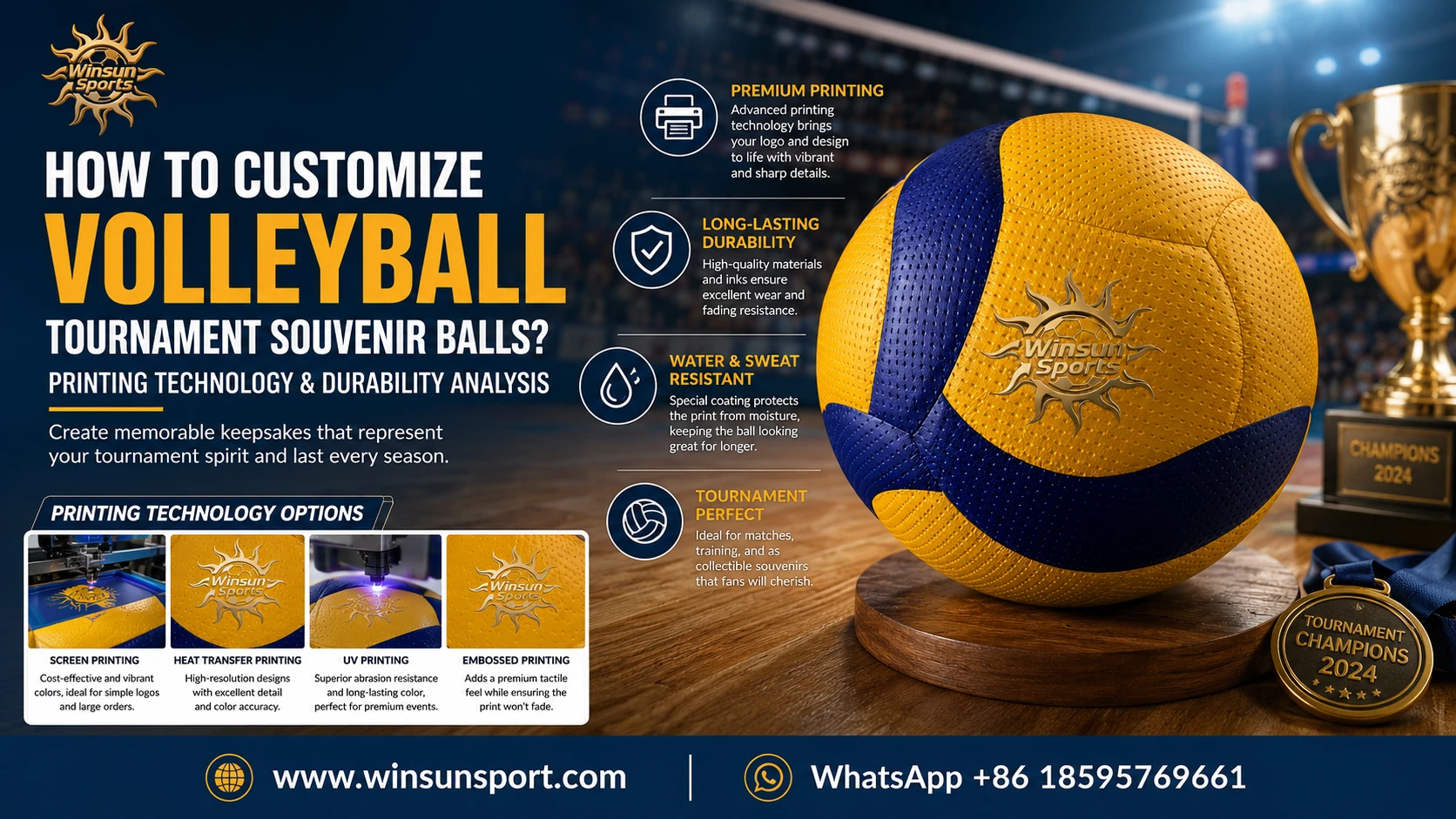
How can the logo on a commemorative event ball be printed to last?First, consider the trade-offs of the three main processes.
The biggest difference between a commemorative event ball and a regular training ball is that it must carry information such as team names, event logos, and years—and once this information wears off, peels, or falls off, the commemorative value is diminished. So before customization, it is more important to understand how the logo is printed than to choose colors and layout.
Heat Transfer and Screen Printing: Common but Each Has Shortcomings
Heat TransferThis involves printing the pattern on release paper first, then transferring it to the ball surface through high temperature and pressure. Its advantage is high color fidelity, allowing for gradients and complex patterns, but the disadvantage is also obvious: the transfer layer is "stuck" to the ball's surface, and under repeated impact, friction, and sweat erosion, the edges are prone to lifting, especially in the seam areas where the ball deforms the most, where the risk of peeling is higher.
Silk-screen printingIn this process, ink is directly scraped onto the spherical surface. It is simple and low-cost, making it suitable for large solid-color areas. However, the ink layer in silk-screen printing is relatively thick, giving a noticeable "raised" feel. Moreover, the adhesion between the ink and PU material is limited, and cracks may appear after long-term use, especially in low-temperature winter conditions where the ink layer becomes brittle and more prone to chipping upon impact.
Seamless High-Temperature Heat Bonding: Why Is It More Suitable for Commemorative Match Balls?
The volleyball from Winsunsport usesseamless high-temperature heat bonding technology。 In simple terms, the logo pattern is fused directly with the ball's surface skin under high temperature, rather than being "stuck" on. The pattern layer and the PU skin form an integrated structure with no boundary, thus eliminating any starting point for peeling. Additionally, the ball surface has no stitching, so the logo does not sit in seam grooves where it would be repeatedly bent. This gives it a clear durability advantage over the previous two processes.
For commemorative match balls, this process also has a practical advantage:the pattern does not affect the feel. The logo area of heat transfer and screen printing feels foreign to the touch, while the heat-applied process makes the pattern flush with the ball surface, ensuring even force distribution upon impact and preventing irregular rebounds due to the logo position.
Situations suitable for the heat-applied process: The ball is for long-term use, the logo includes fine text or complex graphics, or the ball will undergo high-intensity play or outdoor conditions.
Situations where other processes may be considered: Extremely tight budget, the logo is only a temporary mark, the ball is used infrequently, and long-term preservation is not a priority.
If you are unsure which process suits your usage scenario, you can tell the Winsunsport team your match frequency, usage environment, and expected preservation duration, and they will provide a matching solution based on the ball surface material and pattern complexity.
From PU soft leather to size 5: which parameters determine the durability of commemorative balls?
The biggest difference between commemorative balls and training balls is that they must withstand repeated use and still look presentable in a display case months or even years later. So when judging whether a commemorative ball is worth it, you can't just look at how nice the printing is; you have to first look at three hard parameters: the cover, the bladder, and the size.
Cover and bladder: How do PU soft leather and butyl rubber bladders affect lifespan?
PU soft leather determines the 'feel lifespan' and 'appearance lifespan.' Low-end PU or PVC covers will harden, peel, and lose color after a period of use.The advantage of high-flex cushioning PU soft leather is that it balances softness and abrasion resistance through its microporous structure—it provides good cushioning on impact, so fingers don't hurt easily, while the fine dimpled surface maintains anti-slip properties, so it won't become slippery from sweat or dust. For event organizers, this means the ball maintains consistent feel throughout the entire game, and doesn't 'turn into a different ball' in the latter half.
The butyl rubber bladder and wound yarn layer determine the 'structural lifespan'. Butyl rubber has better air retention than ordinary natural rubber, so a single inflation lasts longer and requires less frequent pumping—this translates to a real difference in maintenance costs for schools or event organizers purchasing in bulk. The multi-layer thickened nylon fiber winding serves to fix the bladder's shape and prevent the ball from bulging or deforming during use.
A simple way to judge: after getting the ball, squeeze it firmly; if it rebounds quickly and evenly, the winding layer is usually solid.If a spot feels soft or rebounds slowly when squeezed, the internal structure may be uneven.
Standard Size 5 Specifications: Why Must Competition Balls Meet Size and Weight Requirements?
Size 5 is the universal competition specification for adult volleyball, with specific parameters ofcircumference 65–67 cm and weight 260–280 g。 This range is not arbitrary—it corresponds to the hitting feel and flight trajectory at the standard net height. If the ball is too light, it floats when spiking and is hard to control in passing;if too heavy, it puts strain on the wrists, and long training sessions can cause fatigue.
For buyers, the significance of specifications lies inuniversality: using the same specification for training and matches means players don't need to adapt to different ball feels;when commemorative balls and official match balls share the same specification, the ball players take home after the game is the very one they just played with, adding to its commemorative value. So when confirming specifications, don't just look for "size 5" on the packaging—ask directly whether the circumference and weight fall within the 65–67 cm and 260–280 g ranges.
Next step: confirm the action: Confirm with the current website team the PU skin thickness and the number of yarn winding layers of this ball—these two parameters directly determine its lifespan under high-intensity use. If your procurement purpose is event souvenirs rather than long-term training balls, the skin thickness can be relaxed;But if it is for daily training of a school team, it is recommended to first confirm whether the number of yarn winding layers meets the "multi-layer thickened" standard.
What scenarios are suitable for event souvenir balls?In which cases is customization not recommended?
Recommended scenarios: event prizes, campus procurement, and corporate gifts
This size 5 PU volleyball with red-blue contrasting colors and streamlined silver patterns is itself of standard event specifications, visually distinctive, and suitable for three clear scenarios:
Event Commemorative Prizes—When the event name, edition number, and organizer information are confirmed, print the key details on the ball's surface. When awarding, it serves both as a prize and a souvenir. After players take it away, this ball can continuously evoke memories of the competition, making it more practical than ordinary trophies.
Unified Procurement for Campus Teaching—When schools or training institutions customize school names and team logos in bulk, they can unify the appearance of training balls, avoiding confusion when balls from different classes or teams are mixed together. The PU soft leather material is friendly to beginners' touch, and the standard size 5 also covers most needs from teaching to training.
Corporate Sports Events and Team Building Gifts—When unions or administrative departments make purchases, printing the company logo and event theme on the ball as participation souvenirs or interactive gifts can strengthen team belonging. Sports balls as gifts are used frequently, and the brand exposure cycle is longer than that of a T-shirt.
Scenarios not recommended: when the target is vague or the design changes frequently
In the following situations, it is advisable to hold off and not rush to place an order:
The event theme is not yet finalized。 If the competition name, key visuals, and sponsor rights are still under discussion, any change after customization means the entire batch of balls is scrapped. The minimum order quantity for customized volleyballs is usually not just one or two, and the rework cost is much higher than that of ordinary printed materials.
Frequent design revisions。 The ball surface is curved, and the layout of graphics and text differs from flat printing logic. Every revision requires re-confirming the effect. If the internal decision-making chain is long and opinions fluctuate, the customization cycle will be significantly extended, potentially missing the event deadline.
The budget is extremely limited and only seeks to "have a ball to use"。 Customization itself has pattern-making and minimum order thresholds. If the budget only covers ordinary finished balls, forcing customization will instead compromise the quality of each ball. In this case, buying standard models is more cost-effective.
The judgment criteria are simple: The prerequisite for customization is "information is confirmed, quantity meets the minimum order, and time is sufficient". If all three conditions are met, customization can bring significant unified visual and commemorative value;If any one condition is not met, it is recommended to first confirm with our team whether the current plan matches, and then decide whether to proceed.
How to inspect custom volleyballs?A durability checklist from sampling to bulk delivery
Between custom volleyball sampling and bulk arrival, there is a common gap of 'perfect samples, failed bulk production'. What event organizers and procurement managers really need to focus on is not whether the sample looks good, but whetherthe details confirmed on the sample can be maintained in bulk delivery. Below are actionable inspection steps in two stages.
Sampling stage: Confirm logo details and color fastness
Sampling is one of your key opportunities to personally 'destroy' the sample; don't just hold it in your hands. Focus on three key things:
1. Bend test - check whether the printed layer cracks. Fold the ball firmly along the logo printed area and observe whether the ink layer has fine lines or crazing. PU soft leather itself is elastic, but if the printing ink is under-cured or has poor adhesion, spider-web-like cracks will appear after bending.
After folding, rub the printed area surface with your palm to see if any powder falls off.
2. Scratch test - check the abrasion resistance level. Use a fingernail or the edge of a coin to scratch back and forth along the logo edge 5-10 times. A qualified heat-transfer printed layer should only show slight scratches and should not reveal the underlying PU color.
Note: any printing cannot withstand repeated violent scratching by sharp objects; the purpose of this test is to confirmthat under normal wear and tear, the color will not fade, not to pursue 'never wear out'.
3. Color vividness confirmation - check under natural light, not under artificial light. Indoor warm lighting can make red appear orange and blue appear gray. Take the sample to the window and compare it under natural light with the color values from your design draft.
If the sample color is noticeably dull or off, it is cheapest to request changes now;if color discrepancies are only discovered after mass production, the cost of rework is completely different.
Batch stage: spot-check process consistency and ball performance
After batch arrival, randomly open boxes for inspection at a ratio of 3-5 balls per batch. Don't just sample from the top layer; have warehouse staff take samples from different box numbers and different layers.
The spot-check checklist is prioritized as follows:
- Logo position and clarity—Are the logo positions in the same batch all in the same area?Are there any tilts, ghosting, or blurred edges?Is there any visible difference in shade in the printing color between different balls?
- Sphere circumference and weight—Use a soft tape measure to measure the circumference around the widest part of the sphere; a standard size 5 ball should be between 65–67 cm;Weigh it with an electronic scale; it should be within the range of 260–280 g.Focus on the range: Among the 5 balls drawn, the difference between the heaviest and the lightest should not exceed 10 g, and the circumference difference should not exceed 1 cm.The range reflects production line stability better than individual values.
- Quick air tightness check—Inflate fully and let it sit for 24 hours, then press by hand to feel the degree of air pressure drop.Obvious softening indicates a problem with the seal of the inner bladder or the valve.This is not a precise test, but it can filter out obvious defects.
- Surface finish consistency—Touch the ball surface to check whether the concave anti-slip particles are uniform and whether there are any locally smooth areas;Observe whether there is any color bleeding or uneven boundaries at the red-blue contrasting color joints.
Key trade-off reminder: The acceptance criteria for custom balls should match your actual usage scenario. If it is a commemorative prize for a competition, the consistency of appearance has the highest weight;If it is a ball for daily training, the consistency of ball performance (weight, circumference, air tightness) carries more weight. Do not use competition ball standards to inspect training balls, nor use gift standards to inspect competition balls.— Clarify the core purpose of this batch of balls, then decide which indicator to focus on during spot checks.
Common Questions
Q: During sampling, the logo bending test shows slight fine cracks. Does this count as unqualified? It depends on which layer the fine cracks appear in. If it is only a very slight trace on the surface clear coat layer, and the scratch test does not cause color loss, it usually does not affect the normal service life;If the fine cracks penetrate into the printed color layer, they are likely to worsen during mass production, and it is recommended to request a new sample.
Q: After bulk arrival, spot checks found that individual balls weigh more than 280g. Does the entire batch need to be returned? First, check the extent of the excess and the quantity. If only a few balls exceed by 2-3g, and the circumference is within the standard range, the impact on amateur training and commemorative use is minimal;If multiple balls exceed the weight or the circumference also exceeds the standard, it indicates a drift in production line parameters, and you need to contact the current website team to confirm the adjustment plan.
Q: How can I confirm that the received balls are the same version as the one confirmed during sampling? The most reliable way isretained sample comparison—After confirming the sample, keep a sample ball, and after bulk arrival, compare side by side the color, logo position, and surface texture. If no samples are retained, at least keep the confirmed design color value files and Logo dimension drawings.
Q: Will the printed logo fade in humid environments? PU soft leather itself does not absorb water, and normal indoor use will not cause fading due to sweat or moisture. However, prolonged immersion in water or exposure to sunlight will accelerate the aging of any printed layer, which is a common characteristic of materials, not a defect specific to this product.
Indoor volleyballs are not recommended for long-term outdoor use.
Q: During spot inspection, a 1-2 mm offset in the logo position was found. Should we be concerned? For single-ball use scenarios, a 1-2 mm offset does not affect usage at all;However, if this batch of balls is used as event prizes or for collective display, the offset will be noticeable when placed side by side. It is recommended to first confirm whether the offset is concentrated in a specific box or randomly distributed—concentrated occurrence indicates errors in the production batch parameters, while random distribution falls within the normal tolerance range.
Learn More
If you are preparing commemorative balls for an event or customizing volleyballs in bulk, feel free to contact the Winsunsport team. Provide your usage scenario, expected quantity, and design requirements, and we will offer matching craftsmanship and acceptance suggestions based on the ball surface material and pattern complexity.
Related Products:Red, blue, and silver striped No. 5 professional indoor volleyball, customizable logo