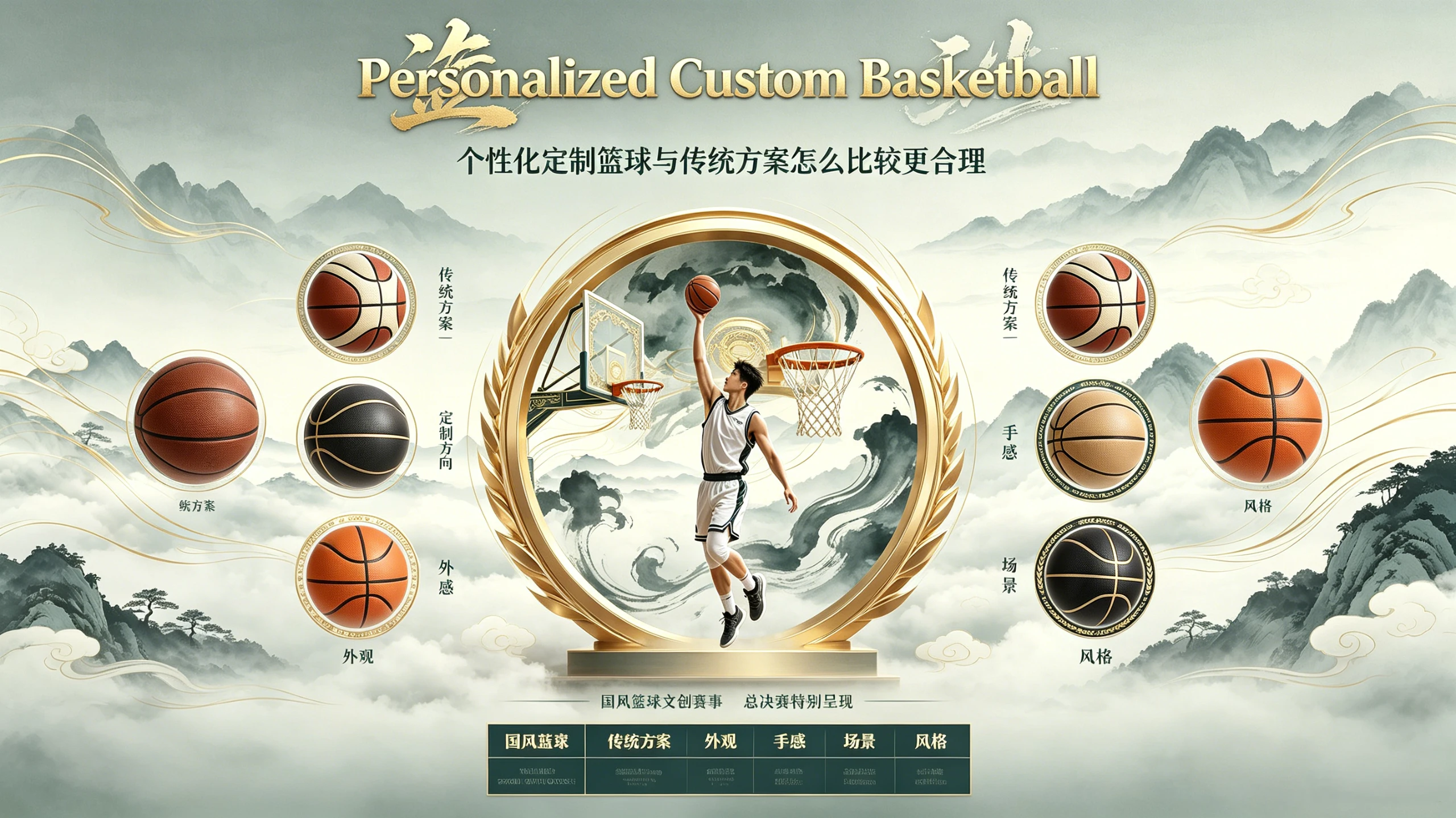
What is a Personalized Custom Basketball: What is its core difference from traditionally mass-produced basketballs?
Personalized Custom Basketball Refers to a basketball product that supports on-demand custom printing. Compared to traditionally mass-produced basketballs, its core difference is reflected inproduction logicandthe final product form.
Differences in Product Form: Complete Size Range and Custom Printing
Traditionally mass-produced basketballs are standardized industrial products, typically offering only fixed specifications (such as size 7 standard balls) and preset patterns. Personalized Custom Basketballs allow users to participate in the design of the appearance, enabling logos, text, or specific patterns to be printed on the ball, while usually providing a more complete range of size options (such as size 5 and size 6 balls) to meet the needs of different users.
Differences in Decision Starting Point: On-Demand Design vs. Stock Selection
The fundamental difference between the two lies in the starting point of the purchasing process:
- Traditional ApproachYou choose from theexisting finished products in stockto make a selection.
- Personalized Custom BasketballYour purchase decision begins withsubmitting personalized design requirements(such as the desired patterns and text to be printed), and the product is manufactured according to these specifications.
Therefore, while traditional basketballs address general sporting needs, custom basketballs further carryteam identity, gift memorabilia, or personal expressionadded value.
Basis: Reference source C1 indicates that custom basketballs can offer various materials, design options, and related benefits for teams, brands, and gifts.
How to judge in four steps: Should your needs choose a custom basketball or a traditional standard solution?
When facing a basketball procurement decision, the key to judging whether to choose a custom basketball or a traditional standard solution lies in the adaptability of your needs. The following framework guides you to evaluate step by step, rather than providing a generic answer directly.
Step 1: Clarify the core purpose—is it functional or for branding?
First, ask yourself: What is the core use of this basketball?
- Functionality firstIf used for team training, daily fitness, and other scenarios, the physical attributes of the basketball, such as feel, elasticity, and durability, are the primary criteria.Traditional standard basketballs are usually more straightforward and cost-controllable, and can be selected based on clear parameters.
- Identity PriorityIf intended for team gifts, brand promotion, event memorabilia, etc., the visual elements on the basketball, such as patterns, logos, and text, carry the primary value.A custom basketball can transform a piece of sports equipment into a unique information carrier.
Step 2: Assess the Clarity of Needs and the Possibility of Future Changes
After determining the core purpose, assess whether your customization needs are clear and stable.
- Needs are Clear and StableIf you already have a confirmed logo file, a clear pattern design, and reasonable expectations for the final product effect, the customization process will be smoother and can precisely meet identity needs.
- Needs are Vague or Prone to ChangeIf the design is not finalized, requires frequent modifications, or the intended use is still being adjusted, committing to customization too early may increase time and cost risks.It is recommended to use a traditional standard basketball as a transitional option first.
In summary, how to choose a basketball solution depends on your needs. The most critical factor is whether the branding requirement is clear and stable enough to drive the decision. If the answer is generally yes and it takes precedence over pure athletic performance, a custom basketball is worth considering;otherwise, a traditional solution is more reliable.
For specific guidance, you can refer to our custom basketball buying guide.
A specific comparison for three major scenarios: how to choose for training, gifts, and brand promotion respectively?
Choosing between a custom or traditional solution hinges on clearly defining your primary goal: meeting basic functions, conveying special value, or strengthening brand impression.
Training and Teaching Scenarios: Functionality First vs. Team Motivation
Is customization necessary for basketball team training? This depends on the core needs.
When functionality is the priority, traditional solutions are usually the first choice. In training scenarios, the primary considerations are the basketball's durability, feel, and professional performance to ensure athletes can practice efficiently. Customization is not a functional necessity.
The main value of customization lies in providing team motivation. Printing team logos, slogans, or numbers on the balls can enhance players' sense of belonging and pride, making the training balls a part of the team culture. This is more of a supplementary investment aimed at boosting morale.
Conclusion: If the budget is limited and the goal is to achieve the ultimate training efficiency, you should prioritize choosing traditional basketballs with reliable performance. If you aim to build team culture and the budget allows, you can consider customizing some training balls.
Gift and Commemorative Scenarios: Versatility vs. Exclusive Value
As corporate gifts for clients, what are the advantages of custom basketballs over regular ones?
The difference is mainly reflected in the value attributes. Standard basketballs have a universal appeal.They are suitable as high-volume, low-cost small gifts, but lack uniqueness and are easily forgotten.
The core value of a custom basketball lies in its exclusive commemorative significance. Based on available information, a company logo, client name, or commemorative date can be printed on the basketball. It transforms from a mere commodity into a gift that carries sentiment, suitable for important occasions like client appreciation or partnership anniversaries, better demonstrating the level of importance placed.
Conclusion: The choice depends on the purpose of the gift. If pursuing low cost and wide coverage, a standard basketball is more practical. If you hope the gift can represent the company's image and solidify important relationships, a custom basketball offers higher added value.
Brand Promotion Scenarios
In promotional campaigns, custom basketballs can serve as creative advertising carriers. Basketballs printed with brand information, given as giveaways at events, are more practical than ordinary printed materials and have a longer retention time, thereby providing more sustained brand exposure.
Summary: Training scenarios focus on performance, with customization as a supplement for team building;In gift scenarios, customization offers irreplaceable exclusive value. Clarifying the primary goal allows for making the appropriate choice.
Deep Dive into Key Differences: From Materials and Craftsmanship to Quality Control and After-sales, What Must Be Focused on in a Comparison?
When comparing Personalized Custom Basketball with traditional off-the-shelf solutions, price is not one of the key decision points. To determine if customization is worth choosing, one must deeply evaluate the supplier'stechnical implementation capabilities,andlong-term service guarantees,。
Material and Process Options: What Possibilities Does Customization Bring?
Traditional basketballs typically offer fixed material combinations. The core advantage of customization lies in the ability to combine different materials and processes based on specific uses (such as training, gifts).
- Surface Material Selection: Common custom materials include PU andgenuine leather(Reference C1). PU materials typically offer different wear-resistance grades to adapt to various venues such as concrete floors or indoor courts; genuine leather focuses more on the feel and playing experience. You can choose the most suitable material based on this.
- Printing Process Differences: Pattern creation often involves processes like heat transfer printing.Different processes directly affect the clarity, durability, and impact on the ball's feel, which is especially crucial for gifts and promotional purposes.
- Key Conclusion: Customization allows you toreverse-matchyour needs, for example, choosing high-abrasion-resistant leather for durability, rather than passively adapting to a fixed combination.
Quality Consistency and After-Sales Service: How Does Supplier Support Affect Long-Term Use?
This is the risk point that requires the most careful scrutiny in a customized solution, directly impacting the long-term user experience.
- Quality Consistency: In batch customization, whether the printing position, color difference, and elasticity of each basketball are consistent depends on the supplier'squality control systemLooking at a single sample's effect is insufficient; you need to examine the stability of their production process.
- After-Sales Service Support: The after-sales response for customized products is highly dependent on the supplier.You need to clarify its specific processes and commitments regardingquality issue handling(such as delamination or air leakage),replenishment consistency(such as small-quantity reprints of the same basketball model).
- Decision Tip: If large-volume or repeat purchases are needed, the value of a supplier's stable quality control and reliable after-sales support may far outweigh the unit price difference.When comparing, 'whether the supplier can deliver stably and guarantee after-sales service' should be a key evaluation criterion.
Frequently Asked Questions
Q: How can you initially judge if a custom basketball supplier's quality control is reliable? A: You can request to see their quality control process description for your order and inquire about the sampling ratio during batch production and the color difference calibration method. At the same time, examine their past batch order cases or sample consistency, which is more reliable than mere promises.
Q: If you only need a few dozen custom basketballs, do you still need to worry about quality control issues? A: Required. Small-batch customization relies more on the producer's experience and individual item inspection.
At this point, you should more carefully evaluate the quality of the initial samples provided by the supplier and clearly communicate your consistency requirements, writing them into the order agreement.
Question: Besides price and samples, what is the one core question you should most ask when comparing suppliers? A: You should ask: "For my specific use case (e.g., team training, gifts),what is your complete implementation plan? " This includes the recommended material combination, printing process, estimated durability, and subsequent quality control and after-sales methods.
The differences in the details of the solution are key to judging their professionalism.
Further Understanding
If you are unsure about your goals, the target audience, existing materials, or subsequent maintenance methods, it is recommended to confirm this information first before determining if a Personalized Custom Basketball is suitable.
Related Products:Personalized Custom Basketball