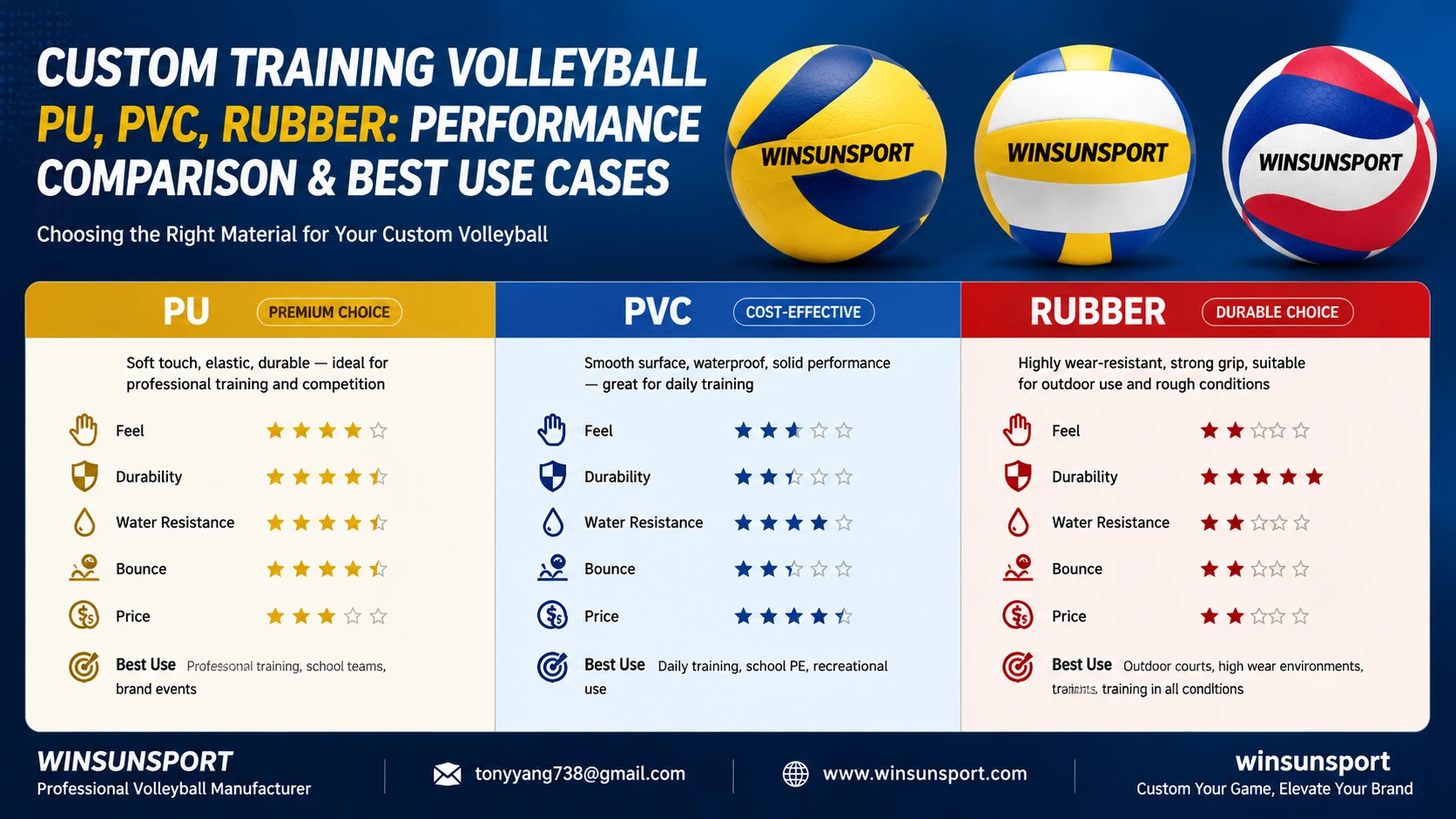
What are the common materials for custom volleyballs?What are PU, PVC, and rubber respectively?
There are three main common materials for custom volleyballs:PU (polyurethane), PVC (polyvinyl chloride), and rubber. They determine the ball's feel, durability, and applicable scenarios. Choosing the right material is the first step in customizing a volleyball.
Basic definitions of PU, PVC, and rubber
- PU (polyurethane): A synthetic polymer material with a soft, elastic surface that feels close to genuine leather.Commonly used in mid-to-high-end competition and training balls.
- PVC (Polyvinyl Chloride): A hard plastic with a relatively smooth, wear-resistant surface.Commonly found in entry-level training balls and low-cost custom balls.
- Rubber: Made from natural or synthetic rubber, with a harder texture and high elasticity.Often used for outdoor courts or children's toy balls.
Typical Applications of the Three Materials in Volleyball Manufacturing
| Material | Feel Characteristics | Common Uses |
|---|---|---|
| PU | Soft, non-slip, moderate rebound | Indoor matches, professional training, high-quality custom gifts |
| PVC | Harder, wear-resistant, slightly slippery surface | School teaching, corporate promotion, low-cost batch customization |
| Rubber | Hard, high elasticity, strong weather resistance | Outdoor beach, children's entertainment, promotional gifts |
Key trade-offs: If you need to customize a batch of volleyballs for formal competitions or long-term training, PU is a common choice, but the cost is higher;If used for school teaching or short-term promotion, PVC offers better cost performance;Rubber is suitable for outdoor or children's scenarios, but the feel is rougher.
Performance comparison of PU, PVC, and rubber materials: feel, durability, and price
When selecting a custom volleyball, the material directly determines feel, durability, and cost. The following compares the differences among PU, PVC, and rubber from three dimensions.
Feel and Elasticity: Which Material Is More Suitable for Competition?
- PU (polyurethane)PU: The feel is relatively soft, the surface has slight tackiness, the elasticity is uniform, and the control feedback is clear.International competition balls mostly use PU material, suitable for formal matches or high-level training that require precise control.
- PVC (Polyvinyl Chloride)PVC: The feel is relatively hard, with greater elasticity but less softness.Suitable for daily fitness, school physical education classes, or amateur recreation. It has a high tolerance for beginners, but control accuracy is not as good as PU.
- RubberRubber: The feel is the hardest, with large and stiff elasticity, and the ball rebounds quickly upon impact.Mainly used for beach volleyball or outdoor cement courts, as it is wear-resistant and not afraid of sand scratches, but it is less used in indoor competitions.
Conclusion: For competitions, PU is the first choice; for amateur training or recreation, choose PVC; for outdoor courts, choose rubber.
Durability and Maintenance: Which material is more durable?
| Material | Wear resistance | Weather resistance (sunlight/humidity) | Maintenance difficulty |
|---|---|---|---|
| PU | Medium | Poor (afraid of sun exposure, afraid of moisture) | Keep dry, avoid scratching with hard objects |
| PVC | Good | Moderate (can be used outdoors for short periods) | Easy to clean, occasional wiping is enough |
| Rubber | Best | Good (sun-resistant, water-resistant) | Almost no maintenance required |
Key trade-offsPU offers the best feel but is more delicate, PVC is the cost-effective choice, and rubber is the most durable but has the worst feel. If custom volleyballs are used for indoor training or competitions, and you can ensure a dry storage environment, PU is worth considering;if used for school bulk purchases or outdoor activities, PVC or rubber is more practical.
Which material should you choose for different usage scenarios?Recommendations for competitions, training, and gifts
The choice of material for custom volleyballs directly determines the feel, durability, and cost of the ball. Below, we break it down by three typical scenarios:competitions, training, and gifts。
Official Match Scenarios: Why Is PU the First Choice?
Suitable for: Inter-school leagues, amateur club matches, and scenarios requiring consistent ball feel and compliance with FIVB (International Volleyball Federation) standards. Not suitable for: Extremely low budgets, or purely recreational or informal activities.
PU (polyurethane) material is the mainstream choice for competition-grade volleyballs. Its surface is soft and tacky, providing better ball control and hitting feedback, making it especially suitable for official matches requiring precise passing and spiking. Custom volleyballs made of PU material can be used in official matches as long as their parameters (weight, circumference, air pressure) meet the standards.
The trade-off is a higher price, and the PU surface is relatively delicate, prone to wear when rubbed on rough ground.
Next confirmation steps: Confirm with the Winsunsport team the competition level you need (e.g., FIVB certified or just amateur standard), and whether custom patterns will affect the ball's balance.
Daily training scenarios: Cost-effectiveness advantage of PVC
Suitable for: School physical education classes, club daily training, children/youth basic practice, budget-limited but need bulk procurement. Not suitable for: Pursuing professional game feel, need long-term high-intensity use (PVC hardens faster after aging).
PVC (polyvinyl chloride) material is stiff, wear-resistant, and low-cost. For daily training, PVC balls are sufficient—they are durable, not afraid of bumps, and even with frequent use on concrete or plastic courts, their lifespan is longer than PU. The downside is that it feels relatively hard, and the elastic feedback is not as delicate as PU, but this has little impact on basic training.
If the purchase volume is large (e.g., more than 50 units), PVC material combined with screen printing can significantly reduce the unit price.
Key trade-offs: If you prioritize "ball feel" and "competition-level experience," choose PU;If you prioritize "durability" and "batch cost," choose PVC.
Corporate gift volleyballs: PU or PVC?
Suitable for: Brand promotion, employee benefits, souvenirs, event giveaways. Not suitable for: If the gift is only for display or decoration, the material is not critical—but if you want the recipient to actually use it, the material becomes very important.
- Choose PU: When the gift is aimed at sports enthusiasts, professional teams, or when the brand wants to convey a 'high quality' image.PU balls have good feel and are presentable, suitable as prizes for competitions or gifts for high-end clients.
- Choose PVC: When the gift quantity is large (e.g., one per person for corporate sports events), the budget is limited, or the recipients are mostly ordinary employees/students.PVC balls are durable, cost-controllable, and custom patterns (screen printing or heat transfer) are clear and firm, suitable for long-term use.
Next confirmation steps: Clarify the usage scenario of the gift (actual playing or decorative item?) quantity (minimum order quantity affects unit price), and printing complexity (single-color screen printing has the lowest cost, full-color heat transfer has better effect but slightly higher price). Share this information with the Winsunsport team, and they will provide a matching solution for material and process.
How to make the final choice based on budget and quantity?
When selecting materials, budget and purchase quantity are key factors. There is no "best" material, only the "most suitable" solution. Below are suggestions based on two common scenarios.
Small batch customization: PVC material + screen printing process, a cost-effective solution
If the purchase quantity is small (e.g., 50-200 pieces), it is recommended to choose PVC material Matching Silk screen printing process。 PVC has a lower unit price and lower mold opening costs than PU, effectively controlling costs. Silk screen printing is suitable for single-color or simple two-color patterns, with good adhesion on PVC surfaces, meeting basic needs for souvenirs or gifts.
However, PVC balls feel harder and are less elastic than PU, making them more suitable for recreational activities or teaching and training, not for high-intensity competitions.
Bulk procurement: Quality upgrade path for PU material
When the purchase quantity exceeds 200 pieces, such as for long-term school training or annual corporate benefits, consider upgrading to PU material。 When purchasing in bulk, the unit price difference of PU is diluted, while PU offers a softer feel, more uniform elasticity, and better wear resistance, allowing it to withstand more frequent use. PU surfaces are also more suitable for heat transfer or digital printing, enabling complex logos with full color and gradients, and the pattern adhesion is strong.
If these balls are used for training scenarios at least twice a week, the long-term cost-effectiveness of PU may be higher.
Frequently Asked Questions
Q1: What is the minimum order quantity for customized volleyballs in small batches? A: We usually accept a minimum order of 50 pieces. If the quantity is less than 50, the unit price after sharing mold and printing costs will be very high. It is recommended to first check if there are existing stock balls available for simple printing.
Q2: Can PVC balls be used for official competitions? A: No. PVC balls do not meet FIVB competition standards.
If used in official matches, you must choose a PU material model that is FIVB certified.
Q3: Will the screen-printed pattern fade? A: On PVC surfaces, the adhesion of screen-printed patterns is relatively good, and they are not prone to peeling under normal use. However, if rubbed against rough ground or exposed to sunlight for a long time, the pattern will gradually wear off.
It is recommended to avoid using on rough surfaces such as cement floors.
Q4: Is there a big difference in feel between PU and PVC materials? A: The difference is obvious. PU is softer, more absorbent, and has even elasticity, making it suitable for long training sessions. PVC is harder with direct elastic feedback, making it suitable for casual entertainment.
If you have requirements for "feel," we recommend requesting samples from our sales team for comparison.
Learn More
Not sure which material is best for your project?Tell us the usage scenario, budget, and quantity, and the Winsunsport team will recommend the matching material and process solution for you.
Related Products:Personalized Custom Volleyball