Why is the manufacturing process of match-grade footballs worth your time to understand?
If you only play a casual game occasionally, the difference in feel between a ball that costs a few dozen yuan and one that costs a few hundred yuan may not be that obvious. But when you start training regularly every week, representing your school in matches, or need to purchase in bulk for a club, the difference becomes impossible to ignore—it's not a question of 'can it be kicked' but 'can it be kicked accurately'.
From 'kickable' to 'accurate': How craftsmanship determines performance differences
Why can the price of the same round ball differ by several times? The core differences lie in three invisible aspects:
- Bladder structure: Ordinary balls use rubber bladders, which tend to deform and lose air after prolonged use.Match-grade footballs commonly use wound bladders or rubber bladders—wound bladders are reinforced by wrapping yarn around the bladder, which enhances the ball's structural integrity, maintains better air retention and roundness, and results in a more stable flight trajectory.This is not 'mysticism'; it is determined by physical structure.
- Leather Thickness and Material: The thinner the leather, the more direct the touch, but the lower the abrasion resistance;the thicker it is, the better the durability, but the feel becomes duller.The leather thickness of match-grade footballs is usually a trade-off, aiming to provide reliable touch feedback while withstanding high-frequency use.This balance point is precisely a reflection of the factory's manufacturing capability.
- Air Retention TreatmentA ball that loses half its air in three days versus one that maintains standard pressure for a week offers a completely different experience.Air tightness depends on the bladder material and the valve craftsmanship, which is also a key factor that sets match balls apart from training balls.
Understanding the craftsmanship is the only way to truly grasp a factory's pricing and capabilities.
As a buyer, the quotation sheet you receive may only list terms like "match-grade," "wear-resistant," and "good air tightness," but the craftsmanship configurations behind these words are completely different. Even for match-grade footballs, whether the bladder is made of rubber-wound or PVC, and the thickness of the leather material, directly determine the cost and lifespan.
Once you understand these craftsmanship differences, you can ask more specific questions when communicating with the factory: **"What kind of bladder structure does this ball have? What is the leather thickness? What frequency of use is it suitable for?
"** instead of asking vaguely 'Is this ball good?'.
For Winsunsport's Premium Match Grade Soccer Ball, it offers multiple bladder and leather thickness configurations, meaning you can match a solution based on your actual usage scenario—whether it's long-term high-intensity training at school or gift customization—rather than being locked into a fixed configuration.
What you can do next: First clarify your usage scenario (match, training, gift, or teaching), then compare the differences in bladder type and leather thickness, and confirm with our team which configuration better suits your budget and frequency. Process knowledge is not about making you an expert, but about giving you the initiative in communication.
Bladder: The first checkpoint that determines the ball's elasticity and durability
The soccer ball bladder is the core air pressure container of the ball, directly determining the ball's elasticity, touch, air retention, and service life. Winsunsport's Premium Match Grade Soccer Ball offers three bladder options—butyl bladder, rubber butyl bladder, and PVC bladder—each with distinct manufacturing methods and performance differences, so your choice should be based on your usage frequency and field conditions.
Thread bladder, rubber thread bladder, PVC bladder: manufacturing differences and performance characteristics of the three inner bladders
Thread bladder (Butyl Bladder) It is currently the mainstream configuration for competition-grade footballs. It is made of butyl rubber and wrapped with high-strength yarn on the outer layer, aiming to limit excessive expansion of the ball after inflation, making the ball's shape more stable and rebound more uniform. The thread bladder has the best air retention among the three types of bladders; one inflation can last for a long time, making it suitable for official matches and long-term training that require stable performance.
Rubber thread bladder Similar in structure to the thread bladder, but the outer winding thread and rubber formula differ, resulting in softer overall elasticity and a softer feel. Its air retention is slightly lower than that of a pure thread bladder, but the manufacturing cost is lower, making it suitable for daily training scenarios where elasticity requirements are not as stringent.
PVC bladder It is the lowest-cost option among the three types of bladders. It is made of polyvinyl chloride material, has average air tightness, and is prone to slow air leakage after prolonged use. Additionally, it hardens in low-temperature environments, affecting the feel underfoot. Its advantage is its low price, making it suitable for low-frequency use, casual entertainment, or children's play where performance requirements are not high.
Which usage scenarios are different bladders suitable for?
| Bladder Type | Durability | Air Tightness | Foot feel | Suitable scenarios |
| Thread core | High | Excellent | Stable elasticity, uniform rebound | Official competitions, professional training, high-frequency long-term use |
| Rubber thread bladder | Medium-high | Good | Relatively soft, gentle touch | Daily training, campus activities, moderate frequency use |
| PVC bladder | Medium-low | Average | Relatively hard, hardens in low temperatures | Leisure and entertainment, children's play, low frequency use |
Which one is more durable? If "durability" means maintaining shape and air pressure stability under long-term, high-frequency use, the wound bladder is the clear choice. Its wound structure effectively resists ball deformation, and it also has the best air retention, reducing the hassle of frequent inflation.
Rubber wound bladders also perform well under normal usage frequency, but air retention will gradually decline over the long term. PVC bladders have the weakest durability, especially in high or low temperature environments, where material aging accelerates.
Which bladder should I choose for my usage scenario? The criteria are simple: if you play more than 2 times a week and need consistent ball feel, choose a wound bladder;if you play occasionally and have a limited budget, a rubber wound bladder is the cost-effective choice;if buying for children or for casual use only, a PVC bladder is sufficient. It should be noted that if you use the ball in cold regions, it is recommended to prioritize butyl bladders or rubber bladders, because PVC bladders become noticeably harder at low temperatures, affecting the playing experience.
If you are unsure which bladder type is more suitable for your frequency of use and field conditions, you can directly explain your usage scenario to the Winsunsport team, and they will recommend a matching bladder configuration based on your actual situation.
Leather Material and Workmanship: How to Balance Touch, Durability, and Cost?
When choosing a soccer ball, the most common intuition is "the thicker the leather, the more durable it is," but in match-grade balls, this intuition is often misleading. The thickness of the leather directly affects the touch and the deformation of the ball, rather than simply determining its lifespan.
Custom Leather Thickness: Why Is Thicker Not Always Better?
The thickness of soccer ball leather typically ranges from 1.0mm to 1.6mm. As thickness increases, the ball becomes harder and more durable, but the cushioning effect upon contact decreases—when striking with the instep, it feels like kicking a wooden board, and when trapping the ball, the shock absorption is also stiffer. For midfielders who need delicate ball control or forwards who seek precise shooting feedback, overly thick leather actually sacrifices the most essential "touch."
Conversely, thin leather (around 1.0mm) provides clear ball contact and direct deformation feedback, but its durability decreases, making it prone to pilling and cracking on rough artificial turf or concrete surfaces. So the real trade-off is:Your playing surface and touch preferences determine which way the thickness should lean.
Winsunsport's match-grade football supports custom leather thickness, precisely to address this contradiction. A practical way to decide is:
- If you mainly play on natural grass or high-quality artificial turf: choose 1.0–1.2mm, prioritizing a more assured touch and control precision.
- Mainly on hard courts, rough fields, or high-frequency training: choose 1.3–1.5mm, sacrificing some touch for wear-resistant durability.
- For children or beginners: it is not recommended to choose the thickest option; an overly hard ball can cause foot discomfort, and a moderate thickness (around 1.2mm) is safer.
The impact of stitching and bonding processes on durability and air tightness
The leather thickness determines "how it feels to kick," while the ball's construction process determines "how long it lasts and whether it leaks air." These are two independent dimensions and should not be conflated.
There are three main methods of football construction:
| Craftsmanship | Features | Suitable scenarios |
| Machine stitching | Low cost, exposed stitches, prone to thread wear and unraveling after long-term use | Training, daily recreation |
| Hand stitching | Dense stitches, thread embedded in leather grooves, better wear resistance and airtightness | Competition, high-frequency use |
| Thermal bonding | No seams, smooth surface, best air tightness, but the leather and inner adhesive layer may delaminate after aging. | Top-tier match balls |
For match-grade footballs,air tightness matters more than "looking sturdy."。 A ball with rough stitching or uneven gluing, even with thicker leather, will develop slow leaks within weeks—requiring reinflation before every kick, with unstable bounce performance. Winsunsport offers multiple construction options, paired with cloth bladders, rubber bladders, or PVC bladders. The core logic is: **the bladder determines the air retention foundation, while the construction process determines whether air tightness can be maintained long-term.**
**
If the budget is limited, prioritize a more reliable construction process (hand-stitched or high-quality thermal bonding), and the leather thickness can be chosen at a mid-range level.If the budget allows, upgrade both the thickness and the bladder at the same time. Conversely, spending the entire budget on thick leather but opting for low-cost machine stitching is the least cost-effective combination—the stitching will come apart before the leather wears out.
Next step: confirm the action: Tell the Winsunsport team your primary playing surface (natural grass/artificial turf/hard court), frequency of use (times per week), and touch preference (control-oriented or power-oriented), and let them provide matching recommendations for thickness and construction based on these three factors. If you are unsure which category you fall into, simply state your usage scenario, and the team can recommend a default configuration based on the field conditions.
Air tightness and quality control: How to determine whether a football is 'well-made'?
A football losing air is often not due to a loose valve, but rather a problem with the seal between the bladder or the valve and the bladder body. The most direct way to check air tightness is to inflate the ball fully and let it sit for 24–48 hours, then press it with your hand to feel for pressure changes, or apply soapy water to the valve and the seams on the ball's surface to see if bubbles form. Match-grade soccer balls prioritize airtightness because pressure stability directly affects rebound height and touch consistency—during a 90-minute match, every 0.1 bar drop in ball pressure results in a perceptible difference in touch feedback.
Airtightness Testing: Why Is It Essential for Match-Grade Soccer Balls?
From a manufacturing perspective, airtightness mainly depends on the bladder type and valve construction. Wound bladders and rubber-wound bladders, due to their multi-layer construction, typically offer better airtightness than standard PVC bladders.Whether the valve is properly vulcanized or bonded to the bladder determines whether leaks occur at the base over long-term use. Winsunsport's Premium Match Grade Soccer Ball offers three bladder configurations: wound, rubber-wound, and PVC. For high-frequency use or scenarios requiring strict pressure stability, prioritize wound or rubber-wound bladders.For casual or low-frequency use, PVC bladders are more cost-effective.
From Process to Quality Control: Key Observations for Evaluating OEM Factory Expertise
To judge whether a football OEM factory is worth cooperating with, don't just listen to verbal promises, but look at several specific aspects:
- Bladder molding method: Ask clearly whether it is a butyl bladder or a natural rubber bladder; butyl has better air tightness;Also ask whether the valve is formed in one shot during molding or implanted later; the former has lower risk of air leakage.
- Leather cutting and bonding: Check whether the factory uses computer cutting; manual cutting has large errors, which can lead to uneven panel seams, affecting flight trajectory and durability.
- Winding process: If it is a wound bladder, ask about the number of winding layers and the control standards for winding uniformity.Uneven winding can cause the ball to deform, making it feel "floaty" when kicked.
- Factory inspection process: Is each ball inflated and left to rest for inspection?What is the sampling inspection rate?Is there an air pressure decay standard?These reflect quality control levels more than any verbal promises.
- Custom sample lead time: A factory willing to make samples first and let you test them usually has more confidence in its craftsmanship.During sampling, focus on testing air tightness and feel, not just appearance.
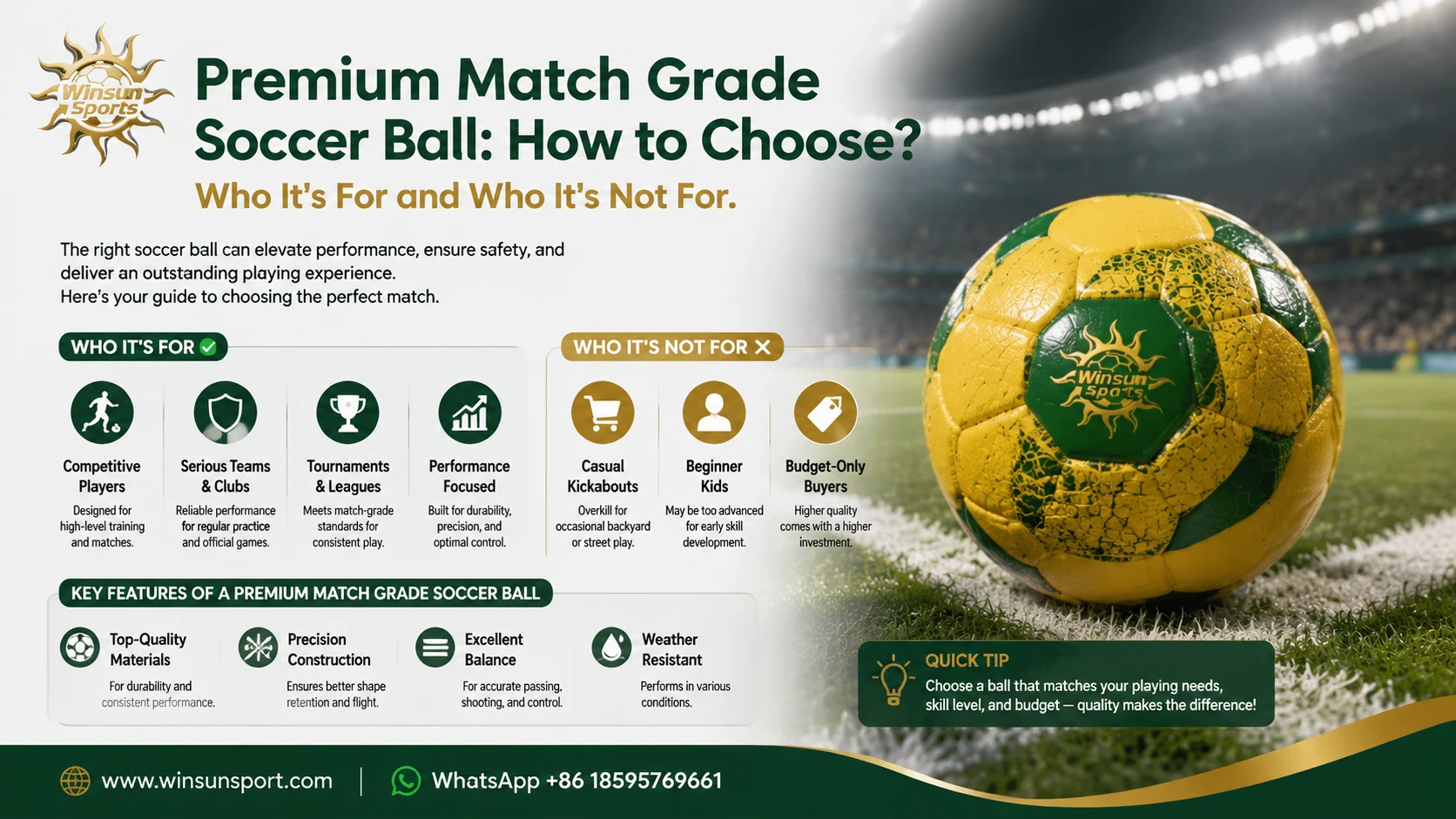
Who is suitable to directly choose the Premium Match Grade Soccer Ball? If you need a stable feel, have clear requirements for durability, and hope to customize the bladder, leather thickness, and appearance in the same factory, the multi-configuration options of this product can cover scenarios from professional training to gift customization.
Who needs to supplement information before deciding? If you do not yet have a clear concept of the usage environment (such as extreme high or low temperatures), expected lifespan, or budget range, it is recommended to first confirm with the Winsunsport team: what field you plan to use it on, the approximate weekly usage frequency, and whether you need to print a specific logo. These conditions will directly affect the recommended combination of bladder and leather thickness, and also help you avoid paying extra for performance you do not need.
Frequently Asked Questions
Q: Can a soccer ball be repaired after it leaks air? A: If the valve is loose, you can try using a valve needle dipped in soapy water to confirm the leak point, then tighten or replace the valve;If the air leak is from the bladder or the seams, the repair cost is often close to that of a new ball. Therefore, when choosing a ball, it is more practical to prioritize the bladder type and factory air-tightness testing over post-purchase repairs.
Q: How to choose between a thread-wound bladder, a rubber thread-wound bladder, and a PVC bladder? A: Thread-wound and rubber thread-wound bladders offer better air retention and shape retention, making them suitable for high-frequency training and matches;PVC bladders are low-cost with direct bounce, suitable for casual play or low-frequency use. If you are unsure about your usage intensity, use "choose a thread-wound bladder if you play more than twice a week" as a reference.
Q: What significance does leather thickness have in judging workmanship? A: The thickness of the leather affects wear resistance and the softness or hardness of the feel. Thicker leather is more resistant to rough ground and artificial turf, but the touch is firmer;thinner leather provides a clearer feel but reduces durability.
Winsunsport supports customization of leather thickness; the key is to inform the factory of your primary playing surface type so they can recommend a matching thickness.
Q: Will custom logos affect the airtightness or durability of the football? A: The printing process itself does not affect airtightness, as airtightness is determined by the bladder and the valve. However, the printing method (screen printing, heat transfer, or embossing) affects the abrasion resistance of the pattern; for high-frequency use scenarios, it is recommended to choose a process with better wear resistance, which can be directly verified during sampling.
Learn more
If you are unsure about the goal, target users, existing materials, or future maintenance methods, it is recommended to confirm this information first before determining whether the Premium Match Grade Soccer Ball is suitable.
Related Products:Premium Match Grade Soccer Ball