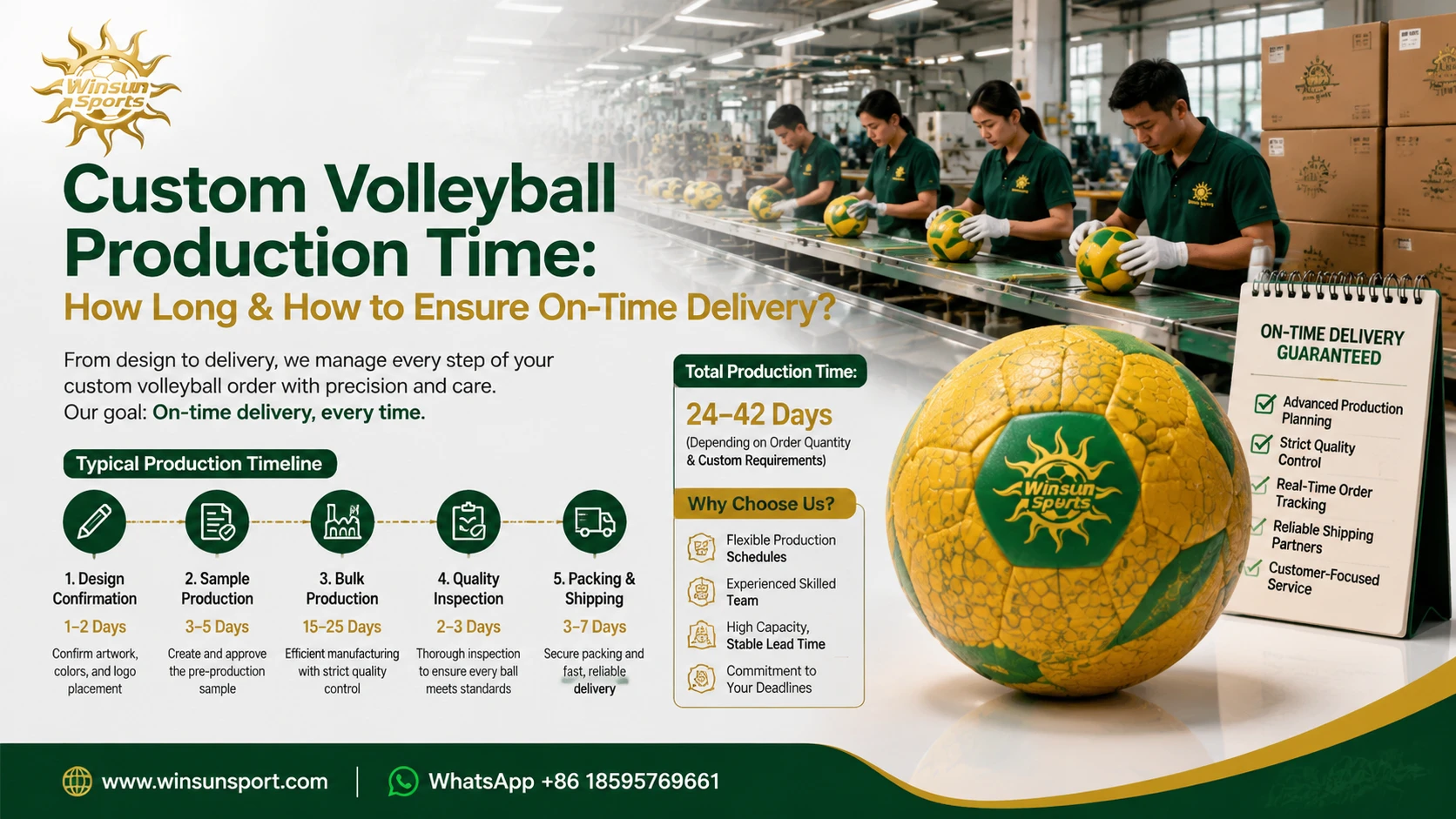
What stages make up the production cycle for custom volleyballs?
The journey of a custom volleyball from order to delivery is not a simple "production-shipping" pipeline, but rather consists of four interlocking stages: design confirmation, prototyping, mass production, and quality inspection and packaging. Each stage affects the total cycle time, but in completely different ways.
From design confirmation to prototyping: why is this the first hurdle in the delivery timeline?
Design confirmation is the most underestimated step in the entire process. The patterns, color schemes, and logo placements you submit need to be converted into printing or panel-lamination techniques that suit the curved surface of a volleyball. The core work in this stage is not "drawing," but confirming process feasibility—for example, whether a gradient color will distort on the ball's surface, or whether fine lines will break at the seams.
Prototyping, on the other hand, turns the design draft into a physical product. Once you receive the sample, you need to check not just whether it looks good, but also whether the pattern distorts when inflated, whether the printed layer peels off after repeated patting, and whether the ball's circumference is uniform. **This stage is the first checkpoint for delivery time, because any modifications will restart the clock from here.
** If the design draft is clear and the process requirements are specific, this stage can be passed in one go;If there are repeated modifications, all subsequent steps will be delayed accordingly.
Mass Production and Quality Inspection: The Core Link Affecting Delivery Stability
After design confirmation, mass production begins. The work content at this stage depends on the process you choose—thermal bonding, machine stitching, hand stitching, or printing—and the production capacity and scheduling cycles vary greatly between different processes. The delivery risks in mass production mainly come from two aspects: whether material stocking is sufficient, and whether the production line schedule is tight.
This is also why confirming the minimum order quantity, material grade, and process options in advance gives you more certainty about delivery time than adding orders at the last minute.
In the delivery schedule, the quality inspection stage plays the role of a "gatekeeper," not an "accelerator." Each batch of balls must go through steps such as inflation testing, circumference measurement, weight sampling, and print adhesion testing. **Quality inspection itself does not directly shorten the delivery time, but it determines whether the goods you receive can pass acceptance in one go.
**If quality inspection finds problems, the time for rework or redoing will be directly added to the total cycle, and this often happens after you have already waited a long time.
So, if you are planning custom volleyballs, the most worthwhile next step is:Organize the usage scenario, design files, expected quantity, and target delivery date all at once, and hand them to the Winsunsport team for process evaluation and production scheduling confirmation. This can minimize the three most common delay points: "repeated design changes, waiting for production scheduling, and quality inspection issues."
Which factors are most likely to cause delays in custom volleyball delivery?
Delays in custom volleyball delivery are rarely caused by insufficient factory capacity; the vast majority of problems arise in the two stages of "requirement confirmation" and "sample confirmation." Below is a breakdown in order of impact, from highest to lowest.
Incomplete design files: the number one cause of delays
This is the most underestimated pitfall. Many buyers assume that "sending a logo image" completes the design submission, but in actual production, the factory needsprintable vector files(such as AI or CDR formats), or at least high-resolution PNG files. If you send a low-resolution image captured from a webpage, or a compressed image forwarded from a chat history, it will appear blurry and have jagged edges when printed on the volleyball, and the factory will have to reject it and ask you to resubmit.
How well-prepared does the design file need to be to avoid rework? At least confirm three things:
- File format: Vector files are preferred;For bitmap images, the resolution should be no less than 300dpi, and the dimensions should be provided at a 1:1 ratio with the actual printing area.
- Color specification: If you have specific color requirements (such as "brand red"), you need to provide the Pantone color number or color value, rather than saying "roughly red".The volleyball material affects color presentation; without a color number, rework due to "wrong color" is likely.
- Print area boundaries: A volleyball is not flat; spherical printing involves distortion and seam lines.If the design draft does not account for the spherical curvature, text or patterns may misalign at the seams, requiring adjustments.
Next step: confirmation actions: Before submitting the design, directly request the design template and file specification checklist from the Winsunsport team, and verify each item against the checklist before submission. This saves at least 3-5 working days compared to submitting and then having it rejected for revisions.
Delayed communication feedback: the hidden time sink in the sample confirmation process
Once the design files are approved, the next hotspot for delays is sample confirmation. The factory needs time to produce samples, but more commonly, after samples are shipped, the buyer's internal approval process drags on for 5-7 days before feedback is given, or the feedback is vague (e.g., "it doesn't feel right, adjust it again"), leading to multiple rounds of revisions, each round requiring a new queue.
How can delays in the sample confirmation stage be avoided?
- Designate a decision-maker in advance: Clarify who has final approval authority before sampling, to avoid the sample being passed around internally after arrival.
- Use "annotated" feedback: After receiving the sample, take photos and circle the areas needing modification directly on the images, with specific written instructions (e.g., "move the logo up 2cm" or "the blue is too dark, lighten it by one shade").Vague "adjust it again" feedback only makes the factory guess, and a wrong guess leads to another round.
- Set a feedback deadline: After confirming the sample shipping time with the Winsunsport team, set an internal feedback deadline for yourself within 48 hours.Every day the sample confirmation is delayed, the total delivery time is extended by one day.
Who is more likely to encounter delays? Who is not?
Situations prone to delays: Design files are made by non-professionals found at the last minute, internal approval processes are lengthy, there is a lack of understanding of volleyball printing processes (for example, thinking it is the same as T-shirt printing), and orders are placed close to the competition or event date.
Situations not prone to delaysDesign files are prepared in advance according to specifications, all color and size parameters are confirmed before sampling, and the order placement time includes a buffer period of at least 2-3 weeks.
If you are unsure whether your design files meet the requirements, the safest approach is to send the design draft to the Winsunsport team for a free pre-review before placing the official order, so they can tell you what is missing and where potential issues may arise. This step does not take much time, but it can help you avoid the biggest pitfall in the entire delivery delay.
How can project management ensure timely delivery of custom volleyballs?
The delivery time for custom volleyballs is not something you simply wait for the factory to notify you about; it is a result managed jointly by the buyer and the manufacturer. Many delays occur in the early stages such as design confirmation, sample modifications, and material preparation, while the actual production line time often accounts for only a small portion.
Establish clear time nodes and milestones
An executable timeline for a custom volleyball project should at least break down into the following five nodes:
- Design Finalization Date: The pattern, color scheme, and LOGO position are all locked in, and no further changes will be made after this.
- Sample Confirmation Date: After receiving the physical sample, check the printing precision, feel, and dimensions, then confirm or request modifications.
- Material Stock Completion Date: Confirm that materials such as the inner liner, outer shell, and printing ink are in place.
- Batch Production Completion Date: The entire batch of products comes off the production line and passes quality inspection.
- Delivery date: Work backward based on the logistics method, leaving buffer for customs clearance and transportation.
When scheduling in reverse, it is recommended to reserve a 3-5 day buffer between every two milestones. Especially in the sample confirmation stage, if the internal approval process is lengthy or requires multiple people to vote on the design, this stage is most likely to cause delays. Setting "design finalization" and "sample confirmation" as hard deadlines is far more effective than only setting a final delivery date.
Choose a manufacturer with OEM/ODM experience: Winsunsport's collaborative advantages
Custom volleyball is not as simple as "picking a style and printing a LOGO." The material combination of the ball cover, the fit of the printing process with the ball's curvature, and the requirements for air pressure and feel in different usage scenarios all affect the production cycle. Factories without OEM/ODM experience often repeatedly trial and error during the sampling stage, and a single sample round trip can consume one to two weeks.
Winsunsport's collaborative approach to custom volleyballs is to first convert your usage scenarios and design requirements into executable production parameters. For example, whether you use it for teaching and training or competitive matches, whether specific size and weight are required, and how large the printing area covers—these details are confirmed during the quotation stage to avoid rework later due to "it didn't turn out right." At the same time, Winsunsport provides a clear timeline at project kickoff and proactively updates progress at key milestones such as sample confirmation and mass production, rather than waiting for you to chase them.
Situations suitable for choosing Winsunsport: Your design is already basically clear, usage scenarios are well-defined, and you need a manufacturer that can advance according to milestones and reduce communication friction.
Situations not suitable: If your design is still changing frequently, or even the basic usage scenarios are not determined, it is recommended to clarify requirements internally before starting the project; otherwise, even the strongest delivery management cannot keep up with constantly changing needs.
Next step: confirmation actions
Before placing a formal order, confirm three things with the Winsunsport team: the current production lead time in days, the number of working days required for sample production, and whether rush orders are supported. Also provide your target arrival date, and ask them to help you work backward to determine the latest design finalization date and sample confirmation date, to see if it is feasible.
How do you balance delivery time, quality, and cost?When is customization not suitable?
The decision to customize a volleyball essentially answers one question: how much time and budget are you willing to spend for 'this ball belongs only to me'? There is no universally safer balance point among these three; there is only a priority ranking.
Where is the balance point among delivery time, quality, and cost?
First clarify your usage deadline, then make decisions by working backward. If there is a competition, event, or delivery milestone in three weeks, then the "delivery date" becomes a hard constraint, and both quality and cost must yield to it. In this case, prioritize solutions with mature processes and flexible minimum order quantities, avoiding repeated revisions on complex designs—every revision could push the delivery date back.
If time is ample, the balance shifts toward the "trade-off between quality and cost." The core of quality is not just durability, but also pattern clarity, color fidelity, and print adhesion. Cost is influenced by minimum order quantity, printing process (such as heat transfer, screen printing, or embroidery), and ball material.
A practical principle:For competition balls, prioritize quality; for promotional gift balls, prioritize cost; for teaching and training balls, prioritize durability.
In which situations is custom volleyball not recommended?
Customization is not the optimal solution for all needs. In the following three situations, it is recommended not to place an order yet:
1. The target users are not yet clear. If it is not determined whether these balls are for children or adults, indoor or beach use, customization will only amplify mistakes. If the size, weight, or material is chosen incorrectly, no matter how exquisite the customization is, the balls cannot be used in play.
2. The design draft is still undergoing frequent changes. If the team name, logo, and color scheme are still being repeatedly adjusted, it is recommended to finalize the design internally before starting customization. In the production cycle of customized volleyballs, design confirmation is a preliminary step. If this step is delayed by one day, delivery will be delayed by one day.
3. You only need an ordinary training ball. If the purpose is just casual daily play, with no requirements for patterns, colors, or commemorative value, it is more cost-effective to directly buy a standard mass-produced ball—customization involves minimum order quantities and design communication costs, and paying a premium for "no-need needs" is irrational.
Typical scenarios suitable for customization
Conversely, customization is a reasonable choice in the following situations:
- Unified team image: During matches and training, the whole team uses balls with the same visual design, which enhances recognition and fosters team identity.
- Gifts and souvenirs: For corporate events, graduation commemorations, and event giveaways, customized balls carry brand or memories, with value far exceeding the ball itself.
- Teaching Grouping: Balls in different colors or numbers are used for group training in class, easily distinguishable at a glance, improving organizational efficiency.
- Promotion and Publicity: As event giveaways or display items, the ball surface serves as advertising space, and the usage scenario naturally carries promotional value.
FAQ
Q: How far in advance should I place an order for custom volleyballs to be safe? A: It is recommended to allow at least 4-6 weeks, including design confirmation, sampling (if needed), and production and shipping time. The specific timeline depends on the complexity of the process and the order quantity. Please confirm the current schedule with the Winsunsport team before placing your order.
Q: What if the minimum order quantity is not enough? A: The minimum order threshold varies depending on the process and size. If the required quantity is small, you can ask whether there are existing molds or simplified process options, but be aware that the precision of the pattern may be limited.
Q: Will the pattern on custom balls fade or peel off? A: Durability is directly related to the printing process. For match and training balls, it is recommended to choose a process with stronger adhesion, while for gift and display balls, visual effects can be prioritized.
To determine which process is suitable, you need to explain your usage frequency and scenarios to the team for confirmation.
Q: Can I place an order before the design is fully finalized? Answer: Not recommended. Design confirmation is a prerequisite for production. Placing an order before finalizing the design will only compress subsequent production time and increase delivery risks.
It is recommended to finalize the design internally first, then start the customization process.
Learn More
If you are planning a custom volleyball project, it is recommended to organize the usage scenarios, design files, expected quantity, and target delivery date, and submit them to the Winsunsport team for process evaluation and production scheduling confirmation.The team will provide a clear timeline based on your needs and proactively update you on progress at key milestones.
Related Products:Custom All-Scene Personal Volleyball