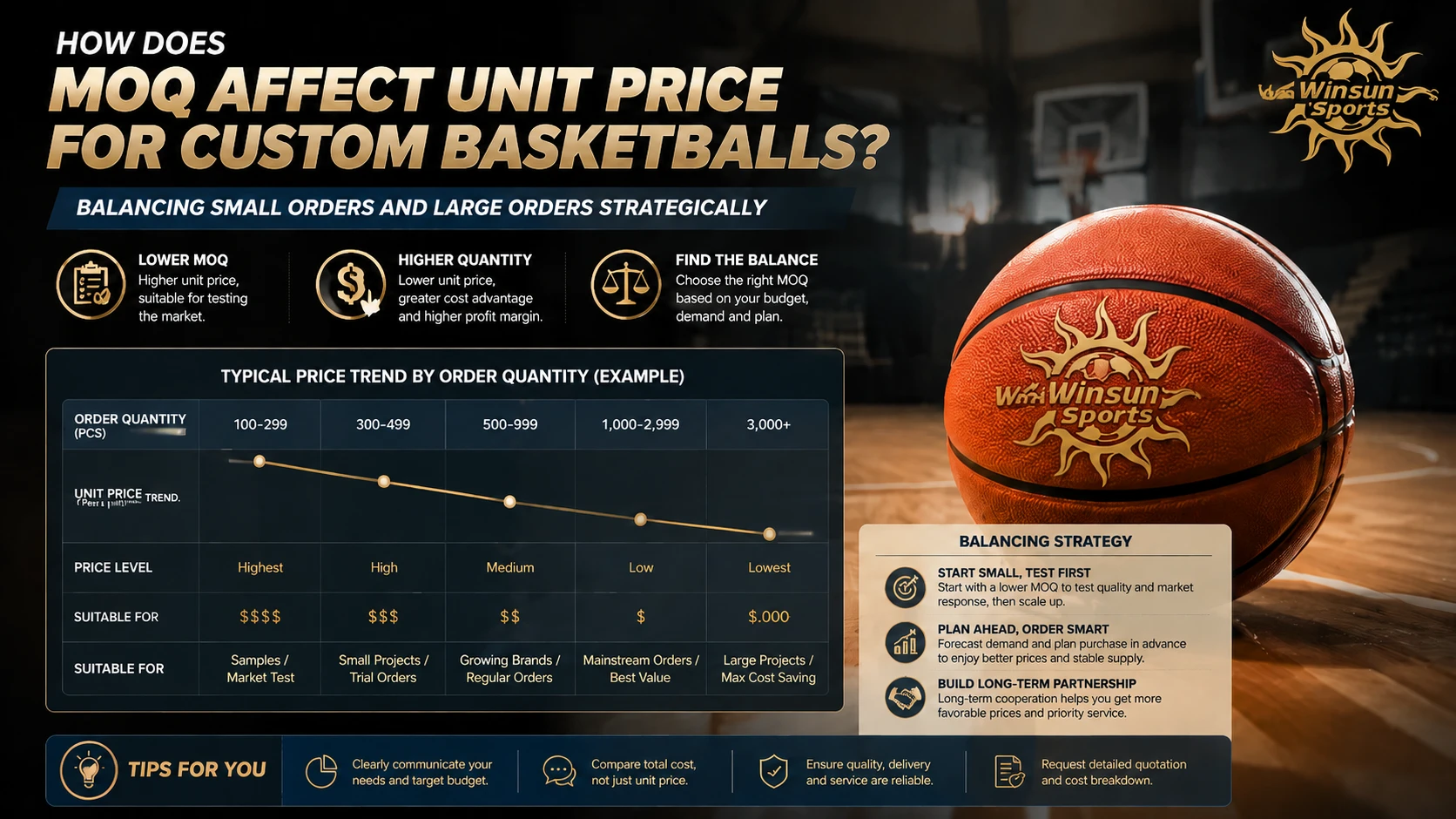
Why does the minimum order quantity (MOQ) for custom basketballs exist?How does it affect the unit price?
You might wonder: why can't you customize just 10 basketballs? Behind this is not that the factory "dislikes small orders," but rather a cost allocation logic at play.
The cost logic behind MOQ: allocation of fixed and variable costs
The production cost of custom basketballs falls into two categories:
- Fixed costs: one-time investments that are independent of quantity.This includes plate-making fees, screen printing mesh or heat transfer mold opening costs, labor for color matching and sampling, and downtime for production line changeovers.This batch of costs remains almost the same whether you make 50 or 5000 units.
- Variable costs: Costs incurred only for each ball produced.This includes ball materials, rubber or PU leather, printing ink, packaging, and labor for individual quality inspection.
The core reason for MOQ is that factories need more certainty that fixed costs can be spread across a sufficient number of products; otherwise, the price per ball would be unrealistically high. Suppose the plate-making fee is 3000 yuan; if you make 50 balls, each ball bears 60 yuan of fixed costs.If you make 500, each only bears 6 yuan. This is why factories set a minimum quantity threshold—below this number, the unit price will get out of control, and it won't be cost-effective for either party.
Looking at MOQ from the quotation: Why does the unit price decrease as quantity increases?
When you receive a quotation for custom basketballs, you'll typically see a tiered structure like this:
| Custom Quantity | Unit Price Range (Illustrative) | Fixed Costs Allocated to Each Ball |
| 100 units | Higher | Very high, accounting for the bulk of the unit price |
| 300 units | Medium | Significant decrease |
| 1000 units | Relatively low | Already diluted to negligible |
The mechanism for the unit price decrease is simple:The larger the quantity, the thinner the fixed costs are spread, and the increased volume of raw material procurement may also lead to lower material unit prices.。 But note that the unit price decrease is not linear—from 100 to 300 units, the price drop is usually most significant;From 1000 to 5000 units, the decrease will slow down, because at that point variable costs begin to dominate the unit price.
For your decision, the key is not to pursue the lowest unit price, but to findthe intersection of "sufficient quantity" and "reasonable unit price"。 If you are an amateur league organizer needing 200 match balls, forcing the quantity up to 1000 will only result in inventory waste;If you are running a brand promotion, 1000 balls distributed as gifts, the amortized unit price actually makes the cost per ball manageable.
Next step suggestion: first clarify your purpose (match, training, or gift) and approximate quantity range, then confirm with the Winsunsport team the specific quotation and fixed cost breakdown for that quantity tier—this way you can clearly see the proportion of fixed costs in the unit price at each quantity level, and thus determine whether it is worth increasing the quantity.
Alternative solutions for small-batch custom basketballs: group ordering, standard product labeling, and sample confirmation
Not meeting the minimum order quantity does not mean that customization is impossible. The key is to first clarify: what exactly do you mean by "customization"—the ball itself(material, size, feel), orthe pattern on the ball's surface(team name, logo, slogan)? The thresholds for these two are completely different.
Group purchasing: How to lower the MOQ threshold by combining demand?
If your demand is dozens rather than hundreds, directly approaching a factory for mold opening or separate production scheduling will result in unit prices that are prohibitively high. The idea behind group purchasing is:Combine demands for different designs into the same production batch.。
In practice, you can:
- Join forces with other teams, classes, or clubs to place a single order,sharing the same ball specifications while printing different designs separately.This way, the ball production volume meets the requirement, and the printing process remains independent for each design.
- Explain your quantity shortfall to the Winsunsport teamand ask whether there are currently any orders of the same specification in production that can be merged.Note: This requires you to accept the other party's production schedule, and the delivery time may not be entirely under your control.
- Accept "batch delivery": The balls are produced uniformly, but printing and delivery are done in batches.This is suitable for scenarios where you don't need to receive all goods at once.
The cost of combining orders isreduced flexibility—You cannot arbitrarily change the ball specifications; you can only change the pattern. If your core requirement is that the feel must be at a competition level, be sure to confirm before pooling orders that the ball model in the batch matches your expectations.
Standard product labeling: achieve low-cost customization using existing balls
If you have a limited budget and have no special requirements for ball performance, this is the most practical path:Choose a standard basketball already available from Winsunsport and only apply surface printing or labeling.。
The benefits of this approach are:
- The minimum order quantity is significantly reduced because there is no need to schedule separate production for the ball itself;
- Lead times are shorter because the balls are ready-made and only the printing step remains;
- The unit price is controllable; the money you pay for "customization" is only spent on the pattern, not on sphere development.
The trade-off is:You can only choose from existing sphere models, and you cannot adjust weight, surface material, or elasticity parameters. If you need training balls or gift balls, standard products with labeling are usually sufficient;but if it is for competitive match balls, be sure to first confirm whether the performance parameters of the standard product meet your competition requirements.
Sample confirmation: No matter which path you take, this step cannot be skipped
Both group buying and labeling mean you give up some customization freedom, soSample confirmation is a key opportunity to correct mistakes in the selection process.Before placing a bulk order, ask Winsunsport to provide a pre-production sample and focus on checking three things:
- Print clarity: Small text and intricate lines are prone to distortion on the spherical curvature; confirm on the sample whether it is acceptable.
- Print adhesion: Gently scratch the edge of the print with your fingernail to see if the color fades or peels.
- Ball feel: If you chose a standard product with labeling, actually bounce and dribble the ball to feel it and confirm it suits your intended use.
Samples will incur a separate fee, but this cost is far less than the rework cost of a wrong bulk order. It is recommended to reserve 10%-15% of your budget for sample confirmation and unforeseen expenses.
Summary: When the MOQ is insufficient, first determine whether you need "ball customization" or "pattern customization." If you only need the pattern, go with standard product labeling;if the ball itself also needs to be changed, try group ordering and accept flexibility in delivery time and specifications. Both paths require sample confirmation of the effect before placing a bulk order.
If you are unsure which category your needs fall into, directly explain your quantity, purpose, and expected delivery time to the Winsunsport team and let them provide a matching solution.
Advantages and Pitfalls of Large Orders: Lower Unit Price but Higher Inventory and Capital Risks
The most obvious appeal of a large order is the lower unit price. When fixed costs such as printing, mold debugging, and manual assembly are spread out, the cost per basketball does decrease as the quantity increases. But a 'lower unit price' does not mean 'lower total cost,' nor does it mean 'this purchase is cost-effective.'
The True Cost of Large Orders: Not Just Unit Price, but Also Inventory and Capital Occupancy
Besides the unit price, large orders bring three easily overlooked hidden costs:
Capital occupancy. Suppose the unit price drops from 60 yuan to 45 yuan, but the minimum order quantity increases from 200 to 2000 balls, the total expenditure goes from 12,000 yuan to 90,000 yuan. The extra 78,000 yuan is dead money until the goods are sold or distributed. If your cash flow is already tight, this cost needs to be calculated separately.
Inventory risk. Custom basketballs printed with your team name, logo, or event date are almost impossible to resell. If the event is canceled, the headcount is misestimated, or the design needs updating, these balls become sunk costs.
Basketballs themselves are not easily damaged, but balls that are "misprinted" and balls that "can't be sold" are both inventory burdens.
Storage and logistics. A large batch arrival means you need storage space, and logistics costs for cross-regional transportation will rise with volume and weight. These costs are usually not included in the unit price, but they genuinely affect the total cost.
When does a large order actually save money?
The criterion is not "how much the unit price dropped," but"whether the extra purchased quantity is certain to be consumed."。
Situations suitable for large orders:
- The usage scenario is clear and the quantity can be estimated, such as training institutions purchasing training balls by semester, where the number of participants and the loss rate are relatively stable;
- The event date and design draft have been finalized and will not be changed;
- There is sufficient storage space and capital surplus, without affecting other expenditures.
Situations not suitable for large orders:
- For first-time cooperation, when the ball's feel, abrasion resistance, and print quality have not yet been confirmed, it is more important to validate with a small batch than to save on unit price.
- The number of participants or the design plan is still being adjusted.
- The budget is tight, and a one-time large expenditure will affect subsequent operations.
A more prudent approach is to first confirm samples and actual usage feedback with a small batch (e.g., 50-100 balls), and then decide whether to place additional orders based on the actual consumption rate. Although the unit price is slightly higher than for large orders, this avoids the extreme situation of "saving on unit price but losing on inventory."
Next steps to confirm: Explain your usage scenarios (competition, training, gifts, or event distribution), expected usage period, and storage conditions to the Winsunsport team, and ask them to provide quotes and delivery time comparisons for different quantity tiers. Be sure to ask clearly: what is the unit price difference between different minimum order quantities, whether plate fees or mold fees are included, and how many times the design can be revised after the order is confirmed. This information helps you calculate how much you actually saved by ordering more, rather than just looking at a lower unit price.
How to balance MOQ and cost based on your own needs?Procurement recommendations by scenario
Let's first answer the most direct question: how many custom basketballs to order is not determined by the factory's minimum order quantity, but by whether your usage scenario can absorb the 'extra ordered portion'. Winsunsport's Custom Match Grade Basketball supports a variety of custom printing options from game balls to gifts and souvenirs, but different uses have completely different sensitivities to quantity and cost.
Match procurement quantity to usage scenario: how to decide for games, training, and gifts?
Game balls—set by 'wear cycle', not by 'lowest price'. Amateur league organizers typically need 10-20 game balls, but what really matters is: how much wear and tear over a season, and how many spares to have. If you order only the exact quantity you need, the unit price will indeed be higher, but match balls don't require bulk stocking—balls age, and next year's league may switch sponsors or change the design.
It's recommended to base your first order on 'seasonal usage + 20% spare,' and don't order double the quantity just to lower the unit price.
Training balls—this is the scenario best suited for increasing quantity to lower unit price. Training institutions and school teams consume balls quickly in daily practice, and the logo designs are relatively fixed, not frequently changed. If you're certain you'll need training balls continuously for the next 6-12 months, it's cost-effective to order the full quantity at once.
For example, if you estimate a monthly consumption of 30 balls, instead of placing small orders monthly, it's better to place one order for a quarter or half a year's supply, which lowers the per-ball cost and saves repeated communication effort.
Gift/souvenir balls—order based on 'event headcount,' and it's better to under-order than over-order. When companies purchase customized basketballs as employee benefits or client gifts, the most common mistake is 'printing a few dozen extra to meet the minimum order quantity.' Once the event is over, what remains of the gift balls is just inventory.
It is recommended to first determine the quantity based on the actual number of attendees or the employee list. If the minimum order quantity truly cannot be met, consider switching to a different customization method (such as simplifying the printing process) rather than forcing a larger quantity.
Budget Allocation and Negotiation Room: Reserve Sample Fees and Contingency Costs
The core logic of budget allocation is:Unit price is only part of the total cost; sample confirmation and logistics/customs duties are often the two underestimated areas.
It is recommended to structure your budget using the following proportions:
- The balls themselves (including custom printing): Approximately 75%-80%.This is your main battleground for price negotiation.The larger the batch, the lower the per-ball printing cost allocation, but be aware—the complexity of printing (single color vs. multi-color, single side vs. double side) can sometimes affect the unit price more than the quantity.If your design can be simplified (e.g., reducing color combinations), the unit price may drop even if the quantity stays the same.
- Sample confirmation: Set aside 5%-10%.For custom basketballs, sample confirmation before mass production is almost essential, especially for game balls—feel, elasticity, and print placement all need physical confirmation.Don't skimp on this cost; saving it might lead to reworking the entire batch.
- Logistics, tariffs, and unforeseen costs: Reserve 10%-15%.For cross-border procurement, shipping and tariffs can account for more than 10% of total costs, and there is almost no room for negotiation on this part.Additionally, if the competition time or event date is approaching, shipping costs for rush orders will increase noticeably.
Regarding negotiation space: Don't just ask 'Can you make it cheaper if I order more?' Instead, ask 'With the same budget, can you upgrade the material or printing process?' Sometimes factories have limited room to reduce unit prices, but they can offer you a better ball at the same price (e.g., a more durable leather surface), which is more cost-effective for you. If you're unsure what price you can get for your quantity, directly tell the Winsunsport team your scenario, quantity range, and expected budget, and let them provide a matching solution—the combination of processes and materials for different quantity tiers may be completely different.
Frequently Asked Questions
Q: What is the typical minimum order quantity for custom basketballs? What if I can't meet the minimum order quantity? A: The minimum order quantity depends on the ball model and printing process you choose.
If your quantity falls short of the standard MOQ, ask whether a simplified printing option (such as fewer colors or single-side printing) can lower the threshold, rather than blindly increasing the quantity.
Q: Between game balls and training balls, which is more suitable for bulk ordering to get a lower price? A: Training balls are more suitable. Game balls have limited demand and designs may change with each season, making inventory risk high;Training balls have steady consumption and fixed designs, so bulk ordering puts less pressure on inventory.
Q: What mainly affects the unit price of customized basketballs? Quantity or craftsmanship? A: Both affect it, but once the quantity reaches a certain tier, the impact of craftsmanship becomes more significant.
Multi-color printing, double-sided customization, and special materials will significantly drive up the unit price. When the budget is limited, simplifying the craftsmanship is more effective than forcing a higher quantity.
Q: How can we avoid wasting budget on promotional balls? A: Set the quantity based on the actual number of event participants, and do not order more just to lower the unit price. If the quantity is indeed small, accept a slightly higher unit price, or switch to a simpler customization plan, rather than stockpiling balls that cannot be distributed.
Q: What percentage of the budget should typically be allocated for sample fees? Can it be waived? A: It is recommended to reserve 5%-10%.
For game balls, it is strongly advised to create samples to confirm the feel and printing effect;for promotional balls, if the design is simple and time allows, you may consider skipping this step, but you do so at your own risk.
Learn More
If you are planning to procure custom basketballs but are unsure how to balance the minimum order quantity and budget, feel free to contact the Winsunsport team.Tell us your usage scenario, approximate quantity range, and expected budget, and we will match you with the most suitable customization plan and quantity tier.
Related Products:Custom Match Grade Basketball