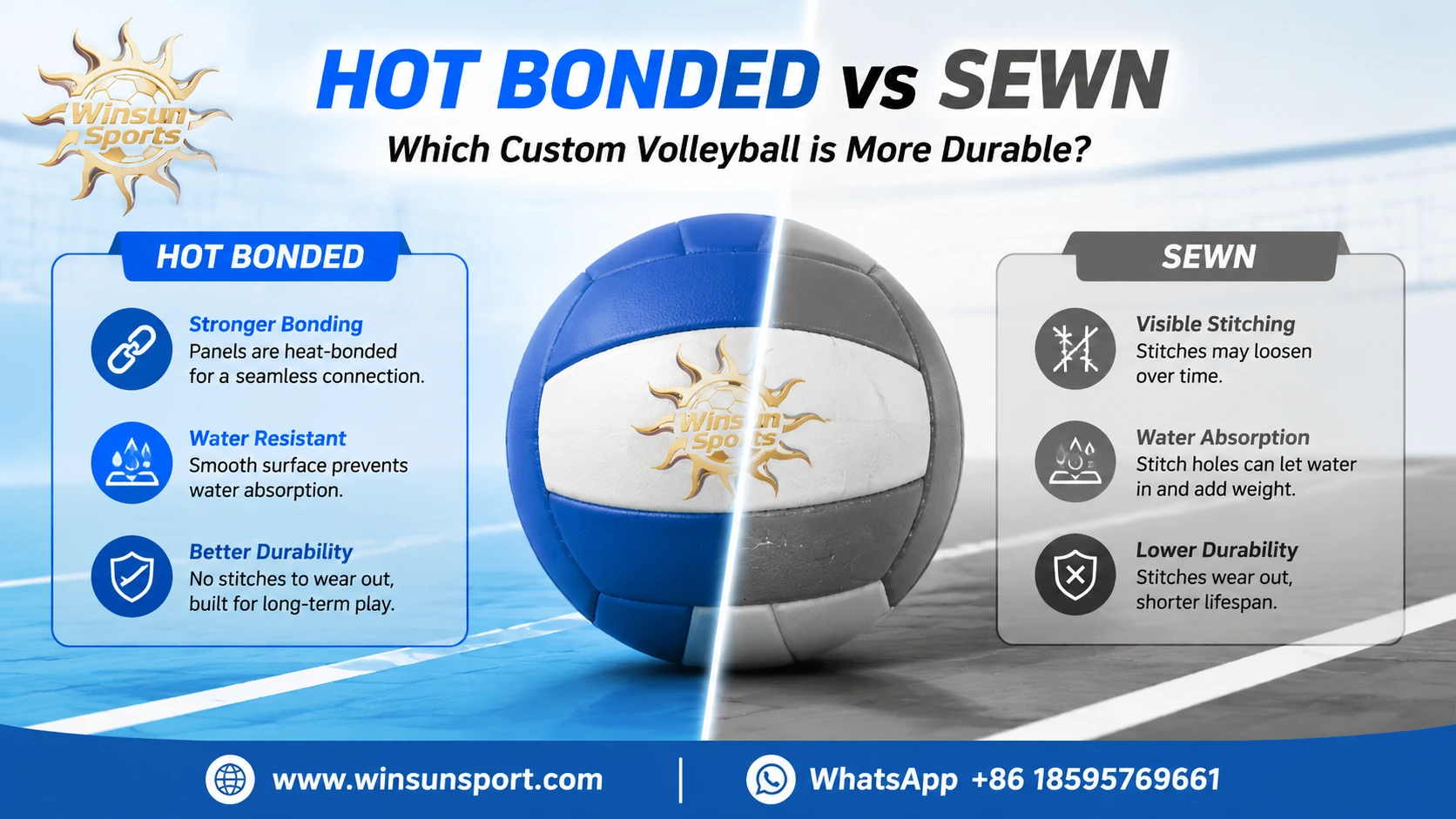
What is the essential difference between thermally bonded and hand-sewn volleyballs?
When buying a volleyball, you may notice a phenomenon: some balls have a smooth, complete surface with no visible seams;others show obvious stitching lines and needle holes. These two types of balls represent the typical difference between thermally bonded and hand-sewn processes. Understanding how they are made is the first step in determining which one suits you better.
From the manufacturing perspective: seamless bonding vs. needle stitching
The thermally bonded processinvolves cutting the ball panels and then directly "bonding" them onto the bladder and wound yarn layer using high temperature and pressure. Take Winsunsport's yellow-blue wavy contrasting volleyball as an example. It uses an 8-panel one-piece heat-bonding process—8 pieces of PU soft leather are fused with the ball's internal structure at high temperature into a single unit, with no stitching on the surface. You can think of it as using hot melt adhesive to 'weld' the leather onto the ball, rather than 'sewing' it on with needle and thread.
Sewn constructionis the traditional method: first cut the ball cover into several panels, sew each panel together along the edges with a sewing machine, then fit the sewn cover over the bladder, and finally inflate it to shape. The stitching lines you see on the ball's surface are the traces of the sewing.
From a structural integrity perspective: one-piece molding vs. stitched assembly
The structural differences brought by these two manufacturing methods are key to understanding durability:
| Comparison dimension | The thermally bonded process | Sewn construction |
| Surface Structure | One-piece molded, no pinholes or stitch marks | Multi-piece stitched, with seams and pinholes |
| Force Distribution | External force is evenly distributed across the entire surface | Force is concentrated at the seams |
| Weak Points | Almost no obvious weak areas | The stitching area is a natural stress concentration point. |
| Feel consistency | The ball surface feels uniform to the touch. | There is a slight difference in feel at the seams. |
This difference directly relates to the "durability" you care about: the stitching on a sewn ball endures long-term impact, friction, and air pressure stretching. Once the thread breaks or comes undone, the ball can deform or even be ruined. In contrast, a thermally bonded ball lacks this weak point of stitching, making it theoretically less prone to damage at the seams. Of course, this is only a structural analysis. Actual durability also depends on usage frequency, court conditions, and maintenance methods, which we will compare in detail in a later section.
What you can do next: Pick up the volleyball you have at hand and check whether there are stitches on the surface. If there are, feel the difference in texture between the seams and the rest of the ball surface;if there aren't, try pressing the ball surface to see whether the force is evenly distributed. This simple action can help you intuitively understand the difference between the two processes.
Which one is more durable? Comparing the pros and cons of the two processes from the perspective of durability
To answer directly: under normal usage intensity, thermally bonded volleyballs are generally more durable than stitched volleyballs, especially over long-term use. The difference between the two is not about 'whether they will break,' but 'where they start to break first.'
Weaknesses of Sewn Volleyballs: Needle Hole Wear and Stitch Breakage
Sewn volleyballs rely on stitching to join the leather panels together, which creates two natural weak points:
- Needle holes are stress concentration points: Each stitch leaves a needle hole on the leather surface. Under prolonged hitting, friction, and compression, the PU leather around the needle holes begins to fatigue first, gradually expanding into cracks.This is the most common way sewn balls fail—not by sudden bursting, but by slowly "rotting open" around the needle holes.
- Stitches directly bear impact: The stitching itself wears out and frays, loses strength when damp, and can be partially broken by fingernails or ground contact during intense play.Once a section of stitching breaks, the stress on adjacent needle holes increases sharply, accelerating the damage.
So, will a machine-sewn volleyball eventually come apart at the seams? — Yes, but a more accurate way to put it is:It usually starts with enlarged needle holes or worn stitching, and only then develops into seam separation. This process doesn't happen overnight, but it is indeed the upper limit of a machine-sewn ball's lifespan.
Advantages of thermally bonded volleyballs: no needle holes, more integrated structure
The thermal bonding process uses high temperature to fuse the edges of the panels together, leaving no needle holes or stitching on the entire ball surface. This means:
- No needle holes means no stress concentration points: The force is evenly distributed across the entire leather surface, with no single hole position that "gives out first."
- Seam strength does not decrease over time: The heat-bonded layer is a fusion of the material itself, unlike stitching, which can wear out, absorb moisture, and age.The durability of the seams remains largely stable throughout the ball's lifespan.
- A more complete surface with better water resistance: The absence of needle holes means moisture is less likely to penetrate the bladder and winding layers, which is a plus in humid environments or for occasional outdoor use.
Why are heat-bonded volleyballs more durable? Because it directly eliminates the two most vulnerable points—needle holes and stitching—that tend to fail first. The structure of the whole ball is closer to a single unit rather than a combination of 'panels + threads'.
But there is a premise that needs to be clarified.
The durability advantage of the thermal bonding process is established under the premise thatthe quality of the leather material itself is the same.is established under the premise that. If a stitched ball uses thicker PU leather while a thermally bonded ball uses thinner material, the stitched ball may actually be more abrasion-resistant. Therefore, when comparing, you should not only look at the process but also confirm the thickness and weight of the leather.
Additionally, if the seams of a thermally bonded ball are subjected to strong scraping by sharp objects, local delamination may occur—but the probability of this happening is far lower than the high likelihood of needle hole wear in stitched balls.
Who should choose heat-bonded, and who can choose sewn
| Use scenario | Recommended process | Reason |
| School team daily training, more than 3 times a week | Heat-bonded | Under high-frequency use, the no-needle-hole advantage is most obvious |
| Match balls, commemorative match balls | Heat-bonded | Requires long-term consistency in appearance and feel |
| Physical education classes, low-intensity recreation | Sewing is acceptable | Low frequency of use, slow needle hole wear |
| Budget-sensitive bulk procurement | Sewing may be considered | Lower initial cost, but replacement cycle needs to be estimated |
Next step: confirm actions: Confirm with the Winsunsport team the PU leather thickness and weight of this hot-bonded volleyball, and whether a stitched version with the same specifications is available for comparative sampling. Once you have the physical sample, you can use your fingernail to scratch test both the seams and the leather surface to feel the difference in leather thickness—this is the most direct way to judge whether the "process advantage can be realized."
Which custom pattern is less likely to peel off?Impact of Process on Print Adhesion
Whether the pattern on a custom volleyball will peel off depends not on the ink itself, but on the "connection method" between the pattern and the ball. Currently, there are two mainstream methods on the market: hot bonding and stitching. The impact of these two processes on pattern adhesion differs far more than most people imagine.
Hot bonding provides a smooth surface for pattern adhesion
The spherical surface of the hot-stick process is complete and continuous. The pattern is directly attached to the PU skin through high-temperature pressing, and the entire printed surface has no breaks, no bumps, and no gaps. The pattern and the skin are bonded surface-to-surface, so stress is evenly distributed under force, making it less likely to start lifting or peeling from a single point.
Additionally, the skin of hot-stick balls is made of microporous anti-slip PU soft leather, which has a certain adsorption capacity on its surface. After pressing, the pattern can "sink" into the surface layer of the leather rather than floating on it. In daily training, impacts, friction, and sweat erosion have less effect on such patterns.
The seams of the stitching process are the challenge for printing.
Almost all pattern adhesion issues with stitched balls occur near the seams. At the joints of the ball panels, there are raised stitches and sunken indentations. When the printed pattern passes through these areas, it is either cut off by the stitches or left suspended over the indentations—the suspended parts lack support and are most prone to cracking or peeling after repeated hitting and squeezing.
The more practical issue is that the pattern on a stitched ball can usually only be printed in the "middle area" of each panel, while the parts near the seams must be left blank or avoided. This means your custom design will be forced to compromise, and the logo or text may not be able to be presented completely across panels. If you want full-surface free customization with complete pattern coverage, stitched craftsmanship cannot achieve this due to physical structure.
Key trade-off: If you are customizing patterns such as team names, logos, or event marks that need to be retained long-term and used frequently, the flat attachment surface of thermal bonding is a more reliable choice. If your budget is extremely limited and you do not have high requirements for pattern integrity, a stitched ball can also be used, but you must accept the reality that the pattern at the seams may wear out prematurely.
Next step confirmation: Confirm with the Winsunsport team whether the pattern you want involves cross-panel printing, and the proportion of the pattern area to the ball surface—this directly determines whether thermal bonding can fully present your design.
How to choose based on the scenario? Selection recommendations and budget boundaries for heat-bonded vs. sewn balls
We've clarified the differences between the two processes above. This section directly addresses your procurement scenarios to help you decide which process is worth your budget.
Scenarios where heat-bonded process is recommended: campus teaching, team training, and event commemoratives
Campus teaching and team trainingare the scenarios where the heat-bonded process offers the most value. The reason is straightforward: training and teaching balls are used frequently and experience more impacts. The heat-bonded process has no stitching, so there are no issues with threads fraying and breaking, which can lead to peeling and exposure of the inner bladder. For middle and high school students and volleyball specialists, daily practice such as setting, spiking, and wall drills wears down the ball's surface much faster than casual recreational use. The overall lifespan advantage of heat-bonded balls truly pays off in these scenarios.
Event commemorative and customized prizesThermal bonding is also recommended. The core requirement for this type of ball is pattern integrity and visual quality—team names, school logos, and event LOGOs need to be printed on the ball's surface, and the thermal bonding process can achieve a seamless integration of the pattern with the ball surface, avoiding the awkwardness of stitching lines cutting through the pattern. If you are making balls for graduation commemorations or league mementos that need to be preserved long-term, the durability of thermal bonding also ensures that the souvenir won't be "disfigured" within half a year.
When budget is limited or needs are simple, stitching remains a backup option
If your need is simply "a ball with printed text that works," such as corporate team-building giveaways, low-intensity recreational use, or one-time event props, stitching is entirely sufficient. In such scenarios, the frequency and intensity of use are low, so the lifespan shortcomings of stitched balls won't be exposed, and its price advantage is tangible.
The decision boundary is here: When the per-ball budget is below 30 yuan and the order quantity is not large, the unit price advantage of heat-sealed technology is not evident, making stitching a more practical choice. However, if your order quantity reaches a certain scale (the specific minimum order quantity needs to be confirmed with the Winsunsport team), the unit price of heat-sealed technology will be diluted, and the price difference between the two may narrow to a level not worth worrying about.
Under what circumstances is it worth increasing the budget for heat-sealed technology?
When the following three conditions are met simultaneously, it is reasonable to spend more on heat-sealed technology:
- High frequency of use—At least 2-3 training sessions or matches per week, with the ball being used repeatedly over a long period;
- High requirements for the pattern—The ball surface has large-area logos, gradient colors, or fine text, and stitching would compromise the integrity of the pattern;
- Long service life—You expect these balls to last more than a year, rather than being replaced after just one season.
Conversely, if you only play occasionally, prefer simple designs, and dispose of them after use, paying extra for heat-sealed technology would be a waste.
Budget boundary recommendation: The reasonable premium for heat-sealed technology typically ranges from 30% to 60% over sewn technology (subject to Winsunsport's actual quotation). If it exceeds this range, you need to reassess whether your usage intensity truly requires heat-sealing;If it falls below this range, heat-sealing offers excellent value for money and can be directly considered.
Frequently Asked Questions
Q: For school-customized volleyballs used in PE classes and school team training, which process is more cost-effective? A: For team training balls, it is recommended to directly choose the thermal bonding process. Given the high training intensity and frequent use, the durability of thermal bonding will spread out the cost per use. If it is only for general PE class teaching with moderate usage intensity, the sewn process can also suffice, and you can decide flexibly based on your budget.
Q: We want to customize a batch of commemorative balls to give to participating teams, but our budget is limited. Is the sewn process acceptable? A: Yes, but you need to clarify the positioning of the commemorative balls. If they are just "given out as a keepsake," the sewn process is sufficient;if you hope the commemorative balls will be kept long-term, displayed in offices or at home, the pattern integrity and texture of thermal bonding better match the identity of "event commemorative."
Q: How much more expensive is the thermal bonding process compared to the sewn process? Is there a rough ratio? Answer: Different order quantities and pattern complexities will affect the final quote, so it is impossible to provide a uniform figure.
We recommend that you directly provide the Winsunsport team with your order quantity and pattern requirements, ask them to give you a specific quote comparison for the two processes, and then combine this with the usage frequency and cycle mentioned in this section to determine whether it is worth it.
Question: Our company is planning a team-building event and wants to customize volleyballs, but we only use them a few times a year. Is it necessary to choose thermal bonding? Answer: It is not necessary. In low-frequency usage scenarios, the durability shortcomings of the sewn process will not be exposed, and the saved budget can be used to order more balls or upgrade other team-building materials.
Unless you particularly care about the visual texture of the ball surface, sewn construction is sufficient.
Learn More
If you are selecting custom volleyballs for a school, team, or event, please feel free to contact the Winsunsport team. Provide your usage scenario, order quantity, and design requirements, and we will help you match the most suitable process solution and provide a comparative quote for the two processes.
Related Products:Yellow and blue wavy pattern No. 5 PU heat transfer volleyball, customizable logo