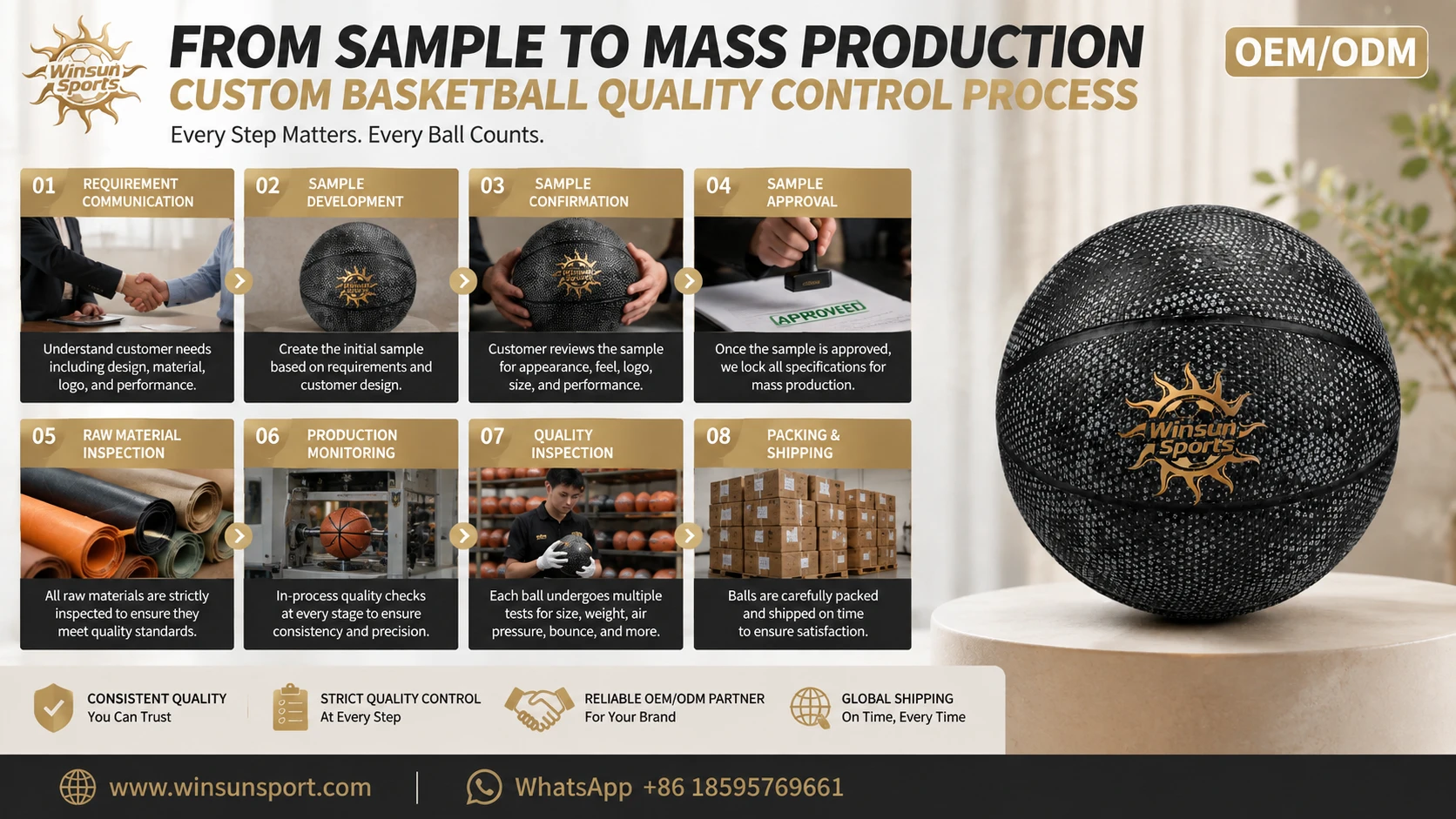
Why should you confirm a sample before customizing basketballs?What problems can sample confirmation solve?
The biggest difference between custom basketballs and buying off-the-shelf basketballs is that when you place an order, you see a design drawing, but what you receive is the physical product. Between the colors, proportions, and material textures on the design drawing and the actual produced basketball, there is a gap that needs to be filled by samples. The sample is not just a formality; it is one of the key choices in your entire procurement process—a chance to touch, see, and bounce-test the ball before mass production.
Sample confirmation is the locking of quality standards, not a mere formality.
The essence of sample confirmation is to turn "what we want" into "what we accept." Once the sample is confirmed, it becomes the benchmark for subsequent mass production—the factory adjusts colors, matches the design, and controls the feel according to the sample, and you accept the bulk goods based on the sample. Without this benchmark, the two parties' understanding of "qualified" may diverge: you think the color is too dark, while the factory thinks it is already close to the design draft;you think the surface is too slippery, while the factory considers it normal for this material.
If these differences are discovered before mass production, the cost is just one sample revision;if discovered after mass production, it means reworking or scrapping the entire batch.
For custom basketballs, sample confirmation can at least solve three specific problems:
- Whether the printing effect meets the standard: The clarity of the pattern, color saturation, and sharpness of edges can only be judged when printed on the ball's surface.The design drawing is flat, but the basketball is curved and textured. The alignment of the pattern across the seams of the ball's panels must be checked on the actual product.
- Whether the feel and bounce meet expectations: Different materials (PU, rubber, genuine leather) show significant differences in softness/hardness, tackiness, and rebound feedback.If you are purchasing basketballs for teaching, training, or competitive play, this directly determines the user experience.
- Overall workmanship details: Whether the valve is flat, whether the panel bonding is even, and whether the printing has smudging or color fading risks—these details can be exposed during the sample stage.
What are the common risks of going directly to mass production without confirming samples?
Skipping sample confirmation is equivalent to staking all quality judgments on post-production. Common risks are concentrated in the following four categories:
Color and design deviations. There are color differences between the design on the screen and the actual print, and different batches of ink may also have subtle variations. Without a sample to lock the color palette, the bulk production color may be darker, duller, or less saturated, especially when the brand logo or specific patterns are printed on the ball surface, which can directly affect the brand image.
The material feel does not match the usage scenario. Student training, children's use, and competitive matches have completely different requirements for the feel of a basketball. Without a sample to test play, you cannot confirm whether the ball is too hard, too slippery, or has excessive bounce.
If you discover the feel is wrong only after the bulk goods arrive at the warehouse, the cost of returns and exchanges is extremely high.
The pattern craftsmanship is not durable. Whether the pattern of a printed basketball will fade or crack after long-term use, friction, or sun exposure can be preliminarily assessed during the sample stage through simple tests such as scratching with a fingernail or bending the ball's surface. If you go straight to mass production, this issue will only surface after a period of use, at which point it will be impossible to trace responsibility.
Loss of control over batch consistency. Sample approval is not just about confirming 'this one ball' but also about confirming the 'mass production standard.' Without a sample as a reference for comparison, the factory may produce color deviations or inconsistent panel adhesion during mass production, leading to variations in color depth or feel within the same batch.
Therefore, the true value of sample approval lies in:It transforms quality risk from 'uncontrollable' to 'controllable' and turns the acceptance standard from 'verbal description' into 'physical comparison.' If the custom basketballs you are sourcing are for gifts, souvenirs, or brand promotion, sample approval is especially important—in these scenarios, the visual quality of the basketball directly represents your brand or sentiment, leaving very little room for error.
If you are preparing to customize basketballs, it is recommended to focus on the following when confirming the sample: the closeness of the printed colors to the design draft, whether the surface feel of the ball suits the target users, and whether the pattern transitions naturally at the seams of the ball's panels. If you have any questions about these items, you can directly raise them with the Winsunsport team, and they will provide material and process matching suggestions based on your usage scenario.
What are the steps in the customized basketball sample confirmation process?What should be checked at each step?
The sample confirmation for customized basketballs is essentially about turning the design in your mind into a real, playable ball, and before it becomes the standard for mass production, identifying all potential issues in advance. The entire process typically consists of three steps: design draft confirmation, physical sample verification, and sealing of the sample. The focus of each step is completely different; missing any step may lead to higher costs during the mass production stage.
From design draft to physical sample: confirm the pattern, colors, and printing process.
Step 1: Design Draft Confirmation (Paper Stage)
This step confirms the "design logic" rather than the "physical effect". You need to check three things:
- Pattern position and proportion: Is the LOGO centered?Will the text be cut off by the basketball's texture (grooves)?A basketball is a sphere, and a flat design draft applied to the spherical surface will likely deform at the edges. Therefore, at the design draft stage, you must confirm whether the pattern avoids the groove areas and whether the edge margins are sufficient.
- Color standards: Don't just say "red"; provide a color number (such as a Pantone color number) or a clear electronic color value.The color difference between screen display and actual printing is the most common reason for rework in custom balls.
- Printing process selection: Basketball printing mainly includes screen printing, heat transfer, inkjet printing, etc., and the durability and feel vary greatly.Screen printing is wear-resistant but has fewer color layers, while heat transfer can achieve gradients but is slightly more costly.At this step, you need to confirm with the Winsunsport team whether your chosen process is suitable for your pattern's complexity—for example, large-area gradient patterns may not be achievable with screen printing.
Step 2: Physical sample verification (after receiving the ball)
Passing the design draft is just the beginning; the physical sample is the real "mirror that reveals flaws." Once you receive the sample, don't just look at whether the pattern looks good. Check the following items one by one in order:
- Color fidelityPlace the sample under natural light and compare it with the color codes in the design draft.Confirm whether the color difference is within the acceptable range, especially the brand LOGO color—this is the bottom line of brand image.
- Pattern clarity and edgesRun your fingertip across the pattern edges to feel for any obvious bumps or burrs.Check whether the pattern edges are sharp, and whether there is any bleeding or broken lines.
- The relative position of the print and the spherical texture: Confirm whether the pattern avoids the rib grooves as expected in the design draft, or whether it is intentionally pressed onto the rib grooves—if it is pressed on, confirm whether the actual effect is acceptable.
- Ball feel and rebound: Bounce the sample ball a few times to feel whether the surface material meets expectations (moisture absorption, anti-slip, wear resistance, etc.).This directly relates to your usage scenario—the feel requirements for training balls and gift display balls are completely different.
- Overall workmanship: Check whether the ball mouth (air valve) is smooth, whether the ball is round and well-formed, and whether there is any obvious deformation.
Sample confirmation and sealing: Lock the quality benchmark as the basis for bulk acceptance.
Step 3: Seal the sample (lock the standard)
Sealed sample, in simple terms, means sealing the sample ball you have confirmed as qualified (or a sample from the same batch) for storage, serving as the "physical standard" for subsequent mass production and delivery acceptance. Its purpose is: during mass production, the factory produces according to the sealed sample;and when the bulk goods arrive, you inspect them against the sealed sample. Without a sealed sample, both parties may have different interpretations of "qualified"—you say the color is too dark, while the factory says it matches the design draft color, leading to a deadlock with no way to judge.
Pay attention to two points when sealing samples:
- The sealed sample ball must be signed or affixed with a seal, and it is best for both parties to jointly confirm and keep photo records to avoid disputes over substitution later.
- Sealing a sample does not mean "choosing the best-looking one"Instead, choose a sample that represents the average level of the batch.If the sample is hand-picked with extra care, and the bulk production cannot meet the same standard, the sealed sample loses its reference value.
Judgment of suitability and unsuitability
- If your use isgifts, souvenirs, or brand promotion, the aesthetics of the pattern and color accuracy are the core. During the sample confirmation stage, focus on checking the printing process and colors. If necessary, you can request multiple color proofing rounds.
- If your use isteaching, training, or daily fitness, touch, abrasion resistance, and bounce stability are more important than pattern precision. During sample verification, spend more time on bounce testing.
- If your design is still undergoing frequent changes and the target pattern has not been finalized, it is recommended not to rush into sampling; otherwise, every revision will require re-sampling, increasing both cost and time.Wait until the design is stable before proceeding with the sample process.
Next step: confirm actions: Clearly communicate to the Winsunsport team your usage scenario (training, gifts, or competition), pattern complexity, desired printing process, and budget range, and request physical samples or past case photos under that process to confirm the effect before formal sampling.
After sample confirmation, how does the factory ensure that bulk production matches the sample quality?
Sample confirmation is only the first step; what truly determines whether the bulk goods you receive match the sample relies on three checkpoints during mass production. If the factory only shows you samples and doesn't explain production control, the quality of bulk goods is basically left to luck.
First article inspection: The first batch of mass production must be checked against the sample in all aspects.
First Article Inspection (FAI) refers to producing a batch of "first articles" before formal mass production and checking them item by item against the samples you have confirmed. It is not just going through the motions, but using the actual products to answer one question:How do the first batch of products made by the production line using this process differ from the samples?
The inspection content typically includes:
- Appearance: Whether the print position, color saturation, and pattern clarity are consistent with the samples
- Dimensions: Whether the basketball's circumference and weight are within the standard range
- Feel: whether the surface texture and elasticity are close to the sample
- Print fastness: wipe the print using standard methods to see if it fades or peels off
Only after the first article inspection passes can the production line continue. If there are deviations in the first article, it is cheapest to adjust the process and parameters at this stage; it would be too late to discover the issue after thousands of balls are made. **When confirming with the factory, you can ask: "Will the first article inspection report be sent to me for confirmation?"
** If the factory is willing to send you the first article data and photos for review, it shows they are confident in their quality control.
In-process inspection and dimensional testing: keeping quality fluctuations under control
First-article inspection addresses whether the start is correct, while in-process inspection addresses whether deviations can be detected in time. During mass production, variations in raw material batches, machine temperature, and worker operations can cause minor fluctuations. In-process inspection involves randomly sampling basketballs from the production line at regular intervals to check whether key indicators remain within the allowable range.
Dimensional testing is a key focus, as the circumference and weight of the basketball directly affect its feel. Taking the standard size 7 basketball as an example, both circumference and weight have defined ranges; exceeding these ranges can lead to inconsistent dribbling and shooting feel. In-process inspection is typically conducted at fixed intervals, such as sampling once after a certain number of units are produced, recording data and tracking trends—if a certain indicator approaches the critical value consecutively, production should be halted for adjustment rather than waiting for defective products to accumulate.
As the buyer, you do not need to understand the specific testing methods, but you do need to confirm two things:
- Whether the factory has an independent quality inspection position, rather than production workers inspecting their own work
- Are inspection records retained, and can test data for key items be provided at the time of shipment?
If the factory can provide inspection records or shipment test reports, it indicates that quality control is systematic;If they only say "our quality is very good" but cannot provide process data, it is recommended to confirm the specific arrangement of the quality inspection process with the Winsunsport team before placing an order, and include the inspection frequency and report format in the contract or order remarks.
In which situations is it not suitable to proceed directly to mass production?How can you determine whether sample confirmation is thorough?
Sample confirmation is not a step that ends with "a quick look and it's fine." Many customized basketballs only reveal problems after mass production and shipment, and the root cause often lies not with the factory but with missing key information during the sample stage. In the following three situations, it is recommended not to rush into mass production.
Typical signals that sample confirmation is not thorough
- Only the appearance was confirmed, not the feel. The custom basketball's printing and LOGO position were clearly visible, but upon receiving it, there was no actual bouncing, dribbling, or feeling of the surface texture and weight distribution.Satisfaction with appearance does not equal satisfaction in use, especially in competitive matches and teaching/training scenarios, where differences in feel directly impact the experience.
- Only a single sample was confirmed, not batch consistency. The sample was carefully selected by the factory and does not represent the same quality level for every batch.If you haven't asked about the "color difference control range for mass production" or "the allowable deviation in printing position," then sample confirmation is only half done.
- Only the pattern was confirmed, not durability. The print looks beautiful on the sample, but whether it is wear-resistant and whether it will crack or peel off can only be determined by simulating actual use.If you haven't done a simple scratch test or understood the durability limits of the printing process, and color fading issues occur after mass production, it will be difficult to clarify responsibility.
Three criteria for judging whether sample confirmation is thorough
- Whether the usage scenario is fully simulated. Who is this ball for, on what court will it be used, and how often?Was it actually tested according to this scenario during sample confirmation?If it was only placed on a table for photo confirmation, that doesn't count as thorough.
- Whether key parameters have been confirmed in writing. Were the dimensions, weight, printing process, material, and color codes checked item by item and recorded during sample confirmation?Verbal "close enough" doesn't count.
- Did you clarify the risks of mass production in advance? Have you asked the factory, "Which steps are prone to deviations during mass production?"If not, it means you're not ready for mass production.
If you find gaps in sample confirmation against the three criteria above, the most direct approach is: list the gaps, contact the Winsunsport team, explain specifically what you lack—whether it's hand-feel testing, batch consistency data, or durability verification—and let them provide a corresponding confirmation plan. Don't proceed to mass production with unconfirmed issues.
Frequently Asked Questions
Q: During sample confirmation, we only looked at pictures and didn't receive the physical sample. Can we proceed directly to mass production? A: It is not recommended. Pictures cannot reflect the actual feel, weight distribution, and printing adhesion effect of the basketball. At least you need to obtain a physical sample to complete touch and basic durability tests before making the mass production decision.
Q: After sample confirmation, will there be deviations in the printing color and position of the bulk goods? A: There will be some deviations. During mass production, color differences and printing position deviations between different batches are difficult to completely avoid. It is recommended to agree in writing with the factory on the color difference range and position deviation standards during the sample confirmation stage, and use this as the acceptance basis for bulk goods.
Q: If the sample confirmation is not thorough, but the delivery deadline is tight, can we proceed to mass production first? A: It is not recommended. Delivery pressure should not be a reason to skip sample confirmation. Unconfirmed pattern or material issues will be amplified in bulk production, and delays caused by rework or scrapping are usually longer than waiting for sample confirmation.
Learn More
If you are preparing to customize basketballs and still have questions about the sample confirmation process or process selection, feel free to contact the Winsunsport team.Submit your design drafts and usage scenarios, and we will assist in confirming materials, printing processes, and sample plans to help you control quality risks before mass production.
Related Products:Personalized Custom Basketball