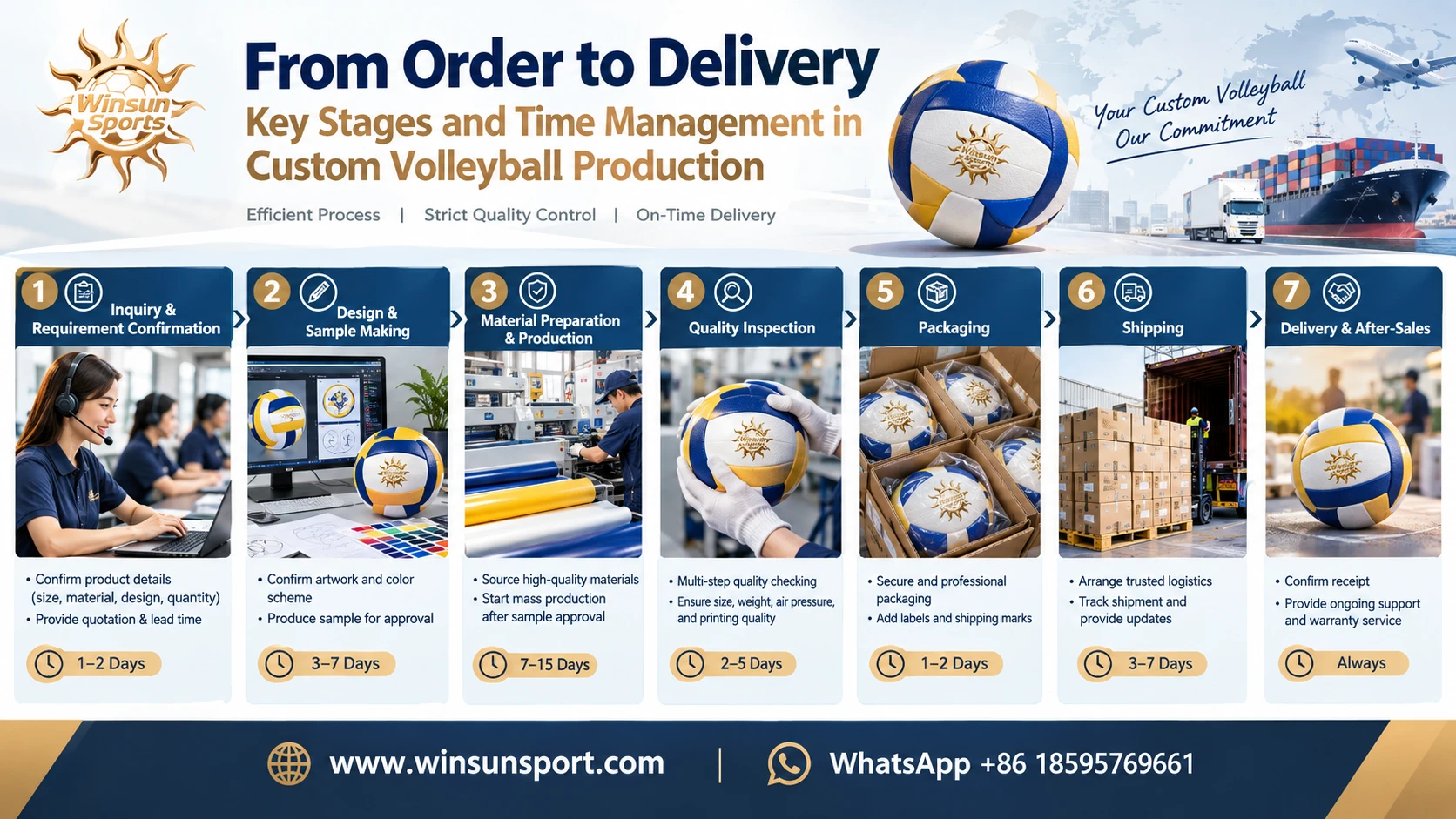
After placing an order for custom volleyballs, where does the time actually go across the four key stages?
The biggest difference between ordering custom gradient volleyballs and buying a standard volleyball is that you are not purchasing off-the-shelf stock, but rather a production chain. From placing the order to receiving the finished product, the time is mainly consumed by four stages: design confirmation, sample approval, batch production, and quality inspection and shipping. Only by understanding what each stage involves can you determine whether the delivery time offered by your supplier is reasonable or just a delay.
Core tasks of the four stages and the logic behind their time allocation:
| Stage | Core Task | Time Allocation Logic |
| Design Confirmation | Confirm the gradient color scheme, size specifications, and pattern placement. | It seems the shortest, but is actually the most uncontrollable, depending on how quickly you can make a decision. |
| Sampling and Sealing | Turn the drawings into physical samples to confirm the gradient transition effect. | Fixed cycle, but the number of reworks determines the actual time spent. |
| Mass Production | Produce according to the sealed sample standards, including printing, lamination, and sewing. | This accounts for the largest share and is affected by order volume and production line scheduling. |
| Quality inspection and shipping | Each batch is checked for color consistency, sphere roundness, and air tightness. | This is easily overlooked, but problems from rushed work tend to concentrate here. |
Why is design confirmation said to be the most underestimated step in the entire process?
Many buyers assume that design confirmation is just sending a picture over and getting it done in a day. In reality, design confirmation for gradient volleyballs is far more complex than for single-color balls—you are not just confirming "whether the color is right," but ratherthe direction of the gradient, the starting position of the transition, and the visual effect at the junction of the two colors.These look fine on a computer screen, but when printed on a spherical surface, they may be a completely different story.
The part that really takes time in this step isdecision-making efficiency。 If there are multiple opinions on the color scheme within your team, requiring layer-by-layer approvals, or if the gradient effect needs repeated revisions, design confirmation could drag on for over a week. Conversely, if the gradient reference image and size requirements are clearly defined before placing the order, this step can be compressed to 1-2 days.
Therefore,unifying requirements internally before placing an order saves much more time than repeatedly revising drafts after the order is placed.。
Sampling and sealing: the critical leap from gradient colors on paper to the actual product
Sampling is the step in the entire process that absolutely cannot be skipped, especially for gradient volleyballs. A gradient effect is one thing on a flat design mockup, but quite another when printed on the curved surface material of a ball—whether the color transition is natural, whether the gradient boundary is clear, and whether the color difference falls within an acceptable range can only be judged by seeing a physical sample.
After sampling is completed, there is another easily overlooked step:sealing the sample.。 Sealing the sample means that you and the supplier jointly confirm that this sample is the standard for mass production, and the color, feel, and size of subsequent bulk orders will all be based on it. If you skip sample sealing and go straight to production, and then find that the gradient effect is wrong when the bulk order comes out, the cost and time required for rework will far exceed waiting for a single sample.
Here is a practical trade-off: sampling requires extra waiting time, but it is one of your key opportunities to identify problems before mass production. If your order volume is small and your requirements for the gradient effect are not high, you can confirm with the supplier whether the sampling step can be skipped;However, if the gradient color scheme is the core selling point of this batch of balls (such as team jersey colors or event theme colors), it is not recommended to skip sampling and sealing. **For which specific situations the sampling process can be simplified, you need to confirm the matching solution with the Winsunsport team based on the complexity of your gradient.
**
What you can do next: Before placing an order, clarify two questions first—who is the decision-maker for the gradient color scheme, and what is the acceptable tolerance range for the gradient effect. Once you have answers to these two questions, the time estimate for the entire process will be accurate.
Design Confirmation and Sampling and Sealing: Why Do These Two Stages Determine Delivery Success?
The gradient effect of custom gradient volleyballs requires color matching and layout to be completed before panel cutting and bonding. Once mass production begins, the cost of modifications is far higher than expected. Design confirmation and pre-production sampling are the only two low-cost error correction windows before mass production.
What information does the buyer need to provide during the design confirmation phase to avoid repeated revisions?
The more complete the information, the fewer subsequent revisions. Before placing an order, it is recommended to prepare the following executable specifications:
- Gradient direction and range: From top to bottom, left to right, or around the sphere?What proportion of the sphere surface should be covered?
- Color values of the starting color and the ending color: Provide Pantone color numbers or HEX color codes to avoid vague descriptions like "dark blue to light blue".
- Gradient transition method: Smooth transition or a spliced look with distinct boundaries?Smooth gradients require higher craftsmanship and affect the sampling cycle.
- Relationship between LOGO and gradient: Is the LOGO placed on top of the gradient, or does it avoid dark areas?A dark LOGO on a dark background has poor visibility on the actual product.
- Usage scenario and sizeIs it for children's training, adult competition, or as a gift or souvenir?The size determines the number of panels; decide on the size first, then the design, to avoid gradients being cut off by panel seams.
How do pre-production samples and sealed samples ensure consistency and reproducibility of gradient colors?
Gradient effects involve multi-color transitions, material layering, and panel stitching; any deviation in any step will make the finished product 'look wrong'. The purpose of confirming pre-production and sealed samples is not just that 'the sample looks good,' but that 'the effect can be stably replicated in mass production.' Specifically, three benchmarks are locked in:
- Color benchmark: The gradient start color, transition colors, and end color are based on the actual sealed sample; during mass production, check against the sealed sample, not the computer design draft.
- Relationship between gradient position and panel stitching: The starting and ending positions of the gradient, and whether it is interrupted by seams, should be fixed after sample approval to avoid inconsistent gradient positions on each ball.
- Material and process stability: Whether the gradient is achieved through printing or material splicing, the materials and process parameters should be locked after sample approval to prevent color shifts due to material changes during mass production.
The buyer's decision speed during sample confirmation directly affects the overall delivery time. It is recommended to provide the Winsunsport team with gradient reference images (indicating color values), usage scenarios, and desired dimensions before placing an order, and to confirm the gradient transition method and panel splicing positions during the sampling stage, using the approved sample as the unified reference for subsequent mass production and acceptance.
Mass Production, Quality Inspection, and Shipping: What Factors Affect Actual Delivery Time?
From order placement to receiving the custom volleyball, there are two stages that are most easily underestimated: mass production and quality inspection with shipping. Many buyers base their time estimates on "production," but in reality, the gaps are often caused by scheduling, quality inspection pace, and logistics.
Key variables affecting production capacity and scheduling in mass production
The first variable is order volume and production line scheduling. The custom gradient color process is not a single production line running from start to finish; gradient dyeing, spherical printing, and assembly lamination each have independent processes. If your order volume happens to fall at a production line switching point—for example, the factory is rushing a large batch order, your small batch order may need to wait for the production line to free up before it can be scheduled.
This is not the supplier "not valuing" you, but the realistic logic of capacity allocation.
The second variable is the complexity of the gradient color scheme. The gradient effect requires multiple coloring and color fixing treatments; the more color transitions and the finer the color block boundaries, the longer the labor time per ball. If you choose a two-color gradient, the production cycle is completely different from a five-color gradient.
This point must be confirmed with the team before placing an order, because many buyers assume that "customization = adding a logo," but the time cost of gradient craftsmanship is far higher than that of single-color printing.
The third variable is the sample confirmation stage. Before mass production, sample confirmation is usually required, and the number of round trips in this stage directly determines the subsequent schedule. If the sample passes on the first try, production starts immediately;if the sample needs to be adjusted twice or three times, each adjustment means re-queuing.
Suggestion: Provide the gradient reference images, Pantone color numbers, or physical color cards all at once before placing the order, which can save at least one round of sample exchanges.
The impact of quality inspection standards and shipping arrangements on final delivery
The quality inspection stage is not just a "formality," but a key checkpoint before the delivery of custom volleyballs that can intercept batch color differences, printing misalignment, and inconsistent feel. Batch stability for gradient dyeing is harder to control than for solid colors—variations in dye formulation and temperature/humidity across batches can all lead to color differences. If the supplier skips quality inspection and ships directly, and you discover issues upon receipt and need to rework, the time lost far exceeds the few days that inspection itself would have taken.
Quality inspection standards directly impact delivery time, but it is time worth waiting for. What you need to confirm with your team is: is inspection performed by sampling or 100% inspection? What is the acceptable tolerance range for color difference in gradient colors?
The earlier these standards are clarified, the smoother the inspection process will be.
In terms of logistics, the truly uncontrollable factors are concentrated in three segments:export customs declaration, international transportation, and customs clearance in the destination country.。 Having customs declaration documents fully prepared can compress the timeline by 1-2 days.International shipping is subject to vessel/flight schedules and may be delayed during peak seasons.Customs clearance depends on the destination country's policies and tariff reviews, which is the hardest part to predict in advance. **What you can do in advance is: confirm at the time of ordering whether the quotation includes sea/air freight, whether it includes destination country tariffs, and whether the supplier can provide logistics tracking milestones.
**
Which factors can be communicated in advance to avoid issues
- Clarify your "must-arrive-by date": work backward from production scheduling, rather than asking "roughly how long will it take"
- Confirm whether the gradient color scheme falls within the scope of conventional processes: Non-standard color matching may require additional time for color adjustment
- Request quality inspection standards and sampling plans: Clearly specify the acceptable color difference tolerance range in the contract
- Confirm the logistics method and the party responsible for customs duties: Avoid discovering additional costs and time delays only when the goods arrive at the port
What truly affects delivery time is not a single step, but whether your expectations for these steps align with the actual production pace. Before placing an order, confirming the above four items with your team one by one is far more effective than repeatedly urging for updates.
How can the purchasing party proactively manage the customization cycle?Four actions to reduce the risk of delays
Delays in the delivery of custom volleyballs are often not solely the supplier's problem, but are caused by changes in requirements midway through the process and a lack of synchronized information between both parties. As the buyer, you can take the initiative by following four actions.
Clarify the required specifications and usage scenarios before placing the order to avoid mid-course changes
The biggest fear in custom volleyballs is 'placing the order first and adding details later.' If you change the size or color scheme midway, the previously scheduled fabric cutting and printing plate making may all be scrapped, and re-queuing is often slower than a new order.
Before placing the order, please confirm the following information all at once:
- Target users and sizeIs it for children's training, adult competition, or as a gift or souvenir?Different scenarios correspond to different sizes and weights, which directly determine the ball specifications.
- Gradient color scheme: From which color to which color does the gradient transition?In which area of the ball surface is the transition located?It is best to provide a reference image or Pantone color numbers.
- Print content and position: Is the logo monochrome or colored?Where on the ball surface is it printed?Do you need to include specific text?
- Quantity and delivery date: Clarify the final usage date and work backward to determine when shipment is needed.If it is for a tournament or event, it is recommended to reserve at least 1-2 weeks of buffer time.
If this information is not fully confirmed at the time of ordering, it is better to place the order a few days later than to proceed with a "start first and see later" mindset. Sufficient communication at the time of ordering usually saves more time than repeated revisions later.
Establish a milestone confirmation mechanism and agree with the supplier on communication methods for each stage.
The production process for custom volleyballs typically includes several key milestones: design draft confirmation, sample confirmation, batch production, quality inspection, and shipment. Each node requires confirmation from the buyer, and the confirmation speed directly affects the overall cycle time.
It is recommended to agree on the following mechanisms with the supplier at the time of order confirmation:
Clearly define the confirmation time limit for each node. For example: provide feedback on modifications within 2 days after the design draft is sent, and confirm whether the sample is approved within 3 days after receipt. Confirmation steps without time limits often become the biggest source of hidden delays.
Designate a single point of contact for key decisions. On the buyer's side, assign one person responsible for all confirmations and feedback to avoid repeated revisions caused by inconsistent opinions from multiple people. On the supplier's side, also require them to designate a corresponding responsible person to ensure uninterrupted information flow.
Agree on communication tools and frequency. Will it be email, WeChat, or other instant messaging tools? During the mass production phase, is a weekly progress sync needed?
Clarifying these at the start of the order is far more efficient than coordinating midway.
Provide all feedback at once when confirming samples. After receiving samples, consolidate all issues—color, feel, print clarity, dimensions, etc.—into a single feedback email, rather than mentioning one issue today and another tomorrow.
Reserve a sample testing step; do not skip confirmation and jump straight to mass production.
For customizations with high visual requirements like gradient color schemes, it is strongly recommended to confirm a pre-production sample before proceeding with batch production. The visual effect of gradient colors is greatly influenced by fabric material and printing process, so there is often a color difference between the design on screen and the actual product.
The sample confirmation step may seem to take a few extra days, but it can prevent the worst-case scenario of discovering color issues after mass production and having to redo the entire batch. If time is really tight, at least confirm a small color swatch sample rather than skipping it entirely.
Include logistics time in the overall timeline, not just production time
Many delays occur after production is completed—ocean freight booking, customs clearance, and domestic transshipment can all add extra time. When placing an order, ask clearly: does the delivery time quoted refer to the factory shipment date or the arrival date? If it is the arrival date, how many days does logistics take?
For balls used in events or activities with a fixed date, it is recommended to add 1-2 weeks of safety buffer to the supplier's delivery time, and then work backward to determine the order placement time. It is better for the balls to arrive at the warehouse early than to be waiting for the courier the day before the event.
Frequently Asked Questions
Q: How much lead time is generally needed to place an order for custom volleyballs? A: It depends on the quantity, the complexity of the color scheme, and whether a sample is needed. Gradient color schemes usually require more confirmation steps than solid colors, so we recommend allowing at least 4-6 weeks.
The specific timeline should be confirmed with the Winsunsport team based on your quantity and usage date, and they will provide a matching production schedule.
Q: What impact would it have if I want to change the color scheme or size midway? A: If production has not yet started, changes usually only affect the design confirmation time;If production has already started, it may be necessary to re-plate or adjust materials, which will significantly extend the delivery time. Therefore, it is better to finalize the plan as completely as possible before placing an order, which saves more time than making changes afterwards.
Q: What aspects should be mainly checked during sample confirmation? A: The key points are whether the gradient transition is natural, how close the color is to the design draft, whether the printing details are clear, and whether the sphere size and feel meet expectations. It is recommended to check the color under natural light to avoid making judgments under off-color lighting.
Q: Does small-batch customization also require the full confirmation process? A: Yes, but the pace can be faster. When the quantity is small, the production cycle itself is shorter, and the main time is spent on design and sample confirmation.
If you only need a small number of samples or trial balls, you can directly explain your purpose to the Winsunsport team, and they will provide a simplified process suitable for small-batch orders.
Learn more
If you are unsure about the target, intended users, existing materials, or subsequent maintenance methods, it is recommended to confirm this information first before determining whether the Custom Gradient Color Volleyball is suitable.