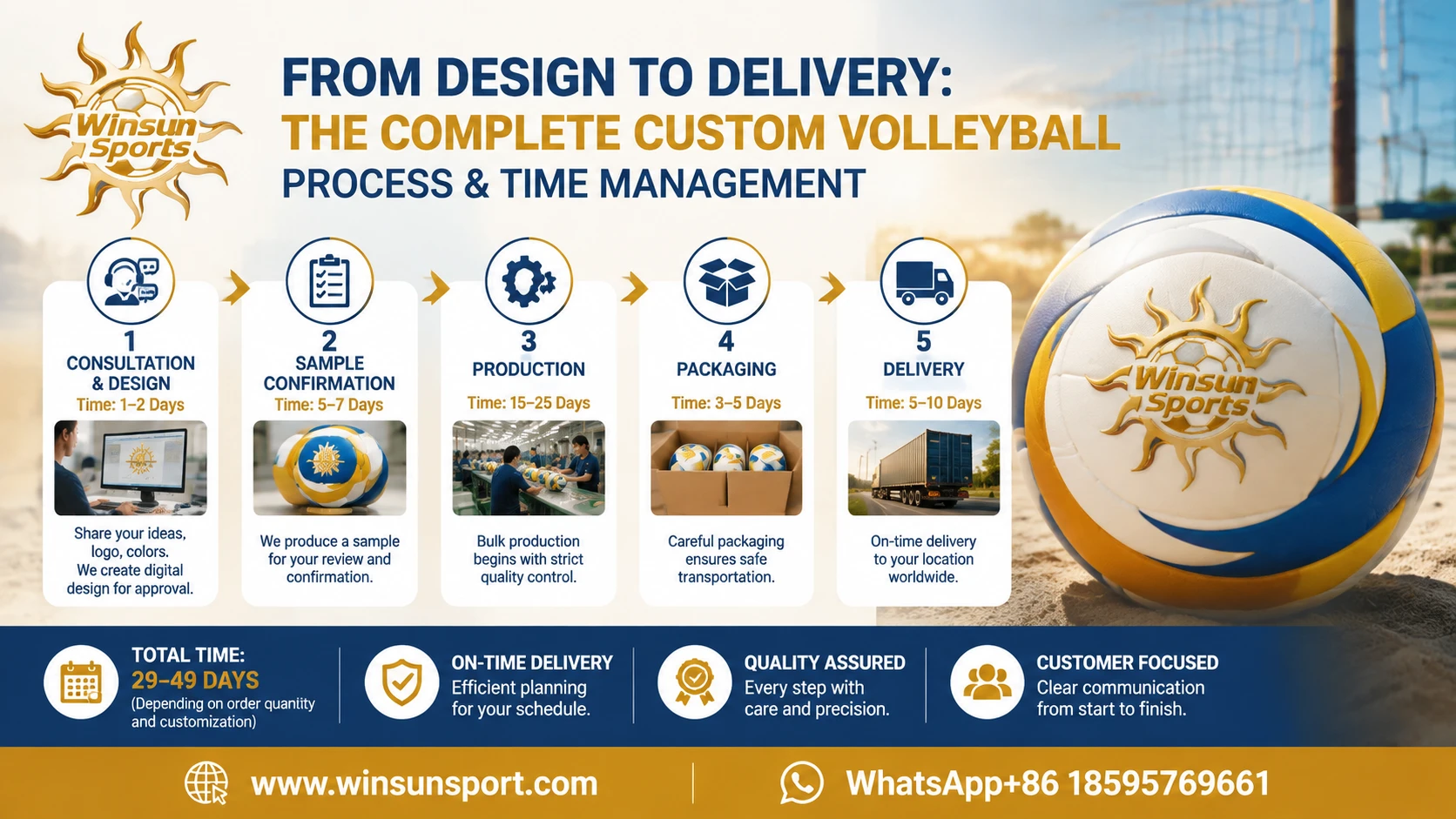
How many steps are there in the complete process from placing an order for a custom volleyball to receiving it?
From placing an order for a custom volleyball to receiving it, you need to go through five stages in sequence:design confirmation, sampling, production, quality inspection, and logistics. Each stage is a prerequisite for the next, and the order cannot be skipped.
Five core stages: design, sampling, production, quality inspection, and logistics
- Design confirmation—Convert customization requirements into producible files, determining the ball surface pattern layout, color scheme, and specifications (such as whether to use the standard size 5, with a circumference of 65–67 cm and a weight of 260–280 g).The core output is the design draft confirmed by both parties.
- Sampling—Creating a physical sample to verify the actual appearance of the pattern on the spherical curvature.PU soft leather is a curved surface material, and flat design drafts may experience stretching or color deviation after printing; sample confirmation is a necessary step before mass production.
- Production—After sample confirmation, production is scheduled according to the order quantity.Taking the yellow-blue wave pattern No. 5 PU heat transfer volleyball as an example, the process involves PU leather cutting, bladder assembly, high-temperature seamless heat bonding, and other steps; the production cycle is directly related to the order quantity.
- Quality Inspection—Checking each batch for ball circumference and weight compliance, whether the printed pattern has any offset or peeling risk, and whether the heat-bonded seams are secure.
- Logistics—Packaging, dispatch, and arranging transportation.Custom products typically have no stock inventory, so logistics time must be counted separately into the total lead time.
Why the order of the process directly affects the total delivery lead time
Each stage depends on the confirmation results of the previous stage: if the design draft is not finalized, sampling cannot begin;if the sample is not confirmed, mass production cannot start. If sampling is skipped and mass production begins directly, the cost of rework after discovering pattern issues is far higher than making modifications during the sampling stage. Therefore, the total delivery lead time is the sum of the time for each stage, where the duration of design confirmation and sample confirmation depends on the feedback speed of the requester—the faster the response, the shorter the total lead time.
Design confirmation and sampling: Why do these two stages affect the total lead time the most?
The delivery lead time for custom volleyballs is often not extended by the production stage, but consumed by the "confirmation" stage. Design confirmation and sampling are the only two nodes in the entire process that require your decision-making participation—the faster you reply and the fewer changes you make, the smoother the subsequent production will be.
Design confirmation stage: From requirement communication to design draft finalization
The materials you need to provide at this stage are actually quite simple:Source files of the logo (AI, CDR, or high-resolution PNG), desired color references, and a rough idea of the layout on the ball surface. If you don't have source files, clear images are also acceptable, but the designer will need time to trace them, which will correspondingly increase the lead time.
The key trade-off is: the ball surface is curved, and there will be visual differences between the effect on a flat design draft and when it is actually applied to the sphere. So when confirming the design draft, don't just stare at the computer screen; proactively ask the team, "Will this pattern be cut off at the spherical seam?" and "Will the text distort when it spans across panels?" If these questions are raised during the confirmation stage, what gets changed is the file;if they are raised after sampling begins, what gets changed is the physical product, and the timeline is completely different.
Sampling Stage: Key Milestones in Sample Production and Confirmation
Sampling typically takes 7-10 days, depending on the complexity of the pattern and the chosen process. The purpose of this stage is to give you the physical sample to judge two things:Whether the color meets expectations and whether the pattern's proportion on the sphere is harmonious。
After receiving the sample, we recommend you do a simple "real ball test"—hold the ball in your hand and rotate it to see how the pattern looks from various angles;then bounce a few balls to feel whether the touch of the PU soft leather suits your target users. If it's for school procurement, you can have the PE teachers or team members review it together to avoid the gap between "a good-looking design draft" and "the actual product not meeting teaching needs."
How can you reduce the number of design revisions to shorten the cycle?
- Reach internal consensus before confirmation: For school procurement or corporate team building, have the people in the decision-making chain review the design draft before submitting it, to avoid back-and-forth changes.
- Clearly state all modification points at once: Don't just "change the color first, and adjust the position next time." Compile all issues into a checklist and provide feedback in one go.
- Reference existing products: If you have seen a physical item of a similar style, directly tell the team "I want something close to this effect," which is more efficient than describing it in words.
It should be noted that if your design involves complex gradients, fine lines, or large areas of spot color, the number of sampling iterations may increase. In such cases, it is recommended to explain this to the team during the requirements communication stage, allowing designers to assess process feasibility in advance, rather than discovering issues only after the sample is produced.
Production and Quality Control: How is a standard size 5 volleyball manufactured and quality assured?
Production Stage: The manufacturing chain from bladder to finished product
Taking the yellow-blue wave contrasting color volleyball as an example, its production chain is: butyl rubber airtight bladder → multi-layer thickened nylon fiber winding yarn → microporous anti-slip PU soft leather patch → high-temperature seamless thermal bonding → heat transfer printing.
The inner bladder is made of butyl rubber, which provides good air retention and reduces the need for frequent inflation. The winding layer uses multiple layers of thickened nylon fiber, which helps maintain the ball's roundness and durability. The outer surface is a micro-porous anti-slip soft PU leather, bonded using an 8-panel one-piece heat lamination process. The seamless design reduces water penetration while enhancing consistency in striking feel.
Custom patterns are applied to the ball surface via heat transfer printing, which is done after the panel lamination process.
Quality inspection: What key indicators need to be confirmed before shipment?
Pre-shipment quality inspection mainly covers four dimensions:
| Inspection item | Standard range | Description |
| Ball circumference | 65–67 cm | Standard size 5 adult volleyball specification |
| Weight | 260–280 g | Standard weight range |
| Pattern printing | Clear, no peeling | Confirm custom pattern quality |
| Heat-sealed seams | Firm, no delamination | Ensure long-term reliability |
This volleyball is positioned as a standard size 5 competition specification, with dimensions and weight executed according to the above ranges. For bulk purchasers, the significance of quality inspection lies in ensuring consistent feel across the same batch of products, avoiding obvious differences between batches.
Logistics and overall timeline planning: How to schedule procurement in reverse to avoid delaying the project?
Custom volleyball from order to delivery is not as simple as "place order - ship - receive." In between, there are six stages: design confirmation, sampling, mass production, cross-border transportation, customs clearance, and domestic delivery, each with its own time requirements and uncertainties. If you only think about purchasing two weeks before the season starts, it is likely too late.
Logistics stage: time differences between domestic and international shipping
Cross-border logistics is the most uncontrollable part of the entire chain. International shipping is generally divided into two methods:
- Air freight: from the factory to major domestic cities, it generally takes 5–10 days.Fast but with high freight costs, suitable for small-volume, time-sensitive orders.
- Sea freight: Usually takes 20–35 days, depending on the port of loading and the port of destination.Low freight costs, but once the shipping schedule is delayed, it is difficult to make up for lost time.
Customs clearance is another step that is easily underestimated. For schools or companies importing for the first time, without existing clearance qualifications or an agent, it may add an extra 3–7 days. In addition, uncontrollable factors such as holidays, carrier overbooking, and customs inspections can double the logistics time.
Key judgment: If your delivery address is in a remote area or a non-first-tier city, you should also allow an additional 2–3 days for domestic shipping, and do not estimate delivery time based on first-tier city transit times.
Reverse timeline: work backward from the target date to determine deadlines for each step
The core of working backward is: first set the date by which you must receive the goods, then work backward to determine the latest deadline for each step. Taking 10 weeks before the season starts as an example, a reasonable timeline is as follows:
| Step | Duration | Latest Deadline |
| Design confirmation and revisions | 3–7 days | Completed within the first week |
| Sampling and confirmation | 5–10 days | Completed before the second week |
| Mass production | 10–15 days | Completed before the fourth week |
| Cross-border transportation (air freight) | 5–10 days | Shipped before week 6 |
| Customs clearance and domestic delivery | 3–7 days | Completed before week 8 |
| Buffer time reserved | 7–10 days | Goods received in week 10 |
If sea freight is chosen, shipment must be made before week 3 after mass production is completed, and the entire schedule needs to be started 3–4 weeks earlier.
Practical operational suggestions: First determine the target date, then fill in the deadlines from bottom to top according to the table above. For each step you fill in, ask yourself: if this date is delayed, which subsequent step can be compressed? If the answer is none, the plan is too tight, and you need to start earlier or consider air freight.
Which steps are prone to delays and need buffer time?
Based on practical experience, delays are most common in three steps:
- Design confirmationSchool procurement often requires multi-level approval; after the PE teacher confirms, it must go through the general affairs office and the principal's signature.Each level of approval may take 1–2 days.It is recommended to complete the internal process first before contacting the supplier.
- Sample confirmation: It is common for physical samples to differ from design drawings in color and position.If you are not satisfied with the sample, each round of modification takes 5–7 days.It is recommended to clearly mark colors, sizes, and positions during the initial design to reduce rework.
- Customs clearance: This is the most uncontrollable step.For first-time importers, it is recommended to consult the current website team in advance to see if they provide customs clearance assistance or use a double-clearance tax-included channel to avoid goods being stuck at customs after arrival at the port.
Who should reserve a longer buffer: For scenarios with fixed dates, such as schools and event organizers, it is recommended to reserve a buffer of more than 2 weeks. Who can compress the buffer: For corporate team-building and daily training balls, where dates are flexible, a 5–7 day buffer is acceptable.
Frequently Asked Questions
Q: What is the minimum lead time for ordering custom volleyballs? It is recommended to order at least 6–8 weeks in advance. If shipping by sea or involving complex designs, 10–12 weeks in advance is safer.
Less than 4 weeks is considered an expedited order, and we need to confirm whether the current website team still has production capacity.
Q: How do I choose between air freight and sea freight? It depends on two factors: shipment volume and time. If the volume is small (within a few dozen balls) and time is tight, air freight is more cost-effective;if the volume is large (several hundred or more) and you order 2 months in advance, sea freight can save a lot on shipping costs.
If you're unsure, you can ask the current website team for quotes and delivery times for both methods, then compare before deciding.
Q: What exactly should I prepare for the design confirmation stage? At least three things: a clear Logo source file (vector format is best), color references (Pantone color numbers or physical color swatches), and sphere layout requirements (what content goes in which areas). The more complete the information, the faster the design confirmation and the lower the risk of rework.
Q: What if quality issues are found after receiving the goods? After receiving the goods, it is recommended to open the boxes and conduct spot checks within 3 days, focusing on printing firmness, ball roundness, and air tightness. If problems are found, take photos and contact the current website team promptly to confirm a replacement or return/exchange plan.
Exceeding the time window may affect after-sales handling.
Q: For school purchases that require a bidding process, how is the time calculated? The bidding process itself takes 2–4 weeks, and this time should be calculated separately, not included in the production and logistics cycle. It is recommended to complete the bidding process before placing an order, or to contact the current website team in advance to confirm whether they can provide product parameter documents for bidding material preparation.
Learn more
If you are planning a volleyball purchase for a school or club, we recommend starting the design confirmation process as early as possible.Share your usage scenario, target delivery date, and order quantity with our website team, and we can help match production and logistics solutions to ensure the balls arrive on time.
Related products:Yellow and blue wavy pattern No. 5 PU heat transfer volleyball, customizable logo