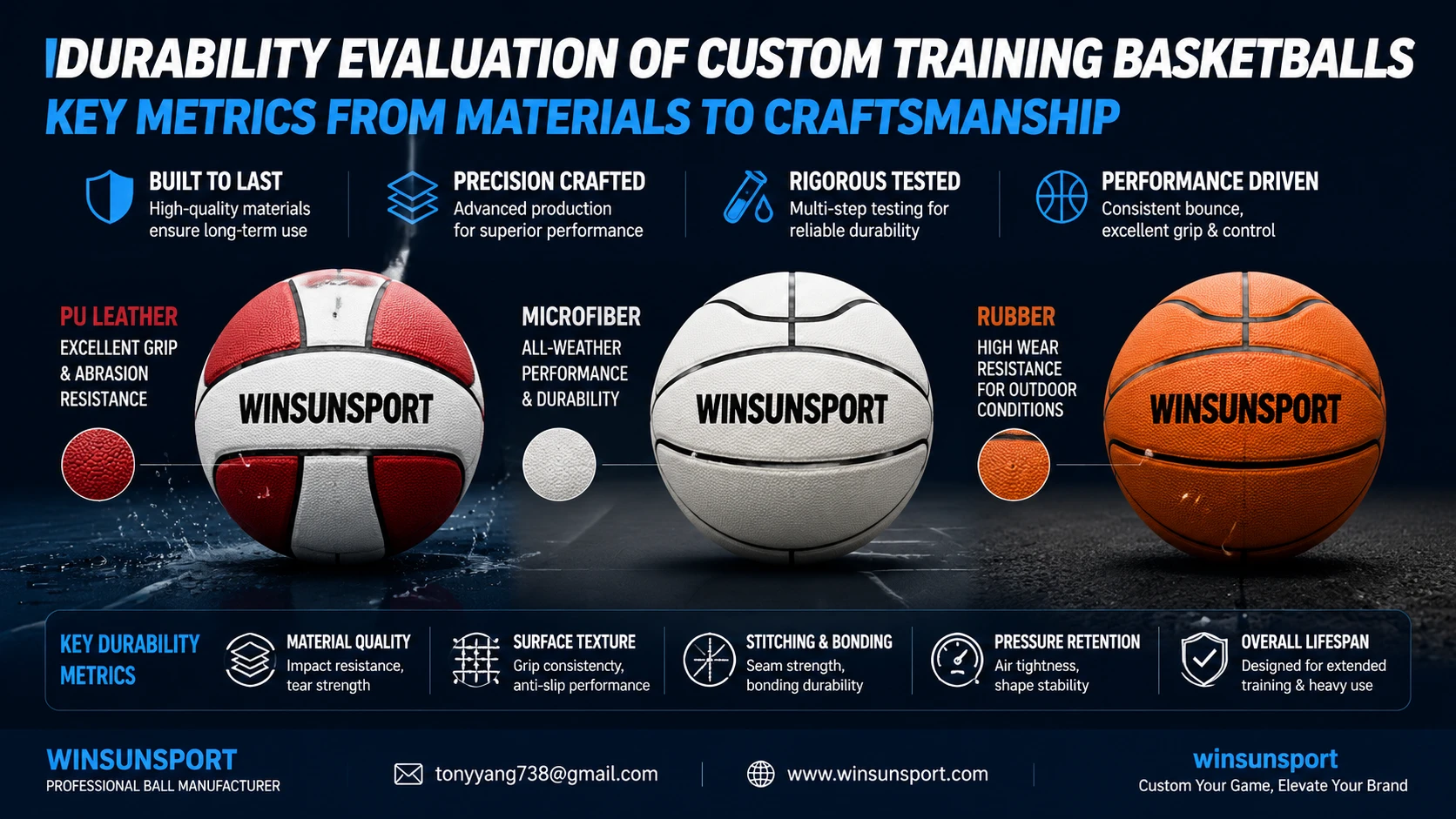
What factors determine the durability of a custom training basketball?
The durability of a custom training basketball directly determines how long your investment will last and how long the printed pattern will remain. It is mainly determined by two core factors:surface materialandinternal structure. Understanding these two points will help you judge whether a custom basketball is suitable for your training intensity.
Basketball Material: Durability Differences Among Rubber, PU, and Synthetic Leather
Basketballs made of different materials have completely different lifespans and feels.
- Rubber Basketball: Most durable, but hard feel and high bounce.Suitable for outdoor concrete and asphalt courts, extremely wear-resistant; surface patterns may still be visible after two to three years.However, disadvantages include poor sweat absorption, hand pain after prolonged use, and printed patterns easily peeling off due to friction.Suitable for: Purely outdoor courts, limited budget, and training with low requirements for feel.
- PU (Polyurethane) Basketball: Balanced choice. Softer than rubber, good feel, moderate wear resistance. Can last 1-2 years on indoor wooden floors or plastic courts, but the surface will gradually become slippery.Suitable for: For indoor and outdoor use, training that balances feel and durability.
- Synthetic leather basketball: Least wear-resistant, but closest feel to genuine leather.Typically used for indoor games; on clean wooden floors, lifespan is about half a year to one year. Once exposed to dust or water, the surface will crack quickly.Suitable for: For professional indoor games and scenarios requiring high ball control feel.
Key Trade-offs: If you mainly play outdoors, choose rubber;if mixed indoor/outdoor, choose PU;if only playing indoor games, choose synthetic leather. Custom printing is most prone to peeling on rubber, relatively durable on PU, and most detailed but most fragile on synthetic leather.
Internal Structure: Impact of Bladder and Winding Process on Lifespan
The "skeleton" of a basketball determines whether it will deform or leak air.
- Bladder Material: Common butyl rubber and natural rubber.Butyl rubber has better air tightness, can maintain air longer after one inflation, and is not prone to air leakage;Natural rubber has good elasticity but poor air tightness.Impact: Poor air tightness of the bladder means the basketball will need frequent inflation, and long-term unstable air pressure can cause the ball to deform and shorten its lifespan.If the bladder of a custom basketball is made of butyl rubber, its durability will be significantly better than that of natural rubber.
- Winding process: This is the "skeleton" of the basketball.The more layers of winding yarn and the more uniform the yarn, the better the basketball's roundness retention and the stronger its impact resistance.Low-end basketballs may have only one thin layer of yarn or no winding at all, and they will deform after just a few shots.Mid-to-high-end basketballs usually have 2-3 layers of nylon winding yarn, capable of withstanding thousands of shots.Impact: The winding process directly determines whether the basketball will develop "bumps" (surface bulges) or deform.If the winding yarn quality of a custom basketball is poor, the pattern will warp and crack as the ball deforms.
Next Confirmation Step: Confirm with the Winsunsport team whether the inner bladder of the custom training basketball you selected is butyl rubber or natural rubber, and how many layers of winding yarn and what material it is. These two pieces of information are more indicative of actual lifespan than the brand name.
Durability of printing process: Can custom patterns withstand long-term use?
Comparison of wear resistance among screen printing, heat transfer, and digital direct printing
The wear resistance of the three mainstream printing processes differs significantly:
- Screen printing: The ink penetrates the basketball surface, offering the highest durability.When used on normal indoor and outdoor courts, the pattern can remain without significant peeling for a long time, suitable for high-frequency bouncing scenarios such as training and games.
- Heat transfer: The pattern is bonded to the ball surface via a hot-pressed film, with medium durability.The edges may lift after scraping on rough ground, suitable for gifts, souvenirs, or light use scenarios.
- Digital direct printing: The ink adhesion is weak, and wear resistance is relatively poor.It can last for several months indoors, but may experience partial peeling quickly when used frequently outdoors, suitable for short-term events or low-frequency use.
Key Trade-offs: If the basketball is used for daily training or games, screen printing is a more reliable choice for long-lasting patterns. If used as a gift or decoration, heat transfer or digital direct printing can reduce unit cost, but the pattern lifespan is shorter.
How to request a wear resistance test report from the supplier?
When confirming durability with the supplier, you can ask the following questions:
- What printing process is used? — Clarify whether it is screen printing, heat transfer, or digital direct printing.
- Has abrasion resistance testing been performed?What are the test conditions? — For example, "After how many machine rubs on a standard rubber floor does the pattern begin to wear off?"Reputable suppliers can provide internal test data or third-party reports.
- Can test samples using the same process be provided? — They can be rubbed 10-20 times on the actual usage surface (e.g., concrete floor, wooden floor) to observe pattern changes.
Suggestion: When contacting the supplier, inform them of the specific usage scenario (e.g., "school basketball team trains 3 times a week, mainly on indoor wooden floors"), ask for the most suitable process recommendation, and request wear test data or samples. If the supplier cannot provide any test basis, it is recommended to prioritize the screen printing process.
In which scenarios is the durability of custom training basketballs most tested?
The durability of custom training basketballs is tested in completely different dimensions depending on the usage scenario. Choosing the wrong material or process may lead to premature wear of the ball, peeling of the print, or even affect the user experience. The following analyzes two typical scenarios to help you determine where your needs fall.
Outdoor concrete court training vs. Indoor wooden floor training
Outdoor concrete courtIt is the "high-pressure testing ground" for custom basketball durability. The concrete surface is rough and granular. When dribbling or landing after a shot, the basketball's surface will continuously experience friction and impact. If the basketball surface is made of ordinary PVC or thin rubber, peeling, cracking, or even bulging will occur quickly.
Custom basketballs suitable for outdoor concrete courts must use thickened rubber or PU material, with deep surface texture and thick wear-resistant layer.The printing process for such basketballs also requires extra attention—if screen printing or heat transfer is not treated for wear resistance, the pattern may blur after just a few intense training sessions.
Indoor wooden flooris relatively "friendly". Wooden floors are smooth and elastic, causing much less wear on the basketball's surface. At this point, the main test of durability comes fromfrequent dribbling, passing, and shooting, rather than friction with the ground.
Indoor balls place greater emphasis onair tightnessandand seam strength—if the ball leaks air or the seams open after prolonged use, it is considered unusable even if the surface is intact. For indoor training, standard PU material with deep groove design is usually sufficient, and the wear resistance requirements for printing can be appropriately relaxed.
Key Trade-offs: If you mainly play on outdoor concrete courts, you must confirm with the Winsunsport team the basketball'sskin material thicknessandprinting wear resistance test data; if only for indoor use, focus on confirmingair tightness test standardsandseam technology。
High-intensity event promotion vs. daily gift distribution
As a tournament prize, the durability of customized basketballs directly affects brand image. In a league or championship, the winning team will repeatedly use this ball for training and games. If the ball shows wear, deformation, or pattern peeling within a few months, the brand not only loses promotional effect but may also be questioned by users about quality.
Balls used as tournament prizes should be made of materials and craftsmanship equivalent to professional training balls, such as thickened PU, double-sided printing, heat transfer, or high-wear-resistant silk screen printing. At the same time, it is recommended to request Winsunsport to providebatch sampling wear resistance test reports(such as pattern integrity after 2000 simulated dribbles).
As a promotional basketball(e.g., for corporate events or promotional giveaways), the durability requirements can be appropriately lowered. The core value of a promotional basketball lies infirst impression—an attractive appearance, clear printing, and comfortable feel are sufficient. Most promotional basketballs are not used frequently; they may be placed in offices or homes as decorations and occasionally bounced a few times.
In this case, standard PVC material and ordinary screen printing process can meet the needs, and excessive pursuit of wear resistance only increases costs.
Key Trade-offs: For tournament prize balls, durability is the top priority. It is recommended to choose Winsunsport'sPro-level customization solution;For gift balls, prioritize budget control and appearance. The standard customization solution is sufficient. If you are unsure which category your scenario falls into, you can provide Winsunsport's team withestimated usage frequencyandprimary usage environment(indoor/outdoor), and they will recommend matching materials and processes.
How to determine durability from a supplier's quality inspection report?
When you receive the supplier's quality inspection report, don't just look at the word "qualified". You need to focus on the following three items, which directly determine how long the basketball can last during training.
What key items should the quality inspection report include?
- Rebound height and air pressure retention rate
The report should provide the initial rebound height (usually ≥120cm) and the air pressure retention rate after 72 hours. If the retention rate is below 85%, it indicates poor air tightness of the ball, requiring frequent inflation after a few uses, and the long-term experience will significantly decline.
- Abrasion resistance test (e.g., Taber abrasion value)
Check whether the report indicates the abrasion loss (in mg) of the surface material. The lower the abrasion value, the better the wear resistance. If the report only states "passed the test" without specific values, it may indicate that the supplier is avoiding key comparison points—you can directly ask: "What is the abrasion value?"
What is the corresponding number of revolutions? "
- Print adhesion test (such as cross-cut test or tape peel test)
Custom basketballs are most prone to pattern peeling. The report should clearly indicate whether the printed layer peels off after standard tape peeling. If the report lacks this, the pattern is likely to peel within weeks during subsequent use.
How to self-evaluate through samples when there is no quality inspection report?
If the supplier cannot provide a report, you can use the sample to make three quick judgments:
- Fingernail scratch test: Use your fingernail to scratch vigorously along the edge of the printed pattern.If there is obvious fading or peeling, it indicates poor adhesion and is not suitable for high-intensity training.
- Press the air valve: Press the area around the air valve with your finger to feel if there is any air leakage sound or obvious looseness.If the air valve seal is poor, the basketball will leak air quickly.
- Surface friction feel: Rub the ball surface vigorously with your palm for 10 seconds, and observe whether it becomes noticeably shiny or fuzzy.If the surface becomes smooth quickly, it indicates that the wear-resistant layer is too thin.
Common Questions
Q1: What is the difference between "Pass" and "Specific Values" on the inspection report? "Pass" only indicates that the minimum standard has been met, but it cannot determine the durability level compared to similar products. Specific values (such as abrasion loss, air pressure retention rate) help you compare the process differences among different suppliers horizontally.
Q2: How to interpret the cross-cut test results for printed patterns? The cross-cut test is usually graded from 0 to 5, with 0 being the best (cut edges completely smooth, no peeling). If the report shows level 3 or below, it indicates that the printed layer is prone to peeling off under repeated friction or sweat erosion, making it unsuitable for training balls.
Q3: Which is more reliable, sample testing or quality inspection report? The quality inspection report provides standardized data, while sample testing reflects actual feel. Combining both is most reliable: first use the report to filter out obviously unqualified options, then use samples to confirm whether the printing and feel meet expectations.
Q4: If a supplier says, 'We don't have a quality inspection report, but the quality is more assured,' can you trust that? Recommend caution. Without a report, you cannot verify key durability indicators, and you will lack evidence when issues like air leakage or color fading arise later.
You can ask the supplier to provide at least one third-party test report for similar products as a reference.
Q5: Will the printing process of custom training basketballs affect durability? Yes. Screen printing is more wear-resistant than heat transfer, but the pattern details are slightly inferior.
If the report does not include printing process instructions, directly confirm with the Winsunsport team which process is used for the current sample and the corresponding wear resistance test results.
Learn More
If you are planning to procure custom training basketballs and are unsure about materials, processes, or quality inspection requirements, feel free to submit your usage scenario and estimated quantity to the Winsunsport team, and we will help match the most durable custom solution.
Related Products:Custom Printed Pro Training Basketball