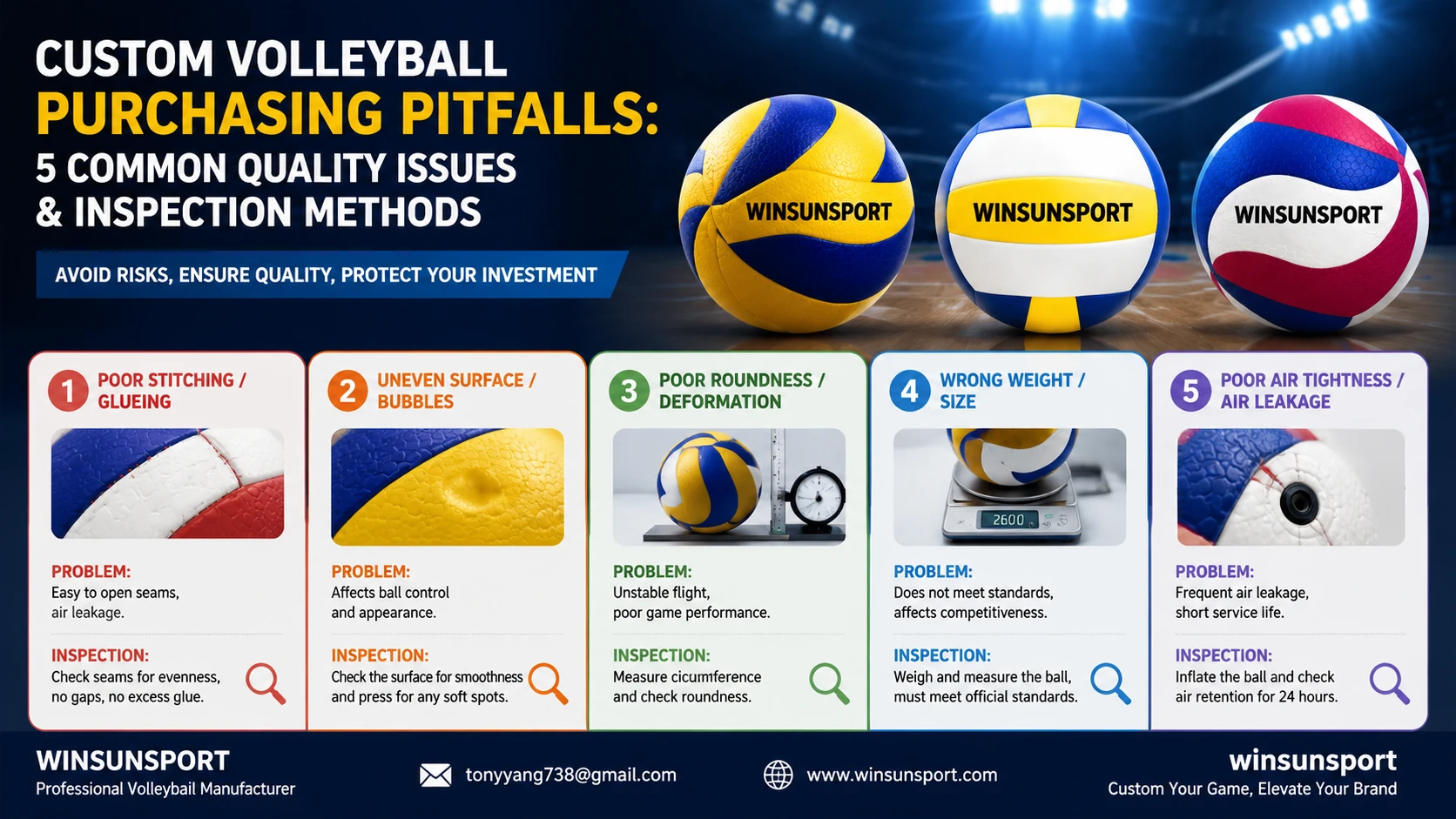
What are the 5 most common quality issues in custom volleyball procurement?
Custom volleyballs are different from standard ones. You select the material, printing, and craftsmanship when ordering, but after receiving the product, the actual performance of the ball may differ from expectations. The following 5 issues are most frequently reported in procurement feedback. Understanding them can help you assess risks in advance and focus on key points during inspection.
Issue 1: Ball Deformation – Out-of-roundness Affects Flight Trajectory
Manifestation:The ball appears not round when stationary, or one side is noticeably softer when pressed by hand. The trajectory is not straight when rolling, and it deviates slightly.
Cause:: The wall thickness of the inner bladder (rubber or butyl) is uneven during molding, or the number of winding layers is insufficient and the tension is inconsistent. This is common in low-cost or small-factory products, because roundness testing requires a specialized spherometer, and not all factories perform full inspections.
Impact on Use: It has the greatest impact on matches and training. When passing or spiking, the ball will wobble unpredictably, making it impossible to accurately predict the landing point. If it is for gifts or decoration, roundness issues do not affect appearance, but if it is for student training or amateur matches, it is recommended to let the ball free-fall several times during acceptance to observe whether the bounce direction is consistent.
Winsunsport's Approach: We use high-precision molds and standard winding processes, and roundness is spot-checked before shipment. If you have strict competition requirements for roundness, please inform us when placing an order. We can perform full inspection according to FIVB standards (roundness deviation ≤ 2mm), but this will increase delivery time and cost.
Problem 2: Skin peeling — substandard material and bonding process
Manifestation:After 1-2 months of use, the skin begins to peel or flake at seams or stress points, and in severe cases, the entire piece comes off.
Cause:This mainly falls into two categories:
- Material issueThe PVC or PU skin itself has poor wear resistance, especially low-cost PVC, where the surface coating is very thin and peels off after a few frictions.
- Bonding issueInsufficient adhesive strength between the skin and the bladder, or uneven glue application.In high temperature or humid environments, peeling will accelerate.
Impact on UseAfter peeling, the surface of the ball becomes uneven, affecting the feel, and the fallen fragments may contaminate the court. If it is a corporate gift or commemorative ball, peeling will directly damage the printed pattern and lose its customization value.
How to avoidWhen purchasing, clarify the usage scenario—if it is for outdoor cement courts or rough ground training, it is recommended to choose PU material (better wear resistance than PVC), and confirm whether the factory uses environmentally friendly hot melt adhesive or cold bonding process. Winsunsport's customized volleyballs support both PU and PVC materials. The PU model uses a double-sided bonding process, which reduces the risk of peeling. If you are unsure which to choose, you can tell our sales team your main type of playing surface, and we will recommend a matching solution.
Problem 3: Printed pattern blurring or peeling off
The team name, logo, or pattern on customized volleyballs is one of the core values of procurement. But common problems are: blurred edges of the print, uneven colors, or the pattern wearing off or peeling after a few uses.
Cause:: Improper selection of printing process. Screen printing (cheap but prone to blurred edges) and heat transfer (clear pattern but average wear resistance) are common processes. If the pattern is large or has many colors, screen printing is prone to misregistration;if the ball surface has texture, the adhesion of heat transfer will decrease.
Acceptance suggestion: After receiving the goods, wipe the pattern area 10 times with a damp cloth to observe if there is any color fading or peeling. If the pattern is gradient or complex lines, it is recommended to choose heat transfer + lamination process, which has higher cost but better durability. Winsunsport offers both screen printing and heat transfer options. For small batches (less than 50 pieces), screen printing is recommended to control costs; for large batches or high-demand patterns, heat transfer is recommended.
Question 4: Excessive weight deviation - inconsistent feel
Manifestation:: Among the same batch of custom volleyballs, some balls are noticeably lighter or heavier, or the weight distribution of the same ball is uneven in different directions (center of gravity offset).
Cause:: The weight control of the bladder is not strict, or the number of winding yarn layers is uneven. The standard volleyball weight is 260-280 grams (FIVB standard). If the material or process of the custom ball is changed, the weight may deviate from this range.
Impact: During training or competition, inconsistent weight can lead to misjudgment of passing force. If used as a gift, weight deviation does not affect usability, but it may leave an impression of "unstable quality."
Inspection Method: Use an electronic scale to randomly weigh 3-5 balls and check if the maximum deviation exceeds 10 grams. If it does, it indicates a problem with batch consistency. Winsunsport's custom volleyballs undergo weight sampling before shipment, with deviation controlled within ±5 grams.
If you require stricter tolerances, just specify it when placing the order.
Problem 5: Poor Air Tightness – Air Leakage Leading to Frequent Inflation
Manifestation:: After inflating a new ball, it becomes noticeably soft after 24 hours, or requires re-inflation every 1-2 days during use.
Cause:: The air valve is not sealed tightly, or the bladder has tiny pinholes. Rubber bladders are more prone to air leakage than butyl bladders because butyl rubber has better air tightness.
Impact: Frequent inflation affects the user experience, especially in school or team training, where no one wants to check the ball's air pressure every day. A ball with severe air leakage may suddenly become soft during a game, leading to mistakes.
Inspection Method: After fully inflating the ball, submerge it in water and observe whether bubbles emerge from the air valve or the ball surface. No bubbles indicate that the air tightness is qualified. Winsunsport's custom volleyballs use butyl bladders by default, which have better air tightness than ordinary rubber bladders.
If you have a limited budget, you can also choose rubber bladders, but it is recommended to perform a water submersion test during acceptance.
Key Trade-off Summary: If the volleyball you purchase is mainly used forofficial matches or high-intensity training, focus on checking roundness, weight, and air tightness. It is recommended to choose PU material + butyl bladder + heat transfer process, which will cost 20-30% more, but the performance is close to standard match balls. If used forgifts, souvenirs, or recreational entertainment, PVC material + screen printing process is sufficient, with key acceptance criteria being print clarity and peeling issues. If you are unsure which configuration corresponds to your usage scenario, you can directly contact the Winsunsport sales team, providing your usage frequency, venue type, and budget range, and we will provide a matching solution.
How to quickly judge the quality of custom volleyballs through visual inspection and touch?
After receiving the custom volleyball, you don't need professional instruments; a few minutes of visual inspection and touch can filter out most obvious problems. The following methods are suitable for operation in a warehouse or office, helping you quickly decide whether to accept the delivery.
Visual inspection: preliminary screening of roundness, surface, and printed patterns
1. Roundness check Place the ball on a flat table or floor, and gently spin it with your hand. If the ball noticeably wobbles or its trajectory is not straight when rolling, it indicates a roundness issue, which will affect the stability of passing and serving. A qualified volleyball should roll smoothly with a nearly straight trajectory.
2. Surface Inspection
- Check for bumps or dents: Gently stroke the ball surface with your palm to feel for any local protrusions or depressions.Bumps are usually caused by issues with the bladder or lamination process, while dents may be mold defects.
- Check seam uniformity: Inspect the panel seams (usually two or three seams) to see if the gaps are consistent in width and if there is any curling at the edges.Uneven seams can cause uneven stress distribution on the ball, affecting durability.
- Printed patterns: When customizing the logo or text on a volleyball, focus on whether the edges are clear, without smudging or missing prints.If the pattern is screen-printed or heat-transferred, gently scratch the edge of the pattern with your finger; it should not peel off easily.
3. Valve Inspection The valve should be flat, free of burrs, and flush with or slightly recessed from the ball surface. A protruding valve can easily cause air leakage or discomfort when touching the ball during a game.
Feel Evaluation: Quick Judgment of Elasticity, Weight, and Surface Texture
1. Elasticity Test Drop the ball freely from a height of about 1.8 meters (the chest height of an adult standing upright) onto a hard surface; the rebound height should be between 1.2 and 1.4 meters. If the rebound is too high or too low, it indicates that the bladder pressure or material may not meet the standard. If you don't have a ruler at hand, you can estimate by sight: a normal rebound height is roughly between the waist and chest.
2. Weight and Balance Hold the ball with one hand and feel whether the weight is evenly distributed. If the ball is noticeably tilted to one side, it indicates that the internal counterweight or bladder position is off, which will affect ball control feel. A standard volleyball weighs about 260-280 grams. Custom balls made of different materials (such as PVC vs PU) may vary in weight, but balls from the same batch should be consistent.
3. Surface Texture
- Slip Resistance: Quickly swipe your finger across the ball's surface to feel if it is rough.A ball that is too smooth may become slippery when sweating or in humid conditions.
- Hardness: Press the ball surface with your thumb. PU material should have moderate elastic feedback, PVC is slightly harder, and rubber is the hardest.If there is obvious indentation after pressing and it does not rebound, the material is too soft or aged.
Key Steps for Inspecting Custom Volleyballs
- Let the ball rest for 30 minutes after unboxing: Allow the ball to acclimate to the ambient temperature to avoid pressure reading deviations due to temperature differences.
- Inflate to standard pressure: Use a needle with a pressure gauge to inflate to 0.30-0.325 kg/cm² (approximately 4.3-4.6 psi).Without a pressure gauge, press the ball surface firmly with your thumb; it should depress about 2-3 mm.
- Check one by one using the above method: First visually inspect roundness, surface, and printing; then feel elasticity, weight, and texture by hand.
- Sampling inspection: For bulk purchases, randomly check 10% of the quantity, at least 3 units.If one is found defective, expand the inspection to 30%.
Key Trade-offs: If visual inspection reveals blurry printing or edge curling, these issues cannot be fixed through later adjustments; you should directly contact the customizer for a return or exchange. If the elasticity is simply low, it may be due to insufficient air pressure; just inflate and retest.
Inflation Testing and Weight Measurement: How to Accurately Verify Key Performance of Custom Volleyballs?
If the custom volleyball you purchase is intended for official matches or professional training, visual inspection alone is not enough. The three indicators—inflation pressure retention, weight, and circumference—directly determine whether the ball behaves as expected on the court. The following method will help you quickly confirm whether the received ball meets the standards.
Inflation Test: Checking Air Tightness and Pressure Retention
How to check if a custom volleyball is leaking air?
- Standard inflation: Use a needle with a pressure gauge to inflate the ball to the FIVB standard pressure (0.30–0.325 kg/cm², approximately 4.26–4.61 psi).Without a pressure gauge, drop the ball freely from a height of 1.8 meters; the rebound height should be between 1.2 and 1.4 meters as a reference.
- Static observation: After inflation, apply soapy water to the valve area and check for bubbles—bubbles indicate a leak at the valve or needle hole.
- 24-hour pressure retention test: Record the initial pressure, then let it sit for 24 hours and measure again.If the air pressure drops by more than 0.02 kg/cm², it indicates a slow air leak in the bladder or valve.
Key Trade-offsFor casual play or training, the 24-hour pressure retention test can be simplified: after inflation, press the ball by hand; if the hardness does not change significantly, it is acceptable. However, for official match balls, a full pressure retention test must be performed.
Weight and Circumference Measurement: Verify Compliance with FIVB Standards or Procurement Specifications
What are the weight and circumference standards for custom volleyballs?
FIVB standards specify: Size 5 volleyballs weigh 260–280 grams and have a circumference of 65–67 cm. If your procurement contract has special requirements (e.g., lightweight balls for youth training), the contract parameters shall prevail.
Measurement Steps:
- Weighing: Use an electronic scale with an accuracy of 0.1g to weigh the dry, uninflated ball.Note: Balls made of different materials (PU, PVC, rubber) will have different weights, as long as they are within the range specified in the contract.
- Circumference Measurement: Use a soft tape measure to measure around the widest part of the ball three times and take the average.If the three measurements differ by more than 0.5 cm, the ball is not round and will affect the flight trajectory.
Suitable/Unsuitable Judgment:
- Suitable: The balls you purchase are clearly marked as "match-grade" or "training-grade", and the contract includes requirements for weight and circumference parameters.
- Not suitable: You purchase souvenirs, decorative balls, or children's toy balls—these products are usually not manufactured according to FIVB standards, and measuring them would mistakenly deem them as "unqualified".
Next confirmation step: Provide your usage scenario (match/training/gift) and desired material (PU/PVC/rubber) to the Winsunsport team, and they will provide the corresponding weight and circumference tolerance ranges, as well as recommendations on whether a pressure retention test is needed.
How should acceptance standards be adjusted for different usage scenarios?
The acceptance standards for custom volleyballs depend primarily on the usage scenario. The three scenarios of match, training, and gift have different requirements for precision, feel, and appearance, and the acceptance focus should be adjusted accordingly.
Match scenario: Must strictly adhere to FIVB standards; it is recommended to conduct inflation testing and weighing.
If the customized volleyball is used for official matches (such as inter-school leagues), two mandatory tests should be performed during acceptance:
- Inflation test: Use a standard pressure gauge to check that the internal air pressure is within the FIVB standard range (0.30-0.325 kg/cm²) to ensure better bounce and flight trajectory.
- Weighing: The standard match ball weight is 260-280 grams; exceeding this range will affect the feel of serving and spiking.
Recommended for: Users with clear competition specification requirements, such as match organizers and school team purchasers. Not recommended for: For recreational competitions or scenarios without referee constraints, these two tests do not need to be performed to avoid increasing acceptance costs.
Training and Gift Scenarios: Visual inspection and feel can be emphasized, focusing on durability and appearance
The acceptance criteria for training and gift balls can be greatly simplified:
- Training Balls: Focus on checkingFeel(whether too hard or too slippery) andDurability(PU material is more wear-resistant than PVC, but the price is higher.)No air pressure and weight tests are required.
- Gifts/Souvenir Balls: The core of acceptance isappearance—whether the pattern printing is clear, the color is uniform, and whether there are scratches or bubbles on the ball surface.Performance parameters can be ignored.
Recommended for: School daily training, corporate employee benefits, event souvenir procurement. Not recommended for: If the gift ball is also used for official matches (e.g., given to professional athletes), it must be inspected according to competition standards.
Budget Boundaries and Scenario Selection
- Competition Grade: Requires higher material and process costs (recommended PU material + heat transfer process). Budget allocation suggestion: 70% material, 20% process, 10% appearance.
- Training/Gift Grade: Can choose PVC material + screen printing process to control costs. Budget allocation suggestion: 50% material, 30% durability, 20% appearance (training), or 30% material, 60% appearance, 10% packaging (gift).
- Not Recommended to Invest High Costs: If the goal is unclear (e.g., only for photography, decoration) or the usage scenario changes frequently, it is not recommended to purchase high-standard customized volleyballs.
Frequently Asked Questions
Q1: Can customized volleyballs meet FIVB standards? Yes. As long as you clearly require production according to FIVB standards (including air pressure, weight, circumference, and bounce height) when customizing, and ask the supplier to provide a factory inspection report.
But note: the printing process for customized patterns (such as heat transfer) will not affect the ball's performance.
Q2: When accepting training balls, how to judge if the feel is appropriate? Press the ball surface with your palm to feel if the rebound is uniform;then bounce it a few times and listen if the sound is crisp. If the surface is too slippery or too sticky (common with PU material), it indicates that the material is not suitable for long-term training.
Q3: What should I do if the pattern easily falls off during acceptance inspection of gift balls? During acceptance, gently scratch the edge of the pattern with your finger. If the color fades or peels off, it means the printing process is not up to standard. It is recommended to choose heat transfer printing (pattern embedded into the ball surface) instead of screen printing (pattern floating on the surface), as the latter is more prone to wear.
Q4: Is it necessary to perform inflation testing for small batch customization (e.g., 50 balls)? If used for competition, it is recommended to randomly test 10% of the balls for inflation;if only used for training or gifts, it is not necessary. For small batch customization, suppliers usually do not perform full inspection separately, but you can request the factory air pressure records.
Q5: When budget is limited, should I prioritize material or printing? For training scenarios, prioritize material (choose PU or high-quality PVC) because the feel directly affects the user experience;For gift scenarios, prioritize printing (choose heat transfer) because appearance is the core value. For competition scenarios, neither can be compromised.
Learn More
Not sure which material, process, or acceptance plan to choose for your custom volleyball?Contact the Winsunsport sales team directly, provide your usage scenario (competition/training/gift), venue type, and budget range, and we will match you with the most suitable configuration and acceptance recommendations.
Related Products:Personalized Custom Volleyball