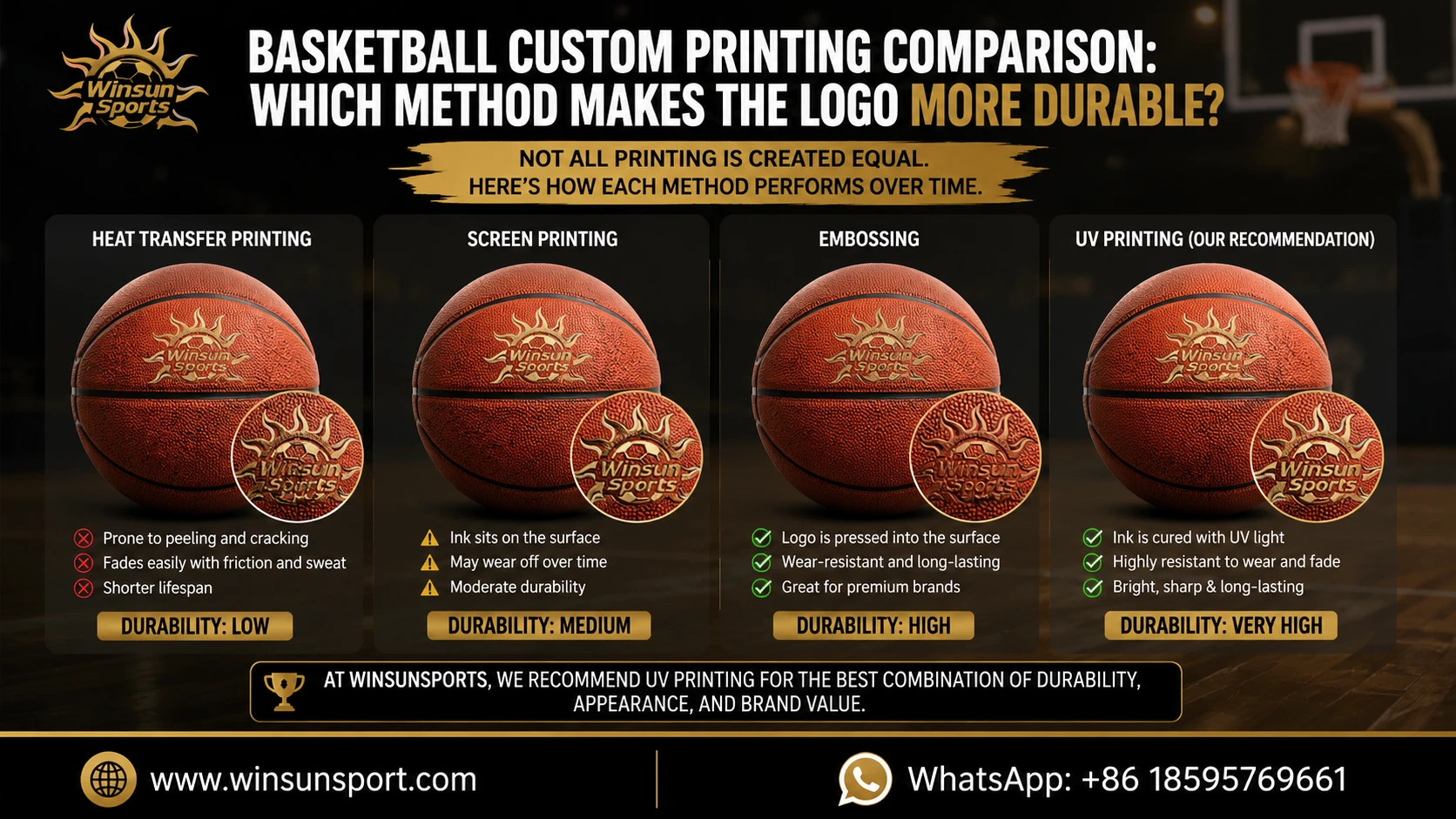
What determines the durability of a basketball logo?First, consider the match between the process and the usage scenario.
When customizing basketballs, many people's first reaction is to ask, "Which printing process is the most fade-resistant?" But this question itself can easily mislead people—because there is no process that is "the most reliable and durable" in absolute terms; there is only a process that is "most suitable under specific usage conditions." Whether the logo fades depends on whether the printing method matches the actual usage scenario of the basketball.
Why the printing process is the primary factor affecting logo lifespan
The fading of a basketball logo is essentially the destruction of the adhesion between the ink or film layer and the ball surface material. Different processes have different adhesion principles, and their lifespans vary significantly. Common processes can be broadly divided into three categories:
- Screen printing: Ink directly penetrates the PU or rubber surface, providing strong adhesion and good wear resistance, suitable for large color blocks and simple graphics.The disadvantage is limited performance in fine gradients and complex lines.
- Heat transfer / hot stamping: The pattern is laminated onto the ball surface under high temperature and pressure, offering high color reproduction, suitable for complex patterns such as gradients and portraits.However, the pattern layer is "applied" on the surface, and after friction on rough ground or prolonged sun exposure, the edges are prone to peeling.
- Pad printing: Mostly used for small-area, high-precision patterns, such as small team logos or text.Adhesion is decent, but large-area use is costly and inefficient.
So to judge the quality of the process, first look at what form your logo takes: is it a solid-color large text, or a complex design with gradients? For the former, screen printing is sufficient; for the latter, you need to consider heat transfer printing.
How the usage scenario determines your real need for durability
A more critical question than the process is: what is this ball used for, how long will it be used, and in what environment? Even for the same 'logo won't fall off,' the acceptance criteria vary completely across different scenarios.
- Daily training or outdoor concrete courts: The spherical surface frequently rubs and contacts sand and soil, and any printing process will accelerate wear.What you really need at this time is "still recognizable after wear" rather than "always brand new."The wear resistance advantage of screen printing is most obvious here.
- Indoor competition or training balls: The usage environment is relatively clean, and the logo mainly faces sweat erosion and occasional bumps.Heat transfer printing has better color expression, and its lifespan is sufficient under indoor conditions.
- Gifts, souvenirs, or display purposes: The ball may rarely be bounced and is mainly placed on a display stand or desk.At this point, "durability" is hardly an issue; what really matters is the fineness of the pattern and the overall texture, and the choice of process is actually the most flexible.
- Children's or family entertainment: The ball may be thrown around, stepped on, or even left outdoors.If losing the logo affects the child's sense of "ownership," it is recommended to choose a wear-resistant process while accepting a certain degree of natural wear and tear.
An easily overlooked point is:The material of the basketball itself also affects the lifespan of the logo。 PU surfaces allow ink to adhere more firmly than rubber surfaces, but PU balls are less wear-resistant outdoors than rubber ones. If you choose a rubber basketball, no matter how good the printing process is, the lifespan of the logo will be limited by the characteristics of the surface material.
So, to determine logo durability, first answer three questions: Is the logo design simple or complex? What type of court will the ball primarily be used on? How long do you expect it to remain intact?
Once you have settled these three answers, then discuss process selection, so you won't fall into the misconception of 'which process is more stable and best.' If you are still unsure which process solution corresponds to your usage scenario, you can directly explain your usage and expected lifespan to the Winsunsport team, and they will provide matching recommendations based on the ball surface material and pattern complexity.
Screen Printing, Heat Transfer, Pad Printing: Durability and Effect Comparison of Three Processes
When choosing a custom basketball, how the logo is printed directly determines whether it remains clear after three months of use or becomes a blurry patch of color. Screen printing, heat transfer, and pad printing are three mainstream methods, but their durability logic is completely different.
Screen printing: outstanding abrasion resistance, suitable for large color blocks and text
Screen printing involves scraping ink directly onto the spherical surface through a mesh stencil. Because the ink layer is thicker and can penetrate the basketball's surface texture, its physical abrasion resistance is the strongest among the three processes. If you need to print graphics with clear edges and solid colors, such as team names, numbers, or large color blocks, screen printing is the most reliable choice.
Is a screen-printed basketball logo durable? Under normal use on indoor and outdoor courts, without intentional scratching with sharp objects, the lifespan of a screen-printed logo typically covers the normal wear cycle of the basketball itself. Its weakness is not in abrasion resistance, but in detail reproduction—gradients, shadows, and multi-color transitions cannot be achieved, and complex patterns may become muddled.
Heat transfer: high color fidelity, suitable for complex patterns and gradients
Heat transfer printing involves first printing the pattern onto a transfer film, and then transferring it onto the spherical surface through high temperature and high pressure. Its advantage is extremely high color reproduction; photo-quality patterns, gradients, and multi-color overlays can all be achieved, with a visual impact far stronger than screen printing.
But the cost is durability. The pattern layer of heat transfer printing is "attached" to the spherical surface, rather than "penetrating" into it. After frequent hitting, friction, or prolonged sun exposure, the edges of the pattern are prone to peeling or cracking.
Which is more durable: heat transfer printing or screen printing? If only considering abrasion resistance, screen printing wins;If considering pattern integrity, heat transfer printing performs better initially, but its long-term degradation is faster. It is suitable for gifts, commemorative balls, display balls, or scenarios with low frequency of use.
Pad printing: suitable for small-area fine patterns, but not suitable for the main visual of basketballs.
Pad printing transfers ink onto irregular surfaces through a silicone head, excelling at small-area, fine patterns such as small brand logos or number codes. However, basketball surfaces have granular textures, and the ink layer from pad printing is thin, leading to uneven coverage in large areas, and its wear resistance is inferior to screen printing. **Is pad printing suitable for basketballs?
** It is suitable for small auxiliary markings, but not as the main logo process.
How to choose: a table to clarify
| Process | Abrasion resistance | Pattern expressiveness | Most suitable scenarios | Unsuitable scenarios |
| Screen printing | Strongest | Color blocks, text, single color | Training balls, match balls, team names and numbers | Gradient, photorealistic patterns |
| Heat transfer | Medium | Gradient, multi-color, complex patterns | Gifts, souvenir balls, display balls | High-intensity, frequent use |
| Pad printing | Weaker | Small-area fine patterns | Small logos, numbering | Large main visual |
Back to Custom Logo Competition Basketball Customization scenario: if your ball is for school team training or official matches, the logo needs to withstand intense bouncing and floor friction, making screen printing the more reasonable primary process;If you are making corporate gifts or collectible commemorative balls, where pattern refinement is more important, heat transfer is more suitable. The two processes can also be combined—use screen printing for the main logo to ensure durability, and heat transfer for detailed decorations to enhance texture.
The next step is to confirm your usage frequency and pattern complexity: if the pattern is mainly text and color blocks, directly confirm the screen printing solution with the Winsunsport team;If the design has a gradient requirement, you need to specify whether the usage scenario is high-frequency play or display collection, so the team can help you determine whether the durability of heat transfer is sufficient.
Choose the process based on usage: what should you choose for games, training, and gifts respectively?
For custom basketballs, the requirements for logo craftsmanship are completely different for games, training, and gifts. If you choose wrong, either the logo will fall off after a few games, or the gift will look cheap when presented. Below are conclusions directly based on the scenario.
Games and high-intensity training: prioritize wear resistance
For game balls and long-term training balls, the logo is not decoration but an identity marker—referees, players, and spectators all need to recognize it. The core requirement for such scenarios is that the logo remains clear under repeated bouncing, friction, and sweat erosion.
Recommended approach: Prioritize screen printing or pad printing processes, and confirm that the ink is abrasion-resistant. The ink layers of these two processes can penetrate the texture of the basketball surface, bonding more firmly with the ball surface and not easily peeling off in large pieces. At the same time, it is recommended to design the logo in the recessed texture areas of the ball surface (if any) to reduce direct contact friction with the ground.
Not recommended: Heat transfer or labeling processes. The logos from these processes are "stuck" onto the ball surface. They look good initially, but after high-intensity use, the edges are prone to lifting, cracking, or peeling off entirely. If the team trains more than 3 times a week, these are not recommended.
Next, confirm the following: Provide the Winsunsport team with your game frequency and court type (indoor wooden floor/outdoor concrete) to confirm whether the wear resistance level of the selected process matches. Outdoor concrete courts wear down much faster than indoor ones, requiring a thicker ink layer.
Gifts and Displays: Prioritize Color Accuracy and Refinement
For gift basketballs and display balls, the core is not "how long they last without fading," but "whether they look good at first glance." These balls may rarely be used on the court, but they will be placed on desks, put into gift boxes, and photographed for social media.
Recommended approach: Prioritize UV printing or sublimation processes. UV printing can render gradients, shadows, and photo-quality patterns with high color saturation, making it suitable for complex logos and colorful team emblems;Dye sublimation, on the other hand, "dyes" the ink into the surface, leaving no raised feel and offering a more refined touch. For corporate gifts or tournament commemorative balls, these two processes offer a noticeably higher visual grade than screen printing.
Not recommended: If the gift ball only features single-color text or a simple line logo, there's no need for UV printing—it costs more but offers limited visual improvement. For single-color logos, screen printing is actually cleaner.
Next, confirm the following: Provide your logo source file (in AI or PDF vector format) to the Winsunsport team, and confirm the number of colors and whether there are gradient requirements. The more colors and the more complex the details, the better suited it is for UV printing;If there are only 1-2 solid colors, screen printing is sufficient.
Quick reference guide
| Use Cases | Recommended Process | Not Recommended | Key Trade-offs |
| Official Competitions | Abrasion-resistant Screen Printing / Pad Printing | Heat transfer | Durability > Color Richness |
| Daily Training (Multiple Times per Week) | Abrasion-resistant Screen Printing / Pad Printing | Labeling type | Abrasion resistance > refinement |
| Corporate gifts / event souvenirs | UV printing / heat sublimation | Single-color screen printing (visually plain) | Refinement > Extreme Durability |
| Children / parent-child entertainment | Any process is acceptable | — | Cost > Process Complexity |
Core conclusion: For games and training, choose screen printing or pad printing that prioritizes durability; for gifts and displays, choose UV printing or sublimation that prioritizes visual appeal. If your use case falls in between—such as team jerseys for a corporate team that are both played on the field and kept as souvenirs—we recommend directly explaining the dual purpose to the Winsunsport team so they can help you find a balance between ink thickness and color performance.
What key details should you confirm with the supplier before customization?
After reviewing the process comparison, the final step is to prevent risks before mass production. Most logo peeling issues are not due to choosing the wrong process, but ratherplacing an order without confirming the usage conditions. Before placing an order, you must obtain clear answers to the following three questions.
Sample Testing: Verify the Compatibility of Craftsmanship and Ball Surface Material
Do I need to test a sample before customizing basketballs? Yes, and it cannot be skipped. Especially when your basketballs are used on outdoor concrete courts, in humid environments, or for high-frequency training, sample testing is one of the key ways to verify whether the combination of 'craftsmanship + ball surface material' is durable.
Sample testing focuses on three things:
- Bend test: Press the ball to deform it, and observe whether there are cracks or lifting at the crease of the logo.This directly reflects the adhesion between the printed layer and the spherical PU or rubber.
- Friction test: Use a fingernail or a hard object to gently scrape the edge of the logo to see if it fades or peels off.Outdoor court friction is much greater than indoor, and this test can help you determine whether to upgrade to a more wear-resistant process.
- Placement observation: Place the sample for a week to see if the logo shows signs of oxidation, yellowing, or stickiness, especially for light-colored logos.
How can I confirm that the printing process is suitable for my basketball? Don't just look at the process name; ask the supplier three specific questions: Does this process perform well inWhat is the adhesion test data on your sphere materials(moisture-absorbing PU, regular PU, rubber)? Underyour intended usage scenarios(indoor/outdoor, dry/wet), what is the expected lifespan?
If peeling occurs after mass production,how are the warranty termscalculated? If the supplier gives vague answers to these three questions, it means they haven't verified them either, and in this case, it's even more important to use sample testing as a safety net.
Impact of Usage Environment and Maintenance Methods on Logo Lifespan
With the same process, playing for three months on indoor wooden floors versus three months on outdoor concrete floors results in completely different levels of logo wear. Before placing an order, you must clarify:
- Usage frequency and venue: How many times per week? Is it primarily indoor or outdoor use? Outdoor UV rays accelerate ink aging, and the abrasive friction of concrete sand is the biggest physical threat to the logo.
- Cleaning method: Wipe with a damp cloth or rinse with water?Will cleaning agents be used?Strong solvent-based cleaners can erode the printed layer, so it is necessary to confirm whether the process is resistant to chemical corrosion.
- Storage conditions: Long-term storage in a car trunk (high temperature) or a damp storage room affects both the logo and the sphere.High temperatures can soften the ink, and humidity may cause micro-separation between the sphere surface and the printed layer.
What information needs to be provided to the supplier? A complete custom order form should include at least: usage scenario (indoor/outdoor/mixed), frequency of use, primary users (children/adults/professional training), expected lifespan (six months/one year/two years or more), and budget range. This information directly determines the recommended process direction—if the budget is limited and it's for indoor use, screen printing may suffice;for frequent outdoor use, a more wear-resistant process solution needs to be considered.
Key Trade-offsSample testing involves time and cost, but it can avoid the greater loss of reworking or scrapping the entire batch after mass production. If your customization volume is large, the usage scenario is clear, and the logo is a core brand asset, sample testing is a necessary investment;if it's just a small batch of gifts or balls for short-term events with low lifespan requirements, you can skip samples, but be sure to clearly define warranty terms in the contract.
Frequently Asked Questions
Q: How long does the logo on a custom basketball generally last before it peels off? Answer: It depends on the match among the process, the ball surface material, and the usage environment. For indoor low-frequency use, logos made with wear-resistant processes can last more than a year;for outdoor high-frequency use on cement floors, any process will accelerate wear.
Before placing an order, ask the supplier to give an expected lifespan based on your usage conditions, rather than just listening to vague claims like "very durable."
Question: Do sample tests require additional payment? Answer: Different suppliers have different policies. Some include the sample fee in the bulk order, while others charge it separately.
Before placing an order, confirm whether the sample fee can be deducted, how long the sample production cycle is, and whether you can test your specified process combinations on the sample. If the supplier refuses to provide samples or the sample fee is non-deductible, the cooperation risk should be carefully evaluated.
Q: What should be done if the logo falls off after mass production? A: This depends on the warranty terms agreed upon before placing the order. It is recommended to specify in the contract that if the logo falls off due to non-human damage during the warranty period, the supplier should provide free replacement or a refund.
Without written warranty terms, it will be very passive to protect your rights later.
Q: Does small-batch customization also need to go through the sample testing process? A: If the quantity is within dozens and the budget is tight, you can ask the supplier to provide samples of past cases or small test pieces of the same material and process, not necessarily a complete basketball sample. But for batch orders of hundreds or more, complete sample testing is the lowest-cost means to control risk.
Learn More
If you are planning a custom solution for Custom Logo Competition Basketball, feel free to contact the Winsunsport team.Tell us about your usage scenario, logo complexity, and expected lifespan, and we will match you with the most suitable logo solution based on the ball surface material and craftsmanship.
Related Products:Custom Logo Competition Basketball