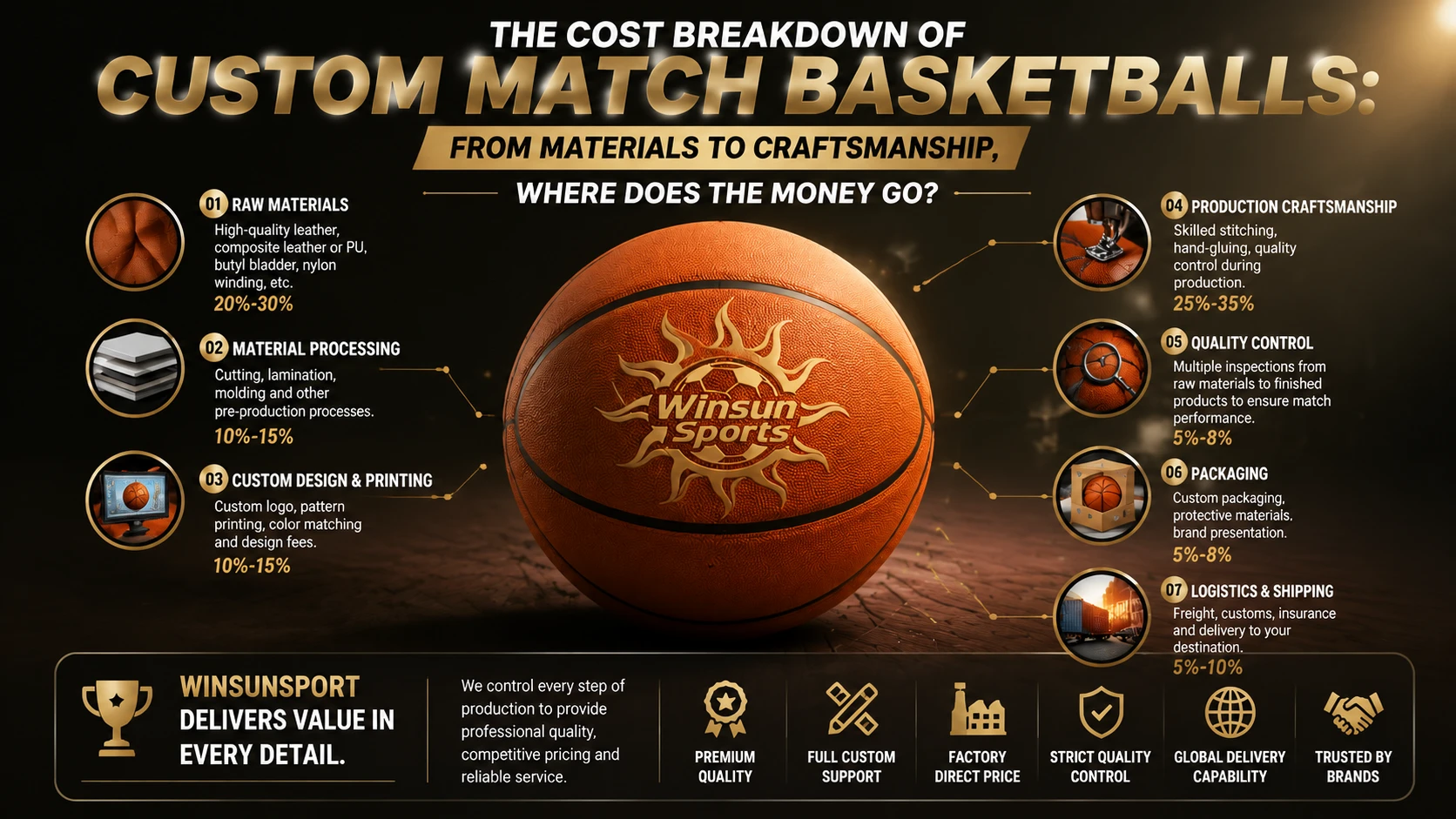
What components make up the price of a custom competition-grade basketball?
The final quote for a custom competition-grade basketball is never as simple as "ball surface price + printing cost." From the moment you raise your requirements to the actual use on the court, the price is composed of at least four stages:material grade, process complexity, customization quantity, and delivery conditions. Understanding this cost chain allows you to judge whether each item on the quotation is reasonable.
The cost chain from material to finished product: more than just ball surface and printing
Material gradeis the foundation of the cost. Competition-grade basketballs have clear requirements for the material of the ball cover, the inner bladder process, and the channel structure. The cost difference between different grades of materials can be several times. For example, the raw material cost difference between moisture-absorbing PU and ordinary PVC is significant, and competition-grade typically requires the former.
This part determines the ball's feel, durability, and rebound stability—and it is the core dividing line between 'competition-grade' and 'training-grade'.
Process complexityis the second variable. Custom printing is not simply printing a logo; it involves printing methods (screen printing, heat transfer, pad printing), number of colors, pattern detail, and whether anti-slip treatment is needed. The more colors and the finer the pattern, the higher the cost of plate making and processes.
If your design requires spot colors or gradient effects, this part of the cost will increase significantly.
Customization quantityDirectly amortized unit price. Plate-making fees and sampling fees are one-time investments; the larger the quantity, the lower the fixed cost allocated to each ball. This is also why the unit price difference between "500 pieces" and "5000 pieces" often far exceeds your intuition.
Delivery conditionsEasily overlooked, but equally affects the quotation. Whether the delivery time is tight (whether expedited), packaging requirements (simple packaging or gift box), and logistics destination—these will all be reflected in the final quotation, especially for cross-border delivery, where logistics and tariffs may account for a considerable proportion.
Why can't you just look at the unit price?The key to total cost thinking
Focusing only on "how much per ball" is the most common mistake in procurement. What really affects your budget are the following three easily overlooked costs:
- Sample confirmation cost: Competition-grade basketballs have strict performance requirements, and sample testing is a necessary step.Sample fees, shipping fees, and confirmation lead time all need to be included in the budget.
- Communication and revision costs: From the initial draft to the final design, multiple rounds of revisions are often required.Every revision consumes time and manpower. If the team repeatedly adjusts the pattern, position, and size, hidden costs will continue to accumulate.
- Quality risk cost: If after mass production you discover fading printing, sphere deformation, or substandard performance, the cost of rework or scrapping far exceeds the extra money spent upfront on a more reliable solution.
So, when comparing quotes from different suppliers, don't just look at the unit price number; instead, ask clearly: **What steps does this unit price include? How are sample fees calculated? What is the minimum order quantity?
What is the delivery time? ** Compare these conditions on the same table to calculate the true "total cost."
Next, confirm the action: Before consulting the team for a quote, first clarify your usage scenario (competition, training, or gift), approximate quantity, expected delivery time, and the complexity of the design draft. The clearer these four pieces of information are, the closer the quote you receive will be to the actual cost, and the easier it will be to judge whether the budget is reasonable.
Material and inner bladder: the first watershed determining performance and cost
The price differences in custom basketball quotes often begin with the choice of surface material. Three common materials—rubber, PU, and genuine leather—correspond to different usage scenarios and budget ranges.
PU, rubber, and genuine leather: the impact of different materials on price and feel
PU (polyurethane) It is the mainstream choice for custom competition-grade basketballs. The feel is between rubber and genuine leather; it is slightly hard when new, but gradually softens and conforms to the palm after several uses. PU provides stable anti-slip performance on indoor wooden floors, and its price is in the middle range—higher than rubber, lower than genuine leather.
For amateur leagues, school team training, and corporate custom gifts, PU is a balanced option between cost and performance.
Rubber Basketballs made of rubber are the cheapest, but they are not a 'low-end version of PU'; they are a different product. Rubber is wear-resistant, unafraid of concrete courts and outdoor dust, making it suitable for open-air courts and children. However, the bounce feedback is relatively stiff, the dribbling feel is somewhat 'wooden', and it hardens in low temperatures.
If the custom ball is intended for outdoor promotions or parent-child activities, rubber is a reasonable choice;for official matches, it is difficult to meet the uniform requirements for ball feel.
Genuine leather Basketballs are the ceiling of competition-grade quality, but attention must be paid to their usage threshold. Genuine leather requires "breaking in"—through repeated use, the leather absorbs moisture and oils before reaching its optimal feel. A new ball is relatively hard, and genuine leather is only suitable for indoor wooden floors; it wears out extremely quickly on concrete or plastic courts.
In terms of price, genuine leather is typically significantly higher than PU. Unless you are a professional team with a fixed indoor court and break-in time, a genuine leather custom ball may be "affordable to buy but hard to maintain."
Inner Bladder and Structure: Why Competition-Grade Basketballs Can't Be Judged by Appearance Alone
The inner bladder is the basketball's airtight layer and shape framework, determining the ball's roundness retention and air pressure stability. Competition-grade basketballs typically use a butyl rubber bladder—which offers good airtightness, maintains inflation longer, and resists deformation after repeated impacts. Cheap basketballs have poor bladder airtightness, requiring re-inflation after just one game, and the ball's circumference gradually loses its roundness, affecting shooting trajectory and dribbling bounce stability.
A practical way to judge:First, confirm the playing surface and frequency, then choose the material;After confirming the material, look to the bladder craftsmanship for stability. If your team plays 2-3 indoor games per week, a PU cover with a butyl rubber bladder offers a good balance of cost and performance;If you only shoot hoops outdoors occasionally, a rubber ball is sufficient; there is no need to pay for performance you will not use.
Printing process and customization complexity: How does personalization affect the final quote?
The price difference in customized basketballs largely comes not from the ball itself, but from the printing process and pattern complexity you choose. Once you understand these two points, you can determine where your budget should go.
Screen printing, heat transfer, and digital printing: How do process differences reflect in price?
The cost logic of the three mainstream processes is completely different, and each suits different scenarios:
- Screen printing: Suitable for large-area logos or text with a single color (1-2 colors).Its cost advantage lies in volume—the plate-making fee is a one-time investment, and the more you print, the lower the unit cost.The downside is that the more colors you use, the higher the plate-making fee, and gradient colors are basically not feasible.If you only need to print a single-color team name or a simple logo, screen printing is the most cost-effective choice.
- Heat transfer printing: Suitable for medium-complexity designs, capable of rendering multiple colors and a certain level of detail.It does not require plate-making by color like screen printing, so the initial cost for multi-color designs is lower than screen printing.However, its unit price is usually higher than screen printing, and the durability of the pattern edges is not as good as screen printing directly on the ball surface.If you need to print a design with 3-5 colors, heat transfer printing is often the more cost-effective middle option.
- Digital printing: Suitable for high-precision, multi-color, gradient, or photo-quality patterns.It has almost no limit on the number of colors and incurs no plate-making fees, but the per-unit printing cost is the highest.If your pattern is rich in detail and has more than 5 colors, digital printing is one of the key choices that can reproduce the design, but you must accept a higher unit price.
Customization complexity: The cost jump from single-color logos to multi-color patterns
The impact of customization complexity on pricing can be understood with a simple tier:
| Complexity | Typical pattern | Main Cost Drivers | Suitable For |
| Low | Monochrome text, simple line logos | Plate making fee (screen printing) | Team names, institution abbreviations |
| Medium | 2-4 color logos with simple graphics | Number of colors + printing area | School/company logo |
| High | Multi-color gradients, people/photos, full-bleed patterns | Printing precision + process selection | Gifts, souvenirs, brand promotion |
Key decision points:The number of colors is the biggest variable in cost jumps.。 From 1 color to 2 colors, the screen printing cost may only increase slightly;but from 3 colors to 4 colors, if you continue using screen printing, the plate-making fee may double. At this point, you need to switch to heat transfer or digital printing, and the switch itself will bring changes in unit price.
Another factor that is easily overlooked isthe pattern area.。 The price difference between full-bleed printing (covering the entire ball surface with the pattern) and a small local logo can be greater than the difference caused by the number of colors. If you only want to print a small logo on the ball, there is no need to pay for the full-bleed effect.
Next, confirm the action: Provide your design draft (or a rough description of the number of colors and area of the pattern) to the Winsunsport team, and inform them of the estimated order quantity. These two pieces of information directly determine the process recommendation and the quotation range—without them, any quote is just a guess.
Labor, Quality Inspection, and Supplier Experience: Invisible Costs, Visible Quality
For custom basketballs, quotes can range from tens to hundreds of dollars. The difference often lies not in the material list, but in the aspects you can't touch but can feel when playing.
Why Are Quality Inspection Standards Higher for Game-Level Basketballs?
The core difference between game-level basketballs and regular training balls is not that they are "more expensive," but ratherconsistency. Training balls allow slight variations between each ball, but game balls require that the weight, circumference, bounce height, and feel of each ball fall within strict ranges—because players adjust their shooting and dribbling rhythm based on the ball's characteristics, and inconsistency between balls directly affects the fairness of the game.
This means the factory's job is not just "production," butInspection of each ball. The inspection process includes:
- Weight and size sampling (the higher the sampling rate, the higher the cost)
- Bounce height test (whether performance is stable at different temperatures)
- Circumference and roundness calibration (affects dribbling trajectory)
- Surface and print adhesion test (affects durability)
Ordinary factories may sample 5% of a batch, while competition-grade production lines typically require full inspection or a high sampling rate. This labor and time cost is directly reflected in the unit price, but you don't see it—you only see 'why is this one 20 yuan more expensive than that one'.
How does supplier experience affect the balance between quotation and quality?
An experienced supplier can save you two types of costs:trial-and-error costs and communication costs.。
For example, if you want to print a complex gradient logo on a spherical surface, a novice factory might simply say "we can do it," but after sampling, you find the colors are off and the pattern deforms on the curved surface, requiring three rounds of revisions, wasting both sampling fees and time. An experienced supplier, however, will tell you before quoting: this design needs color scheme adjustments, suggests switching to a different printing process, and notes that the pattern on the curved surface needs deformation allowance—these judgments come from accumulated experience with similar orders, not from reading a spec sheet.
How do you determine if a factory can produce competition-grade basketballs? Don't just look at samples; ask three questions:
- What is the quality inspection process? Is it spot inspection or full inspection? What is the sampling inspection ratio? Which indicators are tested?
- What is your past experience with competition-grade orders? Which tournaments or league balls have you produced? Who are your clients?(Note: If they are vague, it may indicate insufficient experience.)
- What is the sampling cycle and revision mechanism? How many sampling rounds are done? How is modification charged? This reflects how seriously they take quality control.
What are the invisible costs in a quotation? Besides materials, labor, and printing, there are these easily overlooked items:
- Proofing fee: a one-time investment before confirming quality, usually ranging from a few hundred to over a thousand
- Mold or plate-making fee: Special sizes or complex printing may require
- Full inspection labor costs: Under competition-grade standards, this portion is significantly higher than for ordinary orders
- Packaging and protection: Competition balls must not deform during transport, so packaging standards are higher
- Delivery lead time buffer: Strict quality inspection means a longer production cycle, and rush orders cost more
Frequently Asked Questions
Q: What is the approximate price difference between custom competition-grade basketballs and ordinary custom basketballs? A: It depends on the quality inspection standards and printing complexity. Typically, competition-grade balls are 15%-30% more expensive than ordinary balls of the same material, mainly due to full inspection labor and stricter material selection.
The exact difference needs to be confirmed with the Winsunsport team based on your quantity, printing plan, and delivery time.
Q: If the budget is limited, how should we balance quality and cost? A: First, clarify the intended use. For amateur leagues or daily training, you can accept sampling inspection instead of full inspection, prioritizing more reliable material and printing quality;For official competitions, it is recommended to keep the competition-grade quality inspection standards, as this part is not advisable to cut.
Spend your budget on aspects that affect feel and durability, rather than visual complexity.
Q: What should I focus on when confirming a sample? A: Feel (surface softness/hardness, tackiness), print color accuracy, pattern deformation on curved surfaces, and the ball's roundness. It's recommended to actually dribble and shoot with the sample, rather than just looking at its appearance.
Q: The supplier says they can make 'competition-grade' balls. How can I verify this? A: Ask them to specify their quality control standards and inspection items, such as weight tolerance range, rebound height range, and sampling ratio. If they can only give vague answers like 'good quality,' it's recommended to have the Winsunsport team help you confirm the specific inspection process and standard matching plan.
Q: Can I still require competition-grade quality with a small custom order quantity? A: Yes, but the unit price will be significantly higher because the cost of full inspection labor and mold costs is spread over a small number of balls. If the quantity is below the regular minimum order quantity, it is recommended to first confirm with the Winsunsport team whether they support small-batch competition-grade customization, as well as the specific minimum order requirements.
Learn More
If you are planning custom basketballs for a team, event, or brand, you are welcome to submit your usage scenario, expected quantity, design complexity, and desired delivery time to the Winsunsport team.Based on this information, we will match you with the appropriate process solutions and price ranges, helping you allocate your budget to the aspects that truly affect feel and durability.
Related Products:Custom Match Grade Basketball