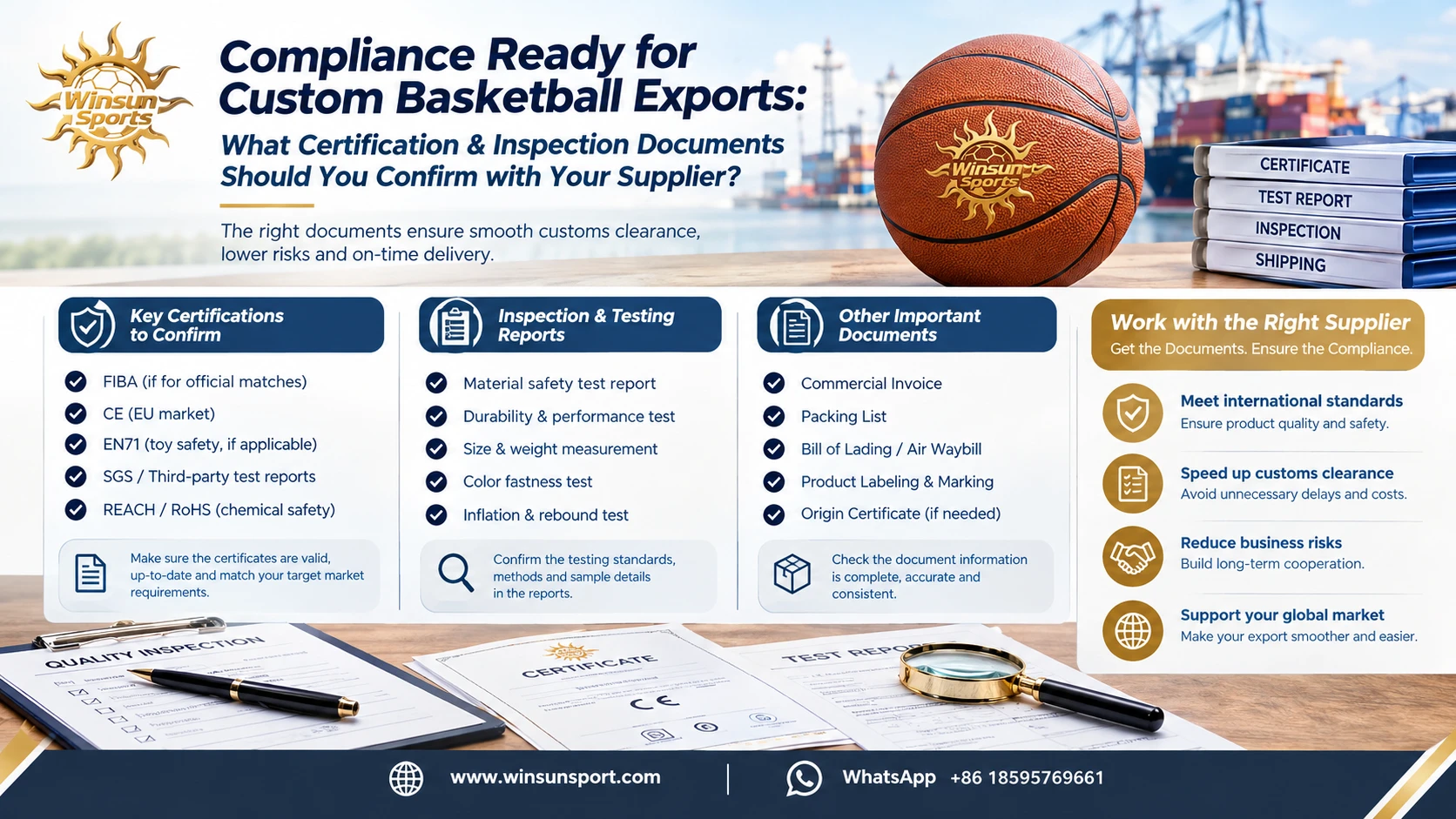
Custom Printed Pro Training Basketball export procurement, what exactly is compliance preparation preparing for?
What exactly does compliance preparation for custom basketball export procurement refer to? It is not a single certificate, but a set of verifiable documents. Custom Printed Pro Training Basketball is a customizable printed professional training basketball, suitable for competitive matches, daily fitness, leisure and entertainment, teaching and training, gift commemorations, promotional activities, and other scenarios.
What is often questioned during export is whether this document chain can match up.
Why compliance preparation is not a single certificate, but a set of verifiable documents
For this customizable printed training basketball, the mutually corroborating documents can be roughly divided into three parts:
- Certification type: Which type of certification the target market requires must be confirmed country by country based on where the goods are sold.
- Test report: The testing documents required for the corresponding certification, provided by the supplier.
- Material and packaging marking description: A written description of the ball's material composition and packaging markings, which must be consistent with the actual product.
If any one of these three is missing, a single certificate cannot make up for it. So what really needs to be asked in compliance preparation is: for this batch of goods, from definition to acceptance, does every step have verifiable written evidence?
How should the boundary of responsibility between the buyer and the supplier regarding compliance documents be divided?
If the boundaries are unclear, gaps will arise where each side assumes the other will prepare something. It can be divided as follows:
| Item | Usually prepared by the buyer | Usually needs to be confirmed with the supplier |
|---|---|---|
| Target market and use | Clarify the destination country, channel, and usage scenario | Whether the corresponding certification documents can be provided |
| Certification type | Propose target market access requirements | Confirm applicable certification types and test reports |
| Material and packaging labeling | Propose labeling content and packaging requirements | Provide material descriptions and packaging labeling explanations |
The buyer is responsible for "what is needed and to whom it will be sold," while the supplier is responsible for "whether it can be made, according to what standards, and how to prove consistency." The line in between is exactly what needs to be clarified item by item during the inquiry stage. The extent to which materials need to be prepared depends on the target market, sales channel, and the complexity of the customization content—the earlier these three points are clarified, the less rework there will be later.
EN71 and CPSIA are just examples: why must certification for custom basketballs be confirmed one by one according to the target market?
EN71 and CPSIA are often mentioned together, but they are only examples of certification types and do not mean that Custom Printed Pro Training Basketball has obtained these certifications. Both revolve around the attribute of "use by children," rather than around the "basketball" category: EN71 is the EU toy safety standard, and CPSIA is the U.S. safety act for consumer products for children under 12. Whether a custom basketball triggers such requirements depends on what use it is classified for in the target market.
What are the differences between toy certification and compliance requirements for sporting goods?
Toy certification usually focuses on test items such as mechanical and physical properties, flammability, and chemical migration, and may involve tracking labels or children's product certificates;The test items and labeling requirements for sporting goods may be different. The specific differences are subject to the regulations of the target market and the supplier's actual documents, and cannot be directly applied.
Why do the documentation requirements change when the same custom basketball is exported to different markets?
There are three reasons: the regulatory systems differ, so an EN71 report cannot be directly used as proof of CPSIA compliance;the product use classification may differ, as the same ball may be considered sporting goods in market A but classified as a toy in market B due to its size or sales channel;the buyer's role differs, and distributors and end users bear different documentation responsibilities. Therefore, basketball export test reports and custom basketball certification types must be confirmed one by one according to the target market, and certification for one market cannot cover all export markets.
What information should be confirmed with Winsunsport to make the export procurement of the Custom Printed Pro Training Basketball acceptable?
Export procurement acceptance cannot rely only on unpacking and inspecting the appearance. It is recommended to confirm three types of information with Winsunsport and clarify the corresponding verification actions for each.
What problems do test reports, material specifications, and packaging labeling instructions each address?
Test report: Confirm whether the product meets the specific testing requirements of the target market. It is necessary to check the product model and test items corresponding to the report, and confirm that the report description is consistent with Custom Printed Pro Training Basketball.
Material specifications: Confirm the material composition of the ball body, printing ink, etc., to help determine whether it matches the requirements of the target market.
Packaging labeling instructions: Confirm whether the outer packaging and product labeling comply with the target market's labeling requirements, including shipping marks, label content, and position.
How to use these materials for verification during acceptance inspection, rather than relying only on visual impressions
After arrival, check item by item according to the following steps:
- Check whether the accompanying documents correspond to the order and test reports, focusing on the model and test items;
- Sample cartons to check packaging markings and see whether the label information is consistent with the documents;
- Open samples to check materials and printing, confirm the material composition against the material description, and observe whether the printing edge clarity and adhesion are consistent with the proofing sample.
If any step does not match, isolate the batch first, then confirm with Winsunsport whether to supplement documents or replace the goods. When documents are missing, first clarify which item is missing and which destination country or acceptance stage it affects, then decide whether to continue placing the order.
Which procurement scenarios are suitable for proceeding with complete compliance documents, and in which situations is it not worth adding complexity?
What compliance documents solve is "whether problems can be traced and evidence can be supplemented after they arise." There is only one criterion for judgment: after this batch of custom basketballs is exported, if it is subject to random inspection, required to provide supplementary certificates, or a batch dispute arises, do you have the energy and channels to handle it?
Scenarios recommended for proceeding with complete documentation and scenarios not recommended
Recommended to proceed with complete compliance documentation:
- Centralized procurement by schools and training camps: institutions follow procedures, need to keep records, and may continue purchasing later; complete documentation can reduce repeated back-and-forth during handover.
- Distributors or OEM buyers listing under their own brand: when facing downstream customers and platforms, the cost of retroactively supplementing compliance documents is higher.
- Event commemorative balls and brand giveaways: these involve brand image, and the sampling records and acceptance standards themselves serve as protective materials.
Not worth adding complexity:
- Personal use or small-batch commemorative items: there is no third-party chain of accountability, so it is more practical to focus energy on confirming the feel and printing effect during sampling.
- Target market undecided, requirements changing frequently: logos, quantities, and delivery dates are all undecided. At this point, preparing complete documentation is like locking in a plan that will still change.
- Requesting to skip sampling and go straight to mass production while promising perfect printing results: the printing performance on deep-textured spherical surfaces must be confirmed through sampling. This is not a step that documentation can replace.
When budget and time are limited, where is the boundary for making trade-offs in compliance preparation?
Divide the investment into three parts: main balls in use, replacement reserves, and sampling and document preparation. The first two parts are estimated based on the actual number of people and training intensity. The third part is an upfront investment, and it is not recommended to cut sampling to save money—the cost of rework is usually higher than this step.
The boundary for making trade-offs in compliance documentation: if it can clearly solve the main problem and no one will come asking for documents later, choose the simple option;once it involves institutional record-keeping, downstream customers, or long-term replenishment, proceed with complete documentation. The specific certifications and acceptance documents required depend on the target market and end users. It is recommended to inform the Winsunsport team of the intended use, sales region, and buyer requirements to confirm a matching document list, and not to fabricate certification status.
Frequently Asked Questions
Q: I'm only buying a few dozen as promotional giveaways. Do I need to prepare complete compliance documentation? A: Usually not. Focus on confirming the printing effect through sampling and the delivery time. The documentation only needs to be sufficient to prove the batch and basic quality.
Q: For a distributor launching a private label, what is the minimum that needs to be confirmed? A: At minimum, confirm the scope of certifications that can be provided, the acceptance standards, and the basis for batch consistency. The specific list needs to be confirmed with the team according to your sales region.
Q: If the requirements aren't finalized yet, would preparing the documentation first be a waste? A: Yes. First finalize the logo, quantity, and delivery time, then decide the depth of the materials, so that if the plan changes, the materials won't all have to be redone.
Q: Can we be more confident about the printing effect without making a sample? A: No. The printing performance on deep-textured surfaces must be based on a sample; skipping the sample will significantly increase the risk of rework and after-sales issues.
Q: When the budget is tight, which part should be cut first? A: Prioritize the sample and the main ball to be more confident; the replacement reserve can be compressed according to the reference range, but it is not recommended to cancel the sample.
Learn more
If you are preparing for export procurement of Custom Printed Pro Training Basketball, you can organize the target market, sales channels, customization content, and usage scenarios and send them to the Winsunsport team.Based on this information, we will help confirm the document checklist, printing plan, and acceptance criteria to reduce back-and-forth rework.