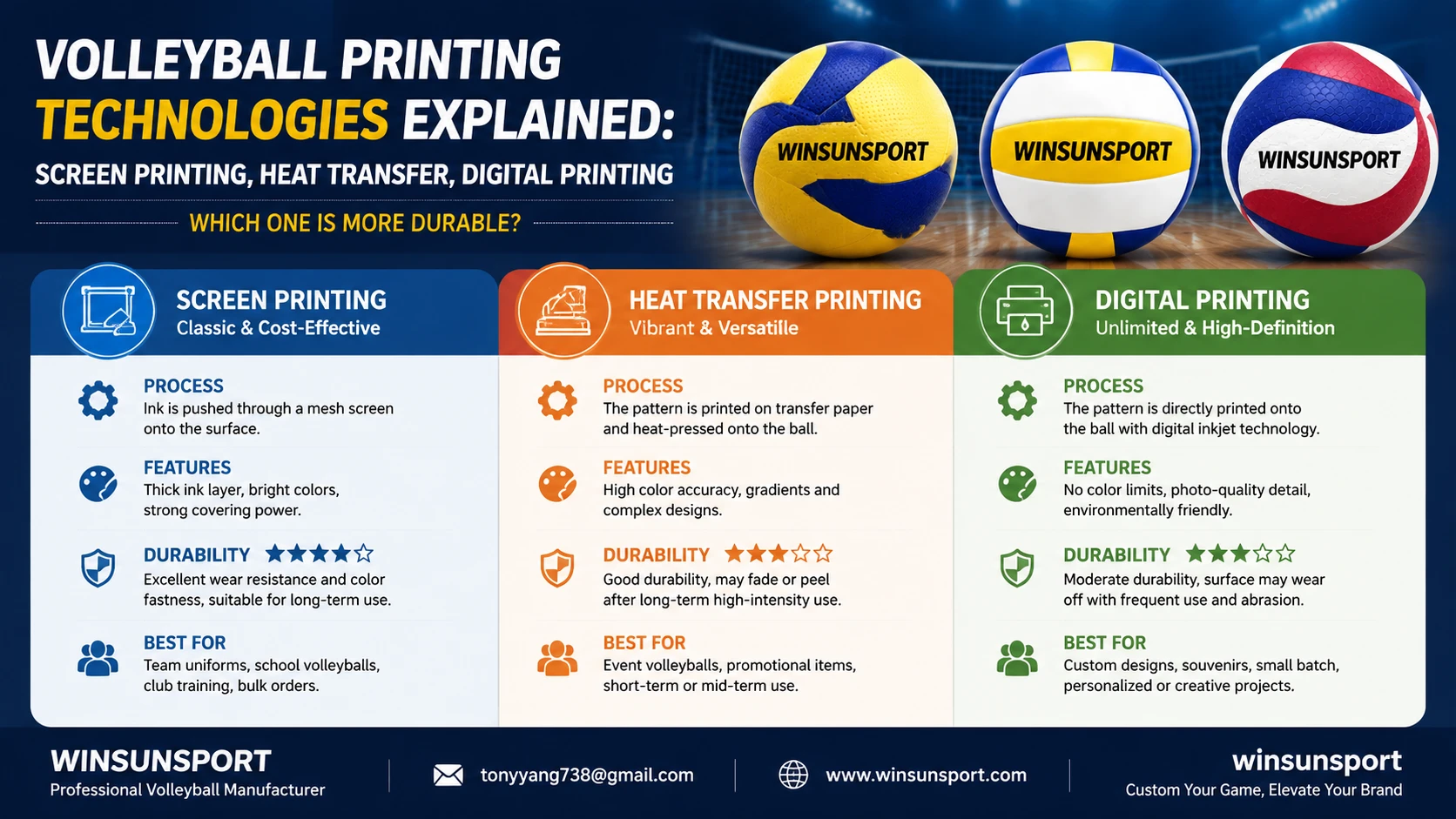
What are the custom volleyball printing processes?How do screen printing, heat transfer, and digital direct printing work respectively?
How are the patterns on custom volleyballs printed? It depends on the printing process you choose. Currently, there are three mainstream methods: screen printing, heat transfer, and digital direct printing.
Their working principles and applicable scenarios are completely different. Choosing the right process directly determines the durability and visual effect of the pattern.
Screen Printing: A Classic Process Suitable for Single-Color Logos
Screen printing uses a squeegee to press ink through the mesh of a screen directly onto the surface of the volleyball. It's like painting a wall with a stencil—only the pattern area on the screen is permeable, and the ink is scraped through to stay on the ball surface.
- How it works: Each color requires a separate screen to be made, so more colors mean higher cost and longer production time.
- Best for: One- or two-color team names, logos, numbers.If you only need a simple white team emblem or black number, screen printing is the most economical and durable choice.
- Key trade-off: Sharp edges, strong abrasion resistance, but cannot reproduce gradients or photographic details.
Heat Transfer: The Ideal Choice for Full-Color Patterns
Heat transfer first prints the pattern onto transfer paper using special ink, and then transfers the pattern from the paper to the volleyball surface through high temperature and pressure. It's like ironing a sticker onto clothing—but here, the "sticker" fuses with the ball surface.
- How it works: Print → Laminate → Heat Press.The pattern can include any colors, gradients, or even photos, all in one go.
- Best for: Custom balls requiring full-color designs, complex gradients, or brand logos, such as corporate gifts or campus event commemorative balls.
- Key trade-off: Best color expression, but after long-term high-intensity use, the edges may slightly peel (depending on the ball surface material and heat press parameters).
Direct-to-Garment Printing: Small-Batch Rapid Prototyping
Digital direct injection is like a printer directly spraying ink onto the ball surface, and then using a curing lamp to dry and solidify the ink. It does not require plate making or transfer paper; the pattern goes directly from the computer file to the ball surface.
- How it works: The print head directly sprays UV ink onto the ball surface, which cures instantly.
- Best for: Small batches (1-10 pieces), urgent orders, and trial production stages requiring frequent design changes.
- Key trade-off: Low unit cost and fast speed, but the pattern adhesion is not as good as screen printing and heat transfer. It may fade or peel off after long-term friction, making it unsuitable for high-intensity game balls.
How to choose? First, consider your pattern and usage
| Process | Pattern Complexity | Durability | Minimum Order Quantity | Cost (Per Unit) |
|---|---|---|---|---|
| Screen Printing | Single Color / Two Colors | High | Medium-High | Low |
| Heat Transfer | Full Color/Gradient | Medium-High | Medium | Medium |
| Digital Direct Printing | Full Color/Gradient | Medium | Low | High (Small Batch) |
Next Step: Confirm Action: Do you want a single-color logo or a full-color photo? ) and expected frequency of use (how many times per week?) ) to our customization consultant, and they will recommend the most suitable process based on your ball surface material (PU, PVC, or rubber).
Durability comparison of the three processes: which one is least prone to peeling or fading?
How long the pattern on a custom volleyball lasts directly depends on the printing process you choose. Below, we break down the three dimensions of wear resistance, water resistance, and UV resistance to help you determine which process best suits your usage intensity.
Screen printing: best durability, suitable for high-frequency use scenarios
Screen printing involves ink penetrating directly into the volleyball surface fibers, fusing with the material after drying. Its advantages are:
- Wear-resistant: The ink layer is thick and tightly bonded to the surface, making it less likely to peel off when frequently hit, rubbed against the ground or walls.Under normal use, the pattern lifespan can cover the wear cycle of the volleyball itself (about 1-2 years of high-intensity training).
- Water-resistant: Sweat, rain, or cleaning wipes will not cause the pattern to blur or peel.
- UV-resistant: The special ink formula has strong anti-fading ability, and color retention under direct outdoor sunlight is better than other processes.
Suitable for: Professional training teams, school physical education classes, outdoor beach volleyball, and other high-frequency, high-friction scenarios. If you need a pattern that is "as durable as the ball itself," screen printing is the first choice.
Heat Transfer: Long-lasting colors, but edges prone to wear
Heat transfer uses high temperature to press the pattern film layer onto the volleyball surface. Its advantage is high color reproduction, capable of printing gradients and complex patterns, but it has a clear weakness in durability:
- Edge wear: The pattern is an independent film layer, and the edges are most vulnerable at the seams with the ball surface.After dozens of high-intensity hits or friction with the ground, the edges may first show lifting or peeling.
- Moderate water resistance: The film layer itself is waterproof, but if the edges are damaged, moisture can seep through the gaps and accelerate peeling.
- Good UV resistance: The anti-fading ability of the film pigment is close to that of screen printing, but the overall lifespan is limited by physical wear.
Suitable for: Suitable for low-intensity usage scenarios such as gifts and souvenirs, corporate promotions, and indoor entertainment. If you value the visual effect of the pattern (such as full-color logos, photo-grade patterns) and the usage frequency is not high, heat transfer is a reasonable choice.
Key Trade-off Quick Reference Table
| Dimension | Screen Printing | Heat Transfer |
|---|---|---|
| Abrasion Resistance | ★★★★★ (Same lifespan as the ball) | ★★★☆☆ (Edges wear first) |
| Water Resistance | ★★★★★ (No delamination risk) | ★★★★☆ (Water ingress after edge damage) |
| UV-resistant | ★★★★☆ (Color retention) | ★★★★☆ (Coating resists fading) |
| Pattern Complexity | Single Color / Simple Multi-Color | Full Color / Gradient / Photo-Realistic |
| Best Suited Scenarios | Training / Competition / Outdoor | Gifts / Indoor / Display |
Next Step: Confirm Action
- If you need it forofficial competitions or high-intensity training, please confirm directly with the Winsunsport team whether the screen printing process supports the number of colors in your design (screen printing is low cost for single color, but multiple colors require layering).
- If you needfull-color logos or photo-quality patterns, and the usage scenario is mainly indoor display or low-intensity entertainment, heat transfer is more suitable.Please confirm with the team the thickness grade of the heat transfer film — a thicker film layer will have slightly better edge wear resistance.
- If the usage scenario includeslong-term outdoor exposure to sunlight(such as beach volleyball), prioritize screen printing and inform the team that an ultraviolet-resistant ink version is needed.
Choose the process based on the usage scenario: which one should be selected for competition, training, and gifts respectively?
The printing process for custom volleyballs directly affects pattern durability, feel, and cost. Choosing the wrong process may result in the ball being deemed illegal for competition, training balls losing color within weeks, or gifts appearing cheap. Below are recommendations directly based on the scenario.
Official Matches: Screen Printing is the Top Choice, Balancing Durability and Compliance
If the custom volleyball is intended for official matches (e.g., inter-school leagues, amateur club competitions),screen printing (silk screen printing) is the most reliable option.。
- Why Choose Screen Printing: Screen printing ink adheres firmly to PU or PVC ball surfaces, is wear-resistant, sweat-resistant, and withstands repeated impacts. The pattern edges are clear, and it is not prone to peeling or falling off.Match balls require high surface flatness. The ink layer of screen printing is relatively thin, which hardly affects the ball's flight trajectory and feel.
- Compliance: As long as the pattern does not cover the brand logo area specified by the FIVB (International Volleyball Federation), does not contain prohibited advertisements or politically sensitive content, screen-printed custom balls can be used in non-international official matches.If you have questions about specific dimensions, air pressure, or pattern placement,it is recommended to directly provide the match level and organizer requirements to the Winsunsport team, and they will help you confirm whether it meets the standards.。
- Who is it not suitable for: If you need full-color gradients or photo-quality patterns, the cost of screen printing will increase significantly (multiple colors require multiple overprints). In this case, heat transfer printing can be considered, but you need to confirm whether the match organizer accepts it.
Daily training: Heat transfer printing offers high cost performance and rich colors.
The core requirements for training balls are "clear patterns, controllable costs, and the ability to last through a training cycle (usually 3-6 months)." Heat transfer printing is the balanced choice for training scenarios。
- Advantages: Heat transfer printing transfers patterns onto the ball surface through heat pressing, enabling full-color, gradient, and complex logos with high color fidelity, suitable for designs requiring rich colors such as team emblems and school names.The cost is lower than screen printing, especially suitable for small batch customization (within dozens of units).
- Durability: Under normal training intensity (2-3 times per week, not on cement courts), heat transfer patterns can last more than 6 months without significant peeling.However, if used long-term on rough surfaces (such as asphalt or cement), the edges may lift first.If your training venue is indoor wooden flooring or plastic, heat transfer printing is fully sufficient.; if it is an outdoor hard court, it is recommended to upgrade to screen printing.
- Who is not suitable: If the training intensity is extremely high (several hours a day, professional team level), or if the ball is frequently thrown, dropped, or soaked in water, the lifespan of heat transfer may be shorter than that of screen printing.In this case, you can consult the Winsunsport team about whether a protective layer can be added on top of the heat transfer.
Gift customization: choose based on budget and design complexity
The scenarios for gift customization of volleyballs are broad: corporate event souvenirs, graduation gifts, fan collectibles, etc. The choice of process mainly depends onbudgetandDesign Complexity。
| Scenario | Recommended Process | Reason |
|---|---|---|
| Company logo, monochrome text | Screen Printing | Low cost (single-color printing), durable, looks professional |
| Full-color patterns, gradients, photos | Heat Transfer | Rich colors, suitable for personalized design, cost-effective even for small batches |
| Very small quantity (1-5 pieces), high precision | Digital Direct Printing | No plate making required, high pattern precision, but higher cost, and need to confirm if the spherical material is compatible |
- Key trade-off: If the gift quantity is over 50 pieces, the unit price advantage of screen printing will be very obvious;If the quantity is small and the design is complex, heat transfer or digital direct printing is more flexible.
- Next step confirmation: If you are not sure whether the gift recipient will actually use the ball (for example, it is just a decoration), you can prioritize heat transfer because the pattern is more exquisite;If the ball will be actually hit, choose the process according to the "training" scenario.
Summary: Quick judgment for three scenarios
- Competition → Screen printing (first confirm the competition's requirements for the pattern)
- Training → Heat transfer (indoor court priority;outdoor hard court can upgrade to screen printing)
- Gifts → Depends on quantity: single color/large quantity choose screen printing, full color/small quantity choose heat transfer
If you are still hesitating,the most direct approach is: tell the Winsunsport team your usage scenario (competition/training/gift), venue type (indoor/outdoor), design complexity, and budget range, and they will recommend a matching process solution.You don't need to figure out all the process details yourself.
How to determine which process is right for you?Trade-offs between budget, pattern complexity, and quantity
Choosing a process is not about which is the "best," but which best matches your specific needs. Here is a direct guide to help you decide: when to choose screen printing, when to choose heat transfer, or when to choose digital direct printing.
Limited budget: screen printing + single-color design is the cost-effective choice
If your custom order is over 50 pieces and the design is one or two colors (such as just a team name or simple logo),screen printing is the most cost-effective choice.。 The plate-making cost for screen printing is spread across each ball, so the larger the quantity, the lower the unit price. For student teams or companies bulk purchasing as employee benefits or promotional items, screen printing is perfectly adequate, and the design is durable and abrasion-resistant.
When screen printing is not suitable:Designs with more than three colors, or those containing gradients or photo-level details—the more colors used in screen printing, the higher the cost, and it cannot reproduce complex gradients.
Complex designs: heat transfer or digital direct printing is more suitable.
If your design is a full-color logo, gradient, photo of a person, or detailed illustration,Heat transfer is a more reliable solution.。 It can fully transfer complex patterns onto the volleyball surface with high color fidelity, suitable for small batches (10-50 pieces) such as gift souvenirs, parent-child activities, or personalized collections. Heat transfer patterns are not prone to peeling under normal use, but long-term high-intensity friction (e.g., professional training) may cause slight wear.
Digital Direct PrintingSuitable for very small quantities (1-10 pieces) with extremely detailed patterns, such as single gifts or samples. Its advantage is that no plate making is required, but the cost is higher, and it has certain requirements for the volleyball surface material—PU material works better, while PVC or rubber balls may have weaker adhesion.
Cases not suitable for heat transfer/digital direct printing: Extremely low budget and large quantity (over 200 pieces), where screen printing has a more obvious unit price advantage.
Key trade-off summary
| Your Situation | Recommended Process | Reason |
|---|---|---|
| Quantity 50+, Single-color/Two-color Logo | Screen Printing | Lowest Cost, Durable |
| Quantity 10-50, Full-color/Gradient Pattern | Heat Transfer | Good Color, Small Batch Feasible |
| Quantity 1-10, Fine Photo-realistic Pattern | Digital Direct Printing | No MOQ, Good Detail Reproduction |
| Professional match ball with simple pattern | Screen Printing | Complies with FIVB standards, does not affect feel |
Next Step: Confirm Action: Send your design draft (number of pattern colors, whether gradient) and estimated quantity to the Winsunsport team, and they will directly tell you which process is most cost-effective and provide a sample proofing plan. If the pattern includes white or light-colored areas, remember to confirm whether the volleyball base color will affect color rendering—printing light patterns on a dark ball may require additional underbase treatment.
FAQ
Q1: Is there a big difference in cost for custom volleyball printing processes? Yes. Screen printing has plate making fees, so the unit price is lowest for single-color designs with orders of 50 or more; Heat transfer and digital direct-to-garment printing do not require plate making, but the unit cost is higher.
Taking 50 custom volleyballs as an example, the total cost of screen printing may be 30%-50% lower than that of heat transfer.
Q2: For small batch custom volleyballs (e.g., 10 pieces), which process is recommended? Recommend heat transfer. It has no minimum order quantity, can reproduce full-color patterns, and the cost is controllable.
If there are only 1-2 pieces and the pattern is extremely detailed, digital direct-to-garment printing is more suitable.
Q3: When the pattern is complex, should I choose screen printing or heat transfer? Choose heat transfer. Screen printing cannot handle gradients and photo-level details, while heat transfer can fully transfer complex patterns.
If the pattern has only 3-4 colors and no gradients, screen printing is also feasible, but it is necessary to confirm whether the plate-making cost is cost-effective.
Q4: Are screen-printed patterns prone to peeling off? Under normal use, they are not prone to peeling off. Screen printing ink penetrates the surface of the volleyball, offering good abrasion resistance.
However, after long-term high-intensity friction (such as professional training), any printing process will experience wear, with heat transfer and digital direct printing wearing slightly faster than screen printing.
Q5: Can customized volleyballs be used in official matches? Yes, as long as the customized parameters (size, weight, air pressure) comply with FIVB standards. Winsunsport's custom volleyballs meet competition-grade specifications, and the printing process does not affect ball performance.
Learn more
If you are unsure about the goal, target users, existing materials, or subsequent maintenance methods, it is recommended to confirm this information first before determining whether Personalized Custom Volleyball is suitable.
Related products:Personalized Custom Volleyball