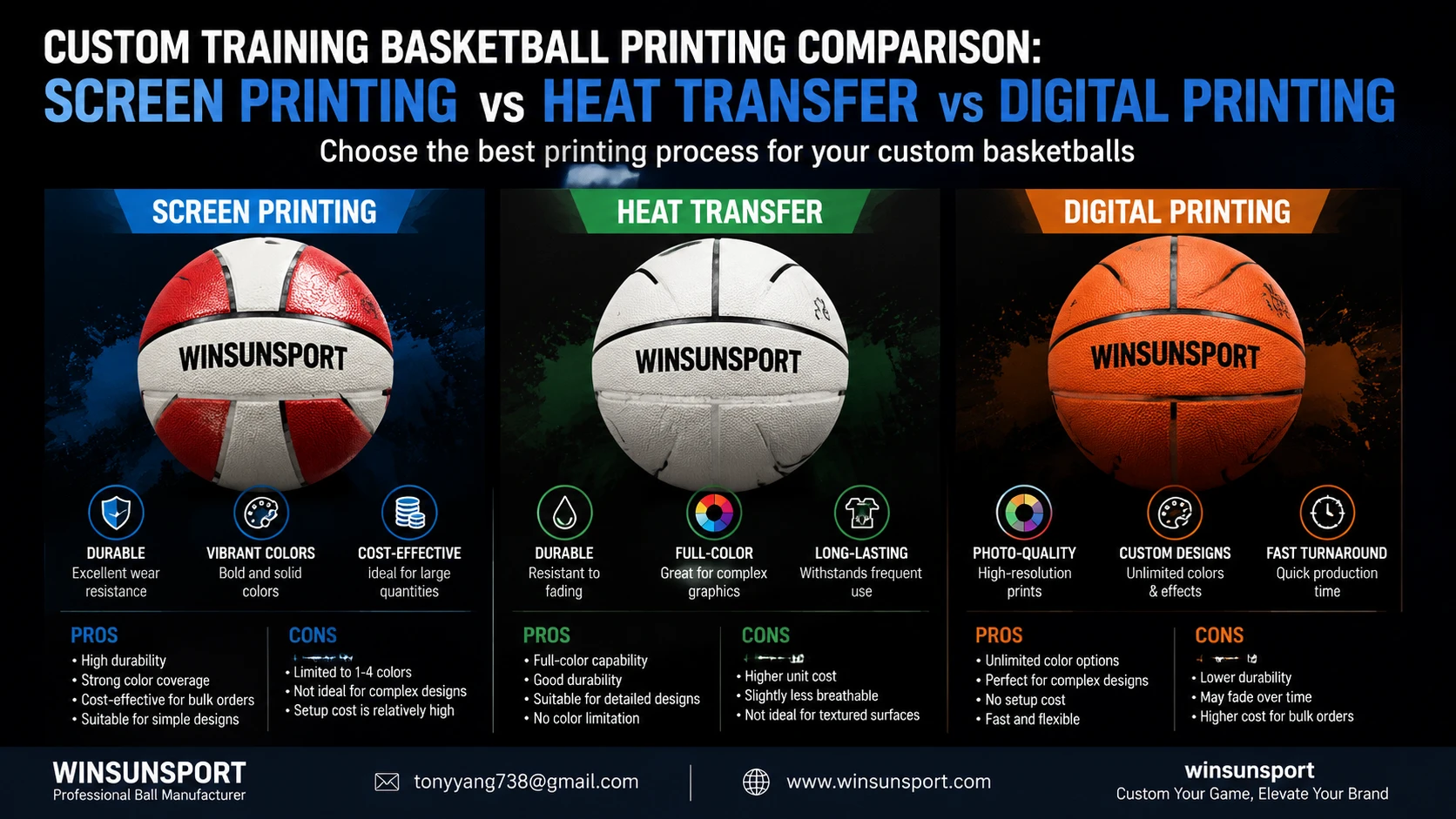
What are the three printing processes for custom training basketballs? How do they work?
When you decide to customize a batch of training basketballs, the first choice you face is the printing process. Different processes determine the clarity, feel, durability, and cost of the pattern. Currently, the three mainstream processes arescreen printing (silk screen printing)、heat transfer printingandDigital Direct Printing。
Below, we explain how each works to help you quickly understand which one suits your needs.
Working Principle and Characteristics of Screen Printing
Screen printing is the most traditional and commonly used process for basketballs. Its working principle is: first, a screen mesh with a pattern (equivalent to a stencil) is made, then ink is pressed through the open areas of the mesh onto the basketball surface using a squeegee. The ink penetrates the leather texture of the basketball and, after drying, forms a pattern with a certain thickness.
- Core Features: The pattern is durable and wear-resistant, with vibrant colors and strong coverage, especially suitable for large color blocks and simple line logos or text.
- Feel Impact: Due to the certain thickness of the ink layer, there will be a slight raised feeling when touched, but it usually does not affect the feel of dribbling and shooting.
- Applicable Scenarios: Schools, teams, and enterprises for bulk customization (usually a minimum order of 100 pieces). Because a screen plate needs to be made, the one-time plate-making cost is high, but the printing cost per piece is low, making it more cost-effective for larger quantities.
Working Principles and Characteristics of Heat Transfer and Digital Direct Printing
Both of these processes are "plateless" printing, requiring no screen plate, making them suitable for small batches or custom designs with complex patterns.
heat transfer printing: First, the pattern is printed onto a transfer film using special ink, and then through high temperature and pressure, the pattern on the film is transferred to the basketball surface. The pattern is essentially "pasted" on and fuses with the basketball surface after cooling.
- Core Features: The pattern has high precision, capable of presenting gradients, photo-like details, and even full-color patterns.However, the wear resistance of the pattern is not as good as screen printing. After long-term use or friction, the edges may lift or peel off.
- Feel Impact: The pattern area will have a film-like feel, smoother than screen printing, but still with a slight tactile sensation.
Digital Direct Printing: Using a specialized industrial printer, ink is directly sprayed onto the basketball surface, then cured by heat or UV light, allowing the ink to penetrate and fix into the material.
- Core Features: Extremely high precision, suitable for complex patterns and photos, and without the thickness of a transfer film, the pattern almost merges with the basketball surface.However, the ink adhesion has requirements for the basketball material, and it is generally more suitable for synthetic leather with good ink absorption.
- Feel Impact: Almost no tactile sensation; the pattern area feels as natural as the rest of the basketball surface, offering the best hand feel among the three processes.
- Applicable Scenarios: Personal customization, small batch gifts (such as graduation commemorative balls), orders requiring high-precision patterns or photos.The unit cost is relatively high, but there is no plate-making fee, and the minimum order quantity is 1 piece.
Quick Comparison of Three Processes
| Process | Pattern Precision | Feel Impact | Wear Resistance | Suitable Batch Size | Unit Cost (Including Plate Fee) |
|---|---|---|---|---|---|
| Screen Printing | Medium (suitable for color blocks and text) | Slight protrusion | High | Large batch (≥100 pieces) | Low (after plate cost sharing) |
| heat transfer printing | High (full-color gradient possible) | Film-like feel | Medium | Small batch (1-50 pieces) | Medium |
| Digital Direct Printing | Highest (photo quality) | Almost imperceptible | Medium to high | Small batch (1-30 pieces) | High |
Next step: confirm action
- If you need large batches (100+ pieces) with simple patterns (single color or few color blocks): Prioritize screen printing, which has the lowest cost and is most durable.
- If you only need a few or dozens, and the pattern is complex (such as gradients, photos): Heat transfer or digital direct printing is more suitable.Which one to choose depends on how high your requirement is for "no touch feeling" – if you want the pattern to be completely imperceptible to the touch, choose digital direct printing;if you can accept a slight film-like feel, heat transfer offers better cost performance.
- If you are unsure whether your pattern is suitable for a certain process: It is recommended to directly provide the design draft to the Winsunsport team, and they will give the most matching process advice based on the pattern details, number of colors, and basketball material.
Screen printing, heat transfer, and digital direct printing: which process produces more durable prints?
If you are choosing a printing process for training basketballs, what you care about most is often:How many times of hitting, rubbing, and sun exposure can the printed pattern withstand? Three mainstream processes—screen printing, heat transfer, and digital direct printing—have significant differences in durability. Choosing the wrong one may cause the pattern to peel or fade within months.
Abrasion resistance test and durability comparison in outdoor environments
- Screen printing (most durable): The ink directly penetrates the basketball surface and integrates with the material after drying.In abrasion resistance tests, screen-printed patterns can typically withstand thousands of repeated rubs without significant wear, and have the strongest anti-peeling ability.In outdoor environments, screen printing also has good resistance to ultraviolet (UV) rays, with the slowest fading speed.
- Heat transfer (medium): The pattern is bonded to the basketball surface via a heat-pressed film.Initially strong, but the film and basketball material are physically bonded; after prolonged friction, the edges are prone to lifting and peeling.After six months to a year of outdoor use, the pattern may develop cracks or partial detachment.
- Digital Direct Printing (Weaker): Ink is sprayed directly onto the surface, but adhesion relies on a coating treatment.For training basketballs that frequently contact the ground, direct-printed patterns have the worst abrasion resistance, especially on outdoor courts with gravel; the pattern may blur or peel off within months.
Key Trade-off: If you primarily train outdoors and use the ball frequently, screen printing is one of the key processes that can more reliably ensure the pattern remains intact throughout the basketball's lifespan. Heat transfer is suitable for indoor or low-frequency use, while digital direct printing is better for display or gift purposes and is not suitable for high-intensity training.
Impact of different basketball materials (PU, rubber) on print adhesion
Basketball material directly determines the adhesion of the printing process:
- PU (polyurethane) basketball: The surface has a microporous structure, allowing screen printing ink to penetrate and bond, resulting in the highest adhesion.Heat transfer also works well on PU, but the film layer and PU have different expansion coefficients, which may cause bubbling under large temperature differences (e.g., after exposure to intense summer sun).Digital direct printing on PU requires a special coating; otherwise, the ink may blur or peel off easily.
- Rubber basketball: The surface is smooth and highly elastic, making ink adhesion difficult.Screen printing requires special rubber ink, otherwise the print is prone to peeling off entirely.Heat transfer has moderate adhesion on rubber, but the rubber itself shrinks with temperature changes, causing the edges of the pattern to lift.Direct digital printing is almost impossible on rubber, as the ink cannot adhere firmly.
Impact on You: If you choose a PU material training basketball (such as the Winsunsport Custom Printed Pro Training Basketball), screen printing is the ideal choice that balances durability and feel. For rubber basketballs, it is recommended to prioritize screen printing (ensure ink compatibility) or accept the shorter lifespan of heat transfer patterns.
Who It Suits and Who It Does Not Suit
- Suitable for screen printing: Outdoor training, long-term use by schools/teams, need the pattern to last as long as the basketball, budget allows (screen printing requires plate-making fees, the larger the batch, the lower the unit price).
- Suitable for heat transfer: Indoor training, small batch customization (no plate-making fees), complex or gradient pattern colors, can accept slight pattern wear after 1-2 years.
- Not suitable for digital direct printing: Any high-frequency training scenario, outdoor use, or clear requirements for pattern durability.
Next step: confirm action
- Define the usage scenario: Mainly indoor or outdoor? How many times per week is it used? This directly determines whether you need the durability of screen printing.
- Confirm the basketball material: Confirm with the Winsunsport team whether you choose PU or rubber material, and the printing process solutions they recommend for each material.
- Request wear resistance test reference: If the budget allows, ask for a sample of the same material and process, and observe the pattern condition after dozens of frictions on a similar ground.
Conclusion: If "durability" is your top priority, and the usage scenario includes outdoor or high-frequency training,Screen printing is one of the key processes worth considering.Heat transfer and digital direct printing are more suitable for scenarios with high pattern complexity but low usage intensity.
Color performance and feel impact: How does the printing process affect the visual effect and touch of a basketball?
If you want the patterns on the customized basketball to have bright colors and natural gradients without sacrificing the ball's elasticity and grip, then the choice of printing process is key. Below is a direct comparison of three processes: screen printing, heat transfer, and digital direct printing, to help you make trade-offs based on design requirements.
Color reproduction comparison between full-color logos and single-color logos
- Screen Printing: High color reproduction, butonly single colors or limited color blocks can be printed(usually no more than 4-5 colors).Suitable for solid color logos, text, or simple geometric patterns.Cannot achieve photographic or gradient effects.
- heat transfer printing: Can print full-color patterns, including photos and complex gradients.Color saturation and transitions are very natural, butthe edges of the pattern may have a transparent film-like feel, especially noticeable on dark-colored basketballs.
- Digital Direct Printing: The richest colors, capable of accurately reproducing photos, gradients, and subtle color differences.The pattern penetrates directly into the basketball surface, without a film-like feel, and the visual effect is closest to "printed on the leather."
Conclusion: If you need to print acolor gradient logo, digital direct printing is one of the key choices that can perfectly achieve it;heat transfer printing comes second, but it will have a film-like feel;screen printing is completely incapable.
The impact of printing layer thickness on basketball elasticity and grip
| Process | Printing layer thickness | Impact on Feel | Impact on Elasticity |
|---|---|---|---|
| Screen Printing | Thicker (ink buildup) | Pattern area is noticeably raised, creating a "bumpy" feel when gripping, affecting dribbling feel. | Almost no impact, but raised areas may crack after long-term use. |
| heat transfer printing | Medium (film layer) | Pattern area has a smooth film layer, with slightly lower friction than the basketball surface; may become slippery with sweaty hands. | No impact. |
| Digital Direct Printing | Extremely thin (ink penetration) | Almost no pattern feel, consistent with non-printed areas, does not affect grip | No impact. |
Key Trade-off:
- Pursuing consistent feel and no slipping: Choose digital direct printing. It hardly changes the surface texture of the basketball, suitable for training and game balls.
- Limited budget, simple pattern: Although screen printing has raised feel, if the pattern area is small (e.g., a school emblem), the impact is acceptable.
- Need full color but medium budget: Thermal transfer is a compromise solution, but note that the film layer may lift at the edges under high temperature or prolonged friction.
Next step: confirm action
- Send your design drafts (especially gradient or photo-like patterns) to our sales team, and they will useDigital Direct Printingproofing to let you directly see the color reproduction and feel.
- If the pattern has only 1-2 solid colors and you care more about cost, you can requestScreen Printinga solution quote and ask for a feel sample.
- If you are concerned about the film-like feel of thermal transfer, you can request physical samples of both processes to touch and decide.
How to choose the most suitable printing process based on budget and batch size?
The key to selecting a printing process is yourBatch sizeandBudget per ball. The three processes (screen printing, heat transfer, and digital direct printing) each have clear cost inflection points and effect trade-offs. Below are solutions directly based on scenarios.
Recommended process for small batch customization (less than 50 pieces)
First choice: digital direct printing.
- Why? Digital Direct PrintingNo plate making fee, printing can start from a single ball, and full-color and gradient effects are achievable.For quantities below 50, the total cost is the lowest, and the delivery time is short (usually 3-5 days).
- Who is it suitable for? Personal collections, graduation souvenirs, team trial samples, gift customization (e.g., within 20 pieces).
- Who is it not suitable for? If you need the pattern to be extremely wear-resistant (e.g., used daily for high-intensity training), the ink layer of digital direct printing is thinner than screen printing, and may slightly fade after long-term friction.
Alternative: Heat transfer (below 50 pieces).
- Heat transfer also has no plate-making fee, but requires a separate transfer film, and the cost per ball is slightly higher than digital direct printing.Unless you specifically need the pattern to have a three-dimensional tactile feel.(The heat transfer film has a certain thickness), otherwise digital direct printing is more cost-effective.
Cost optimization strategy for bulk purchases (500+ units)
First choice: screen printing.
- Why? The plate making cost for screen printing (approximately 200-500 yuan per color) is amortized to almost negligible when ordering 500 or more units, and the printing cost per ball is thelowest. Moreover, screen printing ink layer is thick and has the strongest wear resistance, making it suitable for long-term use in schools, events, and enterprises.
- Key trade-off: Screen printing can only printsingle colors or a few color blocks(usually no more than 4 colors), and complex gradients or photo-quality patterns cannot be done.If your design is a solid color logo or text, screen printing is the best value for money.
- Note: Screen printing requires confirming the basketball surface material (rubber/synthetic leather) in advance, as different materials require matching special inks, otherwise adhesion will be compromised.
Alternative: Heat transfer (for 500+ pieces).
- Heat transfer can print full-color patterns and has better wear resistance than digital direct printing.However, the cost per ball is about 30%-50% higher than screen printing, suitable forcomplex designs but with sufficient budgetbulk orders (such as brand co-branded models).
Which process offers the best cost performance?
There is no definitive answer; it depends on your definition of "cost performance":
- Ifonly considering cost per ball: choose screen printing for large batches (500+), and digital direct-to-garment for small batches (50-).
- IfBalancing pattern effect and wear resistance: Heat transfer is the middle option—full color, scratch-resistant, cost-controllable, but unit price is high for orders under 500 pieces.
- IfNeed rapid prototyping or frequent pattern changes: Digital direct printing is the most flexible, with no plate-making fees and the ability to change designs at any time.
Next step: confirm action
- Determine your batch size: Under 50 pieces, 50-500 pieces, over 500 pieces—directly correspond to the above options.
- Provide design files: Send your pattern (AI/PDF/PNG) to the team; they will determine whether it is suitable for screen printing (color blocks) or requires heat transfer/digital direct printing (full color).
- Specify the intensity of use: Daily training, competition, or gift?Different wear resistance requirements will lead to slight adjustments in process recommendations.
- Request a sample: For small batch trial production, it is required to first make a sample to confirm the color and adhesion before mass production.
Frequently Asked Questions
Q: How to choose between 50-500 pieces? A: This is a gray area. If the design is simple (1-2 colors), the screen printing plate making cost may be lower than heat transfer when spread out;If the design is complex, heat transfer or digital direct printing is more suitable.
It is recommended to send the design directly to the team, and they will calculate the total cost of the two options based on the actual quantity, and you can compare and decide.
Q: Can the pattern of digital direct printing be washed? A: It can be wiped and cleaned normally, but do not use a hard brush or solvent. Daily sweat stains and dust can be gently wiped with a damp cloth.
Long-term high-intensity friction (such as dribbling on concrete) will accelerate wear, but normal indoor training is fine.
Q: How much is the plate making cost for screen printing? A: 200-500 yuan per color, depending on the pattern size and basketball material. For example, printing a single-color logo, the plate making fee is about 300 yuan, and for 500 balls, it's only 0.6 yuan per ball.
Q: Will the heat transfer pattern peel off? A: High-quality heat transfer film has strong adhesion under the correct process (temperature, pressure, time) and will not peel off under normal use. But inferior film or improper operation may cause edge lifting.
It is recommended to choose a supplier that provides proofing confirmation.
Q: I want to print a gradient team logo. Which process is best? A: Digital direct printing or heat transfer. Screen printing cannot achieve gradients.
If the batch size is over 200 pieces, heat transfer printing offers better wear resistance;for batches under 200 pieces, digital direct printing is more cost-effective.
Learn More
Not sure which process is best for your custom training basketball?Contact the Winsunsport team directly, provide your design and batch requirements, and we will match you with the most suitable printing solution and provide a free sample for confirmation.
Related Products:Custom Printed Pro Training Basketball