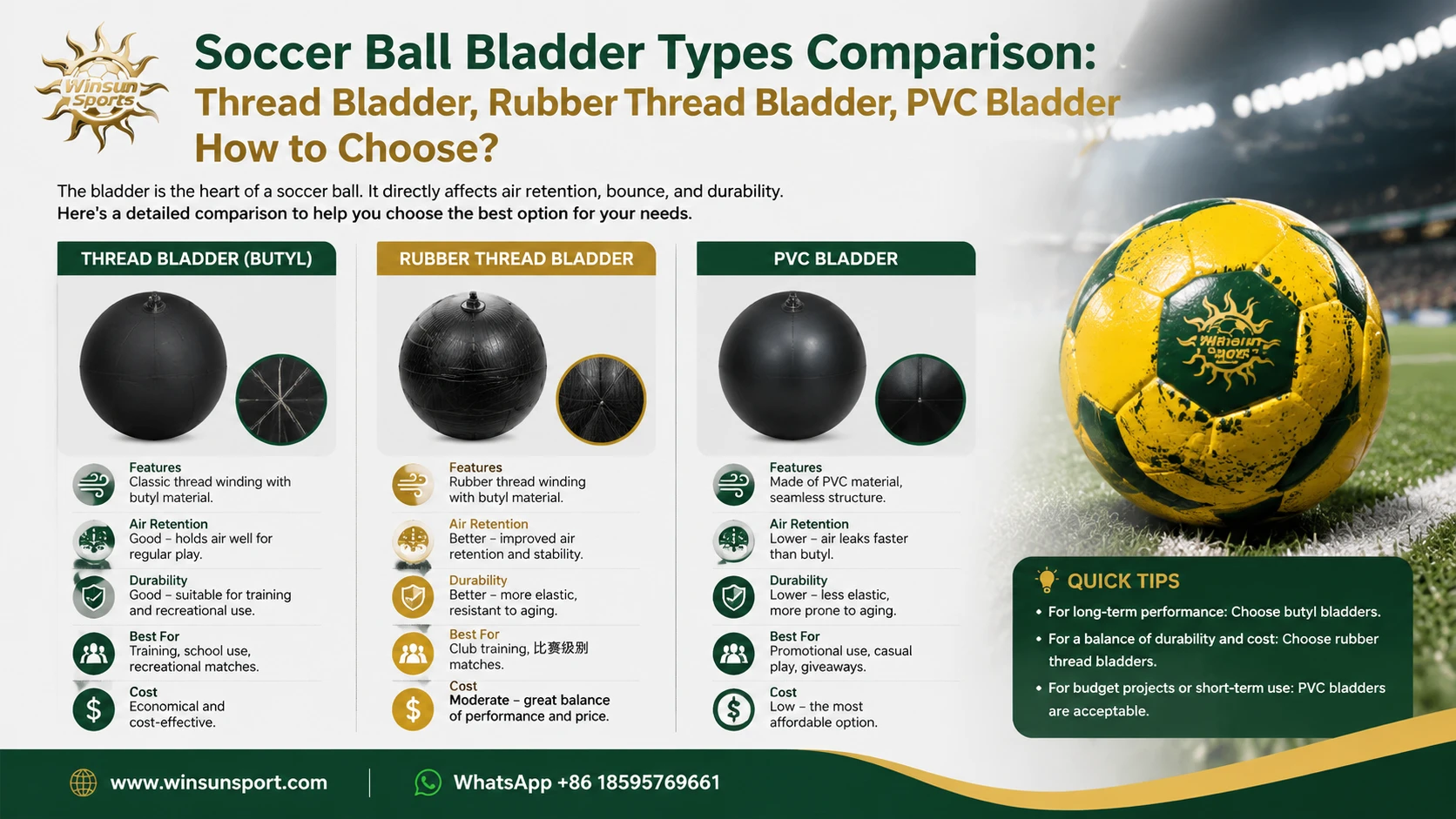
Thread bladders, rubber thread bladders, and PVC bladders—where are the core differences among the three inner bladders?
When buying a football, the inner bladder is often the most overlooked part, yet it most affects the feel of kicking. Simply put, the inner bladder is the 'heart' of the football—it determines whether the ball feels dull or crisp when kicked, and whether it feels hard or flexible with rebound when stepped on. The differences among the three bladders essentially lie in using different materials and processes to balance elasticity, feel, and durability.
Manufacturing Methods and Performance Characteristics of the Three Bladders
PVC bladder (polyvinyl chloride inner bladder): The most common basic configuration, molded from PVC material. It features good air tightness and low cost, but the material is relatively hard, and it becomes harder and more slippery at low temperatures. It suits budget-conscious, low-frequency casual scenarios—like kicking around in the neighborhood or as a toy ball for kids.
If you just want something that bounces, a PVC bladder is enough;but if you play two or three times a week or more, its feel will degrade relatively quickly.
Rubber-wound bladder: One or more layers of nylon thread (similar to tire cord structure) are wound around the rubber inner bladder, then covered and fixed with rubber. This thread layer limits excessive expansion of the inner bladder, making the ball deform more evenly under force. Its elasticity is more controllable than a PVC bladder, with a firmer feel, clear feedback when kicked, and noticeably improved durability.
This is the mainstream configuration for training balls and entry-level match balls, offering the best value for money.
Wound bladder (fully wound bladder): Based on a rubber bladder, high-strength threads are wound more densely and evenly to form a complete "thread skeleton". The number of thread layers and winding density directly determine the ball's elasticity and stability. The advantage of a wound bladder ball is that after each touch, the ball's deformation and recovery are more consistent, avoiding the situation where "the ball feels floaty when kicked";After long-term use, the elasticity of the bladder decays more slowly than that of a rubber bladder.
The trade-off is more complex manufacturing and higher cost, typically used for match-grade balls.
How does the bladder structure affect a football's elasticity and feel?
The key lies in the four words "deformation control".
- Elasticity: The PVC bladder relies on the material's own elasticity to rebound, with large deformation and fast rebound but not uniform enough;The thread-wound bladder relies on the thread to constrain deformation, providing more linear rebound and a more stable flight trajectory for the ball.
- Feel: The PVC bladder is relatively hard, and when juggling, the instep can clearly feel a "thump" rather than a "cushion";The thread-wound bladder, because the deformation is dispersed by the thread, buffers the impact force at the moment of contact, offering a softer and more snug feel.
- Durability: The PVC bladder is prone to aging and cracking at the seams after long-term high-pressure inflation;Rubber bladders and wound bladders have a more complex structure, offering greater fatigue resistance and slower air leakage.
Recommendations for your choice:
- For casual daily use or occasional play: a PVC bladder is sufficient; no need to spend extra.
- For school physical education classes or weekly regular training: a rubber wound bladder is the sweet spot, offering the best balance of durability and touch.
- For matches, high-intensity training, or if you have requirements for touch feedback: a wound bladder is worth the investment, especially if you want the ball to maintain its performance for a year or two without 'changing character'.
If you are torn between options, the next step is not to look at more specifications, but to think clearly about one question:Who is this ball for, and how often will it be used? If buying for a child, a PVC bladder is perfectly fine;If you play football weekly yourself, start with a rubber-wound bladder, and if your budget allows, go straight to a wound bladder. Tell our team about your frequency of use and playing scenarios, and we can confirm which bladder configuration best matches your specific needs.
Which bladder is more durable?From the two dimensions of wear resistance and air retention
To judge whether a football is durable, don't just look at the outer cover. What truly determines how long a ball lasts and how often you need to pump it up is the bladder hidden inside. The Winsunsport Premium Match Grade Soccer Ball offers three configurations: wound bladder, rubber-wound bladder, and PVC bladder, and the differences in performance across these two dimensions are significant.
Wear resistance: performance of different bladders in long-term use
Durability and impact resistance refer to whether the bladder can maintain its structural integrity after repeated impacts, compression, and deformation.
- Wound bladder: Formed by winding multiple layers of yarn, it has the most solid structure.Its advantage lies in strong resistance to deformation; after long-term high-frequency kicking, it is less prone to bulging or warping, making it suitable for high-intensity use scenarios such as professional training and matches.The downside is the highest cost; if you only play occasionally for fun, it is overkill in performance.
- Rubber-wound bladder: A layer of wound thread is added to the outer layer of the rubber bladder, serving as an intermediate solution between wound bladders and pure rubber bladders.It is more resistant to repeated impacts than a pure PVC bladder, while costing less than a full wound bladder, making it suitable for scenarios like schools and clubs that require bulk procurement and high-frequency use.
- PVC bladder: One-piece molding, lowest cost, and abrasion resistance is sufficient for daily leisure use.However, after long-term high-frequency use, the airtight layer is more prone to fatigue, and the probability of micro-cracks is higher than the previous two.Suitable for children's play, parent-child activities, or low-frequency entertainment.
Airtightness: Affects how long the football holds air and frequency of use
Airtightness directly determines how often you need to pump it up. A ball that leaks air quickly becomes soft after half an hour of play, losing all feel, and can also cause uneven stress on the surface, accelerating wear.
The airtightness ranking of the three bladders is basically consistent with abrasion resistance:Wound bladder > Rubber-wound bladder > PVC bladder。 The multi-layer structure of the thread bladder itself provides more barriers against gas permeation;Rubber thread bladders are second, but they can already meet the normal usage frequency of charging once a week;PVC bladders have relatively weaker airtightness, suitable for scenarios where the ball is used and stored the same day.
If you often encounter football air leakage, don't rush to replace the ball—check whether the inflation needle is inserted crookedly or the valve is aged. If air still leaks quickly after ruling out these two factors, then the airtight layer of the inner bladder itself has a problem; in this case, choosing a rubber thread bladder or a thread bladder is the fundamental solution.
How to choose: consider your usage frequency and scenarios
| Your situation | Recommended Bladder | Reason |
| Professional training/competition, more than 3 times per week | Wound bladder | Strongest resistance to deformation and air retention, lower long-term cost |
| School/club bulk purchase, high-frequency use | Rubber-wound bladder | Best balance of durability and cost, highest cost-effectiveness |
| Children's play/leisure, low-frequency use | PVC bladder | Sufficient, most budget-friendly |
It should be noted that the leather thickness of this Winsunsport ball is also customizable. If you choose a PVC bladder but thicken the leather, the overall durability can also be improved—the bladder and the leather work together, not as isolated decisions. For specific combinations, it is recommended to tell the Winsunsport team about your usage scenarios and frequency, and let them provide a matching solution.
Which bladder should you choose for different usage scenarios?Professional matches, training, entry-level, and gift customization
The bladder determines a football's elasticity, feel, and durability baseline. Choosing a bladder is not about which is 'best', but about how your ball will be kicked, how long, and by whom.
Professional matches and training: How do rubber-wound bladders meet high requirements?
If you are preparing for a competition or have a fixed weekly training volume, the core requirements arestable foot feelandquick shape recovery。 The thread bladder limits ball expansion by wrapping yarn, providing a crisper response on contact and less energy loss during kicks, making it suitable for players who pursue precise passing and control. The rubber thread bladder retains the thread bladder structure while using a rubber layer to enhance air tightness, preventing the foot feel from softening due to micro leaks over long-term use, making it suitable for teams with high training frequency and sensitivity to ball pressure changes.
Suitable for: players with a fixed training plan who participate in inter-school or amateur leagues;For coaches who require consistency in ball rebound. Not suitable for: casual players who only play occasionally on weekends and are not sensitive to differences in touch—the extra budget for a butyl bladder is not perceived as worthwhile.
Entry-level, gift, and promotional scenarios: applicability and customization space of PVC bladders
PVC bladders have low cost and acceptable air retention; for beginners, the difference in elasticity is not obvious at the moment of contact. In scenarios like school physical education classes, community activities, and parent-child play, the wear and tear on the ball mainly comes from friction with the ground and rough trampling; a PVC bladder combined with durable leather is actually more cost-effective.
The decision logic for gift and promotional footballs is different:The sense of quality comes from the leather texture, printing, and packaging, not the inner bladder.。 If your goal is to print the school badge, corporate logo, or event theme, spend your budget on custom printing and packaging, and choose a PVC or rubber bladder for the inner core. Winsunsport supports full-dimensional OEM/ODM customization. You can adjust the leather thickness and bladder configuration based on order quantity to find a balance between cost and feel.
Suitable for: Schools and training institutions with limited budgets but needing bulk purchases;Promotional events requiring large quantities of printed logos. Not suitable for: Institutions that distribute the ball as an official game ball—PVC bladders lose elasticity faster under high temperatures or high-intensity use.
Key Trade-offs at a Glance
| Scenario | Recommended Bladder | Reason | Budget Focus |
| Professional competition | Wound bladder | Crisp feel and quick shape recovery | Performance first |
| High-frequency training | Rubber-wound bladder | Good air tightness, stable feel during long-term use | Durability first |
| Long-term use by schools/clubs | Rubber bladder or PVC bladder | Wear-resistant and cost-controllable | Maintenance cost priority |
| Gift/Promotional | PVC bladder | Low cost, saving budget for printing and packaging | Appearance priority |
Next step confirmation action: Explain your usage frequency, field type (artificial grass/natural grass/cement floor), and single purchase quantity to the Winsunsport team. They will provide a matching solution based on the combination of leather thickness and inner bladder—especially for long-term use scenarios, it is recommended to directly ask about the air retention performance of the rubber thread bladder in your local climate, which is more reliable than just looking at parameters to determine suitability.
How can you achieve ideal performance through customization?Recommendations for pairing leather thickness with the bladder
When customizing a football, leather thickness and bladder type are not two independent options, but a combination that needs to be decided together. If you choose incorrectly, you may end up with an imbalance such as 'thick leather but a wooden feel' or 'good bladder elasticity but leather too thin to withstand wear.'
How does leather thickness affect touch and durability?
Leather thickness directly determines two things: the cushioning feel upon ball contact and the abrasion resistance of the ball's surface.
- Thin leather (approximately 0.8–1.0mm): Provides more direct ball contact and a clearer touch, suitable for players who seek control feedback.However, thin leather is more prone to pilling or cracking on rough surfaces (cement floors, artificial turf with high wear).
- Thick leather (approximately 1.2–1.4mm and above): More durable, suitable for long-term high-frequency use in schools and clubs.The trade-off is that the ball feel is somewhat 'dull', and power transfer on shots is not as direct as with thin leather.
The key trade-off is:Do you care more about touch feedback or service life? If it's for professional training and matches, it is recommended to prioritize feel and choose thin to medium thickness;If it's for daily use in schools or clubs, thick leather is more cost-effective.
When communicating with the factory about a customized solution, what requirements need to be clarified?
Winsunsport offers full-dimensional customization, but the solution the factory can provide depends on how much information you provide. When making an inquiry, at least clarify the following four points:
- Main playing surface: Natural grass, artificial turf, concrete, or a mix?This directly determines the recommended leather thickness—rough surfaces require a thicker wear-resistant layer.
- Frequency of use and number of players: How many times per week do you play, and how many people rotate using the balls?High-frequency shared-use scenarios require thicker leather and a more durable bladder than personal-use balls.
- Bladder preferences or pain points: Have the balls you used before leaked air quickly, felt hard underfoot, or shown obvious loss of elasticity?This helps the factory decide between a thread-wound bladder, rubber-wound bladder, or PVC bladder.Thread-wound bladders feel closer to traditional match balls, rubber-wound bladders offer better air retention, and PVC bladders are cheaper but have a harder rebound response.
- Budget range and order quantity: Custom leather thickness and bladder combinations affect unit price, so clarifying your budget allows the factory to offer more practical pairing suggestions between performance and cost.
Next step confirmation action: Send your planned usage scenarios and budget range to the Winsunsport team, and ask them to recommend 2–3 combinations of 'leather thickness + bladder' based on these two parameters, explaining the differences in feel, durability, and unit price for each option. This way, you won't get a generic list of options, but a matching solution tailored to your actual usage conditions.
Frequently Asked Questions
Q: Is thicker leather always more durable than thinner leather? Not necessarily. Leather thickness is only one factor affecting durability; stitching craftsmanship, bladder airtightness, and the playing surface are equally critical.
Thicker leather is more wear-resistant on rough surfaces, but if poor bladder airtightness leads to frequent inflation, the ball's deformation will actually accelerate cracking of the leather surface.
Q: Between a wound bladder, rubber wound bladder, and PVC bladder, which is more suitable for daily training? It depends on training frequency and the playing surface. For high-frequency use, a rubber bladder is recommended—its airtightness is better than that of a standard bladder, and the feel is softer than a PVC bladder.
If your budget is limited and the field conditions are average, a PVC bladder is acceptable, but be prepared for a firmer feel.
Q: Can I request a sample for testing before placing a custom order? Yes, you can. We recommend requesting a sample from Winsunsport before placing a bulk order, and actually playing a few games to feel whether the leather thickness and bladder combination suit your field and feel preferences.
Sample testing is the most effective way to avoid discovering a mismatch only after bulk purchasing.
Q: For custom balls used as gifts or promotions, how should I choose the leather thickness? Gift balls prioritize appearance and printing effects, with lower usage intensity. Choosing a medium-thickness leather is sufficient; there's no need to over-invest in durability. Spending your budget on custom logo printing and packaging design offers better value for money.
Learn more
There is no absolute "best" when it comes to choosing a bladder; it only depends on whether it matches your usage scenario.If you are selecting competition-grade soccer balls for your team, school, or procurement project, feel free to tell us the frequency of use, field type, and budget range. The Winsunsport team will recommend 2-3 combinations of leather thickness and bladder options for you to compare based on your actual conditions.
Related products:Premium Match Grade Soccer Ball