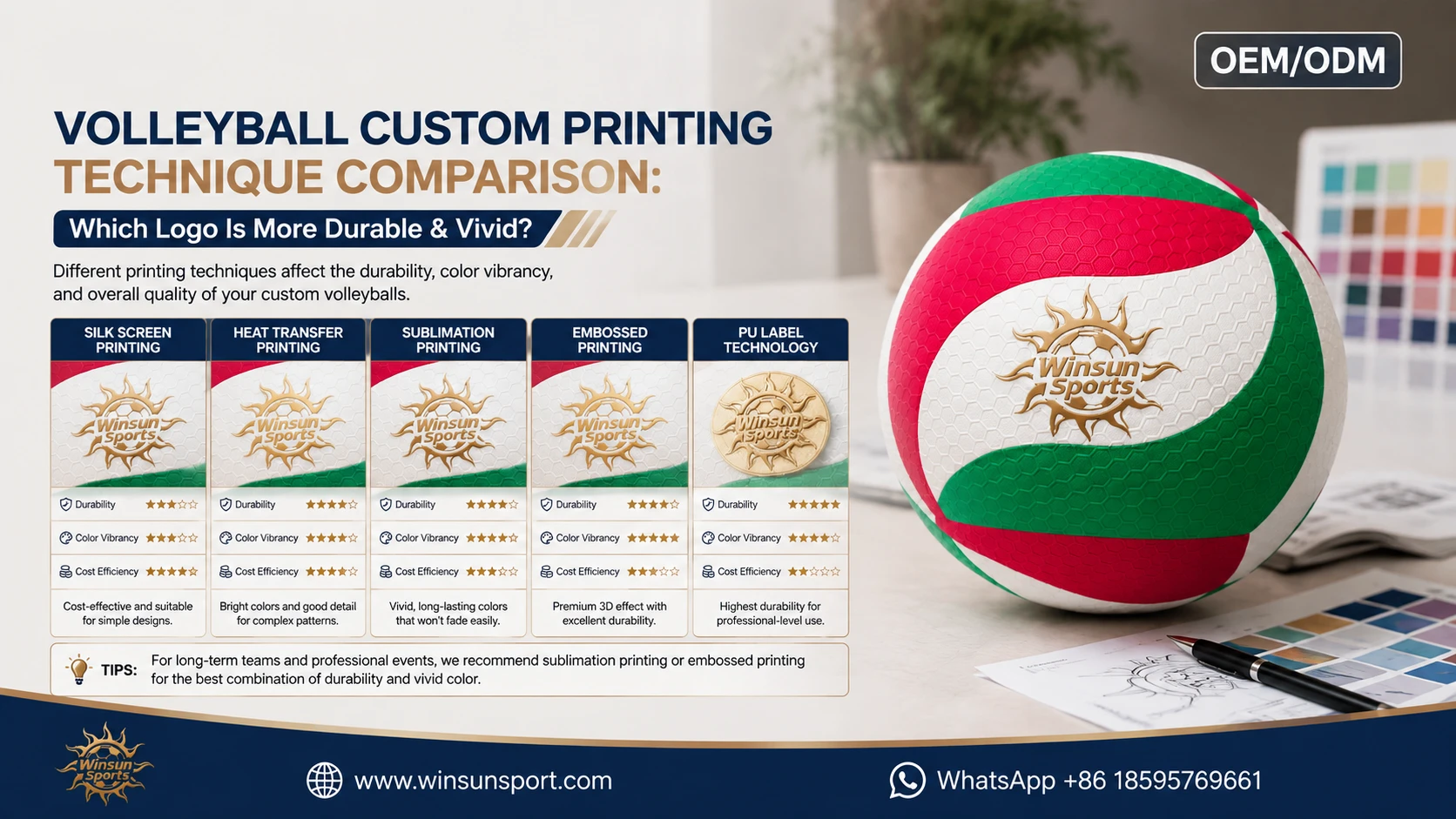
How do the three mainstream printing processes for custom volleyball logos work?
When choosing a custom volleyball, the durability and feel of the logo often affect the user experience more than the pattern itself. Even when printing the same team emblem, the results from different processes can vary greatly. Below, we break down how the three mainstream processes work and why they lead to different feels.
Heat Transfer: Suitable for small batches and multi-color patterns, but with noticeable edges
The principle of heat transfer is to first print the pattern on release paper with special ink, then use high temperature and pressure to "press" the pattern onto the surface of the ball. You can think of it as a process of "sticking it on and then heat-sealing it."
The advantage of this process lies inThe pattern precision is high and the color transitions are natural, making it especially suitable for complex designs with gradients, multiple colors, and fine lines. Moreover, the plate-making cost is low; the unit price difference between making one or two balls and making dozens is not significant, so small-batch customization is very cost-effective.
However, its shortcoming also comes from the "sticking" action—the transfer layer is attached on top of the ball surface, so you can feel an obvious boundary, like a slightly thick film. After long-term use or frequent friction with the ground, the edges may start to lift. If the team often plays on outdoor concrete courts, the durability of this process is questionable.
Screen printing: high color saturation, but limited detail reproduction
Screen printing is a more traditional process: the pattern is cut out on a mesh screen, and a squeegee is used to scrape the ink directly onto the ball surface. The ink penetrates into the microporous structure of the PU leather, sothe color is "eaten" into the material, resulting in high color saturation and no film-like feel of heat transfer, making the hand feel closer to the original ball leather.
The trade-off is limited detail expression. Screen printing is suitable for large color blocks and bold lines. If the logo has very small text or dense thin lines, the print may become blurry. In addition, screen printing requires plate making, and the plate fee is calculated based on the number of colors. The more colors, the higher the cost, so it is more suitable for batch orders with simple patterns and fewer colors.
Seamless high-temperature heat bonding: strongest durability, but limited pattern complexity
Seamless high-temperature heat bonding is a more advanced solution in current volleyball customization. It does not "print" the pattern on the surface of the ball cover, butrather makes the pattern into a thin film, which is fused with the ball cover under high temperature and high pressure, forming an integrated structure. Because there is no adhesive layer between the pattern layer and the ball cover, and no stitching seams, its durability is the highest among the three processes, and it is not easy to peel off even with repeated hitting and bending.
In terms of feel, the heat-bonded layer is thinner and more conforming than heat transfer, but you can still feel a slight outline of the pattern. Its main limitation is thatthe pattern design cannot be too complex—gradients, fine lines, and small text are difficult to achieve, making it more suitable for team logos, school names, or simple graphics with distinct color blocks. Meanwhile, the minimum order quantity and unit price for the heat-press patch process are usually higher than those of the previous two.
How to choose among the three processes?
| Process | Suitable Scenarios | Main Drawbacks |
| Heat Transfer | Small batches, multi-color, gradient patterns | Obvious borders, edges may lift |
| Silk screen printing | Large color blocks, simple patterns, bulk orders | Limited detail, high cost for multiple colors |
| Seamless high-temperature heat bonding | Long-term training, frequent use, seeking durability | Limited pattern complexity, higher cost |
If your customized volleyball is mainly for indoor training and matches, and the logo is a simple team emblem or school name, seamless high-temperature heat bonding is a more durable choice;If the pattern is complex, with many gradients, and the quantity is small, heat transfer is more practical;If the budget is limited, the pattern is simple, and the batch size is large, screen printing offers the best cost-effectiveness.
It should be noted that the material and surface texture of the ball cover also affect the adhesion of the process. This Winsunsport volleyball features micro-porous anti-slip PU soft leather and a streamlined surface texture. Different processes may perform differently on textured surfaces—for specific recommendations on which process suits your design, it is advisable to provide the design draft directly to the Winsunsport team, who will offer a matching solution based on pattern complexity, number of colors, and expected quantity.
Why does the seamless high-temperature heat bonding process make logos more durable and colors more vibrant?
What often troubles people most about custom volleyballs is not the pattern design, but how long the printed logo will last and whether the colors will fade after a few games. Currently, the three common processes on the market—screen printing, traditional sewn labels, and seamless high-temperature heat bonding—show significant differences in durability and color performance.
From a physical structure perspective: no stitching, no edges, avoiding delamination and wear.
The logo from screen printing is an ink layer that 'floats' on the surface of the ball cover. During daily training, friction between the ball surface and the ground or walls gradually wears away the ink layer, especially at the edges of the pattern, which tend to fade first. The traditional sewn label method involves sewing a printed label cloth into the ball's outer skin, where the stitching naturally creates raised areas and gaps. Over long-term use, thread wear and the edges of the label cloth lifting are common issues.
The seamless high-temperature heat-bonding process is completely different. It involves pressing the pattern layer directly into the PU skin under high temperature and pressure, rather than attaching it to the surface. There is no physical boundary between the pattern and the ball's skin, nor are there stress concentration points caused by stitching, so there is no path for edge lifting or thread breakage.
For indoor volleyballs, this structure means the lifespan of the logo is essentially synchronized with the ball's skin itself—only when the skin wears out does the pattern disappear.
From a material compatibility perspective: combined with PU soft leather, color penetration is more thorough.
Color vibrancy depends on two factors: whether the ink/color layer can fully penetrate the substrate, and whether there is an additional surface coating that blocks light reflection. Ink from screen printing stays on the surface, and when light shines on it, part of it is scattered by the ink particles, making the color appear somewhat 'dull'.Sewn labels are limited by the label fabric material, and color saturation is also limited.
The advantage of seamless high-temperature heat bonding is that PU soft leather softens at high temperatures, allowing the color layer to partially penetrate the microporous structure of the surface, forming a fusion layer of 'color layer + surface'. After light enters and reflects through the fusion layer, color saturation and transparency are improved. Additionally, the heat bonding process results in a smooth surface without the protrusions of sewn labels or the graininess of screen printing, providing uniform reflection and making colors appear more 'solid' visually.
However, it is necessary to clarify the applicable boundaries: This process's advantages are based on PU soft leather substrates. If the ball is made of PVC or other hard surfaces, the penetration effect of high-temperature heat bonding will be diminished. Additionally, the heat bonding process is suitable for large color blocks and gradient patterns. If the logo requires extremely fine lines (e.g., strokes less than 1mm), there may be slight bleeding during high-temperature pressing. Such detailed designs need to be confirmed with the customization team in advance.
Next step: confirm the action: If you value long-term training use without logo peeling and high color retention, seamless high-temperature heat transfer is the most reliable choice among the three processes. Before placing an order, provide your logo source files (AI or PDF format) to the Winsunsport team, and specify whether the design contains extremely fine lines or high-density small text, so they can assess the reproduction quality under the heat transfer process.
In different procurement scenarios, which printing process should be prioritized?
When purchasing volleyballs, the choice of printing process is often ranked after material and size, but it precisely determines whether the balls will look like new after three months of use or start to peel and lose their lettering. Different scenarios have very different requirements for durability and color, so let's discuss them separately.
Campus teaching and team training: prioritize durability, recommend seamless high-temperature heat transfer
School bulk purchases and team daily training are the scenarios with the highest volleyball wear and tear. The ball is repeatedly hit, rubbed on the ground, and scraped by net posts, making logo peeling a common complaint. In this scenario, durability should take precedence over color vividness.
Recommended process: seamless high-temperature heat bonding. This process fuses the pattern layer with the PU surface at high temperatures, leaving no stitching gaps and thus no weak points for thread breakage or glue separation. The Winsunsport volleyball uses this high-temperature seamless heat bonding process, combined with micro-porous anti-slip PU soft leather, so the pattern layer does not form obvious protrusions after bonding with the ball surface, and it is not prone to edge lifting even after prolonged use.
Suitable for judging:
- Single purchase quantity of 30 or more, expecting no rework or reprinting within one semester
- The ball will be used on outdoor concrete or rough surfaces (although this is an indoor ball, training scenarios inevitably involve bumps and scrapes)
- It is necessary to print fixed identifiers such as school names and team logos, rather than frequently changing patterns.
Not suitable for judging:
- Extremely tight budget, and the printing cost per ball must be minimized—heat patch technology costs more than ordinary screen printing. If it is only for a one-time temporary event, a cheaper option can be chosen.
- Need to print gradients or photo-level complex patterns—heat patch technology excels at color blocks and text, but its performance on complex patterns is inferior to heat transfer.
Corporate gifts and event souvenirs: considering both color and cost, heat transfer can be considered.
For corporate gift balls and event souvenir balls, the core requirements are "presentable" and "budget control". The frequency of use of such balls is much lower than that of training balls; they may be played only a few times a year, but the patterns must be vibrant and capable of printing corporate logos or event-themed designs.
Recommended process: heat transfer. Heat transfer printing allows the pattern to be printed onto a transfer film first, then pressed onto the spherical surface at high temperature, offering high color fidelity and suitability for multi-color gradients and complex graphics. For gift balls, visual impact matters more than extreme durability.
Budget boundaries: If the single batch purchase quantity is below 50 units, the plate-making cost of heat transfer printing remains manageable after being amortized;If it exceeds 200 units, it is recommended to return to the heat-applied patch process, because at large quantities the unit price advantage of heat-applied patches becomes apparent, and the durability is better, so recipients won't perceive poor quality even after prolonged use.
Suitable for judging:
- The pattern design is complex, with gradients, fine lines, or multi-color overlays.
- The ball is more for display and commemorative purposes, with low frequency of actual use.
- The purchase quantity is moderate (50–200 units), aiming for a balance between color and cost.
Not suitable for judging:
- These balls are for the school team's daily training use—the risk of heat transfer patterns falling off under frequent friction is higher than with heat press.
- The budget is extremely tight, and the printing cost per ball must be kept in single digits—both processes are relatively expensive, so it should be re-evaluated whether customization is necessary.
Key trade-offs at a glance
| Scenario | Recommended process | Primary consideration | Budget sensitivity |
| School bulk purchases / team training | Seamless high-temperature heat bonding | Durability and long-term use | Medium to high, negotiable for large quantities |
| Corporate gifts / event souvenirs | Heat Transfer | Color performance, visual impact | Medium, best for quantities of 50–200 |
| Temporary balls for single events | Standard screen printing (lowest cost) | Single-use | High, custom complex processes are not recommended. |
Next steps to confirm: If you have already determined your procurement scenario, it is recommended to directly explain to the Winsunsport team the frequency of use, expected usage period, and pattern complexity of these balls. They will provide specific process recommendations and quotation boundaries based on your purchase quantity. If you are still hesitating, first answer one question: Are these balls for "daily play" or "occasional use"? The answer will directly point to one of the two processes mentioned above.
Before confirming the process, what key details need to be verified with the supplier?
The printing process of custom volleyballs directly determines the durability and vibrancy of the logo, but these two points are precisely what cannot be judged by looking at product images alone. Before confirming the plan, it is recommended to clarify the following questions one by one.
Sample confirmation: whether color reproduction and edge treatment meet the standards
Why is sampling essential before customization? Because there are two common discrepancies between the design on screen and the actual print on PU soft leather: first, color saturation—dark or fluorescent colors may appear duller on micro-porous PU surfaces;second, edge sharpness—fine lines or small font sizes may show bleeding or jagged edges on spherical curves.
During sampling, focus on three key aspects:
- Logo edges: Use a magnifying glass or phone macro shot to confirm clean, crisp edges without color bleeding.
- Color gradation: Place the sample ball under natural light and indoor lighting to check whether the main color is full and whether the gradient transitions naturally.
- Tactile difference: Whether the printed area is noticeably raised or stiff, which can affect the feel when catching the ball.
If the supplier says "no need for sampling" or "just make it directly according to the drawing," it is recommended to be cautious—the ball surface is curved, and printing difficulty is much higher than on flat surfaces. If mass production is done without sampling, the risk is borne by you.
Material and specification matching: whether PU soft leather is compatible with size 5 standard dimensions
This volleyball is standard size 5 (circumference 65–67cm), with a micro-porous anti-slip PU soft leather surface. The advantage of PU soft leather is that it is soft and provides stable ball control, but it has special requirements for printing processes—ordinary screen printing inks have poor adhesion on PU surfaces and are prone to peeling off during long-term use or in humid environments.
Specific questions to verify with the supplier:
| Verification Item | Why It Matters | Acceptance Criteria |
| Ink Type | PU soft leather requires special flexible ink, otherwise it is prone to cracking. | Confirm the use of PU-specific ink or silicone ink. |
| Curing Method | High-temperature curing provides stronger adhesion than natural air drying. | Confirm whether high-temperature curing treatment has been applied. |
| Print layer thickness | If too thick, it affects the feel; if too thin, it is prone to wear. | Confirm whether the print layer is flush with the surface or slightly recessed. |
| Abrasion resistance test | Volleyballs frequently contact the ground and rub against the net. | Ask whether there are abrasion resistance test results or a warranty period. |
Additionally, the standard size of a size 5 ball means the printing area is curved rather than flat.Customization across the entire spherical surfaceandsmall localized logos involve completely different levels of process difficulty. If your design covers most of the spherical surface, be sure to confirm that the supplier has experience with curved-surface printing, and request actual photos (not renderings) of similar products.
Next step: confirm the actionSend your design to the supplier and ask for photos or videos of past samples made with the same material and process;if possible, directly request a sample ball and perform a few bounce tests on a hard indoor floor to check whether the printed area shows any cracks or signs of peeling.
Frequently Asked Questions
Which logo customization process is the most durable for volleyballs?
The seamless high-temperature heat bonding process offers the highest durability because the pattern layer is fused with the PU surface through high temperature and pressure, eliminating stitching gaps and edge lifting issues.If the volleyball is used for long-term training or frequent use, heat bonding is a more reliable choice.
What is the difference between heat transfer and screen printing?
Heat transfer is suitable for small batches and multi-color gradient patterns, offering high precision but with a film-like feel on the edges.Screen printing provides high color saturation and a feel close to the original ball surface, but it has limited detail and higher costs for multiple colors.In short, choose heat transfer for complex patterns and screen printing for simple large color blocks.
What files need to be prepared before customizing volleyballs?
It is recommended to provide the logo source file in AI or PDF format, and specify whether the pattern contains extremely fine lines or high-density small text, so that the supplier can evaluate the process fidelity.At the same time, confirm the ball surface material (such as PU soft leather) and printing process, and it is best to make a sample to confirm the effect first.
Learn more
If you are customizing volleyballs for a team, school, or event, feel free to contact the Winsunsport team.Provide your design and usage scenario, and we will recommend the most suitable printing process and solution based on pattern complexity, order quantity, and budget.
Related products:Red, blue, and silver striped No. 5 professional indoor volleyball, customizable logo