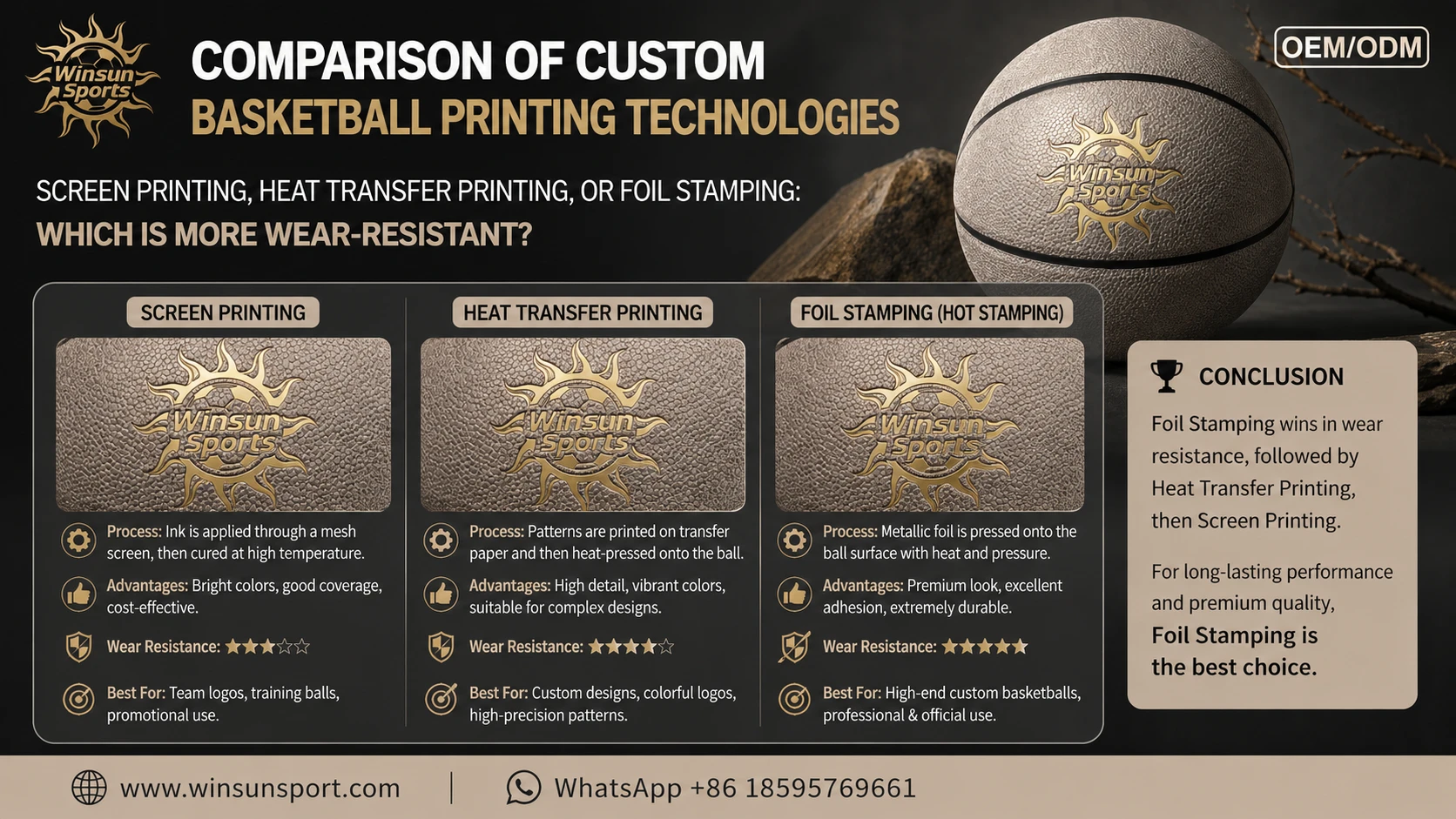
What are the printing processes for custom basketballs?How do screen printing, heat transfer, and hot stamping work respectively?
The pattern on a custom basketball is not simply "printed" on—the basketball surface is curved, and it must withstand bouncing, friction, and sweat, so the process choice directly determines how long the pattern lasts. Currently, there are three mainstream printing methods for custom basketballs: screen printing, heat transfer, and hot stamping.
Working principles and basic processes of the three techniques
Screen printing (silk screen printing) It is the most traditional process. Its principle is: make the pattern into a silk screen plate with mesh holes, where the pattern areas have open mesh and non-pattern areas are blocked. During printing, ink is poured onto the screen, and a squeegee is used to scrape the ink through the mesh openings, allowing the ink to pass through and adhere to the basketball surface.
Each color requires a separate screen, so multi-color patterns must be printed in multiple passes with registration. The process is: plate making → color mixing → registration → squeegee printing → drying and curing.
Heat Transfer Printing This involves first printing the pattern onto transfer paper using special ink, then placing the transfer paper against the basketball surface and applying heat and pressure to cause the ink to release from the paper and penetrate into the basketball's outer skin. After cooling, the paper backing is peeled away, leaving the pattern on the ball's surface. The process is: digital printing of transfer paper → cutting → fitting to the ball surface → heat pressing → peeling the paper → inspection.
Hot Stamping (Gold/Silver Foiling) Similar to heat transfer printing, but instead of ink, it uses an extremely thin layer of metal foil film. A heated stamping plate presses the metallic layer of the foil onto the basketball surface, creating a pattern with a metallic luster. The process is: create the stamping plate → fix the foil film → heat and press → peel off excess foil.
From the factory's perspective, how process selection affects basketball quality
The impact of these three processes on basketball quality is mainly reflected in three dimensions:
There are obvious differences in abrasion resistance. Screen printing ink is "covered" on the surface of the ball. If the basketball surface is made of PU or rubber with poor ink absorption, the ink is prone to cracking or peeling off in large pieces after prolonged dribbling. The ink in heat transfer printing partially penetrates the surface layer during the heat pressing process, and its adhesion is usually better than screen printing, but the penetration depth is limited.
The hot-stamped metallic foil layer is the thinnest and has the weakest abrasion resistance. It is mainly suitable for small-area accents, such as logos or text, and is not suitable for large-area patterns.
The feel changes differently. The screen-printed ink layer has a certain thickness. Large-area printing will make the local surface of the ball harder and smoother, affecting the feel when dribbling. The ink layer of heat transfer printing is relatively thin and has less impact on the ball surface's touch.
The hot-stamped foil film is extremely thin, and the feel barely changes. However, the metallic luster will reflect light under strong light, which may cause visual interference during competitive matches.
Color performance and complexity limits. Screen printing is suitable for simple patterns with clear color blocks. The colors are vivid and the coverage is strong, but gradients and photo-level patterns cannot be achieved. Heat transfer printing uses digital printing, so theoretically any color, gradient, or photo can be reproduced, offering the strongest detail expression.
Hot stamping is only available in metallic colors, typically gold, silver, red gold, etc., and is suitable for small-area markings that require a high-end feel.
A quick way to decide: If you need large areas, multiple colors, or fine patterns, heat transfer is the first choice;If it's a simple color block logo and the budget is limited, screen printing is sufficient;If you're after a metallic texture for small-area accents, hot stamping is the most suitable. In the next section, we will specifically compare the abrasion resistance test performance and applicable scenarios of these three processes.
Screen printing, heat transfer, or hot stamping: which is more abrasion-resistant?Examining the differences from three dimensions
When choosing custom basketball craftsmanship, abrasion resistance is often the first thing asked about, but what truly influences your decision is more than just abrasion resistance. Below, we break it down from three dimensions to help you directly find your match.
Abrasion Resistance Comparison: Which Lasts Longer in High-Frequency Use?
Screen printingThe ink layer directly penetrates the basketball's surface fibers, forming a bond with the ball surface. On indoor wooden floors or plastic courts, the lifespan of screen-printed patterns typically covers the basketball's normal wear cycle; even as the surface begins to wear, the pattern remains faintly visible. Its shortcoming is that if used long-term on concrete or rough outdoor courts, the surface wears out before the pattern, causing the pattern to peel off along with the surface.
Heat Transfer PrintingThe pattern layer is 'attached' to the ball surface, with an adhesive film in between. Its abrasion resistance depends on the film thickness and the surface material of the basketball—it performs well on PU leather basketballs, but on rubber balls with strong moisture absorption, the bonding between the film and the ball surface is compromised, and the edges are prone to lifting after frequent dribbling and friction.
Hot stamping(foil stamping/silver stamping) essentially involves transferring metal foil to the ball surface under high temperature and pressure. It is highly decorative, but the foil is extremely thin, making it the weakest of the three in terms of abrasion resistance. It is suitable for gifts, commemorative balls, or display purposes, and is not suitable as the main pattern process for training or game balls.
Key points to consider: If you are buying this ball for daily student training or school team competitions, screen printing is one of the key choices that can withstand high-frequency use;heat transfer printing is suitable for casual indoor games;hot stamping should be directly excluded from any "durability" requirements.
Clarity and pattern expressiveness: which one to choose for complex designs?
Screen printingThe limitation of screen printing lies in the number of colors—each additional color requires an additional printing process, and the registration accuracy requirements are high. If your design is a single-color logo or a team name in two to three colors, screen printing is sufficient and produces sharp, crisp results.However, if it involves gradients, portrait photos, or complex patterns with more than four colors, the rendering effect of screen printing will be noticeably compromised.
Heat Transfer PrintingHeat transfer printing has the strongest pattern expressiveness. It first prints the entire pattern onto transfer paper, then transfers it as a whole onto the spherical surface, so gradients, fine lines, small text, and photo-quality patterns can all be reproduced. For designs with many details, such as school logos or mascots of training institutions, heat transfer printing is a more reliable choice.
Hot stampingIt is suitable for large color blocks, text, or geometric shapes, but not for fine lines—the foil tends to bleed at the edges under high temperature, causing fine lines to blur.
Key points to consider: If the pattern has ≤3 colors and is mainly text and color blocks, choose screen printing;If the pattern is complex, has gradients, or details, choose heat transfer printing;Hot stamping is only for decorative accents, such as small-area logos or commemorative text.
How to choose with a limited budget?
The cost from low to high is roughly:Screen printing < Heat Transfer Printing < Hot stamping。 The plate-making cost for screen printing is a one-time investment; the larger the quantity, the lower the cost per ball, making it suitable for bulk purchases;Heat transfer requires no plate-making, but the processing cost per ball is slightly higher; for small batches (e.g., dozens of balls), it is more cost-effective than screen printing;Hot stamping has the highest unit price due to material and process reasons.
Direct recommendations for you:
- Training balls, bulk purchases, simple patterns → Screen printing, balancing durability and cost
- Gift balls, complex patterns, small quantities → Heat transfer, prioritizing expressiveness
- Commemorative displays, small-area decorations → Hot stamping, but don't expect it to be durable
If you are unsure which category your design falls into, or want to confirm the wear resistance of a specific process on your ball, simply send your intended playing surface, frequency, and design file to the Winsunsport team. They will provide a matching solution based on the basketball material and design complexity, preventing premature pattern failure from choosing the wrong process.
How to choose for different usage scenarios?Games, training, and gifts each have their own priorities
Even for custom basketballs, the requirements for printing processes differ completely across games, training, and gifts. Choosing the wrong process can lead to poor feel during games, patterns fading after a few months of training, or gifts that are not presentable. Let's break it down by scenario below.
Game balls: durability and feel are equally important; heat transfer or foil stamping is recommended
The core challenge for game balls is that the pattern must withstand high-intensity play, yet the printing must not affect the feel when dribbling and shooting.
Heat Transfer PrintingThe pattern is first printed on a film, then transferred to the spherical surface through high temperature and high pressure. Its advantages are clear pattern edges, high color reproduction, and a very thin print layer that barely alters the original granular feel of the ball surface. Hot stampingThis involves pressing metallic patterns onto the surface using hot gold or hot silver stamping, offering equally excellent abrasion resistance and a more premium visual appeal.
The pattern layer of these two processes bonds tightly with the ball surface, and with normal use on indoor wooden floors or plastic courts, its lifespan can cover a full season. If you mostly play on outdoor concrete courts, we recommend confirming the abrasion resistance rating of the ball surface material with the Winsunsport team—no matter how durable the print is, if the ball itself wears down too quickly, it will also affect the integrity of the pattern.
Suitable for: official matches, school team competitions, and amateur leagues with fixed schedules. Not suitable for: For temporary event balls with extremely low budgets that will only be used for a few games before being replaced.
Training balls: Cost-effectiveness comes first, and screen printing is a reliable choice
Training balls suffer high wear and tear and are used in large quantities, so the core requirements are "clear patterns, controlled costs, and no heartache when they get damaged."
Screen printingThis involves directly scraping ink through a screen mesh onto the ball surface. The process is mature, the minimum order threshold is low, and the per-ball cost is significantly lower than heat transfer printing and hot stamping. Its pattern layer is relatively thicker, and after prolonged bouncing, slight wear may appear at the edges, but it is more than sufficient for training scenarios—training balls are not meant for collecting anyway.
Suitable for: For bulk school purchases, daily teaching at training institutions, and balls used for team summer and winter training. Not suitable for: For scenarios requiring long-term preservation and extremely high pattern precision.
Gift basketballs: Texture takes priority, and the process is just one part of it
Gift balls need to be "presentable". The metallic gold and silver texture from hot stamping naturally carries a gift attribute, while heat transfer can accommodate more complex designs—such as gradient logos, portrait illustrations, or commemorative text.
But what truly determines the texture in gift scenarios is the combination of the ball surface material and the printing. The same hot stamping process shows a noticeable difference in appearance and feel when applied to a PU surface versus a moisture-absorbing microfiber surface. If you want to customize business gifts or limited-edition commemorative balls, it is recommended to first request samples of different material and process combinations from the Winsunsport team, and touch them yourself before finalizing the plan.
Suitable for: Corporate business gifts, event commemorative balls, graduation keepsakes, and brand co-branded editions. Not suitable for: Scenarios where the budget only covers the lowest configuration but expectations are for high-end quality—better to increase the budget or reduce the customization quantity.
Summary in one sentence
| Scenario | Recommended Process | Key Trade-offs |
| Competition | Heat Transfer / Hot Stamping | Prioritize durability and feel, accept higher unit price |
| Training | Screen printing | Prioritize cost, accept slightly shorter pattern lifespan |
| Gift | Hot stamping / heat transfer printing | Texture priority, requires high-end spherical surface material |
The next step is clear: tell the Winsunsport team about your usage scenario, field type, and budget range, and let them provide corresponding process and material combination suggestions. If you haven't yet decided whether it's mainly for competition or training, don't rush to finalize the process—the same ball can hardly meet the extreme demands of both scenarios simultaneously.
Selection advice: when to choose screen printing, and when to choose heat transfer or hot stamping?
Before choosing a process, first clarify one question: is this ball for playing or for display? This answer directly determines how much you should spend and which process to choose.
Recommended scenarios for screen printing: limited budget, simple designs, large quantities
Screen printing essentially involves "scraping ink directly onto the ball's surface," and it suits the following three scenarios:
- Designs that are primarily single-color or two to three colors: For example, a team name, a school emblem, or a slogan.Screen printing adequately handles color blocks and text, so there's no need to spend extra on simple designs.
- Tight budget constraints: Screen printing is the lowest-cost among the three processes, especially when order quantities increase, the per-ball cost advantage becomes very significant.
- Large batches with uniform designsFor example, when a school purchases a batch of training balls for physical education classes, or a company gives welfare balls to employees, screen printing is the most efficient when printing the same pattern on dozens or even hundreds of balls.
But note: the screen-printed pattern is "attached" to the surface of the ball cover. If the ball is frequently used on concrete or asphalt courts, or exposed to prolonged sunlight, the edges of the pattern are prone to wear and peeling first. If your balls are mainly used on indoor wooden floors, the durability of screen printing is more than sufficient.
Recommended for heat transfer or hot stamping: complex patterns, high-frequency use, and pursuit of texture.
The patterns of heat transfer and hot stamping are "fused into" the surface layer of the ball cover, rather than floating on the surface, so their common advantages are:Finer patterns, smoother feel, and better wear resistance. Suitable for the following scenarios:
- Patterns with gradients, shadows, portraits, or multiple color overlays: Screen printing cannot achieve complex color transitions, but heat transfer can.If you want player portraits, cool flame patterns, or multi-color gradients, screen printing is out of the question.
- High frequency of use and average playing conditions: For example, outdoor courts or daily training balls, where friction with the ground and fingers is more intense, heat transfer patterns last significantly longer than screen printing.
- Pursuing feel and texture: Heat-pressed patterns are almost flat to the touch, without the obvious raised feel of screen printing, so fingers won't feel any 'bumpiness' when dribbling over the pattern area.For gift balls or limited edition collectible balls, heat transfer is recommended.
A more direct way to judge: If you get the ball and will place it on a display stand rather than throw it onto the court, choose hot stamping;if it will be bounced thousands of times, choose heat transfer printing;if it's just printing a name and handing it to people, screen printing is enough.
What questions do you need to confirm with the factory?
Regardless of which process you prefer, confirm at least the following four things before placing an order:
- What is the ball's surface material? The adhesion and wear resistance of the same process vary greatly across different materials (PU, PVC, rubber).Screen printing on rubber balls has a higher risk of peeling than on PU balls.
- What are the number of colors and the size of the pattern? Is the source file sent to the factory a vector graphic or a bitmap?The more colors there are, the lower the feasibility of screen printing and the higher the price.
- Are there any samples available for testing? Have the factory make a sample ball first, and actually hit it for a few days to see the wear on the pattern; that is more reliable than looking at any parameters.
- What is the minimum order quantity? The minimum order quantity for screen printing is usually lower than for heat transfer. If your quantity is very small (for example, less than 10), the factory may only be willing to do heat transfer or hot stamping, because the cost of making the screen printing plate cannot be amortized.
The final conclusion boundary: If your design is simple, your budget is limited, and the primary use is indoor, screen printing is the most cost-effective choice;if your design is complex, the ball will be used frequently, or it will be given as a gift, heat transfer and hot stamping are more worth the investment. If you haven't even finalized the final design yet, don't rush to decide on the process—the process choice must be confirmed only after the design is created, otherwise you might waste money.
Frequently Asked Questions
Q: Can a screen-printed basketball be used on outdoor concrete courts? It can be used, but the pattern will wear out much faster than indoors. If you mainly play outdoors, it's recommended to choose heat transfer directly, or accept the fact that the pattern's lifespan will be shortened.
Q: What is the difference between heat transfer and hot stamping? Heat transfer involves printing the design onto a transfer film and then pressing it onto the ball surface, which is suitable for multi-color and complex patterns;Hot stamping emphasizes the texture of "pressing", making the pattern thinner and flatter, with a feel closer to the ball's surface itself. As for which one suits your pattern, you need to send the design to the factory for evaluation.
Q: Will the pattern on custom basketballs fade? Any process will fade to some extent under prolonged sun exposure or repeated friction, but screen printing usually fades and peels faster than heat transfer. If the ball is used indoors, the difference is not significant;If used outdoors, heat transfer is more reliable.
Q: If I only print a name, which process is the most cost-effective? If you only print one name and the quantity is small, screen printing may actually be more expensive due to the plate-making fee. In this case, ask the factory directly: is there a more economical solution for small batches with a single color? Some factories will suggest hot stamping or simple transfer printing.
Q: What processes does Winsunsport support for this custom basketball? This basketball supports custom printing, but to determine whether screen printing or heat transfer is suitable for your design, you need to share your design file and intended usage scenario with our team, so we can provide a matching process solution and quotation.
Learn More
If you are still hesitating about which process to choose, or want to confirm how your design will look on the specific material, send your design file and usage scenario directly to the Winsunsport team. We will help you match the most suitable process solution based on the basketball material, design complexity, and budget.
Related Products:Personalized Custom Basketball