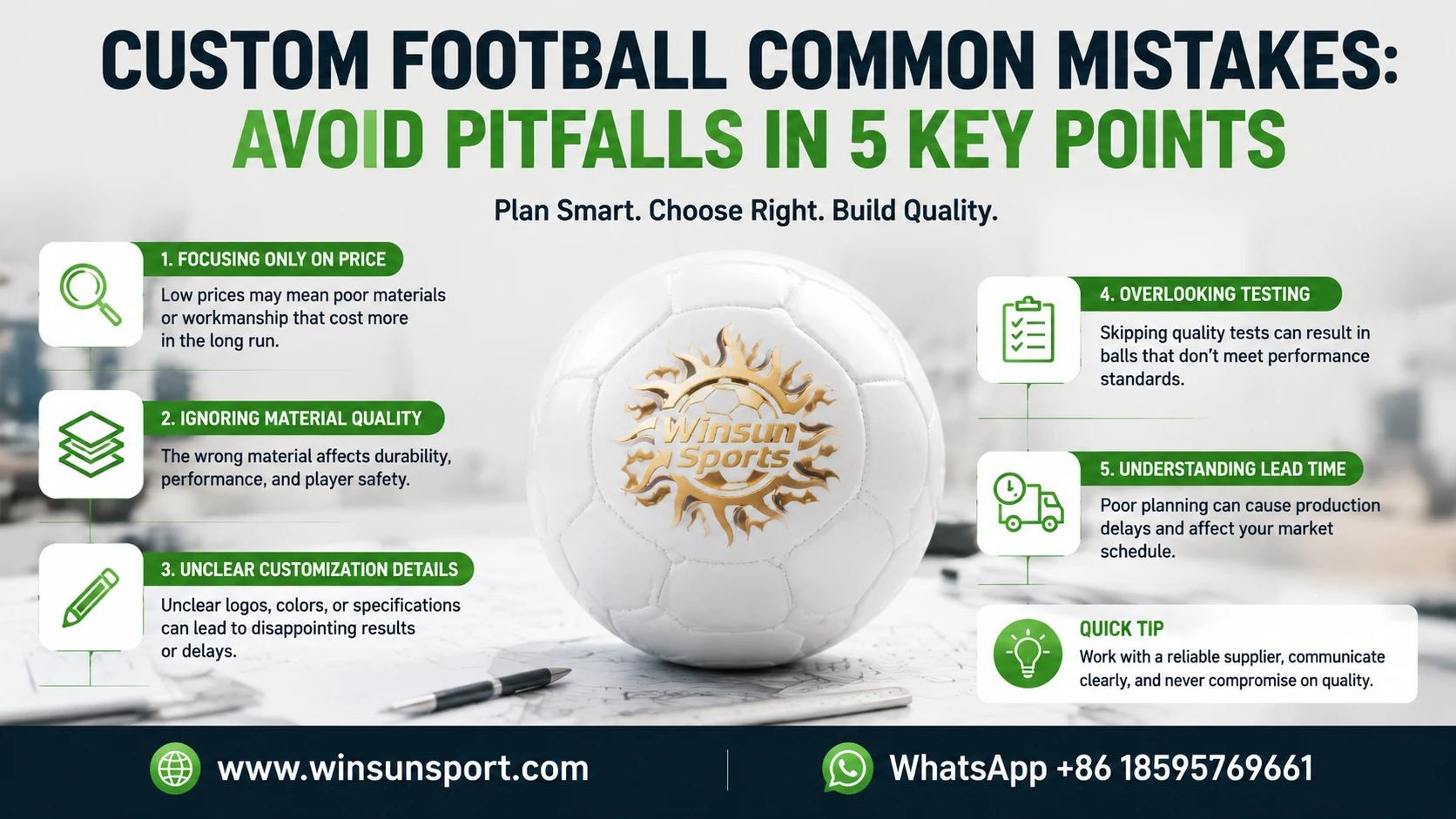
Myth 1: Only focusing on appearance design, ignoring the bladder type and leather thickness
When choosing a custom football, the team badge, color scheme, and printing often catch the eye first, which is normal. But if a ball bulges or deforms after three months of play, it's useless no matter how good it looks. What determines the lifespan and feel of a football is precisely the invisible bladder and leather.
Why does the bladder type determine the durability of a football more than the printing?
The bladder is the "heart" of the football, responsible for air retention and rebound. When customizing, you usually have three options:
- PVC bladder: The lowest price, with average air retention, and it tends to harden and lose elasticity at low temperatures.Suitable for low-frequency use, indoor or soft surfaces, such as for children's beginner play or as gifts.If used frequently on outdoor hard surfaces, it will be the first component to fail.
- Rubber bladder: Wrapped with a rubber layer over the wound yarn, it offers better air retention and rebound than PVC bladders, with significantly improved durability.This is a common configuration for training balls, suitable for daily use in school physical education classes or amateur clubs on artificial turf or hard courts.
- Wound bladder: Provides a more stable ball structure and consistent rebound through a high-strength wound yarn layer, with the best air retention and durability, and a more solid feel.Suitable for professional matches, high-intensity training, and buyers who want a ball that lasts a long time.
The judging criteria are simple:The higher the frequency of use, the harder the playing surface, and the stricter the requirements for touch, the more you should choose a butyl bladder or rubber-wound bladder instead of a PVC bladder. If your budget only allows you to choose between "nice printing + PVC bladder" and "plain surface + rubber-wound bladder," the latter is almost always more cost-effective in terms of durability.
How does leather thickness affect touch and abrasion resistance?
The leather is the "skin" of the football, directly determining abrasion resistance and ball touch. During customization, leather thickness can be selected, but many buyers do not know the relationship between thickness and performance:
- Thin leather (approximately below 1.0mm): The touch is more direct and softer, making it suitable for players who prioritize ball control.However, its durability is weaker, and it is prone to pilling and cracking on rough artificial turf or concrete surfaces.It is suitable for indoor use, natural grass, or low-intensity play.
- Thick leather (approximately 1.2mm or more): Durability is significantly enhanced, resisting friction and impact on hard surfaces, but the feel is stiffer and the rebound response is more "muffled."It is suitable for outdoor hard courts, artificial turf, high-frequency training, and bulk school purchases.
The key trade-off is: do you want it to "feel good to play with" or "last long"? It is hard to have both—thick leather is durable but stiff, while thin leather is soft but not very durable. If you train on artificial turf or hard ground, prioritize thick leather material;if you pursue touch feedback during matches, choose thin leather material and accept a shorter lifespan.
How to choose on the Durable Pro Football for Field?
This product supports customization in both the bladder and leather thickness, meaning you can configure combinations based on actual usage scenarios rather than passively accepting fixed specifications. It is recommended to confirm based on the following approach:
- School physical education classes or youth training: choose rubber thread bladder + thick leather material, which is wear-resistant and durable, and can withstand rough play from students without easily breaking.
- Amateur clubs training on artificial turf/hard ground: Choose a rubber bladder or a bladder with thicker leather to balance durability and feel.
- Professional competition: Choose a bladder with moderately thick leather for better rebound consistency and touch.
- Gifts or collectibles: Appearance can be prioritized; a PVC bladder with custom printing is sufficient, so you don't need to spend extra on durability you won't use.
Next step: confirm action: When contacting the Winsunsport team, directly ask about three things—what type of playing surface you plan to use, how often you play per week, and whether you value durability or feel more. Provide these three answers, and they can match you with the specific bladder and leather thickness combination. If you are not sure about the venue and frequency, don't rush to place an order. Think it through before you decide.
Misconception 2: Believing all footballs are the same and customization is unnecessary
Buying a football as just "a ball" is the most common mistake in procurement. In reality, a ball used in school physical education classes and one used by amateur clubs for training on artificial turf have completely different requirements for the wear layer, bladder structure, and leather thickness. If you choose the wrong one, it's not that the ball isn't durable, but that it wasn't designed for your playing surface in the first place.
How do the requirements for footballs differ across various usage scenarios?
School physical education classesThe core requirements are safety, durability, and cost control. Students' footwork varies greatly, and the ball is often stepped on, kicked against hard objects, or even sat on, so the leather thickness must be sufficient and the airtightness must be good to avoid frequent inflation. Size and weight need to be matched by age group—elementary school students use a size 3 or 4 ball, while middle school students and above use a size 5 ball, which directly affects confidence in ball control.
Artificial turf and hard court trainingare the most severe wear scenarios. The friction of artificial turf particles and hard surfaces against the ball cover is much greater than that of natural grass, and ordinary match balls may start peeling within a few weeks here. These scenarios require thicker, more wear-resistant leather and a sturdier lining structure, rather than pursuing an extremely soft touch—on hard surfaces, overly soft balls tend to deform easily.
Professional competitionConversely, priority is given to consistency of bounce, stability of flight trajectory, and feel feedback. Match balls have much higher requirements for airtightness and roundness than training balls, because any deviation can affect players' judgment.
Brand owner OEMhave different demands: besides performance, they also consider logo printing processes, color schemes, and batch supply stability. At this point, "customization" is not a performance option but part of brand presentation.
Which scenarios are suitable for customization, and which scenarios can use standard balls?
| Scenario | Recommendation | Reason |
| Bulk procurement for school physical education classes | Custom size + standard wear-resistant version | Size must match the age group, but top-level match performance is not required |
| Training on artificial turf/hard courts | Custom thickened leather + rubber thread core | The thickness of the wear-resistant layer directly determines the service life |
| Professional competition | Custom elasticity and feel that meet competition standards | Performance indicators take priority, appearance comes second |
| Brand owner OEM | Full-dimensional customization (logo, color scheme, craftsmanship) | Balancing brand recognition and performance |
| Daily leisure and entertainment | Standard ball is sufficient | Low frequency of use, and the return on custom investment is not obvious |
How to choose a football for school physical education classes?
First determine the age group of the users, then choose the size and weight. For primary school, a size 3 ball is recommended (light weight, friendly touch); for middle school and above, use a size 5 standard ball. Do not choose the thinnest leather thickness - students vary greatly in kicking strength, and thin leather balls are prone to bulging on hard ground.
As for the bladder, a rubber-wound bladder is more pressure-resistant than a regular PVC bladder, making it suitable for high-frequency use.
How to solve the problem of rapid wear of footballs when training on artificial turf and hard ground?
The problem is not the ball itself, but whether the leather thickness and bladder structure match the playing surface. Artificial turf and hard ground have high friction coefficients, so it is necessary to choose thickened, wear-resistant leather, and use a wound or rubber-wound bladder to enhance resistance to deformation. If you find that your current training ball wears out quickly on hard ground, the next step is to confirm: what is the leather thickness of the current ball and what type of bladder does it have—these two parameters determine whether it is suitable for your playing surface.
Winsunsport's Durable Pro Football for Field supports customization of these two aspects based on field conditions. You can provide your team's field type and training frequency, and they will offer a matching combination of leather and bladder.
Misconception 3: Ignoring the long-term impact of air retention on the user experience.
Many people focus on leather, elasticity, and wear resistance when choosing a football, but rarely ask before purchasing: How long can this ball hold air without leaking? Air tightness is precisely the invisible indicator that determines whether a ball feels good in use.
What specific problems can poor air tightness cause?
The most direct consequence of poor air tightness is that it interrupts the training rhythm. When practicing dribbling, passing, or shooting, you have to stop every ten or twenty minutes to add air. Before a set of movements is even solidified, the rhythm is already disrupted. For teenagers who are forming technical movements, this interruption has a more obvious impact—motor memory requires continuous repetition, and frequent interruptions greatly reduce the efficiency of muscle memory formation.
A more subtle problem is the consistency of touch feel. From the fully inflated state right after pumping to the slightly softer state two hours later, the ball's touch feedback and rebound height change imperceptibly. During training, you think you are adapting to 'the same ball,' but in reality, the conditions of each touch are different, which distorts the judgment of technical movement stability.
During a match, if you encounter an under-inflated ball, the margin of error in judging shot power and curve will be amplified.
How can you determine whether the airtightness of a custom football is reliable?
The core of airtightness lies in thebladder。 Custom football bladders generally come in three options: PVC, rubber, and wound, with airtightness and rebound performance improving in that order. PVC bladders are low-cost but have relatively average airtightness, suitable for low-frequency recreational use;Rubber bladders have significantly better airtightness, suitable for daily training;Wound bladders enhance structural stability through a layer of wound yarn, offering the best airtightness and consistent touch, suitable for competitive scenarios where feel is required.
The judgment method is simple:First clarify your frequency of use and scenarios, then choose the bladder grade accordingly. If you train more than three times a week, it is recommended to directly choose a rubber bladder or a wound bladder. Don't choose a PVC bladder to save a little budget—the time cost of frequent inflation later will exceed the price difference.
Taking Winsunsport's Durable Pro Football for Field as an example, this product supports bladder customization, allowing you to choose a rubber wound bladder or a PVC bladder based on actual usage intensity. If it is mainly used for high-frequency training in school physical education classes or amateur clubs, it is recommended to choose the rubber wound bladder version;If it is only for leisure, entertainment, or gift purposes, a PVC bladder is sufficient.
Key trade-off: A ball with good air retention has a slightly higher initial investment, but in return, every training session can be conducted under stable conditions, making the feedback of technical movements truly repeatable. If you are unsure which inner bladder to choose based on your usage frequency, you can tell the Winsunsport team about your training intensity and field conditions, and they will provide a matching solution.
Misconception 4: Underestimating the complexity of the customization process and insufficient communication.
Many customers think that customizing a football is just "sending a logo over and waiting to receive the goods." In reality, from requirement confirmation to batch delivery, there are several key stages in between. If any stage lacks proper communication, the final product may deviate from expectations.
What stages does the complete customization process for footballs include?
The complete customization process is usually divided into four stages:
1. Requirement confirmation (the most easily skipped step) It is not just about confirming "what color to use and what logo to print." You need to clarify: who the users are (children or adults), the main playing surface (grass, hard ground, or artificial turf), the expected frequency of use (several times a week or occasional recreation), and the budget range. This information directly determines the leather thickness, bladder type, and craftsmanship choices—for example, balls for children need to be lighter and softer, while hard-ground training requires more abrasion-resistant leather.
2. Sample Confirmation (Worth the Most Time) The factory will produce samples based on your requirements and send them to you for actual touch and kicking tests. At this step, you need to confirm not only the appearance but also weight, bounce, feel, and stitching craftsmanship. If problems are found during the sample stage, the cost of changes is low;If changes are made after mass production, both time and costs will double.
3. Mass Production (Stage Where Communication Density Decreases) After sample confirmation, proceed to mass production. At this stage, what needs to be confirmed are delivery milestones, packaging methods, and quality inspection standards. Many delays occur between "I thought you would remind me" and "I thought no further confirmation was needed."
4. Acceptance and Delivery Upon arrival, conduct spot checks according to the sample standards, not just checking the quantity.
What common problems can insufficient communication lead to?
| Communication Gaps | Actual Consequences |
| The intended playing surface was not specified. | The leather was chosen too thin, and it cracked after just a few games on hard ground. |
| The target user group was not specified. | An adult standard ball was given to elementary school students, resulting in a stiff feel and a higher risk of injury. |
| Only the appearance was checked during sample approval. | After the bulk shipment arrived, it was discovered that the weight and elasticity did not match expectations. |
| Delivery milestones were not confirmed. | The shipment arrived only a week before the event or season, missing the intended usage window. |
| Packaging requirements were not confirmed. | The gift scenario required individual packaging, but the goods were shipped in bulk. |
The common root of these problems is:Treating "customization" as "selecting an existing model + printing a logo".In fact, every parameter of a custom football—leather material, bladder, size, weight, printing process—is a variable. The more variables, the higher the communication cost.
Specific suggestions for you: Before contacting for customization, first list a requirements checklist, including the following six items: target users, field type, frequency of use, target quantity, expected delivery time, and whether individual packaging is needed. With this checklist, communicate with the team, and they can provide you with an accurate plan and quotation. If you have only decided that you want to launch your own branded football, but are still unclear on the six points above, it is recommended to think them through before entering the sampling stage—this will save much more time and money than repeatedly revising samples.
Frequently Asked Questions
Q: Is there a minimum order quantity for custom footballs? Yes, the MOQ depends on the complexity of the process. Simple single-color printing has a lower MOQ, while multi-color, three-dimensional processes, or special leather materials will raise the MOQ threshold.
The specific quantity needs to be confirmed with the team based on your requirements list and budget to find a matching solution.
Q: Will there be differences between samples and mass production? In theory, there should be no differences, provided that all parameters are clearly recorded during sample confirmation, including weight range, leather thickness, and printing position. If you only verbally confirm "it's about right," there will be no reference standard when the bulk production deviates.
Q: How long is the typical customization cycle? It depends on whether sampling is needed, the complexity of the process, and the order quantity. Sampling usually requires extra time. It is recommended to calculate the sampling cycle and the mass production cycle separately, and reserve buffer time in the schedule.
The specific number of days needs to be confirmed with the team based on your delivery requirements.
Q: I only have a logo, no design draft. Can I still get customization? Yes. Just provide the logo source file (AI or PDF format is best), and the team will assist with layout and process suggestions.
If only image formats are available, you need to confirm whether the resolution meets printing requirements; otherwise, the edges will appear blurry when printed.
Q: Are custom soccer balls suitable as gifts or souvenirs? Yes, they are suitable, but you need to additionally confirm the packaging method and printing details. Gift scenarios typically require individual packaging and more refined printing effects, which will affect the unit price and minimum order quantity. It is recommended to clearly state these requirements during the needs confirmation stage.
Learn More
If you are planning soccer ball procurement or customization, feel free to contact the Winsunsport team.Provide your target user group, field type, frequency of use, and budget range, and we will help you match the appropriate bladder, leather material, and craftsmanship combination solution.
Related Products:Durable Pro Football for Field