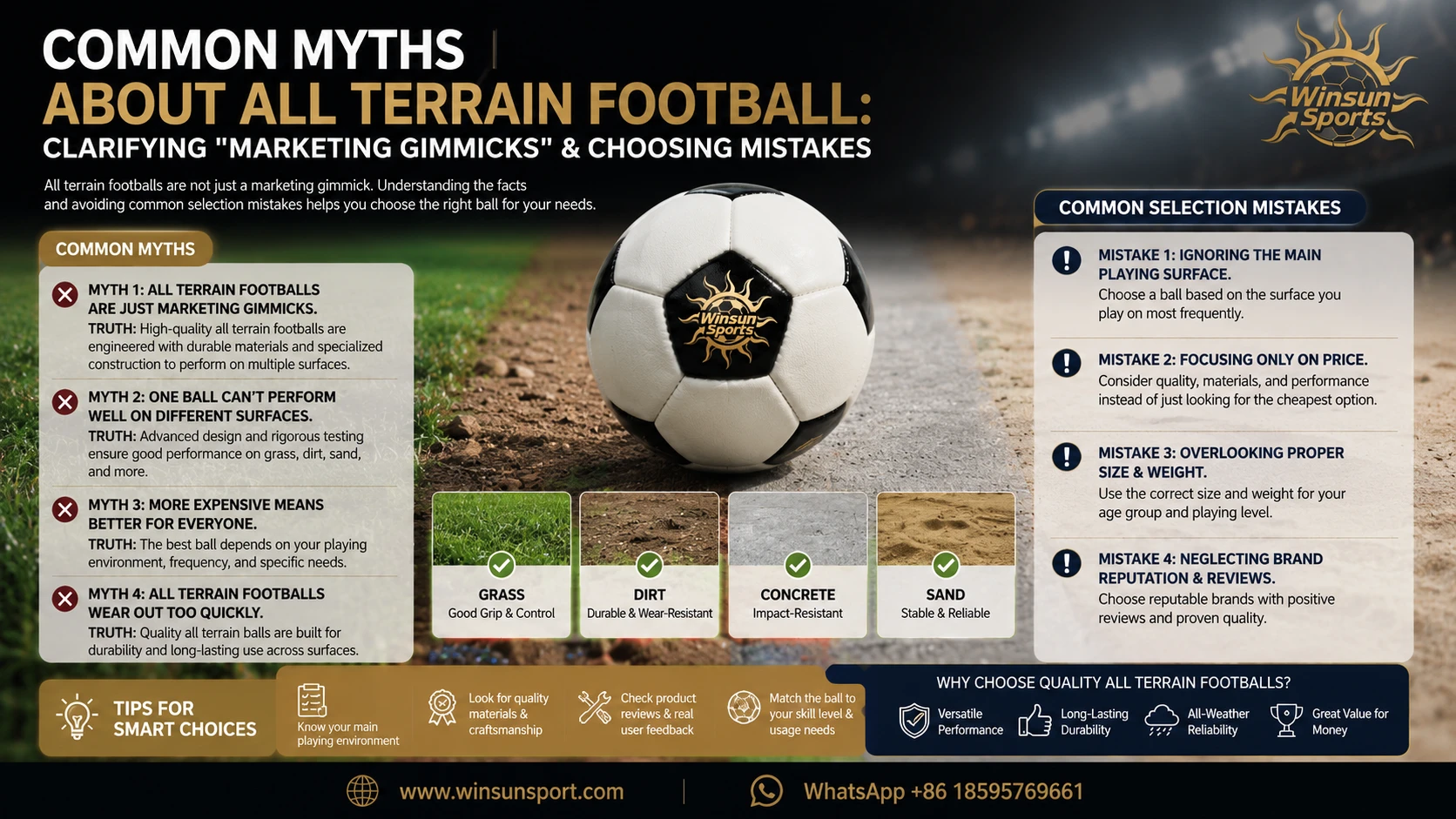
Is all-terrain football a marketing gimmick?First, look at what problems its design solves.
Putting the words "all-terrain" in front of football, the first reaction is that it's an advertising slogan, which is normal. But to judge whether it's a gimmick, don't look at the name, look at what specific problems it actually solves.
Why do ordinary footballs wear out quickly on concrete?
The leather and craftsmanship of ordinary footballs are designed for grass or plastic courts. The surface of concrete and asphalt roads is rough particles. Every touch, roll, and tackle is like rubbing the ball's surface with sandpaper. Ordinary footballs have thinner leather and insufficient wear resistance. After a few games, the surface will become fuzzy, the seams may open, and even the inner bladder may be exposed.
This is not a quality issue, but rather the usage scenario exceeding its design boundaries—like taking running shoes to climb a gravel mountain. It's not the shoes' fault; it's the wrong tool for the job.
How is the abrasion resistance and air tightness of all-terrain footballs achieved?
The core change in all-terrain footballs is making 'adaptation to rough surfaces' a design premise, not an additional selling point. Specifically, it does two things:
First, the leather is thickened and the wear-resistant layer is reinforced. The leather thickness of all-terrain footballs can be customized, being thicker than ordinary footballs, and the surface treatment is more scratch-resistant. This means that when rolling and rubbing on concrete, the wear is absorbed by the leather itself, rather than quickly damaging the bladder.
Second, the bladder structure is reinforced for air tightness. When a regular football's bladder is repeatedly impacted on hard ground, the airtight layer is prone to fatigue, causing air leakage to accelerate. All-terrain footballs offer a variety of bladder options, including thread-wound bladders, rubber thread-wound bladders, and PVC bladders. Among these, rubber thread-wound and thread-wound bladders have structures that better withstand repeated deformation, maintaining stable air pressure after impacts on hard ground.
Airtightness is not just a bonus; it is the prerequisite for maintaining normal elasticity after use on hard ground.
Therefore, 'all-terrain' is not a gimmick; it corresponds to two clear indicators:The thickness of the leather's wear-resistant layerandThe bladder's impact-resistant airtightness。 If you only play on grass, a regular football is perfectly adequate;But if you mainly play on school cement playgrounds, streets, or dirt fields, the reduced replacement frequency of all-terrain soccer balls is where their true value lies.
Next step to confirm: If you mainly play on cement or asphalt surfaces, directly confirm with the Winsunsport team the leather thickness specification and recommended bladder type you need—they will provide a matching solution based on your field conditions and usage frequency.
Misconception 1: Is thicker leather always better?The bladder and craftsmanship are the key to durability limits.
Many people habitually judge a soccer ball by pressing the leather and weighing it, thinking that thicker leather means it can withstand more play. This intuition might hold when choosing shoe soles or tires, but with soccer balls, it's easy to fall into a trap.
Leather thickness can be customized, but why isn't thicker always better?
The leather thickness of this all-terrain football from Winsunsport supports customization, but 'thick' does not mean 'durable', let alone 'good to play with'. Excessively thick leather brings two direct problems:
- Dulled touch: The ball feel feedback becomes worse, and the perception of force during stopping and passing is unclear, which is especially noticeable for students and youth training players who need delicate ball control.
- Weight imbalance: Increased thickness means increased weight, making the flight trajectory more susceptible to wind, leading to greater deviation in long passes and shots.
What truly determines how long a ball lasts isthe way the leather and the bladder work together。 The leather material is responsible for durability and touch, while the inner bladder is responsible for air tightness and rebound. If the inner bladder has poor air tightness, no matter how thick the leather is, it will start leaking after two weeks of kicking. Once the ball softens, it becomes easier to be stepped on and deformed, shortening its lifespan.
Therefore, to judge the upper limit of durability, first look at the inner bladder, then at the craftsmanship.
What are the respective impacts of a thread-wound bladder, a rubber thread-wound bladder, and a PVC bladder?
Winsunsport offers three inner bladder options, which correspond to different usage scenarios and budget trade-offs:
| Inner Bladder Type | Key Features | Best Suited For |
| Wound bladder | Excellent elastic feedback, good air retention, and a feel closer to that of a match ball. | For users who demand a certain touch, suitable for competitive matches and multi-surface training in youth development. |
| Rubber wound bladder | Balances elasticity and durability, offering great value for money. | For daily fitness, school playgrounds, and recreational use. |
| PVC bladder | Lower cost, average air retention, and elasticity degrades more quickly with prolonged use. | Scenarios with low-frequency use, gift or commemorative purposes, decorative ornaments, or budget priority |
The key trade-off is: If you use it frequently on concrete or sandy grounds, you can choose a slightly thicker leather layer to resist wear, but the inner bladder must be a butyl bladder or rubber butyl bladder, otherwise the air retention will not keep up, and the durability ceiling will be dragged down by the bladder. Conversely, if you only kick it occasionally for fun or as a gift, a PVC bladder is sufficient, and there is no need to spend more on performance you won't use.
Next step to confirm: Tell the Winsunsport team your primary playing surface (concrete, grass, or sand), frequency of use (times per week), and user group (children, students, or adults), and let them match the leather thickness and bladder combination based on these three factors. Don't just say 'I want a durable one,' because the optimal solution for 'durability' varies under different ground conditions.
Misconception 2: Are all all-terrain footballs suitable for all age groups?Specification matching is the key
"All-terrain" addresses the issue of field adaptability, not age suitability. Many parents and coaches only focus on selling points like "wear-resistant" and "suitable for concrete courts" when making a purchase, but overlook a more fundamental fact:Players of different ages have completely different requirements for soccer ball specifications, and using the wrong specification is more harmful than using the wrong field.
What are the differences in ball specifications for youth and adults?
The core difference lies inweight and circumference, not appearance.
- Adult standard ball (Size 5): Circumference 68–70 cm, weight 410–450 g.This is the standard specification for international matches and adult amateur games.
- Youth transition ball (Size 4): Circumference 63–66 cm, weight 350–390 g.Suitable for players around 8–12 years old whose bodies are not yet fully developed, with foot strength and control still in the growth stage.
- Children's introductory ball (Size 3): Circumference 56–60 cm, weight 300–320 g.Suitable for children under 8 years old; the ball is smaller and lighter, making it easier to develop touch and basic movement habits.
The actual impact of specification mismatch: If an 8-year-old child directly uses a size 5 ball, the ball is too heavy and too large, and the child can only touch the ball by "pushing," failing to develop correct ankle force application, which over time can easily lead to incorrect kicking posture. Conversely, when an adult trains with a size 3 ball, the tactile feedback is distorted, making it impossible to simulate the passing and shooting force in real matches.
How to choose an all-terrain football based on age group?
All-terrain footballs themselves cover multiple specifications, but what you need to confirm is:Whether the one you choose exactly corresponds to the age group of the user.
| User | Recommended specification | Key points to confirm when choosing |
| Children under 8 years old | Size 3 ball | Whether the ball is light enough for easy ankle power generation |
| Youth aged 8–12 | Size 4 ball | Whether the weight is suitable for daily repeated ball-touching training |
| Ages 12 and above, and adults | Size 5 ball | Whether it meets the specifications for a standard match ball |
Specific recommendations for different purchasing scenarios:
- School or youth training institution procurement: If covering multiple age groups, do not buy only one specification.It is recommended to purchase proportionally based on the age distribution of students, rather than 'uniformly buying size 5 balls'.
- For home use: First clarify the child's current age and the growth space for the next 1–2 years.If the child is in the 8–12 age range, a size 4 ball is a safer choice;If they are close to 12 years old and their height and weight are close to adult levels, you can directly consider a size 5 ball.
- Gift or collection purposes: The size is more symbolic, but you still need to confirm the recipient's actual usage needs to avoid giving a ball that is "nice to look at but unusable."
Key trade-offs: Features of all-terrain footballs such as "wear resistance" and "adaptability to multiple fields" hold true across different sizes, but the size determines whether it suits the user. If you are unsure which size ball to use for a certain age group, or want to confirm which sizes are available for the Winsunsport All Terrain Universal Football for the target age group, simply tell our team the user's age, height, and primary usage scenarios, and we will provide specific size matching recommendations.
Misconception 3: Only looking at the initial price?Long-term replacement cost is the true budget benchmark.
When buying a soccer ball, many people are used to looking at the price tag first. A regular soccer ball costs one to two hundred, while an all-terrain ball costs more, so they simply skip it. But if you play on concrete, dirt, or street courts, this calculation might be exactly backwards.
All-terrain soccer balls are more expensive, but are they more cost-effective in the long run?
The key depends on two variables:Field wear and tearandFrequency of use。
The leather material and thread bladder design of ordinary footballs are mainly intended for grass and relatively flat surfaces. On concrete, asphalt, or sandy fields, after a match, the wear on the ball's surface is visibly noticeable. After two or three months of play, the surface becomes fuzzy, the seams open up, and air retention drops, requiring a replacement ball.
Replacing three or four times a year can cost more in total than one all-terrain football.
The durable leather and solid construction of all-terrain footballs are specifically designed for such rough surfaces. Winsunsport's all-terrain universal football offers multiple inner bladder options including thread bladder, rubber thread bladder, and PVC bladder, with customizable leather thickness—meaning you can allocate your budget to the wear-resistant features you truly need based on your primary playing surface.
| Your situation | Ordinary football | All-terrain football |
| Play 1-2 times a week, mainly on grass | Sufficient, low frequency of ball replacement | Budget is on the high side, advantages not obvious |
| Play more than 3 times a week, including concrete/sand fields | High probability of replacing the ball within half a year | Used for 1-2 years, total cost may be lower |
| Youth training teams, schools with multi-field rotation training | Different fields require different balls | One ball covers multiple surfaces |
When is it worth budgeting extra for an all-terrain football?
Cases where it's worth adding budget:
- The main playing surface is hard or rough ground— Concrete playgrounds, asphalt courts, street cage pitches; wear is the biggest cost factor
- High training frequency— More than 3 times a week, replacement costs quickly add up
- Multi-surface rotation—For youth training and school PE classes, one ball handles grass, hard courts, and indoor surfaces, saving the hassle of separate purchases.
Cases where it's not worth adding to the budget:
- If you only play occasionally on professional grass fields with good conditions, a regular ball already has a long lifespan.
- If you buy it as a gift or for collection, and actual usage is extremely low—the abrasion resistance won't be utilized, so there's no need to pay for features you won't use.
Budget allocation advice: If you confirm you need an all-terrain football, prioritize checking two specifications—Leather thicknessandInner Bladder Type。 For high-wear scenarios, thick leather with a rubber bladder is optional, balancing abrasion resistance and air tightness;For indoor hard courts, a PVC bladder is preferred, offering moderate elasticity and a relatively friendly price. When in doubt, tell the Winsunsport team your main playing surface and usage frequency, and let them help you match specific specifications.
FAQ
Q: How much more expensive is an all-terrain football than a regular football? A: The specific price depends on leather thickness, bladder type, and customization process, and varies significantly across configurations. It is recommended to directly provide the Winsunsport team with your field conditions and usage frequency to get a quote for the corresponding configuration, and then compare it with the annual replacement cost of a regular football.
Q: Is an all-terrain football really more durable when played on concrete? A: The wear-resistant leather and solid construction of all-terrain footballs indeed make them more adaptable to rough surfaces than regular footballs. However, durability also depends on the choice of leather thickness—if you mainly play on concrete, it is recommended to choose a thicker leather configuration and confirm with the team before ordering the expected lifespan of that configuration on hard surfaces.
Q: How long can an all-terrain football last? A: This depends on the playing surface, frequency of use, and maintenance methods; there is no one-size-fits-all answer. Playing on concrete 3-4 times a week, a ball with a wear-resistant configuration can typically last more than a year;If used mainly on grass, the lifespan will be longer.
You can estimate the savings of an all-terrain football based on the replacement cycle of your previous regular footballs.
Q: Are all-terrain footballs suitable for youth training? A: Suitable. This ball covers the needs of different age groups. When youth training teams rotate training on multiple courts, an all-terrain ball can reduce the hassle of frequently changing balls.
When purchasing, confirm the specifications (size and weight) suitable for the corresponding age group, and then choose the leather thickness according to the training court.
Q: What if I am not sure whether I should buy an all-terrain football? A: First answer two questions: What kind of surface do you mainly play on? How many times do you play per week?
If the answers are "concrete or sandy ground" and "more than 3 times per week", an all-terrain football is likely cost-effective;If you mainly play on grass and the frequency is low, a regular ball may be sufficient. When in doubt, share this information with the Winsunsport team and let them help you determine which configuration matches your actual scenario.
Learn More
If you have already confirmed your primary playing field and usage frequency, feel free to contact the Winsunsport team directly and provide your specific scenario (field type, age group, budget range), and we will help you match the most suitable leather thickness and inner bladder configuration.
Related Products:All Terrain Universal Football