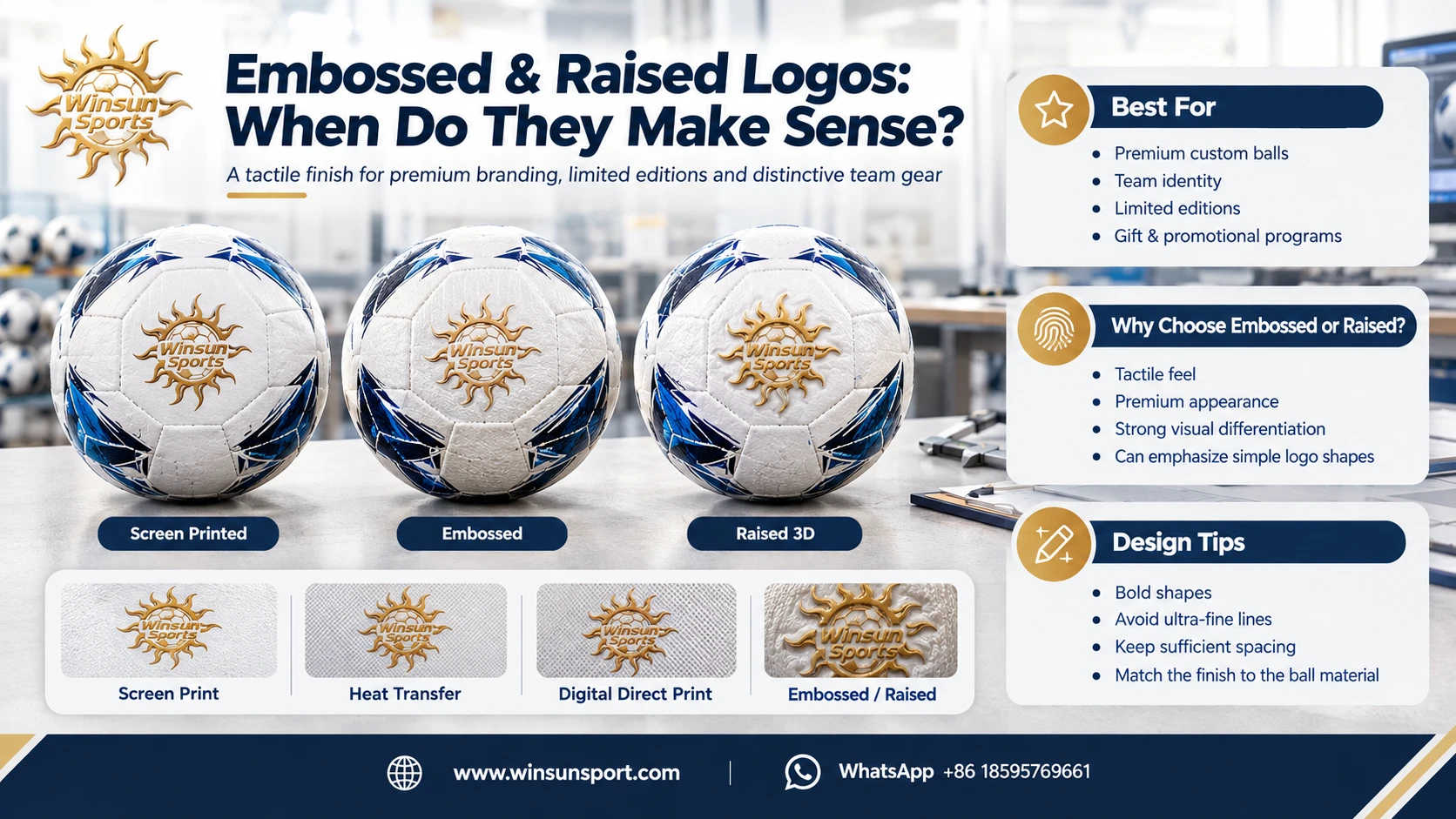
What exactly are embossed and debossed logos: how do they differ from screen printing and heat transfer on a spherical surface?
The choice of process for a logo on a spherical surface is essentially asking one question: do you want "a layer of something printed on the ball," or do you want "the ball itself to become that shape"?
How embossed and debossed logos work: a mold forms recesses or protrusions on the spherical surface
Embossed and debossed logos do not rely on ink. The method is to use a metal mold and press it against the spherical surface at a certain temperature and pressure, causing the ball skin material itself to undergo plastic deformation—where the mold protrudes, the spherical surface is pressed into a recess;where the mold is recessed, the spherical surface is squeezed into a protrusion.
The result is that the logo becomes part of the structure of the ball's surface, rather than a layer of film attached to it. Debossing and embossing are two directions of the same principle, depending on how the mold is made.
Core difference from screen printing, heat transfer, and digital direct-to-garment: ink layer vs. structural change
Screen printing, heat transfer, and digital direct-to-garment all belong to "additive": attaching ink or transfer film to the spherical surface. The only difference is how the ink is applied and how it is cured. Embossing and debossing, on the other hand, belong to "deformation": the ball skin itself is reshaped.
This difference brings several direct consequences:
- Feel: printing types form a thin layer of ink on the spherical surface, giving a slight foreign-body sensation when touched;what embossing/debossing touches is the undulation of the ball skin itself, blending into the spherical surface.
- Durability logic: The failure modes of printed types are ink wear, cracking, and peeling;The failure mode of embossing/debossing is that the pattern is worn flat or deformed; there is no such thing as "fading."
- Visual: Printed types present patterns through color contrast;Embossing/debossing relies on light and shadow—raised and recessed areas create highlights and shadows under side lighting, and the color is usually just the natural color of the ball surface.
Why deep-grooved ball surfaces affect embossing results
Training basketballs often have a pebbled texture on their surface. To emboss a clear logo on this uneven surface with an embossing mold, pressure, temperature, mold precision, and ball leather material must work together.
The deeper and thicker the texture, the more uneven the contact between the mold and the ball surface becomes: if the pressure is insufficient, the texture will not be pressed firmly and the edges will be blurry;excessive pressure or too high a temperature may damage the ball leather structure. This is also why the embossing effect on deeply textured ball surfaces is difficult to predict from parameter tables alone, and actual sampling is required to see the result.
For Winsunsport's custom training basketballs, if you are considering embossed or raised logos, what you need to confirm with the team is: whether the target ball model's leather material and surface texture depth are suitable for embossing, the achievable range of raised and recessed depth with the mold, and the sampling lead time. These conditions directly determine whether the final logo is clear and three-dimensional or blurry and indistinct.
What customization needs embossed and raised logos are suitable for: judgment for commemorative balls, gift balls, and brand collection scenarios
Embossed and raised logos form recessed or raised three-dimensional marks on the ball surface through a mold, with a low-key visual effect and a clear tactile feel. This characteristic makes it more suitable for a ball that is 'kept' rather than a ball that is 'repeatedly hit.'
Commemorative and gift scenarios that pursue differences in texture and feel
Commemorative balls and gift balls are used differently from training balls: they are more often received, looked at, and displayed, rather than repeatedly hit and rubbed. Embossed and raised logos have two direct advantages in this scenario:
- The difference in feel brings the first reaction of 'this is not an ordinary ball,' which flat printing cannot easily replace.
- The appearance is more restrained, suitable for occasions that require a sense of dignity, such as corporate gifts, event commemorations, and graduation keepsakes.
If the purpose of customization is to give to clients, team members, or graduates, embossed and raised logos are usually more suitable than ordinary flat printing. What it answers is 'this ball is worth keeping,' not 'this ball has a logo on it.'
Brand collection and display needs: appearance refinement takes priority over daily wear resistance
Collection and display needs place more emphasis on display effect and long-term visual appeal. Embossed and debossed logos do not rely on color vibrancy, and during long-term display they are less prone to visual issues such as aging of the printed layer or lifting edges.
However, note that the three-dimensional effect of embossed and debossed logos is affected by the spherical material and texture. For embossed and debossed markings on the surface of deeply textured basketballs, the actual clarity and edge sharpness need to be confirmed through sampling, and cannot be judged based on design drafts alone. Designs with too many graphic elements or overly thin lines are also not suitable for embossing-type processes; the simpler the graphics, the more controllable the result.
In which scenarios are embossed and debossed logos not recommended?
- For scenarios focused on daily high-intensity training and requiring long-term wear resistance and consistency of the logo, it is recommended to prioritize ink-based processes such as screen printing or heat transfer printing.
- Large-area logos that need to be recognized from a distance; embossing and debossing are not suitable substitutes for large-area color printing.
- Skipping proofing and going straight to mass production: the embossing effect is related to the spherical material and mold precision, and skipping proofing will increase the risk of rework.
The judgment standard can be simplified into one sentence: is this ball meant to be used, or meant to be kept? If it is meant to be kept, embossed and debossed logos are worth considering;If it is meant to be played with every day, give priority to the more wear-resistant flat process. As for whether the ideal effect can be achieved based on the specific spherical material and logo size, it is recommended to provide the design draft and the ball usage scenario together to the Winsunsport team to confirm the proofing plan.
How to compare silk screen printing, heat transfer printing, and embossing/debossing: visual effect, wear resistance, suitable quantity, and applicable scenarios
There is no safer or better choice among the three processes; the difference lies in what you put first. Looking at it through four dimensions, the choice becomes much clearer.
Visual effect: Screen printing has solid colors and strong coverage, suitable for large color blocks in single colors or a small number of spot colors;Heat transfer can reproduce multi-color gradients and photo-level patterns with rich detail;Embossing/debossing does not rely on color, but on surface relief to create light and shadow, giving a more restrained, premium look.
Wear resistance: Screen printing ink adheres to the surface, and after long-term friction or repeated bending, wear may first appear at the edges;The transfer layer of heat transfer is also on the surface, and large-area patterns need more attention in frequently contacted areas;Embossing/debossing changes the form of the material itself, with no ink layer that can peel off, but the raised parts will gradually be worn flat with use, and the finer the pattern, the more easily it fades.
Suitable quantity: Screen printing has low setup costs for single-color printing, and the larger the quantity, the more cost-effective it is;Heat transfer printing is suitable for small to medium batches and multi-color designs, with no need to make a separate plate for each color;Embossing/debossing relies on molds, with relatively concentrated upfront investment, and it is not economical for too small a quantity.
Applicable scenarios: Screen printing is suitable for simple single-color markings such as camp names and team names;Heat transfer printing is suitable for occasions requiring rich visuals, such as event commemoratives and brand giveaways;Embossing/debossing is suitable for customization where gifting, collectibility, and brand texture are the priority.
The position of embossing/debossing in the comparison: texture first, with higher requirements for graphic simplicity.
The core value of embossing/debossing is the tactile feel and the layering of light and shadow, not color expression. This determines that it imposes additional restrictions on graphics: lines that are too thin, strokes that are too dense, multicolor gradients, or extremely small text tend to blur together or vary unevenly when embossed, which actually reduces legibility. The simpler the graphic and the clearer the blocks of color, the more stable the embossing effect.
So the judgment sequence can proceed like this: first ask whether the logo is mainly monochrome with large blocks of color—if yes, embossing/debossing is worth prioritizing;if the pattern is multicolor with dense details, switching to heat transfer is more reliable;if only monochrome clarity is needed and the quantity is relatively large, screen printing is more direct.
In terms of abrasion resistance, embossing/debossing does not have the problem of ink layer peeling off, but the raised areas will become shallower with friction. The actual performance depends on the material, embossing depth, and frequency of use. These need to be confirmed with the Winsunsport team based on your specific ball usage scenario, rather than applying a uniform conclusion.
Whether your logo is suitable for embossing/debossing: graphic simplicity and file preparation to confirm before proofing
Embossing and debossing rely on molds pressing the spherical leather to form the shape. The pattern is "three-dimensional" with no ink coverage, so it is friendly to tactile consistency, but it is much more demanding on the graphic itself than silk screen printing or heat transfer printing. To determine whether it can be done, first look at three things.
Self-check for graphic simplicity: line thickness, number of elements, and font size
- Line thickness: The three-dimensional effect of embossing comes from the extrusion deformation on both sides of the lines.Lines that are too thin cannot press clear boundaries on the leather and easily blur into a shallow mark.If your logo relies on hairline-thin lines or a large number of thin strokes of uniform width, embossing is usually not a good choice.
- Number of elements: The more elements there are and the tighter the spacing, the harder it is for the mold to apply even pressure across the spherical curvature, and details are prone to varying depths.A single graphic plus one line of short text is much more reliable than a complex badge-style combination.
- Font size: Small text loses legibility noticeably after spherical embossing, especially fonts with dense strokes.If text must be included, prioritize treatments with simple strokes and a relatively bold font weight.
- White space and negative space:Embossing does not rely on color to distinguish layers; if the negative space is too narrow, adjacent elements will visually stick together.
A practical self-check method: shrink the logo to the actual embossing size and convert it to black and white. If the structure is already unclear at that point, it will only be more blurred after embossing.
Proofing confirmation process: why embossing/debossing cannot skip sample confirmation
The embossing effect is jointly affected by spherical curvature, leather texture, mold depth, and pressure, and these variables cannot be seen in a flat file. Skipping proofing and going directly to mass production is equivalent to betting everything on the first molding for whether the pattern is clear, whether the depth is uniform, and whether the position is offset. Once it fails to meet the standard, the entire batch must be reworked.
What proofing needs to confirm is not whether it looks good, but several specific issues: whether the lines are continuous, whether the edges are clear, whether the text is legible, and whether the pattern is consistent at different positions on the spherical surface. These can only be seen on the physical object.
Before asking the supplier, prepare this information first
- Vector files of the logo (such as AI, EPS, or editable PDF), not just bitmaps
- The actual embossing size, and its position on the ball surface
- Whether it is monochrome embossing or needs to distinguish light and dark layers
- The usage scenario (training, gifts, event commemoratives), which will affect the trade-off between clarity and durability
If any of the above is still uncertain, don't rush to compare prices—hand over the usage scenario and logo files to the Winsunsport team, and let them determine whether your graphic is suitable for embossing, or whether it needs to be adjusted to a more reliable process solution.
Frequently Asked Questions
My logo has relatively thin lines. Can it still be embossed? Not necessarily. Fine lines tend to become faint and blurry after being embossed on leather. Whether it works depends on the correspondence between the actual embossing size and the line thickness.
It is recommended to provide a vector file and specify the target size, so the team can evaluate it and give a judgment.
Are embossing and debossing the same thing? Both are mold-formed, but debossing usually has more pronounced three-dimensional relief and places higher demands on graphic simplicity. Which one to use specifically depends on your logo structure and the visual effect you want.
Can I place an order with just one logo image? Not recommended. Bitmap images cannot provide greater assurance of clarity after enlargement and forming, and embossing requires vector files to make the mold.
Incomplete files will directly affect the proofing and subsequent results.
How long does proofing take, and will it be very troublesome? Proofing is a necessary step to confirm the embossing effect, not an optional one. For the specific timeline and process, please confirm directly with the Winsunsport team, and they will make arrangements based on your logo and ball usage scenario.
Learn more
If you are customizing training basketballs for a team, corporate gifts, or commemorative events, and are unsure whether the logo is suitable for embossing or debossing, you can send the vector file, actual embossing size, and ball usage scenario to the Winsunsport team.They will help you determine whether embossing is feasible based on the ball material and graphic structure, or suggest a more suitable process solution, and arrange proofing to confirm the effect.