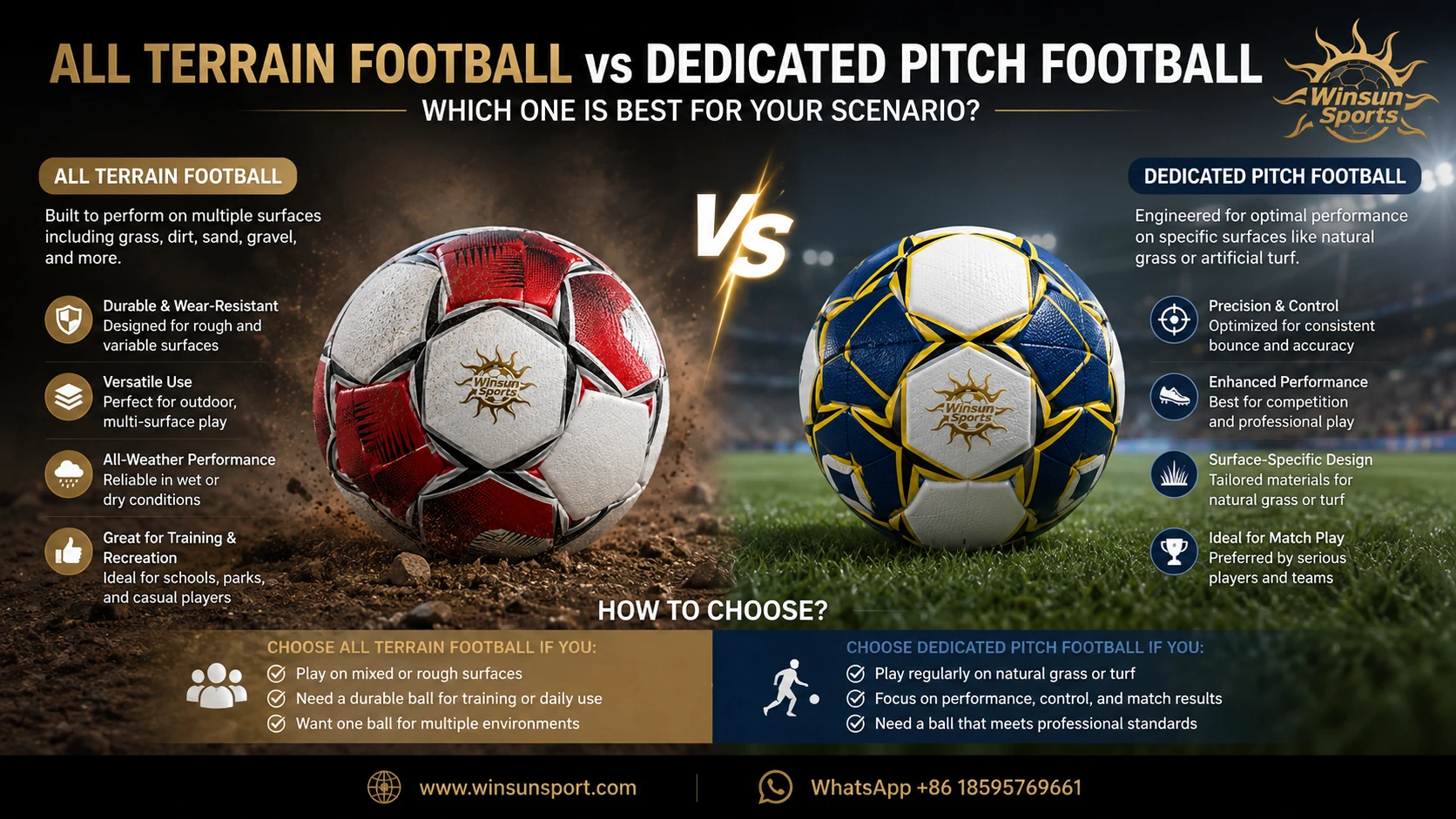
What is the essential difference between all-terrain footballs and specialized field footballs?
The difference between the two types of footballs can be understood as a trade-off between a 'versatile player' and a 'specialist'.
From a design perspective: coping with varied surfaces vs. pursuing ultimate performance on a single field.
Specialized field footballs(such as match balls for grass) are tuned for a single surface, with the leather, bladder, and weight distribution all benchmarked to standard grass, providing the most stable feel, bounce, and flight trajectory on grass. However, on concrete, dirt, or artificial turf, their performance declines and they wear out faster.
All-terrain footballshave the opposite design goal: they do not pursue ultimate performance on a single surface, but rather ensure usable and stable performance across multiple surfaces. It needs to withstand the rough friction of concrete, the granular erosion of dirt fields, the hard bounce of artificial turf, and occasionally natural grass. Therefore, its leather is usually thicker and more wear-resistant, and the inner bladder structure also focuses more on air tightness and resistance to deformation.
From a product structure perspective: how leather thickness and inner bladder affect durability
Specifically in terms of product structure, the differences are more intuitive:
| Structural parameters | All-terrain footballs | Specialized field footballs |
| Leather thickness | Thicker, customizable, sacrificing a bit of touch for resistance to stone impacts and rough ground friction | Thinner and softer, with a delicate touch, but cannot withstand repeated friction on rough surfaces |
| Bladder Type | Options include thread-wound bladder, rubber thread-wound bladder, or PVC bladder, offering strong resistance to deformation and good air tightness, suitable for long-term outdoor use. | It focuses more on rebound response, with the design emphasis not on 'long-term leak-free' performance. |
Taking Winsunsport's All Terrain Universal Football as an example, its leather thickness supports customization, and the inner bladder offers three options: thread-wound, rubber thread-wound, and PVC—these parameters directly affect the ball's durability on hard ground and the stability of feel during long-term use.
The judging criteria are simple:If you only play on a fixed field with good conditions, a specialized football can provide a better experience;If you need to carry the ball across multiple fields, or the field is hard and rough, the durability and stability of an all-terrain football are what you truly need.
Abrasion Resistance Comparison: Are all-terrain footballs truly more durable on concrete and sandy fields?
On concrete and sandy soil, all-terrain footballs are indeed more durable than regular footballs, but 'durable' has its limits—it's not indestructible, but it significantly slows down normal wear and tear. If you mainly play on rough hard surfaces, you'll notice the difference within a few weeks.
Why do regular footballs wear out quickly on rough surfaces?
The leather thickness and formula of regular footballs are mainly designed for grass scenarios. Grass provides cushioning, and the friction between the ball's surface and the ground is intermittent and gentle. But concrete is hard friction, and every touch scrapes the ball's surface;Sandy soil, on the other hand, causes granular wear, with sand particles embedding into the surface and repeatedly cutting the outer layer as the ball rolls.
Regular footballs have thinner leather and insufficient wear resistance, so after a few kicks, the surface may become fuzzy, peel, or even expose the lining. Once the outer skin is broken, the bladder is directly exposed, air tightness drops rapidly, and the ball begins to soften and deform.
Wear-resistant design of all-terrain footballs: custom leather thickness and bladder selection
The approach for all-terrain footballs is not simply to 'make it thicker', but to combine two things:Custom leather thicknessandbladder selection。
- Leather thickness: The leather thickness of this Winsunsport all-terrain football supports customization.In high-wear scenarios such as concrete or sandy fields, it is recommended to choose thicker leather—it provides a 'sacrificial layer', where wear first consumes the outer skin rather than directly damaging the bladder.Once the outer skin is worn through, the ball is essentially ruined, so thicker leather can effectively extend its service life.
- bladder selection: The inner bladder determines the 'margin for error' after the ball's skin is worn through.This ball offers three options: thread bladder, rubber thread bladder, and PVC bladder.For use on rough surfaces, it is recommended to prioritize therubber thread bladder—it is more resistant to compression and friction than a regular thread bladder. Even if the outer skin is partially damaged, the inner bladder can still maintain its basic shape and air tightness, so the ball won't be immediately discarded.The PVC bladder focuses more on air tightness, making it suitable for scenarios requiring high elastic stability.
| Usage Scenarios | Recommended Configuration | Reason |
| Primarily Cement Ground | Thicker Leather + Rubber Bladder | Thicker sacrificial layer, durable inner bladder, longer overall lifespan |
| Primarily Sand and Soil Ground | Thicker Leather + Rubber Bladder | Continuous sand abrasion, thick leather is the key defense |
| Occasional Grass, Occasional Hard Ground | Standard thickness + thread bladder | If wear pressure is not high, the standard configuration is sufficient. |
Next step to confirm actions: If you are sure to use it long-term on concrete or sandy fields, confirm two points with the Winsunsport team: first, the specific thickness options for the leather, and second, the actual lifespan difference between rubber thread bladders and PVC bladders under your field conditions. Tell them the field type, weekly usage frequency, and single session duration, and the team can provide more suitable configuration recommendations.
Scenario comparison: choose all-terrain for multi-field training, or specialized for fixed fields?
First, the conclusion: if your training field is in a state of 'might change next week', an all-terrain football is a more worry-free choice;If you play long-term on only one type of fixed field (such as standard grass), a specialized field football will feel more pure in touch. But the benefits of 'dedicated' are often not as great as you might think.
Multi-surface scenarios: youth training teams, school playgrounds, street football
Youth training teams are the most typical 'all-terrain beneficiaries.' In the morning, they practice passing and receiving on artificial turf, and in the afternoon, they switch to concrete or dirt fields for scrimmages. This kind of switching causes double wear on the ball—the turf wears the outer surface, and the hard ground knocks the inner bladder. The core value of an all-terrain football is that it combines 'abrasion resistance' and 'moderate elasticity' in one ball, so you don't need to switch balls based on the day's surface, and your training rhythm isn't interrupted.
The same applies to school playgrounds and street football. On concrete, rubber tracks, or even occasional dirt, regular footballs have a significantly shorter lifespan, while all-terrain footballs are designed with thicker leather and construction specifically for such 'rough surfaces.' If your budget for buying balls is limited but you use them frequently, all-terrain is actually the lower long-term cost option—it costs more upfront, but saves on replacement frequency.
Here is a key trade-off: all-terrain footballs perform 'adequately and durably' on hard ground, but they won't give you the fine touch feedback of a ball designed specifically for grass. If you're leading a team known for technical finesse and you train mostly on quality turf, all-terrain is not the optimal choice.
Fixed venue scenario: professional grass matches
If you only play on standard grass or high-quality artificial turf, a dedicated venue ball indeed feels more 'responsive'—its leather and elasticity are tuned for turf, providing more direct feedback for trapping, chipping, and long passes. But note that this advantage is premised on stable and high-quality field conditions. If your 'fixed venue' is actually bumpy old turf, the dedicated ball's advantage will be offset by field defects, and the durability of an all-terrain ball becomes more practical.
Another easily overlooked pointAll-terrain footballs are not 'unplayable' on grass; they simply don't maximize performance to the extreme. For non-professional matches and training, this difference is usually not noticeable.
What are the differences between youth and adult ball specifications?
This is where mistakes are most likely to occur during selection. The differences between youth and adult balls mainly lie inweight and circumference, not in whether the material is all-terrain. Youth balls are lighter and smaller, making them easier for players whose strength is not yet fully developed to control.Adult balls are manufactured according to standard specifications.
Winsunsport's all-terrain football is available in multiple specifications covering different age groups—but what you need to confirm is: which age group are the balls you are purchasing intended for? If a youth training team trains across mixed age groups, you may need to equip different specifications by age group, rather than using 'one ball for everyone'.
Next step for confirmation: Explain to the Winsunsport team your primary playing surface types (concrete, turf, sand, and their respective proportions) and the age group of the players, so they can confirm the corresponding leather thickness, bladder type (thread bladder, rubber thread bladder, or PVC bladder), and specification matching plan. If hard surfaces account for more than half of your playing surfaces, the all-terrain model is clearly recommended;if 90% of the time is on high-quality grass, you can ask about the differences in the dedicated field models before making a decision.
Long-term cost and purchasing advice: Is the initial investment in an all-terrain football more cost-effective?
Let's start with the conclusion:If you mainly play on artificial turf, concrete, dirt, or street courts, the long-term cost of an all-terrain football is usually lower than that of a regular football that is 'cheap but wears out quickly'. However, if your playing surface is very uniform and fixed, such as training only on professional natural grass fields, the feel advantage of a specialized field football will be more obvious, and in that case, the extra initial cost for 'all-terrain' may not be worth it.
Let's do the math: replacement frequency vs. initial purchase price
The lifespan of a regular football on rough surfaces is often only a fraction of that of an all-terrain football. For example, on a school concrete playground, a regular ball may show signs of peeling, deformation, or air leakage within two or three months, while a durable one can last the entire semester or even longer. Assume:
- A regular football costs 80 yuan, and you need to replace it 4 times a year, making the annual cost 320 yuan;
- The unit price of the all-terrain football is 200 yuan, and it is replaced once a year, with an annual cost of 200 yuan.
Over two years, the all-terrain football actually saves about 240 yuan, and also saves the time cost of frequently buying balls and adjusting to the feel. The judgment criterion is simple: the rougher your playing surface and the higher the frequency of use, the more the all-terrain football's 'wear resistance and durability' translates into actual savings. Conversely, if you only play once a week and the field conditions are good, the price difference may take two to three years to 'break even' through reduced replacements, and the initial investment pressure is worth more consideration.
Purchase decision framework: choose based on field, frequency, and budget
| Your situation | Recommended choice | Reason |
| Mainly cement, dirt, and street surfaces | All-terrain footballs | The wear resistance advantage directly translates into a longer lifespan. |
| Multi-venue rotation (school + youth training + grass field). | All-terrain footballs | One ball adapts to all surfaces, avoiding frequent ball changes. |
| Fixed natural grass or high-quality artificial turf, with at least 3 sessions per week. | Specialized field footballs | The touch and bounce are more refined, but the all-terrain advantage is not needed. |
| Tight budget, but good field conditions and low frequency of use. | Regular football. | Lower initial investment, less wear pressure, and minimal long-term cost difference. |
Regarding the choice of inner bladder: Butyl bladder offers more stable elasticity and longer lifespan, suitable for players who play more than twice a week or who have high demands on touch;Rubber-wound bladder offers better cost-effectiveness, suitable for children, low-frequency recreational play, or scenarios where budget is a priority;PVC bladder is more suitable for entry-level users with extremely tight budgets and low performance requirements. High-frequency users should prioritize butyl bladder, while low-frequency users need not spend extra on the inner bladder.
In which situations is an all-terrain football not recommended?
In the following three situations, the 'versatility' of an all-terrain football becomes a waste:
- Only playing on professional natural grass fields—The all-terrain design sacrifices some of the soft touch on grass to accommodate hard surfaces, while dedicated grass footballs offer more precise ball control feedback.
- Competitive players seeking match-level feel—If you have extremely high demands for the ball's bounce and flight trajectory, dedicated match balls perform more consistently on standard pitches.
- Very tight budget and good field conditions—If you only play occasionally for fun, the initial cost advantage of a regular football is more practical, and the durability of all-terrain balls is not as noticeable on good fields.
Frequently Asked Questions
Q: Will an all-terrain football be much worse than a dedicated football on grass? It won't be much worse, but there are indeed differences. All-terrain footballs, in order to balance durability on hard ground, typically use thicker leather, resulting in a softer touch and finer rebound on grass that is less refined than that of dedicated grass footballs.
If you only play on grass and prioritize match feel, choose a dedicated model;If you occasionally play on hard ground, an all-terrain ball is a more worry-free compromise.
Q: How do I determine whether I should buy a wound bladder or a rubber bladder? Consider frequency of use and budget: if you play more than twice a week and want stable feel and durability, choose a wound bladder;For low-frequency recreational play, children's entry-level use, or limited budgets, a rubber bladder is sufficient. The extra cost of a wound bladder buys better consistency in bounce and a longer air retention lifespan.
Q: For school procurement, with both concrete playgrounds and grass fields, how should we allocate? It is recommended to use all-terrain footballs as the main configuration, because the wear on the ball from the concrete playground is the main cost factor. If the budget allows, you can stock a few specialized grass footballs for matches or formal training, while daily training should uniformly use the all-terrain model.
Q: How much more expensive is the initial price of an all-terrain football compared to a regular football? The specific price varies greatly due to specifications, bladder, and customization processes, so a unified figure cannot be provided. You can tell the Winsunsport team your budget range, playing surface, and frequency, and they will recommend a matching configuration based on your actual usage conditions, avoiding spending extra on features you won't use.
Learn More
If you are hesitating over multi-surface training or procurement selection, feel free to tell us the type of surface, frequency of use, and age group of players. The Winsunsport team will help you confirm the appropriate leather thickness, bladder type, and specification plan.
Related Products:All Terrain Universal Football